MARKET INSIGHTS
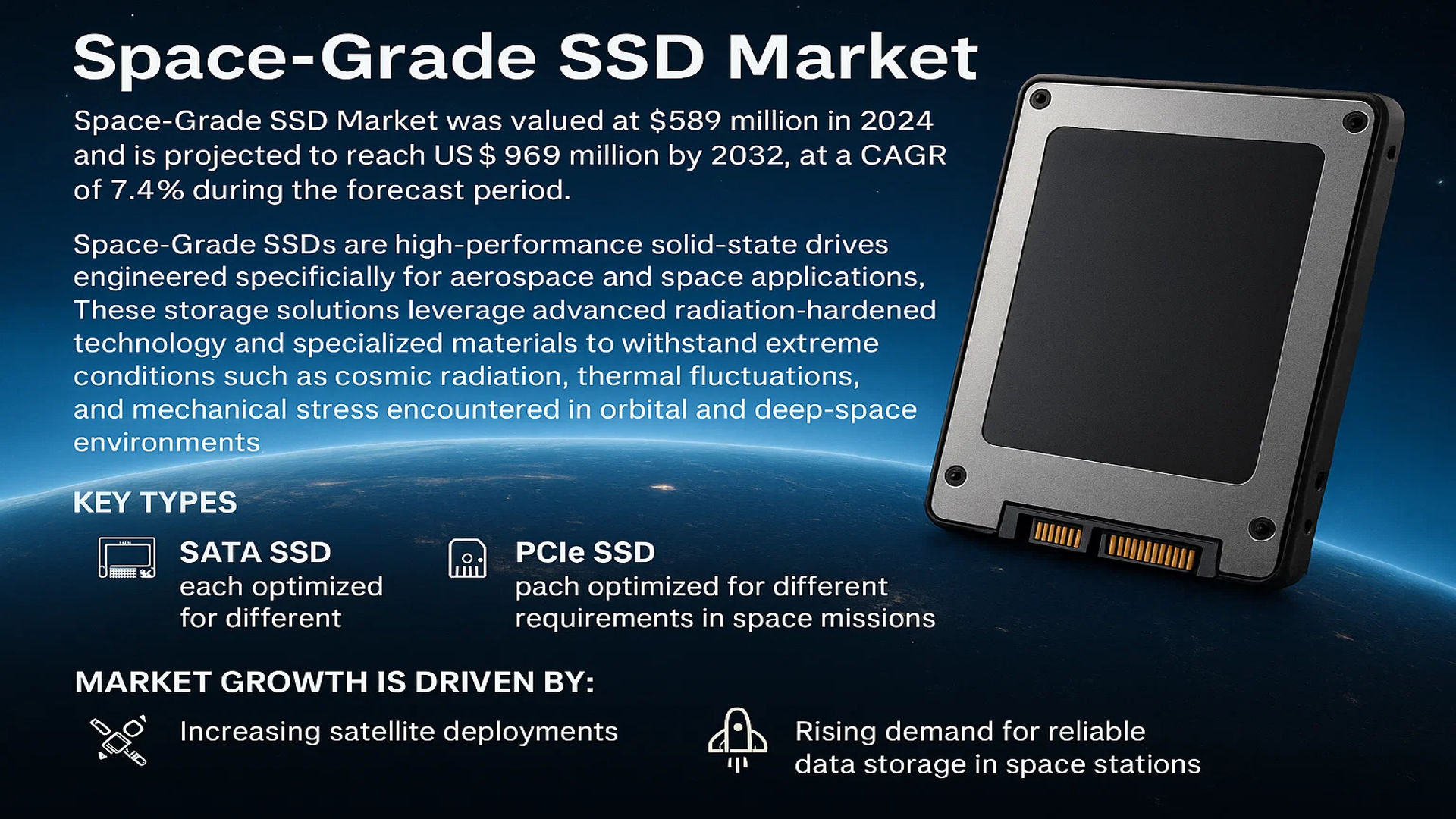
The global Space-Grade SSD Market was valued at 589 million in 2024 and is projected to reach US$ 969 million by 2032, at a CAGR of 7.4% during the forecast period.
Space-Grade SSDs are high-performance solid-state drives engineered specifically for aerospace and space applications. These storage solutions leverage advanced radiation-hardened technology and specialized materials to withstand extreme conditions such as cosmic radiation, thermal fluctuations, and mechanical stress encountered in orbital and deep-space environments. Key types include SATA SSD, PCIe SSD, and NVMe SSD, each optimized for different performance requirements in space missions.
The market growth is driven by increasing satellite deployments, expanding deep-space exploration programs, and rising demand for reliable data storage in space stations. While North America currently dominates the market due to substantial government investments in space technology, Asia-Pacific is emerging as a high-growth region with China’s expanding space program. Major players like Curtiss-Wright, Microchip Technology, and Mercury Systems are actively developing next-generation space-grade storage solutions to meet the evolving demands of the aerospace sector.
MARKET DYNAMICS
MARKET DRIVERS
Rising Satellite Deployment and Space Exploration Activities Drive Market Growth
The global space industry is experiencing unprecedented growth, with satellite deployments increasing at record rates. Over 1,700 satellites were launched in 2022 alone, requiring high-performance storage solutions capable of withstanding harsh space environments. Commercial space ventures, government space programs, and national security applications are all contributing to this demand surge. Space-Grade SSDs are becoming critical components in satellites, space stations, and exploration vehicles due to their ability to maintain data integrity under extreme radiation and temperature conditions that conventional storage cannot endure.
Technological Advancements in Radiation-Hardened Electronics Accelerate Adoption
Breakthroughs in radiation-hardened semiconductor technology are enabling the development of more reliable and higher capacity space-grade SSDs. New error correction algorithms, advanced NAND flash architectures, and innovative shielding techniques have significantly improved data retention and endurance in space environments. These technological improvements are making space-grade SSDs increasingly attractive for mission-critical applications where data loss could jeopardize multi-billion dollar space assets. Additionally, the transition from SATA to PCIe/NVMe interfaces in space applications is enabling faster data transfer rates essential for modern space missions.
Growing Demand for Earth Observation Data Boosts Storage Needs
The exponential growth of Earth observation and remote sensing applications is creating substantial demand for high-capacity, reliable storage in space. Modern Earth imaging satellites generate terabytes of data daily, requiring SSDs that can withstand years of continuous operation in orbit. The commercial Earth observation market is projected to triple in the next five years, driven by applications ranging from climate monitoring to precision agriculture. Space-Grade SSDs enable the storage and rapid downlinking of this valuable data, making them indispensable components in contemporary satellite systems.
MARKET RESTRAINTS
High Development and Certification Costs Limit Market Expansion
The specialized nature of space-grade electronics creates significant barriers to market growth. Developing and qualifying radiation-hardened SSDs involves extensive testing and certification processes that can take years and cost millions of dollars. Components must be validated through radiation testing, thermal vacuum cycling, and long-term reliability assessments. These stringent requirements result in products that are often 10-100 times more expensive than their commercial equivalents, limiting adoption to only the most critical space applications where alternatives are not viable.
Other Restraints
Supply Chain Constraints
The specialized semiconductor fabrication processes required for radiation-hardened components create supply chain bottlenecks. Few foundries worldwide possess the capability to produce these specialized chips, leading to long lead times and limited production capacity. Recent geopolitical tensions have further exacerbated these constraints, making it difficult for manufacturers to scale production to meet growing demand.
Technological Obsolescence
Rapid advancements in commercial flash memory technology create challenges for space-grade SSD manufacturers. While consumer SSDs benefit from the latest process nodes and architectures, space applications often rely on older, more proven technologies due to radiation hardness requirements. This technological lag makes it difficult to offer capacities and performance comparable to terrestrial storage solutions.
MARKET CHALLENGES
Extreme Environmental Conditions Create Technical Hurdles
Designing storage solutions for space presents unique engineering challenges beyond typical commercial applications. Space-Grade SSDs must operate reliably across temperature extremes ranging from -55°C to +125°C while being bombarded by cosmic radiation that can cause bit flips and component degradation. These conditions require specialized error correction, wear leveling algorithms, and physical shielding that significantly complicate design and increase costs. Additionally, the inability to perform maintenance or repairs in orbit means these devices must be engineered for flawless operation over mission lifetimes that can exceed 15 years.
Other Challenges
Regulatory and Standardization Issues
The space industry lacks universal standards for data storage, with different space agencies and commercial operators often specifying unique requirements. This fragmentation increases development costs and makes it difficult to achieve economies of scale. Additionally, export control regulations on radiation-hardened technology create bureaucratic hurdles for international sales.
Limited Radiation Testing Facilities
The specialized equipment required for radiation testing creates capacity constraints in the industry. High-energy particle accelerators used for single-event effects testing are expensive to operate and often have long wait times for test slots. This bottleneck slows product development cycles and makes it difficult to rapidly qualify new technologies for space use.
MARKET OPPORTUNITIES
Emerging Space Economies Create New Growth Frontiers
The rapid development of space programs in multiple countries presents significant growth opportunities for space-grade SSD manufacturers. Nations with emerging space capabilities are investing heavily in satellite fleets and space exploration initiatives, creating new markets for radiation-hardened storage solutions. Commercial space stations and lunar exploration programs also represent promising new applications that could drive demand for advanced space-qualified storage in the coming decade.
Advancements in Reconfigurable Computing Enable New Storage Architectures
Innovations in radiation-tolerant field-programmable gate arrays (FPGAs) and system-on-chip designs are enabling more flexible storage architectures for space applications. These technologies allow for in-orbit reconfiguration of storage systems to adapt to changing mission requirements or mitigate radiation-induced degradation. This capability is particularly valuable for long-duration missions where storage needs may evolve over time. Manufacturers that can integrate these adaptive technologies into their SSD offerings will have a competitive advantage in the market.
Commercial Space Sector Growth Fuels Demand for Cost-Effective Solutions
The expanding commercial space sector is driving demand for more economical radiation-hardened storage solutions. While traditional space programs could absorb the high costs of mil-spec components, commercial operators are pushing for solutions that balance reliability with affordability. This trend is encouraging innovation in radiation mitigation techniques and commercial-off-the-shelf (COTS) components qualified for space use. Companies that can deliver reliable space-grade SSDs at more accessible price points stand to capture significant market share as commercial space activities continue to grow.
SPACE-GRADE SSD MARKET TRENDS
Growing Demand for High-Reliability Storage Solutions in Aerospace Applications
The demand for space-grade SSDs is surging, driven by the increasing number of satellite launches and deep space exploration missions. These specialized storage solutions must withstand extreme radiation, wide temperature fluctuations, and mechanical stresses encountered in space environments. In 2024 alone, over 2,200 satellites were launched globally, with missions increasingly requiring terabytes of radiation-hardened storage for data collection and processing. While commercial SSDs dominate terrestrial applications, the space-grade segment is projected to grow at 7.4% CAGR through 2032 as government space agencies and private aerospace companies invest heavily in next-generation storage technologies.
Other Trends
Advancements in Radiation-Hardened NAND Flash Technology
Manufacturers are developing innovative error correction algorithms and 3D NAND architectures specifically for space applications, where single-event upsets can corrupt mission-critical data. Recent breakthroughs include multi-level cell (MLC) configurations that maintain data integrity despite cosmic radiation exposure, enabling higher storage densities without compromising reliability. The transition from SATA-based interfaces to PCIe and NVMe protocols is accelerating, offering 5-8x faster data transfer speeds to handle the massive datasets generated by high-resolution earth observation and scientific instruments.
Commercial Space Sector Driving Innovation and Cost Reductions
The emergence of private space companies is disrupting traditional aerospace supply chains, creating opportunities for more cost-effective yet reliable storage solutions. Where government contracts previously dominated, commercial satellite constellations now account for 68% of space storage demand. This shift has prompted manufacturers to develop modular SSD designs that balance radiation tolerance with economies of scale. Concurrently, testing methodologies have evolved to combine military-grade qualification standards with accelerated life testing protocols, reducing validation timelines from 24 months to under 18 months for new space-grade SSD models.
COMPETITIVE LANDSCAPE
Key Industry Players
Companies Invest in Radiation-Hardened Storage Solutions to Capture Space Market Share
The global Space-Grade SSD market features a mix of aerospace veterans and specialized storage manufacturers competing to provide reliable data solutions for orbital and deep-space applications. Curtiss-Wright leads the market through its extensive experience in radiation-hardened computing systems and strategic partnerships with space agencies like NASA and ESA. The company’s Parvus division offers SATA and NVMe solutions qualified for MIL-STD-810 and space environments.
Microchip Technology has emerged as a formidable competitor through its acquisition of Microsemi, bringing space-qualified FPGAs and SSD controllers to the market and recently expanding its flash memory offerings for satellite constellations.
The competitive landscape shows increasing specialization, with companies like Mercury Systems focusing on modular storage for small satellites while Seagate leverages its commercial storage expertise to develop cost-effective solutions for proliferated LEO constellations. This segmentation creates parallel competitive arenas within the broader space storage market.
Meanwhile, Aitech and Greenliant are differentiating themselves through proprietary radiation mitigation technologies. Aitech’s “space-adaptive memory mapping” and Greenliant’s ECC algorithms allow higher storage densities while maintaining single-event upset (SEU) protection.
List of Key Space-Grade SSD Manufacturers
- Curtiss-Wright Corporation (U.S.)
- Microchip Technology (U.S.)
- Aitech Defense Systems (U.S.)
- Exascend (Taiwan)
- Flexxon (Singapore)
- Foremay Inc. (U.S.)
- Greenliant (U.S.)
- Mercury Systems (U.S.)
- Seagate Technology (U.S.)
- Smart Modular Technologies (U.S.)
Segment Analysis:
By Type
PCIe SSD Segment Leads Due to High Speed and Radiation-Hardened Capabilities for Space Applications
The market is segmented based on type into:
- SATA SSD
- Subtypes: 2.5-inch, 3.5-inch, and others
- PCIe SSD
- Subtypes: Gen3, Gen4, and others
- NVMe SSD
- Subtypes: U.2, M.2, and others
By Application
Satellite Segment Dominates Owing to Increasing Demand for High-Capacity Data Storage in Earth Observation Systems
The market is segmented based on application into:
- Satellite
- Subtypes: LEO, GEO, and MEO
- Space Station
- Deep Space Exploration
- Subtypes: Planetary missions, Interplanetary missions, and others
- Others
By Capacity
1TB-4TB Range Holds Major Share Due to Balanced Performance and Reliability Requirements
The market is segmented based on capacity into:
- Below 1TB
- 1TB-4TB
- Above 4TB
By Radiation Hardening Level
High Radiation-Hardened Solutions Preferred for Critical Space Missions
The market is segmented based on radiation hardening level into:
- Standard Radiation-Hardened
- High Radiation-Hardened
- Extremely Radiation-Hardened
Regional Analysis: Space-Grade SSD Market
North America
North America currently leads the Space-Grade SSD market, driven by substantial investments in space programs from NASA and private aerospace companies like SpaceX and Blue Origin. The U.S. remains the dominant force here, accounting for the largest market share due to its advanced satellite deployment initiatives and deep-space exploration projects. Government contracts fuel innovation in radiation-hardened storage solutions, with major manufacturers such as Curtiss-Wright and Mercury Systems supplying critical components. The region’s stringent reliability standards for aerospace components create a high barrier to entry, ensuring only technologically advanced players compete. Challenges include component shortages and extended certification timelines, though the demand for high-capacity NVMe SSDs in next-gen spacecraft continues growing.
Europe
Europe’s Space-Grade SSD market thrives through collaborative projects led by ESA (European Space Agency) and national space programs. Countries like France and Germany invest heavily in earth observation satellites, requiring robust data storage for climate monitoring and security applications. The region emphasizes radiation-tolerant PCIe SSD solutions, with Airbus Defence and Space being a key system integrator. European manufacturers face supply chain complexities due to reliance on non-European semiconductor foundries. However, recent EU initiatives to boost sovereign space technology capabilities are gradually strengthening local supply networks. The Galileo navigation system’s expansion and future Moon missions will further accelerate demand.
Asia-Pacific
Asia-Pacific demonstrates the fastest growth rate, propelled by China’s ambitious space station program and lunar exploration activities. China’s state-backed aerospace entities dominate regional demand, prioritizing domestically produced SATA SSDs to reduce foreign dependency. India emerges as another hotspot with its cost-effective satellite deployment strategies, though it still imports high-reliability storage modules. Japan’s JAXA and private firms focus on miniaturized SSD solutions for compact satellites. While price sensitivity exists for commercial space ventures, national security projects drive premium purchases. The region’s challenge lies in balancing rapid technological adoption with rigorous space qualification processes.
South America
South America’s market remains nascent but shows potential through Brazil’s space agency INPE and growing satellite communication needs. Limited local manufacturing capabilities result in dependence on imports from North America and Europe, increasing project costs. Argentina’s recent satellite projects indicate gradual market development. Economic instability restricts large-scale investments, causing most countries to prioritize essential terrestrial infrastructure over space-grade storage solutions. Nevertheless, partnerships with global satellite operators for remote sensing applications create niche opportunities for SSD suppliers targeting cost-effective radiation-hardened solutions.
Middle East & Africa
This region experiences slow but steady growth, primarily driven by UAE’s Mars missions and Saudi Arabia’s expanding satellite communication sector. The lack of local space-grade component manufacturing leads to complete reliance on imports, often through technology transfer agreements. South Africa maintains modest demand through its astronomy projects. While political will for space programs exists, limited R&D budgets and absence of standardized space certification frameworks hinder market expansion. Commercial earth observation partnerships with European and Chinese entities present the most immediate opportunities for storage solution providers.
Report Scope
This market research report provides a comprehensive analysis of the Global Space-Grade SSD Market, covering the forecast period 2024–2032. It offers detailed insights into market dynamics, technological advancements, competitive landscape, and key trends shaping the industry.
Key focus areas of the report include:
- Market Size & Forecast: Historical data and future projections for revenue, unit shipments, and market value across major regions and segments. The Global Space-Grade SSD market was valued at USD 589 million in 2024 and is projected to reach USD 969 million by 2032, growing at a CAGR of 7.4%.
- Segmentation Analysis: Detailed breakdown by product type (SATA SSD, PCIe SSD, NVMe SSD), application (Satellite, Space Station, Deep Space Exploration), and end-user industry to identify high-growth segments and investment opportunities.
- Regional Outlook: Insights into market performance across North America (U.S., Canada, Mexico), Europe (Germany, France, U.K.), Asia-Pacific (China, Japan, India), and other regions.
- Competitive Landscape: Profiles of leading market participants including Aitech, Curtiss-Wright, Exascend, Flexxon, and Seagate, their product offerings, R&D focus, and recent developments.
- Technology Trends & Innovation: Assessment of emerging technologies in radiation-hardened storage, advanced data protection, and evolving aerospace standards.
- Market Drivers & Restraints: Evaluation of factors driving market growth such as increasing space exploration missions, along with challenges like high development costs.
- Stakeholder Analysis: Insights for component suppliers, aerospace OEMs, system integrators, and investors regarding the evolving ecosystem.
Primary and secondary research methods are employed, including interviews with industry experts and data from verified sources, to ensure the accuracy and reliability of the insights presented.
FREQUENTLY ASKED QUESTIONS:
What is the current market size of Global Space-Grade SSD Market?
-> Space-Grade SSD Market was valued at 589 million in 2024 and is projected to reach US$ 969 million by 2032, at a CAGR of 7.4% during the forecast period.
Which key companies operate in Global Space-Grade SSD Market?
-> Key players include Aitech, Curtiss-Wright, Exascend, Flexxon, Foremay, Greenliant, Mercury Systems, Microchip Technology, Seagate, and Smart Modular Technologies.
What are the key growth drivers?
-> Key growth drivers include increasing space exploration missions, growing satellite deployments, and demand for radiation-hardened storage solutions.
Which region dominates the market?
-> North America currently leads the market, while Asia-Pacific is expected to witness the fastest growth.
What are the emerging trends?
-> Emerging trends include development of higher-capacity space SSDs, improved radiation hardening techniques, and miniaturization of storage solutions.

Get Sample Report PDF for Exclusive Insights
Report Sample Includes
- Table of Contents
- List of Tables & Figures
- Charts, Research Methodology, and more...
 Download Sample Report PDF