Key Statistics
Key Takeaways
- Low Earth Orbit (LEO) is the fastest-changing orbit segment because lower latency and dense constellation architectures support broadband, mobility and direct-to-device services that were difficult to deliver economically with traditional GEO-only networks. GEO remains essential for wide-area broadcast and established mobility coverage, while MEO is gaining importance for high-throughput managed connectivity.
- Broadband Internet is the leading application in the source scope because satellite networks increasingly provide primary or backup connectivity where fiber and terrestrial wireless are unavailable, uneconomic or vulnerable. Maritime, aviation and IoT backhaul are faster-growing specialized applications because mobility and remote operations have few equivalent terrestrial alternatives.
- North America is the largest region in 2025 because the United States combines leading constellation operators, launch infrastructure, defense procurement, direct-to-device regulation and strong enterprise demand. Asia Pacific is the fastest-growing region as operators expand rural broadband, offshore energy, aviation, maritime and mobile-backhaul services across geographically dispersed populations.
- Multi-orbit networks are becoming the central competitive model. SES completed its Intelsat acquisition in July 2025 and reported €2.63 billion of 2025 revenue on a reported basis, while O3b mPOWER satellites 7–10 expanded MEO capacity. The integration illustrates how incumbent operators are combining GEO scale with lower-latency MEO capability to compete with LEO networks.
- Capital intensity, spectrum and orbital regulation remain the principal restraints. Satellite systems require spacecraft manufacturing, launch capacity, gateways, spectrum rights, user terminals and years of deployment. The FCC’s Supplemental Coverage from Space framework shows how direct-to-device opportunity depends on terrestrial-spectrum coordination as much as satellite technology.
- Direct-to-device and mobility are the structural growth opportunities. Amazon began full-scale Kuiper deployment with 27 satellites in April 2025, Iridium ended 2025 with 2.537 million billable subscribers, and SES reported more than 13,000 ships served by FlexMaritime. These developments show expanding demand across consumer broadband, IoT, aviation, maritime and mission-critical communications.
Satellite Communication Market Overview
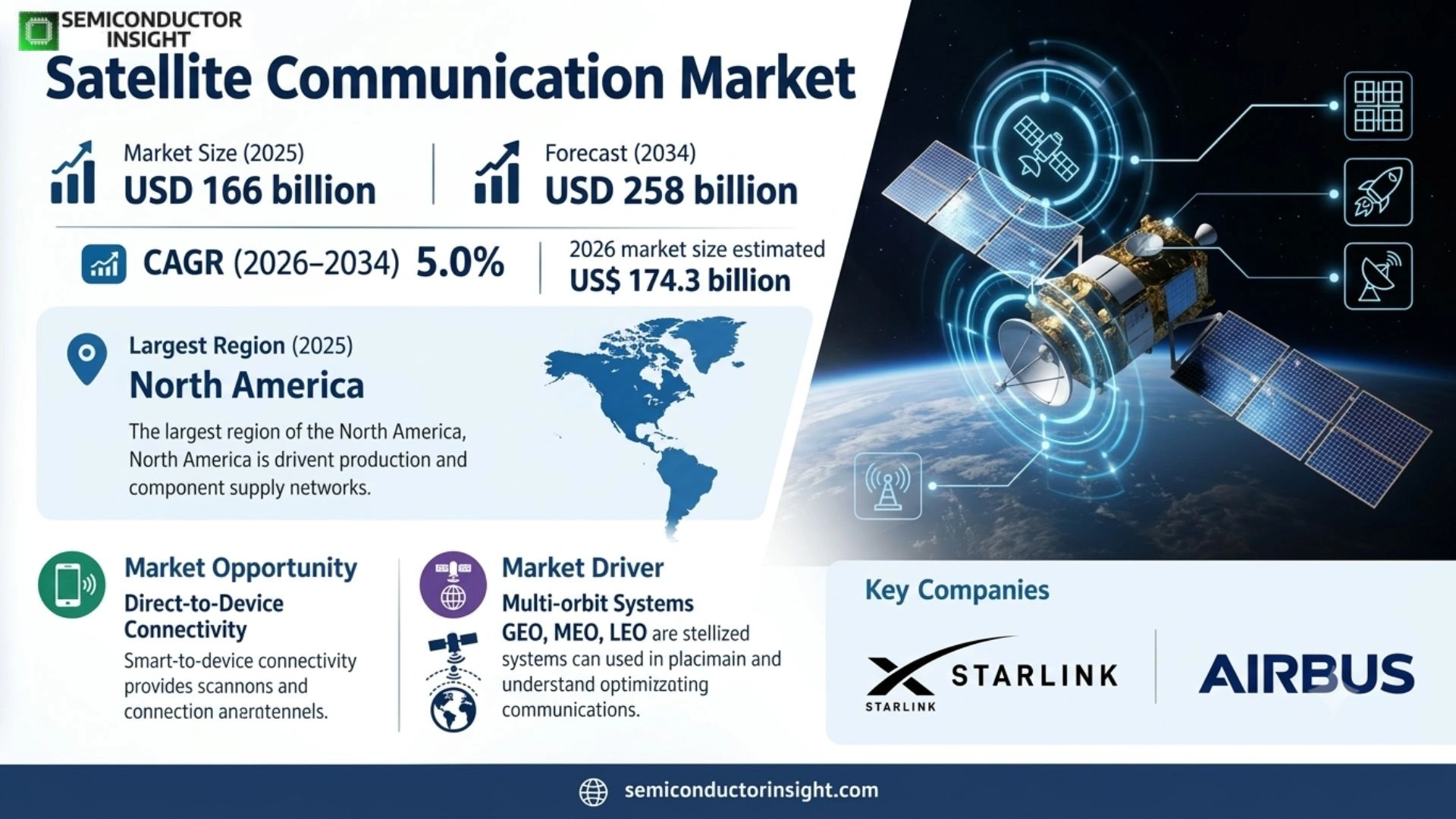
satellite communication market is valued at US$ 166 billion in 2025 and is projected to reach US$ 258 billion by 2034, representing a 5.0% CAGR during 2026–2034. The estimated 2026 market size is US$ 174.3 billion. North America is the largest regional market in 2025, while the strongest growth is concentrated in Asia Pacific. The market is moving from a predominantly GEO architecture toward multi-orbit systems that combine GEO coverage, MEO throughput and LEO latency, while direct-to-device, aviation, maritime and government connectivity broaden the addressable service base.
Satellite communication covers the transmission of voice, data and video through orbiting spacecraft and the associated ground infrastructure that connects users, gateways and terrestrial networks. The source page includes geostationary, medium Earth orbit and low Earth orbit systems and applications spanning broadband internet, maritime connectivity, aviation communications and IoT backhaul. The commercial market therefore combines satellite operators, network services, user terminals, ground stations, payload manufacturing and managed connectivity rather than a single hardware product.
The network architecture is becoming multi-orbit. GEO satellites retain a structural benefit for wide-area coverage, broadcasting and mature mobility services because a small number of spacecraft can cover large geographic areas. MEO systems such as O3b mPOWER offer lower latency and concentrated high-throughput beams for enterprise, government and mobility users. LEO constellations trade far greater satellite count and ground-network complexity for lower latency, frequent coverage opportunities and the ability to scale capacity through iterative launches.
Demand is generated where terrestrial infrastructure is unavailable, too expensive, physically vulnerable or unable to follow a moving user. That includes remote households, ships, aircraft, offshore energy platforms, mining sites, defense units and IoT assets. Satellite economics improve when operators can reuse capacity across many customers and route traffic dynamically through gateways and inter-satellite links. The purchasing trigger is therefore not simply the absence of fiber; it is the value of ubiquitous coverage, mobility, resilience and rapid deployment relative to the cost of terrestrial alternatives.
The market is changing now because commercial launch cadence, smaller spacecraft, phased-array antennas and software-defined networks make non-GEO capacity easier to scale, while regulators are opening pathways for satellite-to-handset connectivity. At the same time, established operators are consolidating and building multi-orbit portfolios. SES’s acquisition of Intelsat, Amazon’s initial Kuiper launches and the European IRIS² program demonstrate three different responses: scale through consolidation, greenfield LEO deployment and sovereign public-private secure connectivity.
Segment Analysis: By Type
By type, the source page segments the market into Geostationary (GEO), Medium Earth Orbit (MEO), and Low Earth Orbit (LEO). GEO remains the mature installed base for broadcast, fixed and wide-area mobility services, while LEO is the fastest-changing segment because dense constellations reduce latency and enable consumer broadband and direct-to-device architectures. MEO occupies a high-performance middle ground, supporting managed enterprise, government, maritime and aviation services with lower latency than GEO and fewer satellites than LEO.
| Type | Core function | Market position and commercial logic |
|---|---|---|
| Geostationary (GEO) | Operates at approximately 35,786 km altitude so a satellite appears fixed relative to the Earth, allowing continuous coverage of a large region with relatively simple ground tracking and established broadcast and mobility architectures. | Mature but strategically important. GEO remains efficient for video distribution, wide-area coverage, government services and high-throughput spot-beam networks. Growth is slower than LEO, but large installed customer bases and long spacecraft lives support durable recurring revenue. Operators increasingly integrate GEO with lower-orbit capacity rather than replacing it outright. |
| Medium Earth Orbit (MEO) | Operates between LEO and GEO altitudes, allowing lower latency than geostationary systems while requiring fewer spacecraft than dense LEO constellations. MEO networks can steer high-capacity beams toward enterprise, mobility and government users. | A differentiated high-performance niche. SES’s O3b mPOWER demonstrates the commercial role of MEO for managed low-latency services, with additional satellites increasing capacity and resilience. MEO is particularly relevant where customers need predictable service levels and multi-gigabit connectivity but do not require a consumer-scale LEO footprint. |
| Low Earth Orbit (LEO) | Uses large numbers of satellites at relatively low altitude, reducing latency and enabling frequent coverage across the globe. The architecture requires continuous handover, gateway connectivity, sophisticated network orchestration and often electronically steered user terminals. | Fastest-changing type and the source page’s emerging leading technology. Starlink, OneWeb/Eutelsat and Amazon Kuiper illustrate competition around broadband, mobility and enterprise services. LEO lowers latency and can add capacity incrementally through launches, but requires far greater satellite count, replenishment, spectrum coordination and ground-network complexity than GEO. |
Service architecture and pricing intensity
Orbit alone does not determine pricing; service economics depend on terminal cost, committed bandwidth, mobility, quality-of-service guarantees and the amount of network management included. Consumer LEO broadband competes on a relatively standardized subscription model, while aviation, maritime, government and enterprise contracts can carry much higher revenue per terminal because they require specialized antennas, service-level commitments, cybersecurity, redundancy and global support. GEO and MEO operators increasingly package capacity as managed multi-orbit connectivity rather than selling raw transponder bandwidth.
| Service architecture | Commercial position | Pricing and capacity logic |
|---|---|---|
| Consumer broadband | Large potential user base in rural and underserved areas, with LEO systems lowering latency and enabling self-installed terminals. Customer acquisition and terminal subsidy economics are important because service must compete with terrestrial broadband wherever it is available. | Pricing is subscription-led and sensitive to local terrestrial alternatives. Capacity is shared geographically, so operators manage congestion through satellite density, gateway placement, spectrum reuse and pricing tiers rather than simply adding one large satellite. |
| Managed enterprise | Enterprise, energy and cloud users value assured throughput, rapid deployment and redundancy more than the lowest monthly price. MEO and GEO remain competitive where predictable service-level agreements and concentrated beam capacity matter. | Contracts can include committed information rate, managed gateways, cybersecurity, installation and network integration. Revenue per site is higher than residential broadband because the operator is selling operational continuity rather than only internet access. |
| Mobility | Maritime and aviation services require coverage along moving routes, specialized flat-panel or stabilized terminals and network handoff across beams and satellites. Demand is structurally resilient where ships and aircraft cannot rely on terrestrial networks. | Operators monetize capacity per vessel, aircraft or passenger experience. Terminal certification, antenna form factor, roaming and service continuity create switching costs, while multi-orbit offerings can improve resilience and route economics. |
| Government & defense | Users require encryption, anti-jam resilience, sovereign or assured capacity, global reach and rapid deployment. Contracts can span GEO, MEO and LEO because different missions need different latency, coverage and survivability profiles. | Pricing reflects mission assurance, security and priority access rather than commodity bandwidth. Long procurement cycles and integration requirements raise barriers to entry but can support long-duration contracts and premium service economics. |
Segment Analysis: By Application
By application, the source page defines Broadband Internet, Maritime Connectivity, Aviation Communications and IoT Backhaul. Broadband Internet is the leading application because satellite networks increasingly bridge connectivity gaps in rural and remote locations and provide backup where terrestrial networks are vulnerable. Maritime and aviation are high-value growth markets because moving users need global coverage, while IoT backhaul expands the market toward low-data-rate monitoring, tracking and machine communications across infrastructure that is difficult to reach with terrestrial networks.
| Application | Demand characteristics |
|---|---|
| Broadband Internet | Broadband is the largest application in the source scope because residential, community and enterprise users in remote locations need primary connectivity where fiber, cable or mobile broadband is unavailable or uneconomic. LEO networks improve latency relative to GEO, while GEO and MEO retain benefits for managed and regional services. Demand is driven by coverage gaps, disaster recovery, enterprise redundancy and government connectivity programs rather than a single consumer use case. |
| Maritime Connectivity | Ships require continuous connectivity for crew welfare, navigation support, operational data, passenger services and increasingly cloud-based applications. Satellite is structurally well-positioned because vessels spend most operating time outside terrestrial coverage. Competition is shifting from narrowband and traditional VSAT toward multi-orbit broadband packages that combine GEO coverage with MEO or LEO performance. SES reported more than 13,000 ships served by its FlexMaritime solution in 2025, illustrating the scale of managed mobility demand. |
| Aviation Communications | Airlines use satellite links for passenger Wi-Fi, operational communications, cockpit data and maintenance connectivity. The application values high throughput, route-wide coverage and low antenna drag, while certification and aircraft installation create long sales cycles. Multi-orbit systems can combine capacity and resiliency across routes. SES reported that its multi-orbit system had been selected by 16 carriers for more than 1,000 aircraft by early 2026, demonstrating the shift toward higher-capacity inflight connectivity. |
| IoT Backhaul | Satellite IoT connects assets such as pipelines, vessels, agriculture systems, utility infrastructure, logistics containers and environmental sensors beyond terrestrial networks. Individual devices use little bandwidth, but the addressable population is large and geographically dispersed. Iridium ended 2025 with 1.998 million commercial IoT data subscribers, up 6% year over year, showing how recurring low-bandwidth connectivity can scale through large device counts rather than high traffic per terminal. |
End user, service type and deployment model
The source page further segments demand by Consumer/Residential, Enterprise/Industrial and Government/Defense; by Voice, Data and Video Services; and by Fixed Ground Stations, Mobile Terminals and Hybrid Solutions. Enterprise/Industrial is identified as the leading end-user group, Data Services as the dominant service type and Hybrid Solutions as the leading deployment model. These axes show that commercial value is moving toward resilient data connectivity that can combine fixed and mobile terminals across terrestrial and satellite networks.
| Axis | Segments | Commercial implication |
|---|---|---|
| End User | Consumer/Residential; Enterprise/Industrial; Government/Defense. | Enterprise and industrial users are particularly valuable because remote sites, ships, energy assets and branch networks require service continuity and can justify managed connectivity, security and service-level commitments. Government and defense add resilience and sovereignty requirements, while consumer demand supplies the largest potential terminal base. |
| Service Type | Voice Services; Data Services; Video Services. | Data services dominate because modern satellite networks support broadband, cloud access, IoT, operational telemetry and enterprise applications. Voice increasingly rides over data networks, while traditional linear video remains significant for GEO operators but faces long-term substitution from internet distribution in developed markets. |
| Deployment Model | Fixed Ground Stations; Mobile Terminals; Hybrid Solutions. | Hybrid solutions are structurally important because customers want satellite connectivity to complement terrestrial networks rather than operate as an isolated system. Mobile terminals add value in aviation, maritime and emergency response, while fixed gateways and user sites provide stable high-capacity access where terrestrial alternatives are weak. |
Regional Analysis
North America is the largest satellite communication market in 2025, supported by the United States’ concentration of satellite operators, launch capability, defense procurement, enterprise connectivity demand and regulatory innovation around direct-to-device services. Asia Pacific is the fastest-growing region as geographically dispersed populations, islands, offshore energy, aviation and maritime routes create strong need for satellite coverage. Europe is strategically important through SES, Eutelsat/OneWeb and the IRIS² secure-connectivity program.
How does regional demand differ across the satellite communication market?
Regional satellite demand is shaped by geography, terrestrial-network quality, mobility patterns, spectrum regulation and government security requirements. North America combines commercial scale with defense and direct-to-device innovation. Europe emphasizes multi-orbit enterprise services and sovereign secure connectivity. Asia Pacific has the strongest structural growth because many markets combine large populations with difficult terrain and maritime geography. South America uses satellite to bridge rural connectivity gaps, while the Middle East & Africa combine remote coverage needs with government, energy and mobility demand.
| Region | Position | Growth outlook | Demand profile | Supplier selection |
|---|---|---|---|---|
| North America | Largest | Strong | Consumer LEO, defense, enterprise and mobility | Spectrum rights, launch and gateway access, terminal economics, government qualification, network performance and the ability to integrate satellite with terrestrial mobile networks. The region rewards operators that can scale quickly while meeting strict regulatory and cybersecurity requirements. |
| Europe | Mature strategic | Moderate | Enterprise, mobility, media and sovereign connectivity | Multi-orbit capability, regulatory compliance, government partnerships, sustainability, secure connectivity and service continuity. IRIS² increases the value of European industrial participation and sovereign network control. |
| Asia Pacific | Fastest growing | Highest growth | Rural broadband, maritime, aviation and mobile backhaul | Coverage economics across islands and remote terrain, local landing rights, gateway infrastructure, affordable terminals and partnerships with telecom operators. Capacity must be localized to very different traffic patterns across the region. |
| South America | Developing | Moderate | Rural broadband, mining, agriculture and resilience | Affordable terminals, local regulatory approvals, gateway coverage and ability to serve low-density populations. Satellite competes most effectively where fiber economics are poor and enterprise operations are geographically dispersed. |
| Middle East & Africa | High need, uneven monetization | Strong from small base | Government, energy, rural access and mobility | National licensing, price affordability, energy and defense relationships, terminal distribution and reliable backhaul. Demand can be high in remote regions, but commercial scale depends on purchasing power and local telecom partnerships. |
Detailed Regional Market Analysis
Key Satellite Communication Companies and Competitive Landscape
Competition is organized around orbital assets, spectrum rights, gateway infrastructure, user terminals and service distribution rather than a single product technology. The source page profiles LEO operators, GEO/MEO incumbents and satellite manufacturers in one ecosystem. Vertically integrated LEO systems compete on constellation scale, terminal economics and launch cadence, while established operators defend enterprise, government, mobility and media relationships through multi-orbit networks and long-term customer contracts. Manufacturers remain strategically important because payload flexibility and production cadence determine how quickly operators can refresh capacity.
SpaceX’s Starlink sets the pace in consumer LEO scale and increasingly in mobility and direct-to-device, while Amazon Kuiper is moving from prototype to deployment and OneWeb/Eutelsat focuses more heavily on enterprise and wholesale connectivity. These LEO systems use frequent launches and large satellite fleets to lower latency and expand capacity incrementally. The commercial challenge is to convert constellation scale into sustainable regional utilization after accounting for terminal subsidies, gateway costs, spectrum fees and continuous satellite replenishment.
SES and Intelsat now operate under one combined company after the July 2025 transaction, creating a larger multi-orbit platform with GEO scale and O3b MEO capability. SES reported €2.63 billion of 2025 revenue on a reported basis and said Networks delivered a fourth consecutive year of growth, supported by aviation and government. This model competes by offering managed enterprise and mobility service levels across orbits rather than pursuing only mass-market residential broadband.
Iridium occupies a differentiated LEO position focused on narrowband and mission-critical connectivity. The company ended 2025 with 2.537 million billable subscribers and US$634 million of service revenue, with commercial IoT data subscribers approaching two million. This demonstrates that satellite value is not limited to high-throughput broadband; low-data-rate global coverage can create attractive recurring revenue when devices remain deployed for years across logistics, maritime, industrial and government applications.
Competition is also becoming more vertically interconnected. Thales Alenia Space, Boeing and Lockheed Martin supply spacecraft and payload capability, while operators depend on terminal makers, launch providers, ground-network vendors and telecom partners. A service provider can therefore gain benefit through control of more of the stack, but vertical integration also raises capital requirements. Partnerships remain essential where local spectrum access, aircraft certification, maritime distribution or sovereign-security requirements prevent one company from owning every customer interface.
| Competitive tier | Companies from source scope | Strategic position |
|---|---|---|
| LEO constellation leaders | SpaceX; OneWeb; Amazon (Project Kuiper); Telesat | Compete through lower-latency non-GEO capacity, large constellation deployment, electronically steered terminals and coverage expansion. Scale economics depend on launch cadence, satellite production, gateway access and customer utilization across many geographic markets. |
| Multi-orbit / incumbent operators | SES; Intelsat; Eutelsat; Viasat; Inmarsat; Iridium Communications | Defend enterprise, mobility, government and media relationships through established spectrum, fleet assets and managed services. Multi-orbit integration, acquisitions and differentiated service-level agreements are central to competing with LEO broadband networks. |
| Satellite manufacturers & strategic suppliers | Thales Alenia Space; Boeing; Lockheed Martin | Provide spacecraft and payload technology that determines operator capacity, flexibility and replenishment economics. Manufacturing cadence, software-defined payloads and integration with new network architectures influence how quickly service providers can expand or refresh fleets. |
Companies profiled in the report
- SpaceX
- OneWeb
- Amazon (Project Kuiper)
- SES
- Intelsat
- Telesat
- Iridium Communications
- Inmarsat
- Eutelsat
- Viasat
- Thales Alenia Space
- Boeing
- Lockheed Martin
- ViaSat
Satellite Communication Production Capacity Analysis
Capacity in satellite communication is a network concept rather than a factory-output measure alone. Commercial capacity is created by the number and capability of satellites in orbit, spectrum reuse, beam design, gateway connectivity, inter-satellite links and the quantity of user terminals that can access the system. LEO operators add capacity through frequent launches and dense constellations, GEO operators deploy fewer but higher-capacity spacecraft, and MEO systems concentrate throughput with lower latency. The practical constraint is often the slowest part of the chain: spacecraft production, launch slots, gateways, spectrum, terminals or regulatory approval.
LEO capacity scales through satellite count and frequency reuse. Amazon opened a US$140 million, 100,000-square-foot payload processing facility at Kennedy Space Center in 2025 and said it had secured more than 80 launches for its initial constellation, illustrating the industrial scale required to deploy and replenish a broadband network. The benefit is incremental capacity addition; the drawback is that hundreds or thousands of satellites must be manufactured, launched, tracked and eventually replaced, creating a continuous capital requirement rather than a single long-lived GEO investment.
MEO offers a different capacity model. SES’s O3b mPOWER constellation comprises an initial 13 high-throughput satellites, with satellites 7 and 8 entering service in 2025 and 9 and 10 launching in July 2025. SES said the completed deployment would bring up to a threefold increase in available capacity by 2027. Because MEO satellites are fewer than LEO but closer than GEO, operators can offer predictable low-latency managed services with concentrated capacity and fewer handovers than dense LEO systems.
GEO capacity remains important because one spacecraft can cover a large region continuously, and high-throughput payloads can reuse spectrum across many spot beams. The constraint is long development and launch cycles: a GEO satellite can take years from order to service, so operators must forecast demand well ahead. Software-defined payloads and flexible beam allocation improve this economics by allowing capacity to move after launch, reducing the risk that a fixed payload becomes mismatched with traffic before the end of a long spacecraft life.
Ground infrastructure is an equally important capacity constraint. Gateways need fiber backhaul, spectrum coordination and clear visibility to the constellation, while user terminals must be affordable and manufacturable at scale. A satellite fleet can have theoretical capacity that cannot be monetized if gateway coverage, local licenses or terminal availability lag. This is why operators increasingly invest in integrated ground networks, cloud routing and electronically steered antennas alongside spacecraft, and why local telecom partnerships can unlock more commercial capacity than another satellite in some markets.
Satellite Communication Market Dynamics: Drivers, Restraints and Opportunities
The market is growing because satellite is becoming a complement to terrestrial connectivity rather than a separate last-resort network. LEO and MEO reduce latency, multi-orbit architectures improve resilience, and new terminals bring satellite into aircraft, ships, remote industrial sites and potentially ordinary handsets. Against this, constellations require large capital commitments, spectrum and orbital rights, gateway infrastructure and continuous replenishment. Competition from fiber and 5G is intense wherever terrestrial networks are economical, so operators must focus on mobility, remote coverage, resilience and regulated mission-critical applications where satellite has a structural benefit.
MARKET DRIVERS
Driver Impact Analysis
| Factor | Directional impact on CAGR forecast* | Commercial mechanism |
|---|---|---|
| LEO and multi-orbit broadband expansion | +1.4 percentage points | Lower latency, incremental constellation deployment and multi-orbit service design widen addressable use cases from rural broadband to mobility and enterprise resilience. More network options also intensify competition and reduce dependence on traditional GEO-only architectures. |
| Aviation, maritime and remote enterprise demand | +1.0 percentage point | Moving and remote users have few terrestrial alternatives. Higher bandwidth expectations on aircraft, ships and offshore sites support premium managed connectivity, specialized terminals and recurring service revenue. |
| Government, defense and sovereign connectivity | +0.9 percentage point | Defense and public-sector users value resilient, encrypted and rapidly deployable connectivity. Programs such as IRIS² and U.S. military hybrid-network procurement support long-duration contracts and new infrastructure investment. |
| Direct-to-device and satellite IoT | +0.7 percentage point | Regulatory frameworks and standards increasingly allow satellite links to ordinary or compact mobile devices. Large device populations create new low-bandwidth recurring-revenue pools beyond conventional fixed satellite terminals. |
LEO changes the latency and deployment equation
Dense LEO constellations reduce propagation delay and allow operators to add network capacity through repeated launches rather than waiting for one very large spacecraft. This makes satellite more competitive for interactive broadband, cloud applications and mobility. Amazon’s first full-scale deployment of 27 Kuiper satellites in April 2025 and the continuing expansion of Starlink and OneWeb illustrate how launch cadence has become part of the communications business model. The market implication is faster capacity refresh but also a permanent need for satellite replacement and launch spending.
Mobility creates structurally satellite-native demand
Aircraft and ships move across regions where fiber and mobile towers cannot follow them, making satellite the natural wide-area connectivity layer. Passenger Wi-Fi, crew welfare, operational data, route optimization and cloud applications are raising bandwidth requirements. SES reported that its multi-orbit system had been selected by 16 carriers for more than 1,000 aircraft and that FlexMaritime served more than 13,000 ships. These figures show a recurring managed-service market where reliability and global coverage matter more than consumer broadband pricing.
Government and defense prioritize resilient communications
Military, emergency-response and sovereign-network users need communications that remain available when terrestrial infrastructure is damaged, jammed or outside national control. This supports protected capacity, multi-orbit architectures, dedicated gateways and long-term service contracts. Europe’s IRIS² program and U.S. defense procurement both reflect the same requirement: resilient space-based connectivity is increasingly treated as strategic infrastructure. Suppliers benefit through spacecraft, ground systems, cybersecurity, terminals and managed services rather than only satellite bandwidth.
Satellite IoT scales through device count
IoT applications use less bandwidth per device than broadband but can create large recurring subscriber bases because assets remain deployed globally for long periods. Iridium ended 2025 with 1.998 million commercial IoT data subscribers, up 6% year over year, while IoT data revenue rose 11% in the fourth quarter comparison. The commercial model is attractive where operators can connect logistics, maritime, agriculture, utilities and industrial assets without installing terrestrial network infrastructure at every location.
MARKET RESTRAINTS
Restraint Impact Analysis
| Factor | Directional impact on CAGR forecast* | Commercial mechanism |
|---|---|---|
| High constellation and launch capital requirements | -1.2 percentage points | Spacecraft factories, launches, gateways, spectrum, terminals and replenishment create large upfront and recurring capital needs. Operators must finance deployment before full customer utilization develops, increasing execution and balance-sheet risk. |
| Terrestrial fiber and 5G competition | -0.9 percentage point | Where dense terrestrial networks are available, they often provide lower cost and lower latency than satellite. Satellite adoption therefore concentrates in remote, mobile, resilient or regulated applications rather than replacing fixed terrestrial broadband everywhere. |
| Spectrum, orbital and national licensing complexity | -0.8 percentage point | Operators need international coordination, landing rights, gateway approvals and often local telecom partnerships. Regulatory delays can leave technically available satellite capacity unable to generate revenue in a target market. |
| Terminal cost and capacity congestion | -0.6 percentage point | Electronically steered antennas, aviation terminals and rugged mobility hardware can be expensive. Dense user adoption can also create local capacity constraints, forcing operators to add satellites, gateways or pricing controls. |
Constellations require capital before utilization
Satellite networks reverse the usual terrestrial expansion logic because operators often deploy substantial capacity before a customer base is fully established. Spacecraft manufacturing, launch services, insurance, gateways and terminals consume capital while revenue ramps by geography. This is particularly demanding for LEO systems that require hundreds or thousands of satellites and ongoing replenishment. Operators therefore need access to long-duration financing and must manage deployment pace carefully so network capacity does not outgrow customer acquisition or local regulatory access.
Fiber and 5G remain superior in dense markets
Satellite is most competitive where terrestrial infrastructure is absent, expensive to extend or unable to serve mobility. In dense urban areas, fiber and 5G can deliver lower latency and lower cost per bit because the infrastructure serves many nearby users. This limits satellite’s total addressable consumer market and forces operators to differentiate through ubiquitous coverage, backup connectivity, maritime, aviation and remote enterprise service. The most successful business models treat terrestrial networks as partners or complements rather than assuming satellite will replace them universally.
Regulatory fragmentation slows market entry
A constellation may be technically global but commercially national. Operators need spectrum authorization, landing rights, gateway permissions, equipment certification and sometimes local ownership or telecom partnerships. Direct-to-device adds another layer because satellite and terrestrial mobile spectrum must be coordinated. The FCC’s Supplemental Coverage from Space framework demonstrates regulatory progress, but each country can adopt different rules. Capacity therefore can remain idle over a market even when satellites are overhead, making regulatory execution a core competitive capability.
User terminals can limit adoption
The satellite is only one side of the link. Consumer broadband needs affordable electronically steered antennas, aviation requires certified low-drag terminals, maritime requires ruggedized systems and IoT needs very low-cost modules with low power consumption. Terminal shortages or high hardware prices can slow subscriber growth even when orbital capacity is available. Operators increasingly subsidize equipment, partner with terminal manufacturers or standardize around smaller form factors, but those strategies can compress near-term margins and increase working-capital requirements.
MARKET OPPORTUNITIES
Direct-to-device mobile connectivity
The largest structural adjacency is connecting ordinary or lightly modified cellular devices through satellites using terrestrial-compatible spectrum. The FCC’s Supplemental Coverage from Space framework provides a regulatory model for partnerships between mobile carriers and satellite operators. The commercial opportunity is not to replace terrestrial networks but to fill dead zones, support emergency messaging and extend basic connectivity beyond tower coverage. Operators with spectrum partnerships, large constellations and efficient handset links can access enormous device populations without distributing a traditional satellite terminal to every user.
Multi-orbit enterprise and government networks
Enterprises and governments increasingly want one managed service that can route traffic across GEO, MEO, LEO and terrestrial networks based on latency, availability and cost. SES’s combination of GEO, O3b MEO and Intelsat assets illustrates this strategy. The opportunity supports higher-value contracts because customers buy performance and resilience rather than raw bandwidth. Software-defined routing, secure gateways and common user terminals become as important as spacecraft, creating opportunities for network integrators and ground-segment suppliers alongside satellite operators.
Aviation and maritime broadband
Passenger connectivity and digital vessel operations are increasing bandwidth demand in two markets that are inherently mobile and difficult for terrestrial networks. Airlines can monetize Wi-Fi directly or use it to improve passenger experience, while ships use connectivity for operations, safety, crew welfare and cloud applications. Multi-orbit systems can improve route coverage and latency, and terminal innovation reduces installation and aerodynamic penalties. The commercial opportunity includes capacity, antennas, managed services, cybersecurity, analytics and long-term maintenance.
Satellite IoT and remote industrial monitoring
Millions of low-bandwidth assets remain outside terrestrial coverage or move across network boundaries. Satellite IoT can connect containers, pipelines, agriculture equipment, environmental sensors and maritime assets with small data volumes but high operational value. Iridium’s subscriber growth demonstrates the scalability of recurring service revenue when device hardware is compact and battery efficient. The opportunity expands further as 3GPP non-terrestrial-network standards make satellite connectivity more compatible with mainstream cellular chipsets and enterprise IoT platforms.
Satellite Communication Supply Chain Analysis
The satellite communication value chain runs from spacecraft and payload components through satellite manufacturing and launch, then into orbital network operations, gateways, user terminals and managed services. Value capture is increasingly shifting toward integrated networks that control spectrum, software, terminals and customer distribution in addition to spacecraft. Bottlenecks can appear at any stage: specialized radiation-tolerant components, satellite production cadence, launch availability, spectrum coordination, gateway siting, flat-panel antenna cost or national licensing. A network becomes commercially productive only when all of these stages are aligned.
Stage 1 — components and spacecraft manufacturing
Satellite systems depend on specialized RF electronics, antennas, power systems, propulsion, radiation-tolerant components and precision structures. LEO constellations push manufacturing toward higher-volume industrial processes, while GEO spacecraft remain lower-volume but highly customized. Production cadence is strategically important because a delayed satellite can postpone network capacity for months. Operators increasingly use software-defined payloads and common satellite buses to shorten build cycles, while manufacturers must balance standardization with customer-specific frequency, power and mission requirements.
Stage 2 — launch and orbital deployment
Launch is both a cost center and a capacity gate. LEO systems need frequent missions and ongoing replenishment, MEO networks launch smaller groups of high-capacity satellites, and GEO systems often depend on one major launch per spacecraft. Amazon said it secured more than 80 launches for its initial constellation, showing the scale of launch planning behind a consumer broadband network. Operators reduce risk through diversified launch providers and dedicated payload-processing infrastructure, but launch failures or schedule slips can still delay revenue-generating coverage.
Stage 3 — ground segment and terminals
Gateways connect satellite networks to fiber and cloud infrastructure, while user terminals determine whether customers can access the service economically. Electronically steered antennas are central to LEO and multi-orbit adoption because they track moving satellites without mechanical dishes. Aviation and maritime terminals require certification and ruggedization, while consumer broadband needs low-cost manufacturing at very large scale. The ground segment can become the limiting factor even when space capacity is abundant, particularly where local gateway permits or fiber backhaul are difficult to secure.
Stage 4 — network operations and services
Operators create recurring value through spectrum management, routing, billing, cybersecurity, service-level guarantees and customer distribution. Multi-orbit networks increasingly need software to select the best path across GEO, MEO, LEO and terrestrial systems. Telecom partnerships become especially important for direct-to-device and rural broadband because local carriers already own spectrum, billing relationships and customer support. The service layer therefore determines how efficiently expensive orbital capacity is monetized and whether the network can maintain high utilization across different geographies and applications.
Recent Developments in the Satellite Communication Market
SES reported full-year 2025 revenue of €2.63 billion on a reported basis after fully consolidating Intelsat from 17 July 2025. Networks delivered a fourth consecutive year of growth, the combined company signed €1.8 billion of new business and renewals during 2025, and total gross backlog exceeded €6.6 billion. The integration increases scale across GEO and MEO assets and strengthens multi-orbit competition in government, aviation, maritime and enterprise connectivity.
Iridium reported 2025 revenue of US$871.7 million, including US$634.0 million of service revenue, and ended the year with 2.537 million billable subscribers. Commercial IoT data subscribers reached 1.998 million, showing that low-bandwidth satellite services can scale through large device populations and generate recurring revenue outside the consumer broadband model. The result supports continued expansion in mission-critical and industrial satellite IoT applications.
Amazon opened a US$140 million, 100,000-square-foot payload processing facility at Kennedy Space Center for its LEO broadband network and said it had secured more than 80 launches for the initial constellation. The facility can support up to three simultaneous launch campaigns, illustrating the industrial infrastructure required to move from prototype satellites to continuous constellation deployment and replenishment.
Amazon’s first full-scale Kuiper mission launched 27 satellites on a United Launch Alliance Atlas V and established contact with all spacecraft. The mission marked the transition from test satellites to full-scale network deployment, increasing competitive pressure in LEO broadband and creating a new demand stream for launches, gateways, terminals and satellite manufacturing as the constellation moves toward commercial service.
Space42 successfully launched Thuraya-4, its sixth geostationary telecommunications satellite, to provide more secure capacity, faster speeds and wider coverage across Africa, Europe, Central Asia and the Middle East. The company said the satellite would support plans for 16 new products, showing how GEO platforms continue to create new mobile-satellite services even as LEO and MEO systems expand.
Report Scope & Segmentation
| Attribute | Scope |
|---|---|
| Report title | Satellite Communication Market, Trends, Business Strategies 2026-2034 |
| Category | Communication systems |
| Market size and forecast | Base year 2025: US$ 166 billion. Estimated year 2026: US$ 174.3 billion. Forecast end 2034: US$ 258 billion. CAGR during 2026–2034: 5.0%. |
| By Type | Geostationary (GEO); Medium Earth Orbit (MEO); Low Earth Orbit (LEO). These orbit classes are retained from the source page without adding or merging categories. |
| By Application | Broadband Internet; Maritime Connectivity; Aviation Communications; IoT Backhaul. These are the four application segments stated on the source page. |
| By End User | Consumer/Residential; Enterprise/Industrial; Government/Defense. Enterprise/Industrial is identified by the source page as the leading end-user segment. |
| By Service Type | Voice Services; Data Services; Video Services. Data Services are identified as the dominant service landscape because broadband, cloud, enterprise and IoT traffic increasingly drive satellite usage. |
| By Deployment Model | Fixed Ground Stations; Mobile Terminals; Hybrid Solutions. Hybrid Solutions are identified by the source page as the leading deployment model because customers increasingly combine satellite and terrestrial connectivity. |
| Regions | North America; Europe; Asia-Pacific; South America; Middle East & Africa. North America is treated as the largest regional market in 2025 and Asia Pacific as the fastest-growing region, matching the source page’s FAQ and regional discussion. |
| Companies profiled | SpaceX; OneWeb; Amazon (Project Kuiper); SES; Intelsat; Telesat; Iridium Communications; Inmarsat; Eutelsat; Viasat; Thales Alenia Space; Boeing; Lockheed Martin; ViaSat. |
Frequently Asked Questions
What is the 2025 size of the global Satellite Communication market?
The global market size is US$ 166 billion in 2025. The scope includes GEO, MEO and LEO communication networks and applications spanning broadband internet, maritime connectivity, aviation communications and IoT backhaul, together with the service, ground and terminal infrastructure required to deliver those connections. The market increasingly functions as part of a hybrid connectivity stack, complementing fiber and terrestrial mobile networks rather than serving only locations with no other communications option.
What is the 2034 forecast and CAGR?
The market is projected to reach US$ 258 billion by 2034, with a 5.0% CAGR during 2026–2034. The estimated 2026 market size is US$ 174.3 billion. Growth is supported by LEO broadband, aviation and maritime connectivity, satellite IoT, direct-to-device services and government secure networks, while high capital requirements, spectrum regulation and strong terrestrial fiber and 5G competition constrain adoption in dense urban markets.
Which region is the largest market in 2025?
North America is the largest regional market in 2025 because the United States combines leading constellation operators, launch infrastructure, defense and government procurement, a large enterprise market and active regulation around direct-to-device services. The region supports consumer LEO broadband, GEO and MEO managed services, aviation, maritime, IoT and mission-critical communications simultaneously, creating a broader revenue mix than regions where one or two applications dominate satellite demand.
Which region is growing fastest?
Asia Pacific is the fastest-growing region because geography creates strong satellite economics across archipelagos, remote rural populations, offshore energy, maritime trade and long aviation routes. Satellite increasingly complements expanding terrestrial 5G and fiber through backhaul, resilience and mobility rather than replacing those networks. Commercial growth depends on landing rights, gateway infrastructure, local telecom partnerships and affordable terminals because each national market applies different spectrum and service regulations.
Which orbit segment is changing fastest?
Low Earth Orbit (LEO) is the fastest-changing type segment. Large constellations reduce latency and allow capacity to be added incrementally through frequent launches, supporting consumer broadband, mobility and direct-to-device services. LEO requires far more satellites, gateways and network orchestration than GEO, however, so operators must achieve scale in spacecraft manufacturing, launch procurement and user terminals. The result is a high-growth but highly capital-intensive competitive model.
What is the leading application?
Broadband Internet is the leading application in the source scope because satellite can provide primary or backup connectivity across remote homes, communities and enterprises where terrestrial infrastructure is unavailable, uneconomic or vulnerable. LEO improves latency for interactive applications, while GEO and MEO remain competitive for managed regional services. Maritime, aviation and IoT are faster-growing specialized applications because users are mobile or physically beyond normal terrestrial-network reach.
What are the main market restraints?
The main restraints are high spacecraft and launch capital requirements, competition from fiber and 5G, fragmented spectrum and landing-right regulation, user-terminal cost and the risk of localized capacity congestion. A technically global constellation cannot monetize every country automatically because operators still need national approvals, gateways and distribution. Consumer broadband is also price sensitive wherever terrestrial networks are available, forcing satellite providers to focus on coverage, mobility, resilience and mission-critical performance rather than competing only on cost per bit.
Where are the strongest opportunities for suppliers?
The strongest opportunities are direct-to-device connectivity, multi-orbit enterprise and government networks, aviation and maritime broadband, and satellite IoT. These segments reward providers that combine space capacity with terminals, ground systems, software routing, cybersecurity and customer distribution. The opportunity extends across the supply chain because each new service requires satellite manufacturing, launch capacity, gateways, electronically steered antennas, telecom partnerships and managed network operations rather than only additional transponder or constellation bandwidth.
Which companies are profiled in the report?
The source page profiles SpaceX, OneWeb, Amazon Project Kuiper, SES, Intelsat, Telesat, Iridium Communications, Inmarsat, Eutelsat, Viasat, Thales Alenia Space, Boeing, Lockheed Martin and a duplicate ViaSat naming entry. The list spans LEO constellation operators, multi-orbit and GEO incumbents, narrowband LEO specialists and major satellite manufacturers, illustrating an ecosystem where orbital assets, terminal technology, spectrum rights, launch access and service distribution all shape competitive position.
What does the report cover beyond market size?
The report covers orbit type, application, end user, service type, deployment model, regional demand, competition, network capacity, market dynamics, supply chain and recent developments. It also analyzes how multi-orbit architectures change enterprise service, how direct-to-device regulation expands the user base, how aviation and maritime generate premium mobility revenue and how constellation manufacturing, launch cadence, gateways and terminals determine whether theoretical orbital capacity can be converted into commercially utilized network capacity.

Get Sample Report PDF for Exclusive Insights
Report Sample Includes
- Table of Contents
- List of Tables & Figures
- Charts, Research Methodology, and more...
 Download Sample Report PDF