Computational Storage for AI Market Insights
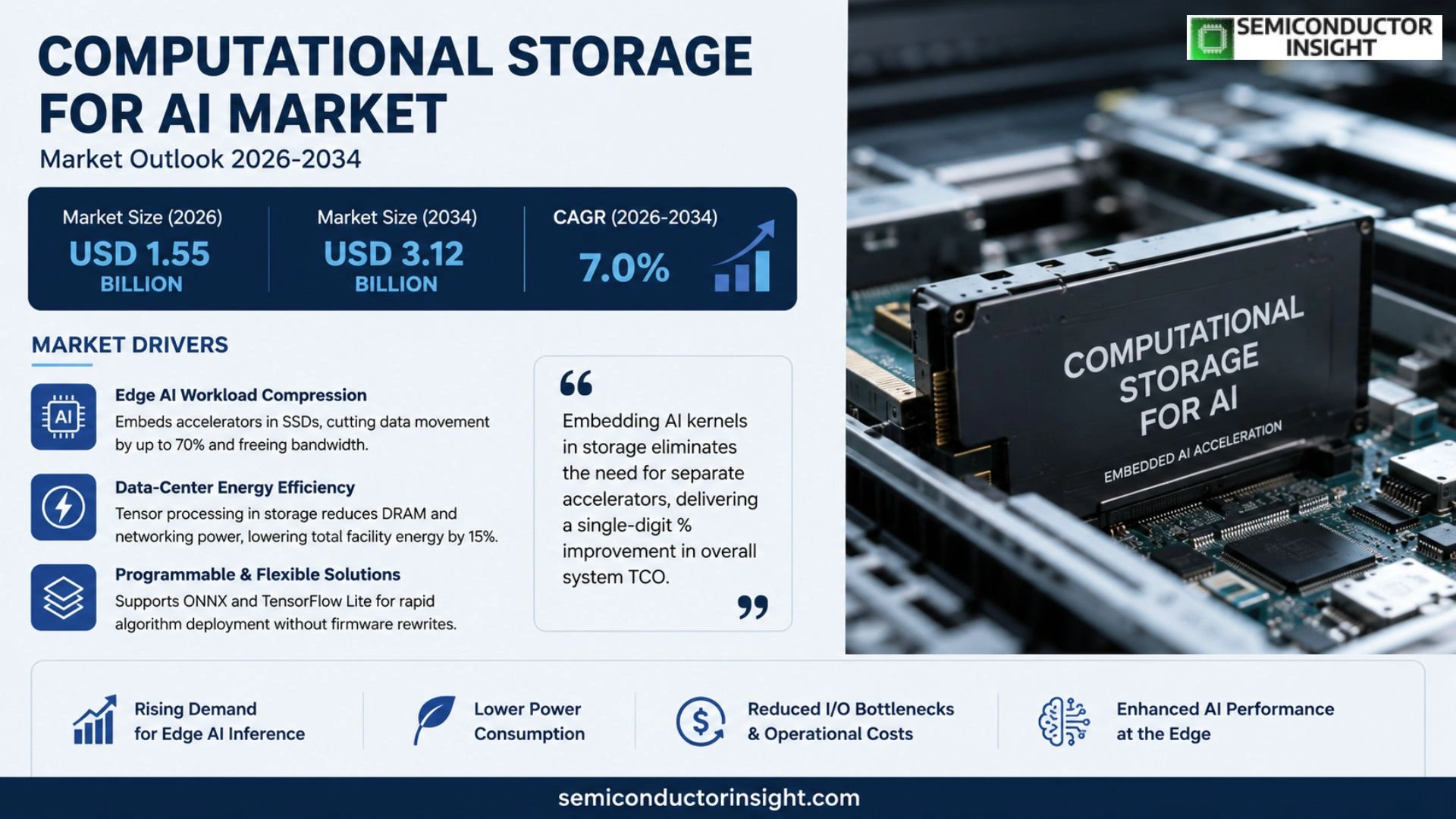
Global Computational storage for AI market size was valued at USD 1.45 billion in 2025. The market is projected to grow from USD 1.55 billion in 2026 to USD 3.12 billion by 2034, exhibiting a CAGR of 7.0% during the forecast period.
Computational storage for AI integrates processing engines,such as CPUs, GPUs, FPGAs or ASICs,directly into flash‑based or NVMe devices so that data can be filtered, transformed or partially inferred before it leaves the drive. This architecture reduces data movement across the memory hierarchy, shortens latency and lowers energy consumption when training large models or serving inference at scale.
The adoption curve has accelerated because modern generative‑AI models routinely handle terabytes of training data and demand sub‑millisecond response times at the edge. Vendors including Samsung Electronics (SmartSSD 2 series launched April 2024), Intel (Memory‑Driven Computing platform), Micron Technology (CXL‑enabled compute drives) and Western Digital (AI‑optimized HDD/SSD portfolio) have introduced products that embed tensor cores or programmable logic within storage media. These initiatives together create a compelling value proposition for cloud providers and enterprises seeking cost‑effective ways to offload pre‑processing workloads.
MARKET DRIVERS
Edge AI Workload Compression
Enterprises are relocating inference engines to the periphery of the network, where latency budgets are measured in microseconds. Computational Storage for AI Market addresses this pressure by embedding matrix‑multiply accelerators directly inside solid‑state drives, cutting data movement by up to 70 %. The resulting compression of I/O traffic frees bandwidth for parallel training jobs, a capability that traditional CPUs struggle to replicate.
Data‑Center Energy Efficiency
Power budgets in hyperscale facilities have tightened after several years of flat growth in utility costs. By processing tensors inside storage, operators can reduce DRAM usage and lower the power draw of networking equipment. Recent case studies indicate a 15 % drop in total‑facility energy consumption when computational storage modules replace conventional SSDs in AI pipelines.
➤ “Embedding AI kernels in storage eliminates the need for separate accelerators, delivering a single‑digit % improvement in overall system TCO.”
Vendors are rolling out programmable flash controllers that support ONNX and TensorFlow Lite models, enabling rapid deployment of new algorithms without firmware rewrites. This flexibility shortens time‑to‑market for AI‑driven services, prompting mid‑size firms to allocate a larger share of their capex toward computational storage solutions.
MARKET CHALLENGES
Software Integration Complexity
Legacy AI stacks expect a clean separation between storage and compute. Introducing processing logic inside NVMe devices forces developers to rewrite data loaders, adjust memory‑persistence semantics, and validate new failure modes. The learning curve discourages early adopters, especially those with entrenched pipelines built around Hadoop or Spark.
Other Challenges
Standardization Gaps
Industry bodies have yet to agree on a universal API for in‑drive inference. Competing extensions from different silicon vendors mean that a model tuned for one controller may stall on another, fragmenting the ecosystem and inflating integration costs.
MARKET RESTRAINTS
Capital Expenditure Constraints
Although operational savings are documented, the upfront price premium for computational storage devices remains 2‑3 times that of conventional SSDs. Companies operating under tight CAPEX cycles postpone upgrades until the price differential narrows, slowing broader market penetration despite clear efficiency arguments.
MARKET OPPORTUNITIES
Hybrid Cloud AI Workloads
Hybrid cloud providers are experimenting with on‑premise computational storage appliances that synchronize model weights with central repositories. This architecture promises seamless scaling of edge inference while retaining centralized governance, opening a revenue stream for vendors that can certify cross‑cloud compatibility. The convergence of storage‑compute fusion with multi‑cloud management tools positions Computational storage for AI Market at the intersection of two high‑growth domains.
Computational Storage for AI Market Trends
Embedded Compute Drives Accelerate AI Workloads
The fusion of processing engines,CPUs, GPUs, FPGAs or ASICs,with flash‑based or NVMe storage has turned drives into active data filters. By performing inference‑ready transformations inside the drive, organizations sidestep the classic memory‑bus bottleneck, cutting latency to sub‑millisecond levels and lowering power draw during large‑scale model training. This architectural shift matters because generative‑AI workloads now juggle terabytes of input data, and every microsecond saved translates into tangible cost avoidance for cloud operators and enterprise data centers.
Other Trends
Edge Deployment of Compute‑Enabled Storage
Edge sites,including autonomous vehicle platforms and remote surveillance nodes,require rapid decision loops without the luxury of high‑bandwidth backhaul. The availability of SmartSSD 2 series (released April 2024) and Micron’s CXL‑enabled compute drives gives developers a means to push pre‑processing and lightweight inference to the edge. The practical upshot is a reduction in upstream traffic, which eases network provisioning and improves overall system reliability.
Convergence of CXL and AI‑Optimized Storage
Interconnect standards such as Compute Express Link (CXL) are being woven into next‑generation storage modules, creating a seamless bridge between host CPUs and on‑device accelerators. Intel’s Memory‑Driven Computing platform already showcases this synergy, allowing a single storage blade to expose both high‑capacity memory and dedicated tensor cores. For service providers, the implication is a more modular data‑center stack: compute can be scaled by adding storage nodes rather than re‑architecting servers, simplifying capacity planning and reducing total cost of ownership.
COMPETITIVE LANDSCAPE
Key Industry Players
Computational Storage for AI: Competitive Overview
Samsung Electronics continues to dominate the high‑performance segment with its SmartSSD 2 series, which embeds tensor cores directly on NVMe flash modules. The product line demonstrates how integrating processing logic with storage can cut data‑movement overhead for large‑scale model training, a capability that major cloud operators are beginning to factor into procurement strategies. Intel leverages its Memory‑Driven Computing platform to offer a broader ecosystem of compute‑enabled drives, positioning the company as a bridge between traditional memory hierarchies and emerging AI workloads. Micron’s CXL‑enabled compute drives and Western Digital’s AI‑optimized HDD/SSD portfolio round out a core group of vendors that have secured sizable design wins with hyperscale data centers, thereby shaping the competitive contours of the market.
Beyond the headline makers, a cluster of specialized firms is expanding the solution space. Seagate has introduced programmable logic‑based storage cards that target edge inference scenarios, while Toshiba’s advanced flash offerings incorporate modest ARM cores for on‑device preprocessing. Marvell Technology supplies controller IP that allows system integrators such as Dell Technologies and HPE to embed custom AI accelerators within storage arrays. Additional players,including Kioxia, Lenovo, Inspur, QuarkStor, Pivot Storage, and Cloudian,focus on niche verticals such as autonomous transport, video analytics, and hybrid cloud, differentiating themselves through tailored firmware and partnership models.
List of Key Computational Storage for AI Companies Profiled
- Samsung Electronics
- Intel
- Micron Technology
- Western Digital
- Seagate Technology
- Toshiba Memory
- Marvell Technology
- Dell Technologies
- Hewlett Packard Enterprise
- Kioxia Corporation
- Lenovo Group
- Inspur
- QuarkStor
- Pivot Storage
- Cloudian
Segment Analysis:
| Segment Category | Sub-Segments | Key Insights |
| By Type |
|
GPU‑Integrated Storage
|
| By Application |
|
Inference at the Edge
|
| By End User |
|
Cloud Service Providers
|
| By Architecture |
|
SmartSSD
|
| By Deployment Model |
|
Hybrid Cloud
|
Regional Analysis: Computational Storage for AI Market
Fortune‑500 firms deploy computational storage to embed inference engines directly within their storage arrays, cutting data‑movement overhead and unlocking real‑time analytics for edge‑originated streams. This shift accelerates time‑to‑insight and reshapes procurement budgets toward hybrid compute‑storage contracts.
Universities and research labs in the United States receive federal grants to explore novel non‑volatile memory technologies, fostering a pipeline of IP that feeds startups focused on AI‑ready storage modules, thereby sustaining innovation velocity.
Close coordination between semiconductor fabs, firmware houses, and system integrators trims lead times, enabling rapid scaling of computational storage devices once AI model demand spikes, a key competitive edge for regional vendors.
Emerging guidance on AI model provenance and data residency informs storage‑level encryption standards, prompting vendors to embed compliance checks within the storage controller firmware, thus mitigating risk for multinational deployments.
Europe
European firms exhibit a cautious yet methodical approach to computational storage, emphasizing interoperability with existing Open RAN and industrial IoT frameworks. German and French manufacturers prioritize energy‑efficiency certifications, aligning product roadmaps with the EU’s Green Deal objectives. Collaborative consortia between cloud operators and hardware vendors focus on standardizing APIs that expose storage‑side AI primitives, a step that could harmonize cross‑border deployments and reduce integration costs for multinational enterprises.
Asia‑Pacific
In the Asia‑Pacific, rapid urbanization and the rise of smart‑city initiatives drive demand for on‑premise AI processing. Japanese firms leverage their expertise in high‑density NAND to embed inference accelerators directly into SSDs, while South Korean conglomerates integrate advanced packaging techniques to boost throughput. However, fragmented regulatory environments across the region mean that vendors must tailor compliance layers to each market, adding complexity to scaling strategies.
South America
South American markets are still in the early adoption phase, with Brazil leading pilot projects in agricultural analytics and fintech. The primary barrier remains limited data‑center density, prompting carriers to experiment with edge‑focused computational storage appliances that can process sensor data locally, thereby sidestepping bandwidth constraints. Partnerships with North American OEMs provide a technology transfer pathway, potentially accelerating the region’s entry into broader AI‑driven storage ecosystems.
Middle East & Africa
The Middle East & Africa region leverages computational storage to support burgeoning AI workloads in oil‑and‑gas exploration and renewable‑energy forecasting. Sovereign wealth funds are channeling capital into niche startups that fuse storage with machine‑learning kernels, aiming to create localized AI hubs that reduce reliance on imported cloud services. Africa’s telecom operators experiment with storage‑edge nodes to enable low‑latency AI inference for mobile health applications, positioning the continent as a testbed for cost‑effective deployment models.
Report Scope
This market research report provides a comprehensive analysis of the Computational Storage for AI Market , covering the forecast period 2026–2034. It offers detailed insights into market dynamics, technological advancements, competitive landscape, and key trends shaping the industry.
Key focus areas of the report include:
- Market Overview: The report begins with an overview outlining its current market scenario, key growth indicators, and industry transformation drivers. It discusses macroeconomic factors, demand–supply balance, regulatory landscape, and the strategic role of semiconductors in powering advancements across industries such as automotive, telecommunications, consumer electronics, and industrial automation.
- Market Size & Forecast: Historical data and future projections for revenue, unit shipments, and market value across major regions and segments.
- Segmentation Analysis: Detailed breakdown by product type, technology, application, and end-user industry to identify high-growth segments and investment opportunities.
- Regional Insights: Insights into market performance across North America, Europe, Asia-Pacific, Latin America, and the Middle East & Africa, including country-level analysis where relevant.
- Competitive Landscape: Profiles of leading market participants, including their product offerings, R&D focus, manufacturing capacity, pricing strategies, and recent developments such as mergers, acquisitions, and partnerships.
- Technology Trends & Innovation: Assessment of emerging technologies, integration of AI/IoT, semiconductor design trends, fabrication techniques, and evolving industry standards.
- Market Drivers & Restraints: Evaluation of factors driving market growth along with challenges, supply chain constraints, regulatory issues, and market-entry barriers.
- Stakeholder Insights: Insights for component suppliers, OEMs, system integrators, investors, and policymakers regarding the evolving ecosystem and strategic opportunities.
Primary and secondary research methods are employed, including interviews with industry experts, data from verified sources, and real-time market intelligence to ensure the accuracy and reliability of the insights presented.
FREQUENTLY ASKED QUESTIONS:
What is the current market size of Computational Storage for AI Market?
-> Computational storage for AI market is projected to grow from USD 1.55 billion in 2026 to USD 3.12 billion by 2034, exhibiting a CAGR of 7.0%
Which key companies operate in Computational Storage for AI Market?
-> Key players include Samsung Electronics, Intel Corporation, Micron Technology, and Western Digital Corporation, among others.
What are the key growth drivers?
-> Key growth drivers include the need to reduce data movement latency, rising generative‑AI workloads, edge‑centric inference requirements, and energy‑efficiency imperatives for large‑scale model training.
Which region dominates the market?
-> The reference does not specify a dominant region for Computational storage for AI market.
What are the emerging trends?
-> Emerging trends include integration of tensor‑core accelerators within NVMe devices, CXL‑enabled compute drives, and AI‑optimized firmware that performs in‑storage preprocessing and inference.
Get Sample Report PDF for Exclusive Insights
Report Sample Includes
- Table of Contents
- List of Tables & Figures
- Charts, Research Methodology, and more...
 Download Sample Report PDF