Key Statistics
Key Takeaways
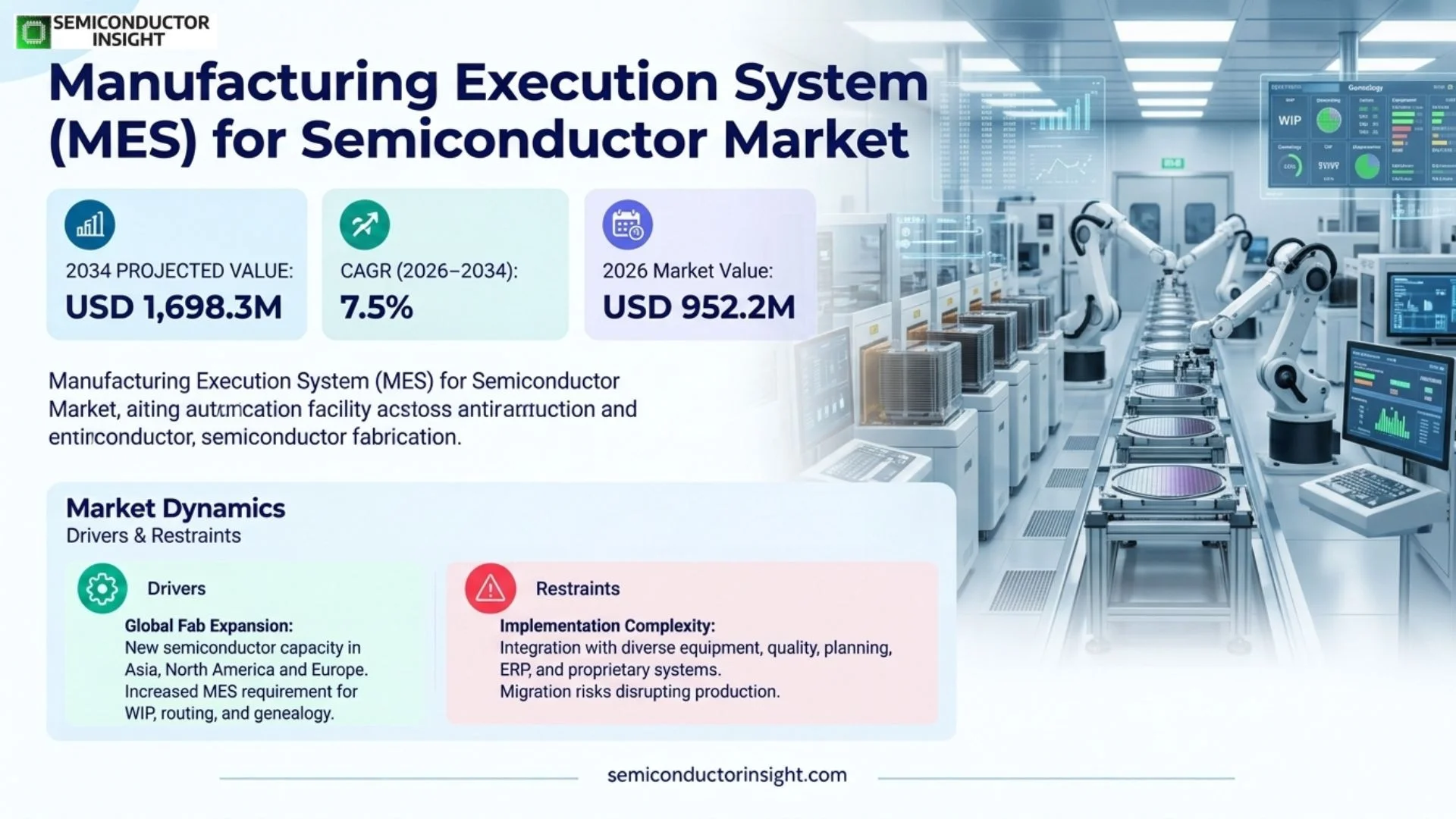
- Market size: The market is valued at USD 885.8 million in 2025 and is projected to reach USD 1,698.3 million by 2034, representing a 7.5% CAGR during 2026–2034.
- Integrated MES remains the largest segment, unifying work-in-process, dispatch, genealogy, quality and equipment connectivity across the fab.
- Asia Pacific leads the market because Taiwan, South Korea, China and Japan contain the highest concentration of wafer fabs, memory factories and OSAT capacity.
- AI, digital twins and event-driven dispatch are expanding software value from transaction tracking toward yield, cycle-time and utilization optimization.
- Cloud and containerized deployment are increasing flexibility, but fabs still demand strict cybersecurity, uptime and controlled release management.
Manufacturing Execution System (MES) for Semiconductor Market Overview
Semiconductor MES Market is valued at USD 885.8 million in 2025 and is projected to reach USD 1,698.3 million by 2034, expanding at a 7.5% CAGR during 2026–2034. The 2026 market level is USD 952.2 million. Asia Pacific leads because the region contains the largest concentration of semiconductor manufacturing capacity. The market is shifting from transaction-centric shop-floor tracking toward integrated digital manufacturing platforms that combine dispatching, genealogy, equipment integration, analytics, substrate maps and production digital twins.
A semiconductor manufacturing execution system is the software layer that controls and records production as wafers, lots, carriers and packages move through complex manufacturing flows. It manages work-in-process, routing, recipes, dispatching, genealogy, non-conformance, data collection, equipment status and quality events. Semiconductor MES is more specialized than generic factory software because a single wafer can pass through hundreds of steps with rework, holds, split lots and strict traceability requirements.
Modern platforms are moving toward modular architectures, containerized deployment, richer APIs, advanced scheduling, AI-assisted configuration and digital-twin integration. Siemens Opcenter Execution Semiconductor supports wafer fabrication and assembly/test, including single-wafer traceability, real-time dispatch and production digital twins. Vendors are increasingly connecting MES with APC, FDC, SPC, maintenance, material control and enterprise systems to create a continuous data thread across the manufacturing lifecycle.
MES purchases are long-term infrastructure decisions because replacing the execution layer inside a live fab is operationally risky. Customers evaluate implementation methodology, uptime, scalability, migration tooling, cybersecurity and the supplier’s ability to support legacy and advanced equipment simultaneously. Revenue combines software licenses or subscriptions with implementation, customization, integration and long-term support, making services a meaningful part of market value and customer lifetime economics.
Segment Analysis: By Type
By type, the market is segmented into Integrated MES, Modular MES and Customized MES. Integrated systems provide a broad execution backbone across fab operations, modular systems allow phased deployment of selected functions, and customized MES reflects the highly specific process and legacy-software environments found in established semiconductor factories. Large fabs often use a standard core combined with extensive customer-specific integration and workflow configuration.
| Type | Commercial role |
|---|---|
| Integrated MES | Unified execution, dispatch, quality, genealogy and equipment connectivity; strongest fit for greenfield fabs and broad modernization. |
| Modular MES | Composable capabilities deployed around existing factory systems or introduced in stages to reduce migration risk. |
| Customized MES | Tailored workflows and interfaces built around proprietary fab operations, legacy software and customer-specific process rules. |
Additional Segmentation: By Deployment Model
Deployment models range from conventional on-premise installations to private-cloud, hybrid and SaaS-enabled approaches. Core execution commonly remains close to the fab for latency, uptime and security, while analytics, reporting and development environments can move into cloud infrastructure. Containerization and modular services make updates easier, but semiconductor customers still require carefully controlled release testing before production changes are introduced.
| Deployment Model | Demand characteristics |
|---|---|
| On-Premise | Traditional deployment inside fab data centers with direct control over latency, security and change management. |
| Private Cloud / Hybrid | Core execution remains near the factory while analytics, reporting and development use cloud or enterprise infrastructure. |
| SaaS-Enabled | Subscription or managed delivery for selected modules, remote sites or less latency-sensitive functions. |
Segment Analysis: By Application
By application, wafer fabs are the largest segment because front-end manufacturing has the most complex routing, rework, dispatching and equipment-integration requirements. Silicon wafer manufacturing uses MES for crystal, slicing, polishing and quality traceability, while OSAT facilities use it for assembly, test, package genealogy and high-mix production. All three environments benefit from tighter digital links between engineering and execution.
| Application | Demand characteristics |
|---|---|
| Silicon Wafer Manufacturing | Crystal growth, slicing, polishing, inspection and lot traceability across substrate production. |
| Wafer Fab | Front-end semiconductor manufacturing with hundreds of process steps, dynamic dispatching and strict genealogy. |
| OSAT | Assembly, packaging and test with high mix, device-level traceability and equipment integration. |
Additional Segmentation: By Functional Layer
Functional demand can be separated into production execution and dispatch, quality and traceability, equipment integration, and analytics or digital twin capabilities. The core transaction engine remains mission-critical, but growth is moving toward functions that improve yield, cycle time and decision quality. Vendors increasingly bundle these layers into one platform or expose APIs so customers can connect specialist analytics and factory-control tools.
| Functional Layer | Commercial relevance |
|---|---|
| Production Execution & Dispatch | WIP control, routing, holds, lot selection, scheduling and real-time execution. |
| Quality & Traceability | Genealogy, non-conformance, SPC, audit trails and device-level quality records. |
| Equipment Integration | Machine connectivity, recipe management, automation interfaces and event processing. |
| Analytics & Digital Twin | Yield, cycle-time, capacity modeling, predictive analytics and closed-loop optimization. |
Regional Analysis
Asia Pacific leads because Taiwan, South Korea, China and Japan contain the largest concentration of wafer fabs, memory factories and OSAT capacity. North America is a high-value growth market as new U.S. fabs modernize software stacks, while Europe has strong automotive and power-semiconductor demand. South America and the Middle East & Africa remain much smaller due to limited front-end manufacturing capacity.
Why does regional demand differ across the Manufacturing Execution System (MES) for Semiconductor market?
MES demand follows semiconductor production capacity and factory modernization rather than chip consumption. A new advanced fab requires execution software before production starts, while an established fab can generate recurring upgrade, integration and analytics demand for decades. Asia therefore leads through installed capacity, while North America and Europe can grow rapidly during periods of greenfield construction and software modernization.
| Region | Position | Demand profile | Key commercial factor |
|---|---|---|---|
| Asia Pacific | Largest | Foundry, memory, OSAT | Installed fab base and modernization |
| North America | High-value growth | Greenfield fabs, advanced logic | Cybersecurity and digital twin integration |
| Europe | Strategic | Automotive, power, industrial | Traceability and lifecycle support |
| South America | Emerging | Limited semiconductor production | Implementation economics |
| Middle East & Africa | Emerging | New projects, R&D | Greenfield qualification and support |
Competitive Landscape
Applied Materials, Siemens, Critical Manufacturing, IBM, Infosys and regional software companies compete across semiconductor MES, factory automation and services. Competitive strength depends on real-time execution, scalability, equipment connectivity, dispatching, traceability and the ability to integrate with decades of fab-specific software. Implementation capability and semiconductor domain knowledge are as important as product features because production interruptions can carry very high cost.
The market is moving toward more modular and data-centric architectures. Siemens’ 2025 and 2026 Opcenter releases added containerized deployment, dispatch enhancements, reporting and AI-assisted configuration. Critical Manufacturing and other modern platforms emphasize composability and Industry 4.0 integration. These trends reduce some legacy constraints but raise expectations for APIs, cybersecurity, rapid software lifecycle management and support across multi-site global factories.
Customer relationships are durable because semiconductor MES becomes embedded in daily production. Once a platform controls lot movement, genealogy, recipes and equipment interfaces, replacement can require a multi-year migration program. Vendors therefore compete on lifecycle support, roadmap continuity and migration tooling as much as new features. Greenfield fabs provide the easiest route for new architectures because they avoid the burden of preserving decades of legacy workflows.
| Competitive tier | Representative companies | Primary differentiation |
|---|---|---|
| Semiconductor-specific MES platforms | Siemens Opcenter, Critical Manufacturing, Applied Materials | Deep fab execution, equipment integration, dispatch and semiconductor-specific workflows. |
| Large technology / services providers | IBM, Infosys | Integration, analytics, cloud and enterprise transformation around factory execution. |
| Regional / specialist vendors | Chroma ATE, Shanghai Corelli Software, Jiangsu TaizhiTech | Local implementation, specialized software and regional customer access. |
Key companies profiled
Applied Materials, IBM, Critical Manufacturing, Infosys, Chroma ATE, Shanghai Corelli Software, Jiangsu TaizhiTech and other regional providers are included in the competitive scope. Siemens Opcenter is also a major semiconductor MES platform used across wafer fabrication and assembly/test. Competitive roles differ between core software vendors, implementation partners and broader automation suppliers, so product comparisons should focus on execution depth and semiconductor domain capability.
Production Capacity Analysis
MES capacity is primarily software and implementation capacity rather than physical manufacturing. Vendors need product-engineering teams, semiconductor domain experts, solution architects, integration engineers and 24/7 support. A large fab deployment can involve years of configuration and migration, so the number of parallel implementations a supplier can support becomes a practical growth constraint even when software licenses themselves are infinitely reproducible.
Cloud and containerized architectures can improve deployment efficiency by standardizing environments, automating updates and separating modules. Semiconductor fabs still require controlled testing and validation before production releases. Vendors therefore need strong DevOps and release-management processes as well as local support. The ability to maintain multiple software versions across customer fabs can be as important as new-feature development and helps determine practical service capacity.
Market Dynamics
The semiconductor MES market grows with fab expansion, Industry 4.0 adoption and the need to control increasingly complex process flows in real time. The core value proposition is improving throughput, yield, traceability and cycle time while reducing manual intervention. Growth is restrained by implementation cost, legacy integration and the operational risk of changing mission-critical factory software. AI, digital twins and modular deployment provide the strongest opportunities for increasing software value per fab.
Market Drivers
| Driver | Impact | Commercial mechanism |
|---|---|---|
| Fab expansion | High | Every new wafer fab requires an execution backbone. |
| Yield and cycle-time optimization | High | Real-time execution data can improve utilization and reduce variability. |
| AI and digital twins | Medium-High | Factories are using simulation and analytics to improve decisions. |
| Device-level traceability | Medium | Advanced packaging and automotive quality require deeper genealogy. |
Fab expansion
Greenfield fabs need MES for WIP, routing, dispatching, genealogy, recipes and equipment integration from day one. New semiconductor capacity in Asia, North America and Europe therefore creates direct software demand. Greenfield projects also allow modern architectures to be adopted without the full migration complexity of replacing decades-old legacy systems. For commercial buyers in the Manufacturing Execution System (MES) for Semiconductor market, the practical decision therefore depends on qualification evidence, integration effort, operating reliability, lifecycle support, supply continuity and measurable system-level value rather than a single headline specification.
Yield and cycle-time optimization
Advanced fabs operate thousands of tools and millions of process events. Better dispatching, traceability and closed-loop data can reduce queue time, identify excursions and improve equipment utilization. As wafer value rises at advanced nodes, even small yield or cycle-time improvements can justify substantial MES and analytics investment. For commercial buyers in the Manufacturing Execution System (MES) for Semiconductor market, the practical decision therefore depends on qualification evidence, integration effort, operating reliability, lifecycle support, supply continuity and measurable system-level value rather than a single headline specification.
AI and digital twins
MES data provides the real-time foundation for production digital twins, predictive analytics and AI-assisted scheduling. Siemens positions its semiconductor platform around event-based dispatch and an execution-driven digital twin. These capabilities can extend MES from transaction processing into optimization, increasing the strategic value of the software layer. For commercial buyers in the Manufacturing Execution System (MES) for Semiconductor market, the practical decision therefore depends on qualification evidence, integration effort, operating reliability, lifecycle support, supply continuity and measurable system-level value rather than a single headline specification.
Device-level traceability
Chiplets, automotive semiconductors and heterogeneous integration increase the importance of tracking wafers, die, packages and process history. MES platforms that maintain single-wafer or device-level genealogy can improve root-cause analysis and compliance while supporting customers with strict quality requirements. For commercial buyers in the Manufacturing Execution System (MES) for Semiconductor market, the practical decision therefore depends on qualification evidence, integration effort, operating reliability, lifecycle support, supply continuity and measurable system-level value rather than a single headline specification.
Market Restraints
| Restraint | Impact | Commercial consequence |
|---|---|---|
| Implementation complexity | High | MES projects touch nearly every production process and interface. |
| Legacy integration | Medium-High | Many fabs rely on software built over decades. |
| Cybersecurity and uptime | Medium-High | The MES is mission-critical and cannot tolerate prolonged outages. |
| Customization burden | Medium | Heavy customer-specific logic can make upgrades difficult. |
Implementation complexity
A semiconductor MES must integrate with equipment automation, planning, quality, maintenance, ERP and proprietary factory systems. Migration errors can disrupt production. Customers therefore require staged testing, shadow operation and extensive validation, making implementation long and expensive compared with ordinary enterprise software. For commercial buyers in the Manufacturing Execution System (MES) for Semiconductor market, the practical decision therefore depends on qualification evidence, integration effort, operating reliability, lifecycle support, supply continuity and measurable system-level value rather than a single headline specification.
Legacy integration
Brownfield factories may operate custom dispatch, recipe and material systems that cannot be replaced easily. Modern MES must coexist with legacy protocols and data models. This can limit standardized cloud adoption and increase customer-specific engineering required for upgrades. For commercial buyers in the Manufacturing Execution System (MES) for Semiconductor market, the practical decision therefore depends on qualification evidence, integration effort, operating reliability, lifecycle support, supply continuity and measurable system-level value rather than a single headline specification.
Cybersecurity and uptime
Factory execution software controls production and connects to large numbers of tools. Cybersecurity incidents or software failures can stop a fab. Customers therefore impose strict access control, redundancy, patch testing and change-management rules, slowing software updates and increasing support cost. For commercial buyers in the Manufacturing Execution System (MES) for Semiconductor market, the practical decision therefore depends on qualification evidence, integration effort, operating reliability, lifecycle support, supply continuity and measurable system-level value rather than a single headline specification.
Customization burden
Fabs often encode proprietary production rules and workflows into MES implementations. Excessive customization can create technical debt and make future releases expensive to adopt. Vendors are responding with configurable low-code tools and modular services, but customers must balance flexibility with maintainability. For commercial buyers in the Manufacturing Execution System (MES) for Semiconductor market, the practical decision therefore depends on qualification evidence, integration effort, operating reliability, lifecycle support, supply continuity and measurable system-level value rather than a single headline specification.
Market Opportunities
AI-assisted dispatch and analytics
Real-time fab data can be used to predict bottlenecks, optimize lot selection and identify yield risks. MES vendors can monetize higher-value analytics while keeping the execution layer as the trusted system of record. For commercial buyers in the Manufacturing Execution System (MES) for Semiconductor market, the practical decision therefore depends on qualification evidence, integration effort, operating reliability, lifecycle support, supply continuity and measurable system-level value rather than a single headline specification.
Production digital twins
Connecting engineering models with live MES events allows fabs to test dispatch rules, capacity changes and new-product introductions before changing production. Digital-twin integration can become a premium platform capability. For commercial buyers in the Manufacturing Execution System (MES) for Semiconductor market, the practical decision therefore depends on qualification evidence, integration effort, operating reliability, lifecycle support, supply continuity and measurable system-level value rather than a single headline specification.
Cloud and containerized deployment
Containerized and hybrid architectures can simplify upgrades, development and multi-site standardization. The opportunity is strongest for new fabs and non-latency-critical modules, while core execution remains close to production for resilience. For commercial buyers in the Manufacturing Execution System (MES) for Semiconductor market, the practical decision therefore depends on qualification evidence, integration effort, operating reliability, lifecycle support, supply continuity and measurable system-level value rather than a single headline specification.
Advanced packaging and chiplets
OSAT and advanced packaging factories need deeper die-level genealogy, complex routing and equipment integration. MES vendors can expand from wafer fabs into heterogeneous integration as packaging becomes a larger share of semiconductor value. For commercial buyers in the Manufacturing Execution System (MES) for Semiconductor market, the practical decision therefore depends on qualification evidence, integration effort, operating reliability, lifecycle support, supply continuity and measurable system-level value rather than a single headline specification.
Supply Chain Analysis
Platform development. Vendors build execution engines, data models, user interfaces, APIs, dispatching, quality and equipment-integration capabilities. Semiconductor domain knowledge is embedded in product architecture because wafer fabs need concepts such as lots, carriers, splits, rework, recipe control and substrate maps that generic MES systems do not handle natively. For commercial buyers in the Manufacturing Execution System (MES) for Semiconductor market, the practical decision therefore depends on qualification evidence, integration effort, operating reliability, lifecycle support, supply continuity and measurable system-level value rather than a single headline specification.
Implementation. Solution teams map factory routes, equipment interfaces, hold rules, genealogy, security and data integration. Brownfield migration can be especially complex because existing fabs contain custom software and decades of operational logic. Extensive testing is required before production cutover to avoid line disruption and preserve traceability. For commercial buyers in the Manufacturing Execution System (MES) for Semiconductor market, the practical decision therefore depends on qualification evidence, integration effort, operating reliability, lifecycle support, supply continuity and measurable system-level value rather than a single headline specification.
Operations. Once live, MES becomes mission-critical infrastructure. Vendors and customer IT teams manage availability, databases, interfaces, cybersecurity and change control around the clock. Fab expansion, new equipment and product introductions continuously add configuration requirements, creating recurring services and support demand. For commercial buyers in the Manufacturing Execution System (MES) for Semiconductor market, the practical decision therefore depends on qualification evidence, integration effort, operating reliability, lifecycle support, supply continuity and measurable system-level value rather than a single headline specification.
Optimization. Production data flows into dispatching, analytics, digital twins and yield systems. The long-term value of MES grows when the platform becomes the reliable execution data layer for factory optimization, creating opportunities for AI, predictive analytics and multi-site benchmarking. For commercial buyers in the Manufacturing Execution System (MES) for Semiconductor market, the practical decision therefore depends on qualification evidence, integration effort, operating reliability, lifecycle support, supply continuity and measurable system-level value rather than a single headline specification.
Recent Developments in the Manufacturing Execution System (MES) for Semiconductor Market
Developments tracked through September 2026 and limited to events that materially affect technology, capacity, adoption or competition.
- 18 May 2026
Siemens released Opcenter Execution Semiconductor 2604 with a new reporting solution and additional execution improvements, reflecting continued investment in more configurable and data-rich semiconductor factory software. Source - 24 November 2025
Siemens released Opcenter Execution Semiconductor 2510 with enhanced role-based interfaces and AI-powered configuration support, illustrating the shift toward better usability and faster application administration. Source - 7 May 2025
Siemens released Opcenter Execution Semiconductor 2504 with containerized deployment support, dispatch enhancements, improved SPC handling and rework workflow control. Source
Report Scope & Segmentation
| Attribute | Scope |
|---|---|
| Base year | 2025 |
| Estimated year | 2026 |
| Forecast period | 2026–2034 |
| 2025 market size | USD 885.8 million |
| 2026 estimated size | USD 952.2 million |
| 2034 projected size | USD 1,698.3 million |
| CAGR (2026–2034) | 7.5% |
| Largest market in 2025 | Asia Pacific |
| By Type | Integrated MES; Modular MES; Customized MES |
| By Application | Silicon Wafer Manufacturing; Wafer Fab; OSAT |
| By Deployment Model | On-Premise; Private Cloud/Hybrid; SaaS-Enabled |
| By Functional Layer | Production Execution & Dispatch; Quality & Traceability; Equipment Integration; Analytics & Digital Twin |
| Companies profiled | Applied Materials; Siemens Opcenter; IBM; Critical Manufacturing; Infosys; Chroma ATE; Shanghai Corelli Software; Jiangsu TaizhiTech |
Frequently Asked Questions
What is the semiconductor MES market size in 2025?
The global Manufacturing Execution System for Semiconductor market is valued at USD 885.8 million in 2025 and includes execution software used in wafer manufacturing, wafer fabs and OSAT operations. The commercial implication is that buyers in the Manufacturing Execution System (MES) for Semiconductor market evaluate the complete operating context, including validation history, integration effort, reliability, lifecycle support, supply continuity and measurable system-level value rather than a single headline specification.
What is the market forecast for 2034?
The market is projected to reach USD 1,698.3 million by 2034, representing a 7.5% CAGR during 2026–2034. The corresponding 2026 market level is USD 952.2 million. The commercial implication is that buyers in the Manufacturing Execution System (MES) for Semiconductor market evaluate the complete operating context, including validation history, integration effort, reliability, lifecycle support, supply continuity and measurable system-level value rather than a single headline specification.
Which region leads the market?
Asia Pacific leads because Taiwan, South Korea, China and Japan contain the largest concentration of semiconductor wafer fabs, memory factories and OSAT capacity. The commercial implication is that buyers in the Manufacturing Execution System (MES) for Semiconductor market evaluate the complete operating context, including validation history, integration effort, reliability, lifecycle support, supply continuity and measurable system-level value rather than a single headline specification.
What does semiconductor MES do?
It controls WIP, routing, dispatching, genealogy, quality events, equipment integration and production records across complex semiconductor manufacturing flows. The commercial implication is that buyers in the Manufacturing Execution System (MES) for Semiconductor market evaluate the complete operating context, including validation history, integration effort, reliability, lifecycle support, supply continuity and measurable system-level value rather than a single headline specification.
Which MES type is largest?
Integrated MES is the largest type because large fabs need one trusted execution layer connecting production control, traceability, equipment and quality functions. The commercial implication is that buyers in the Manufacturing Execution System (MES) for Semiconductor market evaluate the complete operating context, including validation history, integration effort, reliability, lifecycle support, supply continuity and measurable system-level value rather than a single headline specification.
How is AI changing semiconductor MES?
AI and analytics are being used for dispatching, bottleneck prediction, yield insights and configuration support. MES provides the trusted real-time data needed for these capabilities. The commercial implication is that buyers in the Manufacturing Execution System (MES) for Semiconductor market evaluate the complete operating context, including validation history, integration effort, reliability, lifecycle support, supply continuity and measurable system-level value rather than a single headline specification.
Why are digital twins important?
Production digital twins let manufacturers test dispatch rules, capacity changes and new-product introductions using live execution data before modifying the physical factory. The commercial implication is that buyers in the Manufacturing Execution System (MES) for Semiconductor market evaluate the complete operating context, including validation history, integration effort, reliability, lifecycle support, supply continuity and measurable system-level value rather than a single headline specification.
Who are the major vendors?
Important suppliers include Siemens Opcenter, Applied Materials, Critical Manufacturing, IBM, Infosys and regional semiconductor software providers. The commercial implication is that buyers in the Manufacturing Execution System (MES) for Semiconductor market evaluate the complete operating context, including validation history, integration effort, reliability, lifecycle support, supply continuity and measurable system-level value rather than a single headline specification.
What limits adoption?
Implementation complexity, legacy integration, cybersecurity requirements and the operational risk of changing mission-critical factory software are the main constraints. The commercial implication is that buyers in the Manufacturing Execution System (MES) for Semiconductor market evaluate the complete operating context, including validation history, integration effort, reliability, lifecycle support, supply continuity and measurable system-level value rather than a single headline specification.
What will drive growth through 2034?
New fabs, Industry 4.0, AI, digital twins, advanced packaging and deeper device-level traceability will increase both the installed base and software value per site. The commercial implication is that buyers in the Manufacturing Execution System (MES) for Semiconductor market evaluate the complete operating context, including validation history, integration effort, reliability, lifecycle support, supply continuity and measurable system-level value rather than a single headline specification.
Research Sources & Evidence Base
View research sources used in this market overview
- Siemens – Opcenter Execution Semiconductor. Semiconductor MES functions, digital twin, traceability and dispatch evidence.
- Siemens – Opcenter Execution Semiconductor 2504. 2025 containerization, dispatch and SPC enhancements.
- Siemens – Opcenter Execution Semiconductor 2510. 2025 user-interface and AI-assisted configuration updates.
- Semiconductor Insight – MES for Semiconductor Market. Market anchors, segmentation and regional position.
Get Sample Report PDF for Exclusive Insights
Report Sample Includes
- Table of Contents
- List of Tables & Figures
- Charts, Research Methodology, and more...