Key Statistics
Key Takeaways
- 2.5D CoWoS-type packaging is the leading technology because AI accelerators require high-bandwidth connections between large logic dies and multiple HBM stacks, while silicon interposers and local bridges provide dense routing without forcing all functions onto one monolithic die.
- AI accelerators generate the largest application demand as cloud providers scale training and inference clusters that combine GPUs or custom accelerators with HBM, advanced substrates, high-current power delivery and increasingly sophisticated thermal solutions.
- Asia Pacific is the dominant region because Taiwan, South Korea, China and Japan combine foundries, OSATs, HBM suppliers, substrate makers and equipment companies. The source report states that Taiwan controls more than half of global advanced-packaging capacity.
- U.S. capacity is expanding quickly. Amkor announced a long-term Arizona partnership with TSMC in June 2026, a USD 1.5 billion multi-year agreement with NVIDIA in July 2026, and a September 2026 expansion that lifts planned Arizona investment to about USD 12 billion.
- Chiplet standards are maturing. UCIe 3.0 supports 48 GT/s and 64 GT/s data rates, doubling UCIe 2.0 bandwidth and strengthening the ecosystem for interoperable multi-die systems used in AI and high-performance computing.
Advanced Packaging for AI Chip Market Overview
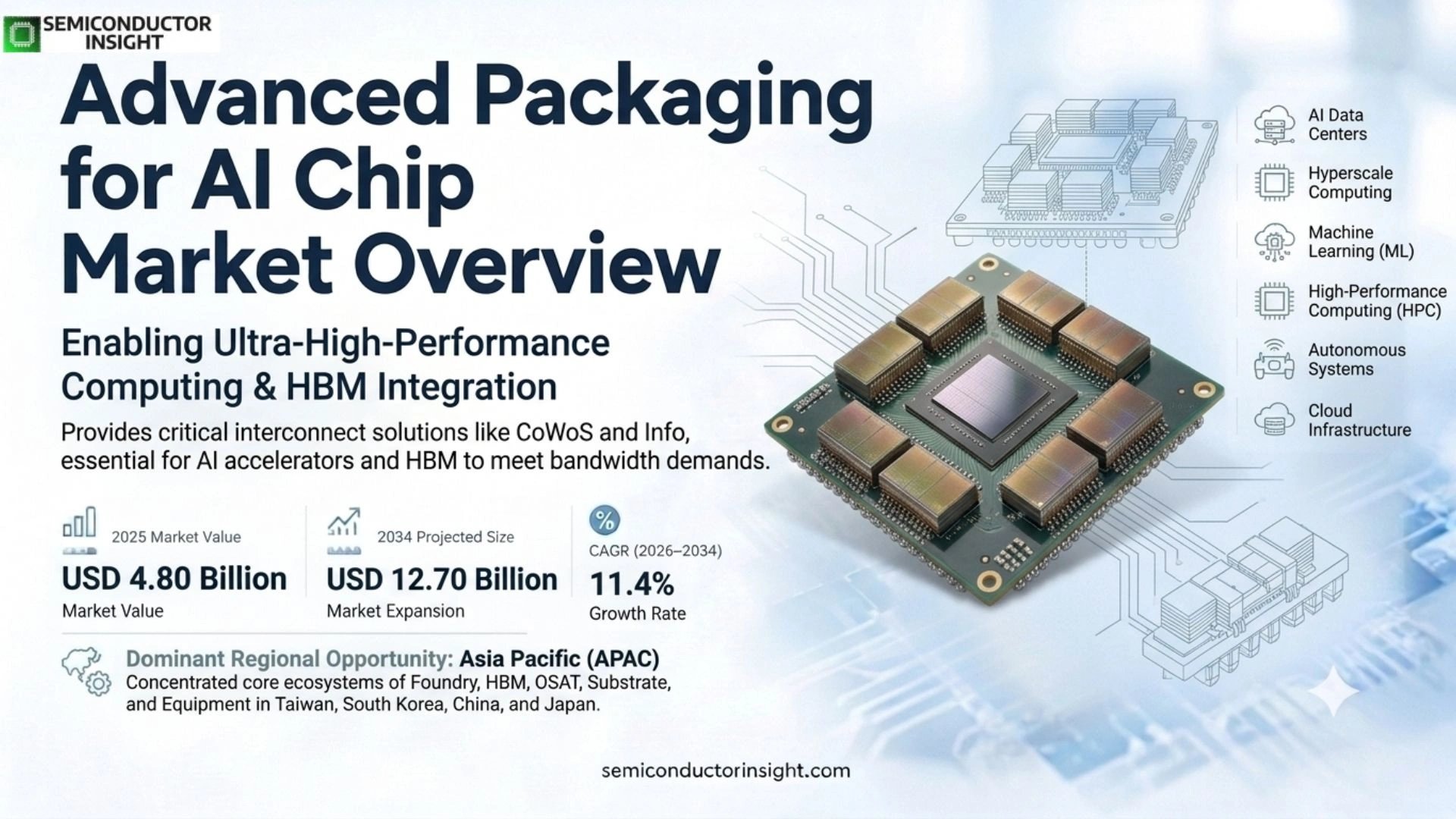
Advanced Packaging for AI Chip market was valued at USD 4.80 billion in 2025 and is projected to reach USD 12.70 billion by 2034, representing an 11.4% CAGR during 2026–2034. The 2026 estimated market size is USD 5.35 billion. Asia Pacific is the largest region because the core foundry, HBM, OSAT, substrate and equipment ecosystems are concentrated in Taiwan, South Korea, China and Japan.
Advanced packaging has become a system-performance technology rather than a final assembly step. AI processors increasingly split compute, I/O and memory functions across several dies and then reconnect them using silicon interposers, redistribution layers, local bridges or direct 3D bonding. This approach allows designers to combine different process nodes, exceed single-reticle die limits and place HBM close to accelerators, improving bandwidth and energy efficiency while avoiding the yield penalty of one very large monolithic die.
Thermal and power delivery requirements are rising in parallel with interconnect density. AI packages can contain several large logic dies and multiple HBM stacks inside one substrate footprint, creating hot spots, high transient current and complex mechanical stress. Packaging providers therefore compete on interposer size, micro-bump or hybrid-bond pitch, substrate warpage control, thermal-interface design, integrated capacitors, backside power options and co-design tools rather than on assembly cost alone.
Industry structure is evolving as foundries, IDMs, OSATs and memory suppliers invest simultaneously. TSMC is scaling CoWoS, SoIC and related 3DFabric technologies; Intel uses EMIB and Foveros; Samsung offers 2.5D and 3D Cube architectures; ASE is expanding VIPack and panel-level packaging; and Amkor is building a large U.S. advanced-packaging campus. This creates a competitive market where capacity access, ecosystem coordination and design enablement can be as important as the package technology itself.
Segment Analysis: By Type
By type, the report segments the market into 2.5D CoWoS, 3D Stacking and Fan-Out Wafer Level Packaging. 2.5D CoWoS-type packaging is the leading segment because it has become the production architecture for many high-end AI accelerators that need wide interfaces between logic and HBM, while 3D stacking and fan-out approaches are expanding as interconnect density, power efficiency and package size become more demanding.
| Type | Technical architecture | Market position |
|---|---|---|
| 2.5D CoWoS | 2.5D integration places logic dies and HBM side by side on a silicon interposer, RDL interposer or local silicon bridge before mounting the assembly on a package substrate. The architecture supports very wide memory interfaces and large package footprints while allowing each die to use the most suitable process node. Routing density, interposer area, substrate warpage and power delivery are major engineering constraints. | Largest type. The source report identifies 2.5D CoWoS as dominant because the architecture is proven in HPC and AI accelerators. TSMC’s CoWoS family is the best-known implementation, while Intel EMIB, Samsung I-Cube and OSAT bridge approaches compete for similar heterogeneous-integration workloads. |
| 3D Stacking | 3D packaging stacks active dies vertically using through-silicon vias, micro-bumps or hybrid copper bonding. Shorter vertical links can provide much higher interconnect density and lower energy per bit than package-level horizontal routing. The architecture is attractive for cache, logic-on-logic and memory integration but introduces complex thermal, yield, test and known-good-die requirements. | A high-growth strategic segment. TSMC SoIC, Intel Foveros and Samsung 3D Cube technologies demonstrate the industry’s move toward vertical integration. Adoption is strongest where system performance benefits justify higher process complexity and where thermal management can be solved without compromising stacked-die reliability. |
| Fan-Out Wafer Level Packaging | Fan-out redistributes die I/O into a larger molded or panel area without a conventional laminate substrate for every routing layer. High-density fan-out can integrate chiplets, bridges and passive components while offering a path to larger panel formats and lower cost at scale. Package warpage, RDL yield and panel handling remain important development areas. | An expanding alternative for selected AI and edge-compute designs. ASE’s FOCoS family and new panel-level initiatives show how fan-out is moving beyond mobile packaging toward larger HPC packages where cost, area and high-density routing need to be balanced. |
Packaging material and technology-provider segmentation
The report also segments the market by packaging material and provider model. Silicon interposers are strategically important because they deliver fine-pitch, high-density routing between AI logic and HBM. Organic substrates remain essential for package-level power and board connection, while glass substrates are emerging for larger panel dimensions and improved dimensional stability. Foundry-led solutions lead because front-end process knowledge can be co-optimized with package design, but OSAT and IDM offerings are expanding rapidly.
| Axis | Segments | Commercial implication |
|---|---|---|
| By Packaging Material | Organic Substrates · Silicon Interposers · Glass Substrates | Silicon interposers lead high-density 2.5D routing, organic substrates provide the main package-to-board interface, and glass offers a possible path to larger form factors, better dimensional stability and panel-level economics. AI packages increasingly use several of these material classes together rather than choosing only one. |
| By Technology Provider | Foundry-led Solutions · OSAT Providers · IDM Offerings | Foundry-led packaging benefits from tight front-end and package co-optimization; OSATs offer broader customer neutrality and high-volume assembly/test expertise; IDMs can integrate their own process, memory and package roadmaps. Capacity security and design enablement often determine provider selection. |
Segment Analysis: By Application
By application, AI Accelerators generate the strongest demand, followed by GPUs, CPUs and memory-related package use. AI systems need to combine very large compute dies with HBM and high-speed I/O, making package architecture central to bandwidth, power and thermal performance. Cloud service providers and data-center operators are the leading end users because they deploy these devices at very large scale.
| Application | Demand characteristics |
|---|---|
| AI Accelerators | The largest demand pool includes GPUs, custom ASICs and domain-specific accelerators used for training and inference. Advanced packaging connects logic to several HBM stacks through wide interfaces and allows chiplet partitioning across reticle boundaries. Package yield, thermal resistance and power delivery have direct effects on system cost and usable accelerator performance. |
| GPUs | High-end GPUs increasingly use 2.5D integration with HBM to support massive memory bandwidth for AI and HPC workloads. Packaging must manage very large die area, high package power and dense signal routing while maintaining mechanical stability across large interposers and substrates. |
| CPUs | Server and high-performance CPUs use chiplets and advanced substrates to combine compute tiles, I/O dies and cache. AI servers also need large host-memory bandwidth and high-speed accelerator connectivity, so CPU packaging evolves alongside GPU and custom accelerator packages even when HBM is not present in every product. |
| DRAM / HBM | HBM is itself a 3D-stacked memory technology and must be integrated into the final accelerator package. Memory suppliers therefore participate directly in advanced packaging through TSV, wafer thinning, stacking, mold and thermal technologies. HBM4 and higher stack counts increase thermal and interconnect challenges further. |
| Edge AI and Automotive | Smaller AI processors in vehicles and edge systems use heterogeneous integration to combine compute, memory, connectivity and sensor interfaces within tighter power and footprint limits. These applications may favor fan-out, chiplets or lower-cost 2.5D solutions rather than the largest data-center interposers. |
Regional Analysis
Asia Pacific dominates Advanced Packaging for AI Chip because Taiwan, South Korea, China and Japan combine leading foundries, HBM production, OSAT scale, substrates and semiconductor equipment. The source report states that Taiwan controls more than 50% of global advanced-packaging capacity. North America is expanding rapidly through Intel and Amkor investment, while Europe concentrates more heavily on research, automotive and industrial heterogeneous integration.
How is advanced AI packaging capacity distributed across major regions?
The market remains highly concentrated but is becoming more geographically diversified. Taiwan leads through TSMC, ASE and SPIL; South Korea combines Samsung and SK hynix memory and packaging capability; China is expanding domestic OSAT and foundry packaging; and Japan provides critical materials and equipment. The United States is building new capacity to support AI customers locally, while Europe contributes research, equipment and automotive expertise rather than comparable high-volume AI package output.
| Region | Market position | Growth outlook | Demand profile | What decides supplier selection |
|---|---|---|---|---|
| Asia Pacific | Largest capacity base | Very high | Foundry, HBM & OSAT ecosystem | Capacity access, yield and ecosystem coordination |
| North America | Rapidly expanding | Very high | AI design & new package fabs | Local capacity, chiplet integration and supply security |
| Europe | R&D and specialty | High | Automotive, industrial & research | Advanced bonding, materials and co-design |
| South America | Small | Selective | Downstream electronics | Imported package supply and logistics |
| Middle East & Africa | Emerging demand | High from small base | AI data centers & sovereign compute | Access to qualified global packaging capacity |
Competitive Landscape
The report profiles TSMC, Samsung Electronics, Intel, SK Hynix, Micron, ASE Technology, Amkor Technology, JCET, Tongfu Microelectronics, Powertech Technology, SPIL, Chipbond, STATS ChipPAC, NEPES and HT-Tech. Competition is split across foundry-led platforms, memory-centric integration, OSAT services and IDM architectures. TSMC leads with CoWoS, while Intel, Samsung, ASE and Amkor are investing aggressively in alternative or complementary 2.5D and 3D solutions.
TSMC holds the strongest position because CoWoS has become a production standard for high-end AI accelerators, while SoIC adds vertical 3D integration. The company’s 2025 annual report shows multiple CoWoS variants in production and continued expansion toward larger interposer and chiplet configurations. Tight coupling between leading-edge wafer fabrication and advanced packaging gives TSMC a strong co-optimization advantage when customers design very large AI systems.
Intel differentiates with EMIB silicon bridges and Foveros 3D stacking, providing alternatives to full silicon interposers and enabling multi-die products within its foundry strategy. Samsung combines I-Cube, 3D Cube, memory and foundry capability, while its HBM business creates a vertically integrated memory-plus-package position. These IDM approaches can reduce coordination across suppliers but must achieve broad external customer adoption to match open foundry and OSAT ecosystems.
ASE and Amkor compete as independent OSAT providers with broad customer access. ASE’s VIPack platform spans fan-out, bridges, TSV-based 2.5D and 3D, while Amkor is building very large U.S. capacity and signing direct partnerships with TSMC and NVIDIA. Their strength is customer neutrality and assembly/test expertise, but they must secure substrates, equipment and leading-edge process capability fast enough to keep pace with foundry-led packaging.
Competitive tier structure
| Tier | Companies | Basis of competition |
|---|---|---|
| Foundry-led leaders | TSMC; Samsung; Intel | Co-optimization with leading-edge silicon, proprietary 2.5D/3D platforms, interposer and hybrid-bond roadmaps |
| Global OSAT leaders | ASE Technology; Amkor; SPIL; JCET; Tongfu | High-volume assembly/test, fan-out, bridge and 2.5D/3D services across many customers |
| Memory & specialist providers | SK Hynix; Micron; Powertech; Chipbond; NEPES; HT-Tech | HBM stacking, memory-centric packaging, specialized assembly and regional capacity |
Key companies profiled in the report scope
- Taiwan Semiconductor Manufacturing Company (TSMC)
- Samsung Electronics
- Intel Corporation
- SK Hynix
- Micron Technology
- ASE Technology Holding
- Amkor Technology
- JCET Group
- Tongfu Microelectronics
- Powertech Technology
- Silicon Precision Industries (SPIL)
- Chipbond Technology
- STATS ChipPAC
- NEPES Corporation
- HT-Tech
Advanced AI Packaging Capacity & Supply-Side Analysis
Capacity is one of the most important variables in this market because advanced packages require specialized interposer, bump, bonding, substrate, assembly and test equipment that cannot be added as quickly as conventional backend lines. AI customers also reserve capacity years in advance. Effective output is constrained by the slowest step across interposer fabrication, HBM supply, substrate availability, bonding yield and final package test rather than by assembly-floor space alone.
TSMC’s expansion of CoWoS variants illustrates how capacity must evolve with package size and complexity. Larger interposers require more silicon or RDL area per package, reducing output from a fixed wafer-processing line. CoWoS-L and similar architectures add local silicon bridges, capacitors and larger substrates, which increases material and equipment intensity. Yield improvement is therefore a major source of effective capacity growth even before new factories are completed.
OSAT capacity is expanding geographically. Amkor’s Arizona campus is planned as a large U.S. advanced-packaging and test hub, while ASE is investing in Taiwan and developing a 310 mm by 310 mm automated panel-level line. Panel processing can improve area utilization for fan-out packaging, but it introduces new warpage, handling and process-control challenges. Successful scaling requires close coordination across materials, lithography, plating, bonding and test.
Market Dynamics
Growth is driven by AI accelerator demand, HBM scaling, chiplet architectures and the limits of monolithic scaling. Restraints include constrained package capacity, substrate and HBM supply, yield complexity, thermal limits and high capital intensity. Opportunities center on larger 2.5D platforms, hybrid bonding, panel-level packaging, co-packaged optics and geographically diversified capacity.
MARKET DRIVERS
Drivers Impact Analysis*
| Factor | Forecast impact* | Geographic relevance | Impact timeline |
|---|---|---|---|
| AI accelerator deployment | High | Global cloud markets | Short to long term |
| HBM bandwidth scaling | High | Asia Pacific, North America | Medium to long term |
| Chiplet and heterogeneous integration | High | Global | Persistent |
| UCIe standardization | Medium to high | Global | Medium term |
*Directional analytical rating; it is not a measured contribution to the headline CAGR.
AI accelerators make packaging part of system performance
Training and inference processors require enormous memory bandwidth and high-speed chip-to-chip communication. Packaging determines how closely logic and HBM can be placed, how many signals can be routed and how effectively heat can be removed. As accelerator power and die count rise, advanced packaging becomes a performance bottleneck and therefore captures a larger share of semiconductor system value.
HBM growth directly increases 2.5D demand
HBM stacks are connected to AI logic through very wide interfaces that are impractical on conventional package substrates. Silicon interposers, RDL interposers or high-density bridges provide the required routing. Moving from several HBM stacks to even larger memory configurations increases package area, substrate complexity and thermal load, supporting growth in advanced packaging even if accelerator unit volumes rise more slowly.
Chiplets improve economics beyond reticle limits
Large monolithic dies become expensive as defect risk and reticle limits constrain scaling. Chiplets let designers use different process nodes for compute, I/O, cache and analog functions, then reconnect them at package level. This can improve yield and reuse IP, but only if the package offers enough bandwidth and power efficiency. Advanced packaging is therefore the enabling layer of the chiplet economic model.
Open standards can broaden the supplier ecosystem
UCIe provides a common die-to-die interface framework for multi-chip systems. UCIe 3.0 raises supported data rates to 48 and 64 GT/s and improves manageability, helping chiplet vendors design interoperable components. Wider standard adoption can reduce custom integration cost and create more package opportunities beyond vertically integrated proprietary systems.
MARKET RESTRAINTS
Restraints Impact Analysis*
| Factor | Forecast impact* | Geographic relevance | Impact timeline |
|---|---|---|---|
| Advanced packaging capacity shortages | High | Global | Short to medium term |
| HBM and substrate constraints | High | Asia Pacific supply chain | Short to medium term |
| Thermal and power density | High | AI accelerators | Persistent |
| High capital and yield risk | Medium to high | All providers | Persistent |
*Directional analytical rating; it is not a measured contribution to the headline CAGR.
Capacity additions take time
CoWoS, hybrid bonding and high-density fan-out need specialized equipment, cleanroom space and trained process teams. Customers reserve output far ahead of volume ramp, and one constrained step can limit the entire line. This can delay accelerator shipments even when front-end wafers are available, making package capacity a strategic bottleneck rather than a commodity backend service.
HBM and substrate supply are tightly coupled to package output
An AI package cannot ship if HBM stacks or large organic substrates are unavailable. Higher HBM stack counts, larger interposers and more layers increase the material content of each package. Supply-chain planning therefore extends across memory vendors, substrate manufacturers, OSATs and foundries, creating a more complex capacity equation than conventional single-die packaging.
Thermal density becomes harder with each generation
More compute and memory inside one package raises heat flux and creates non-uniform hot spots. 3D stacking shortens electrical paths but can trap heat between active layers. Packaging providers need advanced lids, thermal interface materials, integrated cooling and mechanical design to prevent temperature from limiting frequency or reliability.
Yield loss is expensive on multi-die packages
A package can contain several very high-value logic and memory dies. Failure during bonding, substrate assembly or final test can scrap a large amount of semiconductor value. Known-good-die testing, redundancy, process control and repair strategies therefore become critical. High capital intensity and expensive yield learning can slow entry by smaller competitors.
MARKET OPPORTUNITIES
Scale larger 2.5D platforms
AI processors are moving toward larger interposer areas and more HBM stacks. CoWoS-L, bridge-based solutions and advanced RDL interposers can support these configurations while controlling silicon-interposer cost. Providers that raise usable interposer area without sacrificing warpage, yield or signal integrity can capture premium data-center applications.
Commercialize hybrid bonding for 3D AI systems
Hybrid copper bonding can achieve much finer interconnect pitch than micro-bumps, increasing bandwidth density and reducing energy per bit. It is well suited to logic-on-logic, cache and tightly coupled chiplet stacks. The opportunity is to move the technology from high-value niche products into scalable manufacturing with high alignment accuracy and acceptable rework economics.
Use panel-level packaging to improve cost
Large panels can process more package area per cycle than circular wafers, potentially improving fan-out economics for large AI modules. ASE’s 310 mm square panel line shows growing industrial interest. Success depends on solving panel warpage, lithography uniformity, handling and equipment compatibility while preserving the fine routing needed for high-performance chiplets.
Expand regional package capacity
Customers and governments want more geographically resilient AI supply chains. New U.S. capacity from Amkor and Intel, plus continued investment in Taiwan and Korea, creates opportunities for local materials, test, equipment service and substrate ecosystems. Providers that combine geographic diversity with proven yield can turn supply security into a commercial differentiator.
Advanced Packaging for AI Chip Value Chain Analysis
Known-good-die quality is the starting point
Advanced packages combine several expensive dies, so front-end test quality directly affects package economics. Logic and HBM suppliers need accurate wafer sort to avoid assembling defective die into a high-value package. Better known-good-die screening raises effective package yield and becomes even more important as the number of chiplets per system increases.
Interposers and substrates set the physical scale
2.5D packages depend on silicon interposers, RDL layers, local bridges and large organic substrates to route thousands of high-speed signals and power rails. As package area increases, warpage, routing congestion and voltage drop become difficult. Material choices therefore influence bandwidth, yield, thermal behavior and the maximum practical size of an AI package.
Assembly combines many precision process steps
Micro-bumping, TSV reveal, die placement, bonding, underfill, molding and lid attach must all be controlled within tight tolerances. 3D and hybrid-bonding flows add even more alignment and surface requirements. Automation and in-line metrology are essential because a late-stage defect can waste several valuable logic and HBM dies at once.
Final test closes the economics loop
Advanced packages require electrical, thermal and system-level validation before shipment. High power can make test equipment and cooling a bottleneck, while chiplet systems may need debug across several dies and interfaces. Standards such as UCIe are adding manageability features that can simplify multi-die test and telemetry over time.
Recent Developments in the Advanced Packaging for AI Chip Market
Amkor expands Arizona advanced packaging plan to about USD 12 billion
Amkor announced a second phase that adds 60,000 square meters of cleanroom capacity to its Arizona campus, bringing the planned total to about 93,000 square meters. The expansion reflects strong customer commitments and rising U.S. demand for advanced semiconductor packaging and test.
SK hynix breaks ground on U.S. AI-memory advanced-packaging base
SK hynix began construction of a next-generation HBM advanced-packaging facility in Indiana, creating a new U.S. production hub linked to AI memory and research collaboration. The project strengthens geographic diversification of the HBM packaging supply chain.
Intel highlights U.S. Foveros and EMIB packaging for next-generation AI
Intel described how Foveros stacking, EMIB silicon bridges and EMIB-T can connect multiple dies, bypass reticle limits and scale AI processors. The update reinforces advanced packaging as a core foundry technology rather than a downstream assembly service.
Amkor and NVIDIA sign USD 1.5 billion multi-year advanced-packaging agreement
The partnership aligns development and capacity expansion for next-generation AI and accelerated-computing platforms. NVIDIA’s prepayment supports U.S. advanced-packaging growth and demonstrates how leading AI customers are securing packaging capacity directly.
ASE launches automated 310 mm square panel-level packaging line
ASE announced development of an automated 310 mm by 310 mm panel-level packaging production line for AI and high-performance computing. The line is expected to enter production in the first half of 2027 and extends fan-out packaging toward larger-scale panel processing.
REPORT SCOPE & SEGMENTATION
| Attribute | Details |
|---|---|
| Study Period | 2021–2034 |
| Base Year | 2025 |
| Estimated Year | 2026 |
| Forecast Period | 2026–2034 |
| Historical Period | 2021–2025 |
| Market Size 2025 | USD 4.80 billion |
| Market Size 2034 | USD 12.70 billion |
| Growth Rate | CAGR of 11.4% from 2026–2034 |
| Unit | Value (USD Million/Billion) and package output where applicable |
| Segmentation | By Type, By Application, By End User, By Packaging Material, By Technology Provider, By Region |
| By Type | 2.5D CoWoS · 3D Stacking · Fan-Out Wafer Level Packaging |
| By Application | DRAM · CPUs · GPUs · AI Accelerators |
| By End User | Cloud Service Providers · Data Center Operators · Automotive Electronics |
| By Packaging Material | Organic Substrates · Silicon Interposers · Glass Substrates |
| By Technology Provider | Foundry-led Solutions · OSAT Providers · IDM Offerings |
| By Region | Each region analysed by package type, application, end user, material, technology provider and country ecosystemNorth AmericaUnited States, Canada, MexicoEuropeGermany, France, Belgium, Netherlands and other European marketsAsia PacificTaiwan, South Korea, China, Japan, Singapore and other Asian marketsSouth AmericaBrazil, Argentina and other South American marketsMiddle East & AfricaSaudi Arabia, UAE, Israel, South Africa and other MEA markets |
| Key Companies Profiled | Taiwan Semiconductor Manufacturing Company (TSMC) · Samsung Electronics · Intel Corporation · SK Hynix · Micron Technology · ASE Technology Holding · Amkor Technology · JCET Group · Tongfu Microelectronics · Powertech Technology · Silicon Precision Industries (SPIL) · Chipbond Technology · STATS ChipPAC · NEPES Corporation · HT-Tech |
| Customization Scope | Free report customization equivalent to up to four analyst working days with purchase. Addition or alteration to country, regional and segment scope. |
Frequently Asked Questions
What is the 2025 size of the Advanced Packaging for AI Chip market?
The market was valued at USD 4.80 billion in 2025 and is projected to reach USD 12.70 billion by 2034. Those endpoints imply an 11.4% CAGR during 2026–2034 and a normalized 2026 estimate of USD 5.35 billion. The endpoint-derived values are used consistently throughout the article.
Which packaging type leads the market?
2.5D CoWoS-type packaging is the leading segment because it has become a production architecture for high-end AI accelerators that need large logic dies connected to multiple HBM stacks. Silicon interposers, RDL interposers and local bridges provide dense routing while avoiding the yield and reticle limits of one monolithic die.
Which application drives the most demand?
AI accelerators generate the strongest demand because training and inference chips require exceptionally high memory bandwidth, large package area, advanced power delivery and thermal control. GPUs and custom AI ASICs often use several HBM stacks in one package, making advanced packaging a direct performance and capacity constraint.
Which region leads in 2025?
Asia Pacific is the largest region because Taiwan, South Korea, China and Japan contain the most complete foundry, HBM, OSAT, substrate, materials and equipment ecosystems. The source report states that Taiwan controls more than 50% of global advanced-packaging capacity, led by CoWoS and major OSAT platforms.
What is the estimated market size in 2026?
The normalized 2026 market size is USD 5.35 billion. It is derived from the 2025 base of USD 4.80 billion and the 2034 forecast of USD 12.70 billion using a constant annual growth factor, producing an 11.4% CAGR for the 2026–2034 forecast period.
What are the main market drivers?
The main drivers are AI accelerator deployment, HBM bandwidth scaling, chiplet architecture, the limits of monolithic die scaling and new die-to-die standards such as UCIe. These forces increase demand for 2.5D interposers, 3D stacking, high-density fan-out, advanced substrates and package-level co-design.
What are the main restraints?
The strongest restraints are limited CoWoS and other advanced-package capacity, HBM and substrate constraints, thermal and power density, high capital intensity and yield risk. A defect late in the package flow can scrap several expensive logic and memory dies, making process control and known-good-die quality critical.
Why is UCIe important for advanced packaging?
UCIe creates a common die-to-die interconnect standard that can make chiplets from different vendors easier to integrate. UCIe 3.0 supports 48 GT/s and 64 GT/s data rates and adds manageability and power features, improving bandwidth density and system control for future multi-chip AI and high-performance computing packages.
How is U.S. advanced-packaging capacity changing?
The United States is adding significant new capacity. Amkor is expanding its Arizona campus to about 93,000 square meters of planned cleanroom space with roughly USD 12 billion of investment, while Intel already operates Foveros and EMIB packaging. New partnerships with TSMC and NVIDIA further strengthen the domestic ecosystem.
What does the report cover?
The report covers 2.5D CoWoS, 3D stacking and fan-out wafer-level packaging; applications in DRAM, CPUs, GPUs and AI accelerators; cloud, data-center and automotive end users; organic, silicon and glass materials; foundry, OSAT and IDM provider models; five global regions; capacity analysis; and all profiled companies.
Research Sources & Evidence Base
View primary and authoritative evidence used in this overview
- TSMC. 2025 Annual Report – 3DFabric and Advanced Packaging – Primary foundry evidence on CoWoS, SoIC, CoWoS-L, CoWoS-R and other advanced-packaging development.
- Intel. Intel’s U.S. Advanced Packaging Enables Next-Generation AI Semiconductors – July 2026 official Intel overview of Foveros, EMIB and multi-chip AI integration.
- Amkor Technology. Strategic partnership with NVIDIA – July 2026 official announcement of a USD 1.5 billion multi-year AI advanced-packaging agreement.
- ASE. VIPack advanced packaging platform – Official ASE technology description covering fan-out, 2.5D/3D, heterogeneous integration and AI packaging.
- UCIe Consortium. UCIe 3.0 Specification – Official standard information covering 48 GT/s and 64 GT/s die-to-die data rates, 3D packaging support and manageability.
- Samsung Semiconductor. Advanced Package Platforms – Official Samsung overview of 2.5D I-Cube and 3D packaging platforms for heterogeneous integration.
Get Sample Report PDF for Exclusive Insights
Report Sample Includes
- Table of Contents
- List of Tables & Figures
- Charts, Research Methodology, and more...
 Download Sample Report PDF