Key Statistics
Key Takeaways
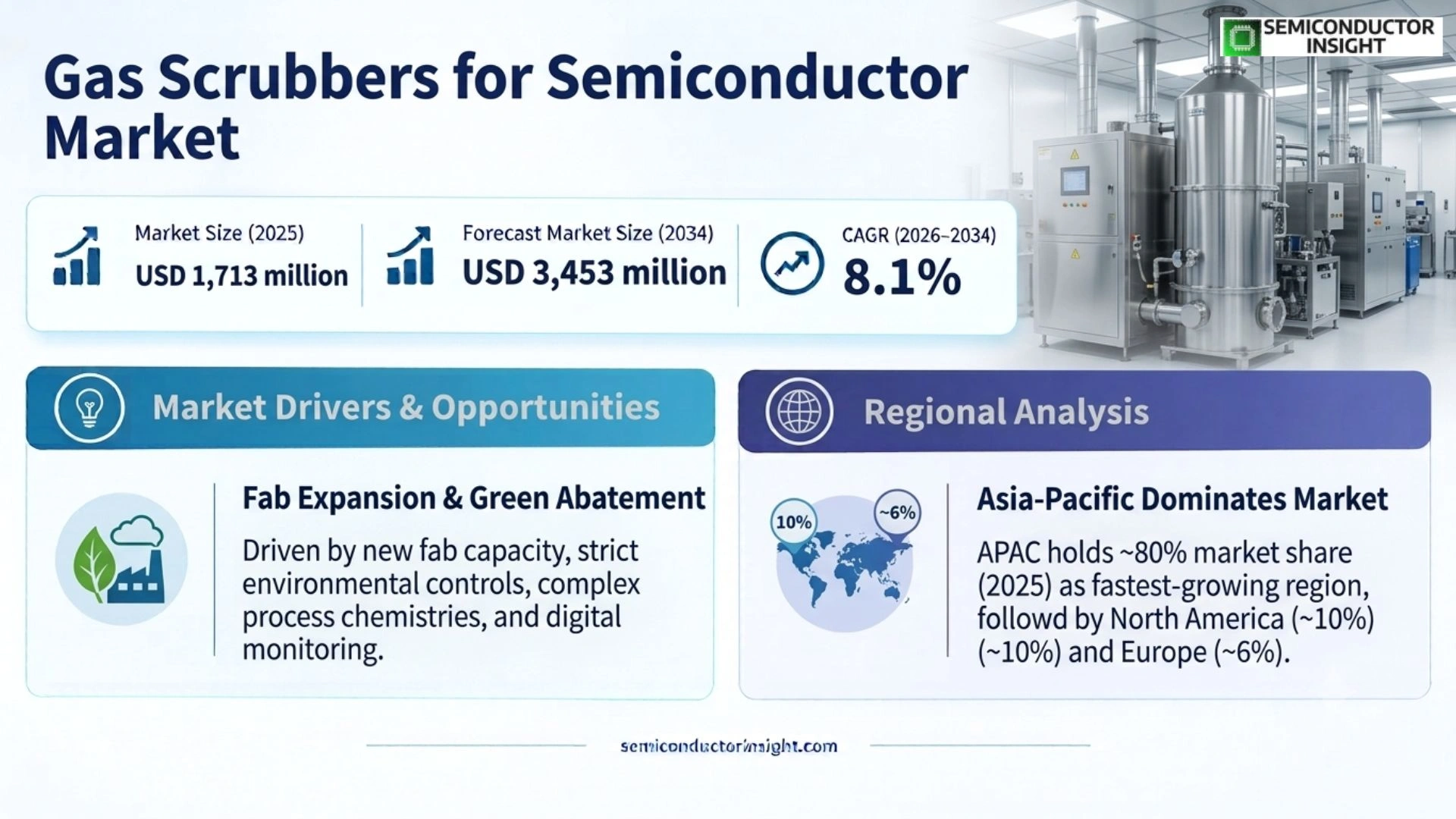
- Gas scrubbers are integral to semiconductor-fab environmental control because fabrication uses toxic, corrosive, reactive and greenhouse-gas-forming process chemistries that require controlled abatement before exhaust discharge.
- Asia Pacific is the dominant regional market and production base, reflecting the concentration of semiconductor fabs and related manufacturing ecosystems in South Korea, Taiwan, Japan and China.
- Burn, plasma, heat-wet and dry scrubbers address different exhaust chemistries, so supplier competitiveness depends on destruction/removal performance, energy and water consumption, footprint, reliability and process integration.
- Fab capacity expansion supports new equipment demand, while an installed base of scrubbers creates recurring replacement, service, consumable and retrofit opportunities.
- Environmental performance is becoming a procurement variable alongside uptime and cost, encouraging systems with lower resource intensity, better monitoring and higher treatment efficiency.
Gas Scrubbers for Semiconductor Market Overview
Gas Scrubbers for Semiconductor Market was valued at USD 1.71 billion in 2025 and is projected to reach USD 3.45 billion by 2034, representing an extended 8.0% CAGR across 2025–2034. The 2025 and 2034 values are transparent extensions of the report page’s primary headline series of USD 1.585 billion in 2024 and USD 2.955 billion in 2032 at an 8.0% CAGR. Asia Pacific remains the largest regional market.
Gas scrubbers, or gas-abatement systems, are installed around semiconductor process equipment to remove, destroy or neutralize hazardous exhaust gases before they enter facility exhaust systems. Semiconductor manufacturing uses chemistries such as silane, ammonia, nitrogen trifluoride, tungsten hexafluoride, chlorine, bromine compounds and fluorinated etchants. The precise gas mixture changes by process step, which makes application-specific abatement essential.
Demand is structurally linked to wafer-fabrication capacity. New fabs and production tools add exhaust-treatment requirements, while process changes can require scrubber upgrades even when the overall fab footprint does not change. The commercial specification therefore includes treatment efficiency, flow handling, thermal performance, chemical compatibility, power and water requirements, maintenance access, footprint and integration with facility monitoring.
The replacement cycle is equally important. Scrubbers operate continuously in harsh environments and require scheduled maintenance, replacement components and periodic modernization. As semiconductor manufacturers improve process control and environmental performance, older systems can become uneconomic because their utility consumption or maintenance burden is higher than newer designs. This creates an installed-base opportunity in addition to greenfield fab demand.
Segment Analysis: By Type
The market is segmented into burn scrubber, plasma scrubber, heat wet scrubber and dry scrubber systems. Selection is determined by gas chemistry, exhaust flow, required destruction or removal efficiency, facility utilities, by-product handling and operating cost.
| Type | Function | Market position |
|---|---|---|
| Burn Scrubber | Uses combustion/thermal oxidation to destroy combustible or reactive process gases, often followed by downstream wet treatment. | Widely relevant where thermal destruction is effective and facility utilities support combustion-based treatment. Integration and by-product control are important. |
| Plasma Scrubber | Uses plasma-driven reactions to decompose difficult process gases. | Important in demanding chemistries where compact high-performance treatment can justify more complex equipment and power electronics. |
| Heat Wet Scrubber | Combines thermal treatment with wet-stage capture, cooling or neutralization. | Well suited to mixed exhaust streams that require both destruction and physical/chemical removal of reaction products. |
| Dry Scrubber | Uses reactive media, adsorption or other dry treatment methods to capture selected contaminants. | Attractive where water use, wastewater generation, footprint or specific gas-stream constraints favor dry treatment. |
Technology selection and operating economics
Scrubber selection is a process-engineering decision rather than a simple equipment category choice. A system optimized for one chemistry may be inappropriate for another because destruction pathways, by-products, corrosion behavior and required downstream treatment differ. Semiconductor customers consequently evaluate total cost of ownership, including gas usage, water, energy, maintenance and consumables, rather than looking only at initial capital expenditure.
Segment Analysis: By Application
Application demand is concentrated in CVD, diffusion, etch and other semiconductor process steps. Each process creates a characteristic set of exhaust gases and by-products, making chemistry-specific abatement an important part of the equipment specification.
| Application | Demand characteristics |
|---|---|
| CVD | Deposition processes can use silane, NF3, WF6, B2H6, TEOS, TDMAT and related chemistries. Abatement must handle reactive and potentially toxic gases while maintaining reliable flow control and destruction efficiency. |
| Diffusion | Diffusion processes can involve silane, TEOS, dichlorosilane, ammonia and other gases. Treatment requirements vary by recipe and by the reaction products created during the process. |
| Etch | Etch steps may use CF4, SF6, BCl3, Cl2, HBr and related chemistries. Fluorinated and halogen-containing exhausts can require specialized treatment and corrosion-resistant system design. |
| Other Semiconductor Processes | Cleaning, specialty deposition and other fabrication activities add further exhaust streams. Equipment suppliers increasingly provide application-specific configurations rather than one generic abatement architecture. |
Regional Analysis
Asia Pacific is the largest Gas Scrubbers for Semiconductor market, with the report page identifying the region at roughly 80% of market share in its historical reference year. South Korea is also identified as the largest producer, followed by Japan and Europe in the source’s production comparison. North American and European markets remain strategically important as local semiconductor capacity expands.
How does regional demand differ across the gas-scrubber market?
The regional market tracks fab location more closely than general industrial spending. East Asian markets combine dense wafer-fabrication capacity with established abatement suppliers and field-service ecosystems. North America is expanding its domestic semiconductor manufacturing base, supporting greenfield equipment demand, while Europe combines mature fabs with new capacity and a strong environmental-compliance orientation. Supplier selection therefore depends on chemistry expertise, uptime, local service and qualification history.
Key Gas Scrubber Manufacturers and Competitive Landscape
The market features specialized semiconductor-abatement manufacturers whose competitive advantage comes from process chemistry expertise, qualification history, global service coverage and equipment reliability. The source page identifies Ebara, Global Standard Technology and Unisem among the main manufacturers and states that the top three held about 51% in its historical reference. Other established suppliers include Edwards Vacuum, Kanken Techno and regional technology specialists.
Competition is evaluated on abatement efficiency, uptime, energy and water consumption, footprint, maintenance burden, integration with process tools, monitoring and ability to tailor the equipment to difficult gas streams. The buying decision is therefore technically intensive and tends to favor suppliers with proven installations and field engineering depth.
Tier structure
| Tier | Companies | Basis of competition |
|---|---|---|
| Tier 1 | Ebara, Global Standard Technology, Unisem | Scale, established fab relationships, broad product coverage and application engineering. |
| Tier 2 | Edwards Vacuum, Kanken Techno and other established specialists | Technology depth, service network, gas-treatment expertise and global customer support. |
| Regional / technology specialists | Specialist abatement suppliers | Process-specific treatment, localized service, customization and cost competitiveness. |
Gas Scrubbers for Semiconductor Production Capacity Analysis
Production capacity is closely tied to semiconductor fab construction and the ability of equipment suppliers to deliver complete systems, not merely scrubber vessels. Manufacturing involves pumps, burners, plasma systems, wet stages, fans, sensors, control electronics and chemical-resistant materials, followed by factory testing, site commissioning and process qualification.
The source report identifies South Korea as the largest producer, at around 47% in its historical comparison, followed by Japan at around 37% and Europe at around 5%. Those figures describe the source report’s historical production basis and should not be read as a current 2025/2034 market-share series. They nevertheless illustrate the supply concentration around major semiconductor manufacturing regions.
Capacity additions follow fab capital expenditure. New production lines require scrubber systems to be planned alongside process tools and facility utilities, while technology-node changes can trigger equipment upgrades. Service organizations are therefore part of effective supply capacity because commissioning, preventive maintenance and spare-parts availability determine whether installed systems can deliver required uptime.
Gas Scrubbers for Semiconductor Market Dynamics: Drivers, Restraints and Opportunities
Fab capacity expansion is the core demand driver, reinforced by environmental controls, more complex process chemistries and the need to modernize aging equipment. Restraints include high capital and utility costs, process-specific engineering complexity and long qualification cycles. Opportunities are strongest in advanced-node fabs, resource-efficient abatement and digital monitoring.
MARKET DRIVERS
| Driver | Relative impact | Geographic relevance | Impact timeline |
|---|---|---|---|
| Semiconductor fab capacity expansion | High | Asia Pacific, North America, Europe | Medium to long term |
| Increasing process-gas complexity | High | Global | Medium term |
| Environmental and emissions requirements | High | Global | Short to medium term |
| Replacement and retrofit of installed equipment | Medium | Asia Pacific, North America, Europe | Long term |
| Energy and water optimization | Medium | Global | Medium term |
Drivers Impact Analysis*
| Factor | (~) % impact on CAGR forecast | Geographic relevance | Impact timeline |
|---|---|---|---|
| Fab capacity expansion | +3.0% | Asia Pacific, North America, Europe | Medium to long term |
| Environmental compliance and emissions control | +1.9% | Global | Short to medium term |
| Process chemistry complexity | +1.6% | Advanced-node fabs globally | Medium term |
| Installed-base replacement | +1.2% | Mature fab regions | Long term |
*Directional analytical estimates only; these figures are not additive to the headline CAGR.
MARKET RESTRAINTS
| Restraint | Relative impact | What it changes |
|---|---|---|
| High equipment and operating cost | High | Fabs must evaluate energy, water, gas and maintenance costs alongside treatment performance. |
| Process-specific qualification | Medium | Changing a scrubber can require chemistry validation and extensive field testing. |
| Complexity of hazardous-gas treatment | Medium | Specialized engineering and safety requirements raise barriers to new suppliers. |
| Fab construction cyclicality | Medium | Large project delays can shift equipment orders even when long-term demand remains intact. |
Restraints Impact Analysis*
| Factor | (~) % impact on CAGR forecast | Geographic relevance | Impact timeline |
|---|---|---|---|
| Capital and utility cost | -1.8% | Global | Short to medium term |
| Qualification and installation complexity | -1.2% | Global | Medium term |
| Fab investment cyclicality | -0.9% | Asia Pacific, North America, Europe | Short term |
*Directional analytical estimates only; not additive to the headline CAGR.
MARKET OPPORTUNITIES
| Opportunity | Relative impact | Why it matters |
|---|---|---|
| Resource-efficient scrubbers | High | Lower energy and water consumption improve the total cost of ownership of fab environmental systems. |
| Digital monitoring and predictive maintenance | High | Continuous measurement can improve uptime, maintenance planning and compliance documentation. |
| Advanced-node process abatement | High | More complex chemistries require specialized high-performance treatment systems. |
| Greenfield fabs outside historical production centers | Medium | Geographic diversification creates new project opportunities for qualified suppliers. |
Gas Scrubbers for Semiconductor Supply Chain Analysis
The value chain spans chemical- and equipment-component suppliers, scrubber engineering and manufacturing, facility integration, process-tool suppliers and semiconductor fabs. The downstream customer is technically demanding because exhaust treatment is connected to process safety, environmental compliance and fab uptime.
| Stage | Key inputs / activities | Commercial role |
|---|---|---|
| Upstream | Burners, plasma generators, pumps, fans, valves, sensors, chemical-resistant materials, controls | Determines component availability, equipment reliability and material compatibility. |
| Manufacturing | System fabrication, assembly, control integration, factory testing, process validation | Creates the complete abatement system and supports chemistry-specific qualification. |
| Channel | Direct fab sales, facility contractors, equipment integrators, regional service organizations | Manages project integration, commissioning and long-term service. |
| Downstream | IDMs, foundries, memory manufacturers and specialty fabs | Specify, qualify and operate scrubbers as part of environmental and facility infrastructure. |
Upstream: Component quality and chemical compatibility determine reliability. Pumps, burners, plasma systems and control electronics are particularly important for uptime.
Manufacturing: Application engineering and integration are as important as physical assembly because each gas stream can require a different treatment path.
Channel: Large fab projects often involve facility engineering contractors, process-equipment teams and specialist service organizations rather than a conventional distributor-only route.
Downstream: Fabs evaluate suppliers on lifecycle performance, support and compliance in addition to capital cost.
Recent Developments in the Gas Scrubbers for Semiconductor Market
Recent developments are centered on semiconductor capacity expansion, higher-performance abatement, resource efficiency and digital equipment monitoring. The following developments are framed as market-structure signals rather than as a news compilation.
| Period | Organization / market development | Why it matters | Market significance |
|---|---|---|---|
| 2025–2026 | Semiconductor manufacturers and governments continue advancing new fab and capacity projects across the United States, Japan, South Korea, Taiwan, Europe and other markets. | Every qualifying fab adds exhaust-treatment infrastructure requirements and usually requires installation during facility construction. | Direct positive impact on new-equipment demand. |
| 2025–2026 | Fab operators continue improving treatment efficiency and utility consumption as environmental performance becomes a larger operational priority. | Energy, water and waste-treatment costs influence the total cost of ownership of abatement systems. | Supports higher-efficiency replacement and upgrade demand. |
| 2025–2026 | Advanced semiconductor processes increase reliance on complex fluorinated and reactive process chemistries. | More demanding exhaust streams strengthen the value of chemistry-specific treatment and monitoring. | Supports premium technology and application-engineering demand. |
| 2025–2026 | Digital monitoring and predictive-maintenance capabilities become more important in fab environmental equipment. | Continuous performance visibility can reduce unplanned maintenance and improve compliance documentation. | Creates an upgrade path for installed systems. |
The common thread is that scrubbers are increasingly treated as strategic fab infrastructure rather than peripheral environmental equipment. As semiconductor manufacturers optimize uptime, environmental performance and cost simultaneously, equipment with better monitoring, lower resource consumption and stable service support gains commercial relevance.
REPORT SCOPE & SEGMENTATION
| Attribute | Details |
|---|---|
| Study Period | 2018–2034 |
| Base Year | 2025 |
| Estimated Year | 2025 |
| Forecast Period | 2025–2034 |
| Historical Period | 2018–2024 |
| Market Size 2025 | USD 1.71 billion (transparent extension from source headline series) |
| Market Size 2034 | USD 3.45 billion (transparent extension from source headline series) |
| Growth Rate | 8.0% CAGR across the extended 2025–2034 period |
| Unit | USD Million / USD Billion |
| Segmentation | By Type · By Application · By Region; technology and end-user context included where supported |
| By Type | Burn Scrubber · Plasma Scrubber · Heat Wet Scrubber · Dry Scrubber |
| By Application | CVD · Diffusion · Etch · Others |
| By Technology | Chemical Absorption · Physical Adsorption · Catalytic Conversion · Thermal Oxidation |
| By End User | IDMs · Foundries · OEMs / other semiconductor manufacturing users |
| By Region | North America · Europe · Asia Pacific · South America · Middle East & Africa |
| Key Companies Profiled | Ebara · Global Standard Technology · Unisem · Edwards Vacuum · Kanken Techno · Other specialist suppliers |
| Customization Scope | Country, fab type, application, chemistry, technology and end-user segmentation can be expanded. |
Frequently Asked Questions
What is the current size of the Gas Scrubbers for Semiconductor market?
What is the CAGR of the Gas Scrubbers for Semiconductor market?
What will the Gas Scrubbers for Semiconductor market size be in 2034?
Which companies lead the Gas Scrubbers for Semiconductor market?
What is a semiconductor gas scrubber?
What are the main types of semiconductor gas scrubbers?
What are the key applications for gas scrubbers?
Which region leads the Gas Scrubbers for Semiconductor market?
What are the key growth drivers for the market?
What are the main challenges facing the market?
Get Sample Report PDF for Exclusive Insights
Report Sample Includes
- Table of Contents
- List of Tables & Figures
- Charts, Research Methodology, and more...