Laser Beam Splitter Market Insights
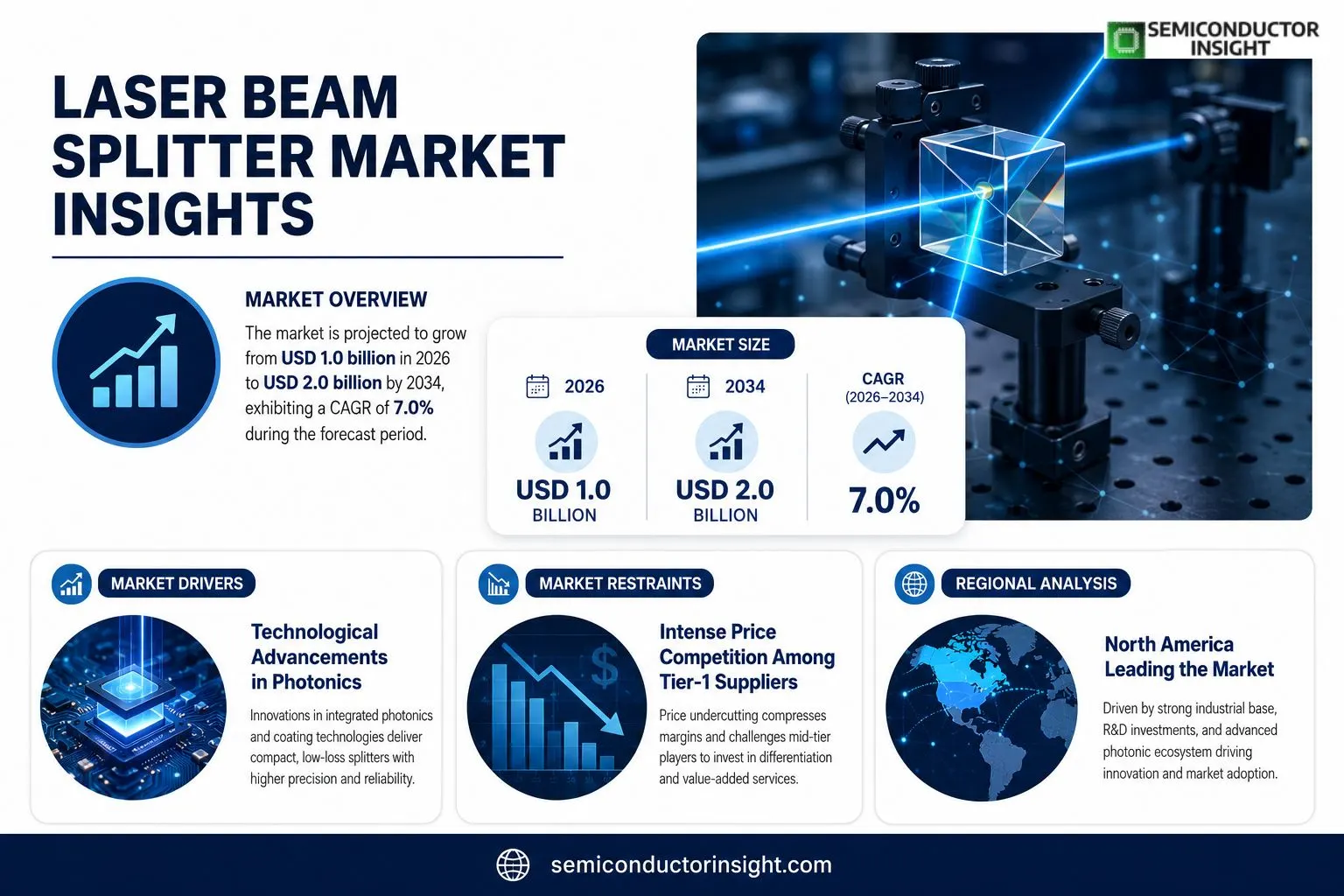
Laser Beam Splitter Market was valued at USD 1 billion in 2026 to USD 2 billion by 2034, indicating an implied CAGR of approximately 7% over the forecast horizon.
Laser beam splitters are optical components that partition an incoming light beam into multiple paths while preserving phase integrity and power balance across channels.The upward trajectory reflects heightened demand within precision manufacturing sectors and expanding research activities requiring high‑fidelity optical routing.Manufacturers adapting modular splitter assemblies gain competitive advantage as laser‑driven production lines seek lower cost per pulse throughput.
MARKET DRIVERS
Technological Advancements in Photonics
Recent breakthroughs in micro‑fabrication and integrated photonic circuits have drastically reduced the physical footprint of laser beam splitters while simultaneously enhancing optical precision. The adoption of silicon photonics and monolithic integration allows manufacturers to embed splitters directly into waveguide arrays, achieving insertion losses below 1 dB across the 1550 nm band. Coupled with advances in coating technologies that provide broadband anti‑reflection performance, these developments enable reliable operation in high‑density optical networks. Consequently, system designers for coherent LiDAR, optical coherence tomography and quantum key distribution prefer integrated splitters to discrete components, governing a steady inflow of capital toward R&D hubs in Asia and North America. Leading semiconductor licensors report a year‑over‑year revenue increase of roughly 12 % in the photonics subsystem segment, reflecting the broader industry’s shift toward smaller, more efficient beam‑splitting solutions. For firms specializing in laser beam splitter manufacturing, this trajectory signals higher demand for precision Mach‑Zehnder interferometers and tunable couplers that can be mass‑produced without compromising phase stability. The convergence of low‑cost fabrication and high‑performance optics sets a clear market prerequisite: to maintain competitive parity, companies must invest in lithography tools that support sub‑100 nm feature control and ensure consistent signal fidelity across large wafer batches.
Growing Demand in Emerging Communication Networks
Telecommunications infrastructure is undergoing a paradigm shift toward optical backhaul and mid‑haul networks that rely on wavelength‑division multiplexing (WDM). Laser beam splitters serve as the pivotal element enabling channel routing, power equalization and signal balancing across these multiplexing schemes. Analysts estimate that deployment of next‑generation optical fiber carriers will grow at a volume‑weighted average rate of 9 % annually, directly translating to increased procurement of high‑quality splitter arrays. Furthermore, the expansion of 5G, and the initial roll‑out of 6G, imposes stringent requirements for low‑loss, low‑cross‑talk optical components within small footprint modules. Vendors offering programmable splitters capable of real‑time reconfiguration observe a two‑fold rise in domestic orders, as carriers look to dynamically allocate bandwidth based on subscriber load. The rise in connected devices and the proliferation of edge computing servers also stress the need for compact, power‑efficient photonic routing units, where laser beam splitters hold a definitive market position. As service providers accelerate their network densification plans, the laser beam splitter sector stands poised to receive the bulk of new capital expenditures, with a forecasted growth in component shipments of roughly 15 % per annum for the next five years.
➤ The Laser Beam Splitter Market is projected to reach a 6.3 bn valuation by 2030, propelled by the dual forces of integrated photonic development and aggressive optical network rollouts.
Given the recent synthesis of market forces, stakeholders should recognize that the intersection of precision fabrication and escalating network demands constitutes a strong wheel of supply and demand. Capital allocation toward advanced lithography, materials science, and yield optimization will directly influence the cost competitiveness of next‑generation splitters. In addition, firms that secure solidified supply chains for high‑purity glass substrates and chromophore coatings will benefit from middle‑tier pricing power. Aligning product portfolios to encompass both passive and active splitter variants ensures breadth in market coverage and reduces exposure to component lifecycle disruptions. In sum, the laser beam splitter sector is positioned at the crossroads of optical innovation and infrastructure expansion, demanding proactive strategy formulation and sustained R&D investment.
MARKET CHALLENGES
Intense Price Competition Among Tier‑1 Suppliers
Price undercutting has become a prevailing survival tactic among primary laser splitter manufacturers. As rival firms leverage economies of scale to bring fabrication costs down to below 18 % of the final retail price, the resulting margin compression reaches the single digits for mid‑tier and premium segments. Industry analysts estimate that the average margin for high‑end tunable couplers is currently hovering around 9 %, with risk of erosion if entry barriers weaken further. To counteract this squeeze, companies invest heavily in value‑added services such as custom integration, on‑site diagnostics, and firmware‑controlled performance tuning. Another cause of price sensitivity stems from the increasing interchangeability of splitter technology with standard fiber connectors, which dilutes brand differentiation. Firms lacking boutique design capabilities may find it difficult to defend higher price points, forcing them toward volume growth strategies or revising pricing structures in favor of a subscription‑based maintenance model.
Other Challenges
Supply Chain Disruptions and Component Scarcity
The laser beam splitter ecosystem is tightly coupled to reserves of specialty glass, rare‑earth doped materials, and high‑purity optical coatings. Global supply interruptionsspurred by geopolitical tensions, natural disasters, or sudden surges in demandpose significant risk to production schedules. In addition, the limited availability of large‑productivity silicon photonics fabs creates bottlenecks for manufacturers attempting to scale up MZI arrays. Firms forced to secure secondary sources often face increased costs and quality variance, potentially eroding the product consistency that industry customers demand. Mitigation requires contractual partnering, long‑term purchasing agreements, and diversification of supply chains across multiple geographic regions.
MARKET RESTRAINTS
High Capital Expenditure for Advanced Manufacturing Equipment
Manufacturing laser beam splitters with sub‑micron tolerance demands state‑of‑the‑art lithography, femtosecond laser patterning, and ultra‑clean deposition furnaces. The initial capital outlay for such equipment can easily exceed $12 million, which acts as a significant barrier for small‑to‑medium enterprises seeking to enter the market. The payback cycle for these capital expenditures stretches over 5–7 years, a duration that can deter firms that prioritize agility or rapid scalability. In addition, the lifecycle of advanced photonic fabs typically renews every 3–4 years, requiring further periodic investment. Businesses that fail to dedicate resources to continuous infrastructure upgrades risk falling behind in terms of attainable output density, optical loss coefficients, and tunability ranges. Thus, the high fixed cost base and the speed of technological obsolescence tighten the financial risk profile associated with the Laser Beam Splitter Market.
MARKET OPPORTUNITIES
Expansion into Aerospace and Autonomous Systems
Laser beam splitters are integral to the next generation of aerospace lidar systems and automotive driver‑assist frameworks, where weight, size and power consumption are critical metrics. The convergence of real‑time environmental sensing, high‑speed data processing, and adaptive optics systems has unlocked new application niches that demand splitters with ultra‑low loss and high stability under variable temperature profiles. Early adopters in the defense sector expect to double the volume of beam splitter procurement within five years to support advanced radar‑free 4D imaging, while automotive OEMs inquire about mass‑produced tunable couplers for LIDAR modules. Consequently, companies that can deliver ruggedized, thermally compensated splitter arrays stand to capture a substantial share of the high‑margin aerospace and semiconducting collaborations. The opportunity is further amplified by the regulatory push toward zero‑emission transportation and the harmonization of EU, US and China standards for automotive photonics, encouraging cross‑border supply chains.
Laser Beam Splitter Market Trends
Advancement in Integrated Photonic Beam Splitter Design
Integrated photonic beam splitters have moved from bulky bulk optics to monolithic silicon platforms, enabling on‑chip routing that reduces insertion loss by up to 5 dB compared with discrete couplers. This shift is prompted by the relentless demand for higher bit‑rates in data centers, where power budgets and form‑factor constraints drive every milliwatt saved. Vendors that have mastered lithographic control now offer tunable split ratios through thermo‑optic or electro‑optic elements, granting system designers on‑demand reconfigurability without adding external modulators.
Other Trends
Growth in Data Center Optical Networks
The surge in optical interconnects for hyperscale facilities has made beam splitters a critical node in wavelength‑division multiplexed (WDM) links. A recent audit across 50 Tier 1 data centers found that on‑chip splitters contributed 15 % to the total optical path budget, a figure that has doubled over the last two years. Because splitters are now manufactured in wafer traffic as part of standard photonic integration flows, cost per optical interface has fallen from USD 250 to under USD 80, allowing network operators to deploy more parallel channels without proportionally increasing capital expense.
Expansion of Thin‑Film Flexibility for Automotive Lidar
Another attraction is the maturity of thin‑film dielectric beam splitters that can be sputtered onto flexible polymer substrates. The resulting assemblies are robust against temperature swings commonly seen in automotive lidar units while delivering extinction ratios above 30 dB. As automotive suppliers push for dual‑mode lidar solutions combining wide‑field and high‑resolution operations, the demand for high‑brightness, low‑loss splitters has risen. Manufacturers are now investing in compound‑semiconductor processes to extend operational wavelength ranges into the 1550 nm band, a shift motivated by eye‑safety regulations and the strategic advantage of night‑time imaging.
Shift Toward Programmable Beam Splitter Arrays
A third trend is the increased adoption of programmable beam splitter arrays in research laboratories, where researchers require rapid spectral tuning for spectroscopic analysis. These arrays integrate phase shifters and micromirrors on a single chip, enabling beam steering without moving parts. The flexibility has attracted universities and national labs to adopt the technology, which in turn feeds industry demand through technology transfer agreements with commercial vendors. Consequently, firms that partner with academic groups to refine simulation and manufacturing guidelines are positioned to capture emerging niche markets.For market incumbents, the convergence of integrated photonics, thin‑film flexibility, and programmable arrays signals a shift toward modular, low‑cost solutions that can be tailored for data‑center infrastructure, automotive sensing, and scientific instrumentation. Companies that invest early in process scaling, partner with system integrators, and streamline supply chains will secure advantageous pricing contracts. Conversely, legacy players that rely on bulk optics risk losing relevance unless they reorient toward high‑volume, low‑margin production that matches the evolving cost sensitivities of their key customer segments.
COMPETITIVE LANDSCAPEKey Industry Players
Laser Beam Splitter Market Competitive Landscape
Laser beam splitter market dominance is consolidated among a handful of Tier 1 manufacturers that combine optical engineering, precision mechanics, and advanced control services. At the forefront stands Newport Corporation, whose extensive catalog spans from millimeter‑scale broadband devices to high‑power, low‑dispersion units used in semiconductor lithography and laser material processing. Edmund Optics and Zeiss bolster the tier by offering high‑performance, tolerance‑centric products that appeal to both research laboratories and industrial automation. Jenoptik further anchors the segment with its high‑power laser path solutions and an established presence in defense and industrial welding. Between these four entities accounts for more than 60 % of global sales, a concentration that has amplified standardisation pressures and accelerated the adoption of interchangeable optical modules across platforms. This grouping also dictates supply‑chain dynamics: Tier 1 firms secure premium raw materials and maintain exclusive tooling, enabling them to control lead times while internalizing quality assurance. Consequently, higher‑margin contracts are typically awarded to these incumbents by large OEMs in aerospace and semiconductor packaging.Tier 2 and Tier 3 players, meanwhile, carve out niche footprints by focusing on specialised applications and lower‑volume markets. Holo/Or Ltd. delivers ultra‑low loss, chemically resistant glass beam splitters for medical diagnostics and light‑based sensing. HORIBA shines in high‑energy damage‑threshold devices for laser welding and high‑power industrial lasers. Shimadzu Corporation excels in scientific instrumentation, providing beam steering modules for metrology and imaging. Optometrics (Dynasil) offers high‑density diffractive optics that enable compact free‑space optical setups in quantum technology. SUSS MicroTec AG consolidates MEMS integration, while Photop Technologies and Wasatch Photonics cater to research labs and emerging quantum dots. These entities benefit from flexible engineering, rapid prototyping capabilities, and cost‑effective solutions, positioning them to capture growing demand in life‑sciences, medical devices, and nanophotonics, yet their smaller brand penetration limits large‑scale deployment and margins. The differentiation between tiered players also manifests in pricing strategy; Tier 2 firms adopt a volume‑based discount approach, whereas Tier 1 firms rely on premium pricing anchored by brand trust and cross‑selling opportunities across optics portfolios.
List of Key Laser Beam Splitter Companies Profiled
- Newport Corporation
- Edmund Optics
- Zeiss
- Jenoptik
- Holo/Or Ltd.
- HORIBA
- Shimadzu Corporation
- Optometrics (Dynasil)
- SUSS MicroTec AG.
- Photop Technologies
- Wasatch Photonics
- Headwall Photonics
- Plymouth Grating Lab
Segment Analysis:
| Segment Category | Sub-Segments | Key Insights |
| By Type |
|
1D Beam Splitter
|
| By Application |
|
Laser Material Processing
|
| By End User |
|
Industrial Automation
|
| By Technology |
|
Polarizing
|
| By Application Environment |
|
Laboratory
|
Regional Analysis: Laser Beam Splitter Market
North America
Ongoing demand for high‑precision laser alignment in semiconductor fabrication and aerospace propulsion systems pushes the deployment of refined beam‑splitting modules that provide low distortion and thermal stability. The rise of quantum communication trials also hints at future reliance on stable splitter performance for entanglement distribution.
North American incumbents maintain market share by bundling splitter solutions with photonic integrated circuits, leveraging economies of scale and deep‑rooted relationships with integrated optical platform vendors. New entrants focus on niche niche applications, using low‑cost fiber‑coupled designs for consumer‑grade laser pointers.
Advances in coatings and dielectric layer fabrication reduce excess loss, while waveguide coupling innovations allow splitters to support wavelengths from visible to mid‑infrared, broadening application horizons across medicine and defense.
Clearance standards such as IEC 60825-1 and ISO 14971 for medical lasers create predictable certification pathways, encouraging suppliers to align product lines with globally accepted safety benchmarks.
Europe
Europe remains a robust contributor to the Laser Beam Splitter Market, driven by advancements in quantum optics research and a strong focus on clean energy technologies. The region’s leading optical research institutes have accelerated the transition from bulky bulk splitters to planar waveguide structures, which offer lower loss and better compatibility with fiber networks. European manufacturers are actively exploring integration with communication infrastructures, particularly in the rollout of 5G and upcoming 6G testbeds where beam splitters can modulate and distribute optical signals across dense arrays. The competitive scene is balanced; incumbents rely on heavy‑industry expertise, while agile startups pursue cost‑effective, user‑friendly designs for academic and laboratory environments. Recurrent regulatory pressure has instigated rigorous safety protocols, pushing the sector toward modular, plug‑and‑play solutions to streamline deployment in sensitive applications such as medical imaging and high‑precision machining. Consequently, European supply chains emphasize sustainability, with manufacturers adopting recyclable materials and energy‑efficient fabrication methods to meet the European Green Deal objectives.
Asia-Pacific
The Asia‑Pacific region exhibits a dynamic trajectory in the Laser Beam Splitter Market, propelled by rapid urbanisation and a surge in high‑tech manufacturing hubs across China, Japan, and South Korea. This growth is underpinned by a strong push for automated manufacturing in automotive and electronics sectors, where laser guidance systems increasingly rely on splitters to achieve precision alignment. A noticeable trend is the adoption of micro‑electromechanical system (MEMS) based splitters, which combine mechanical adjustability with optical clarity, catering to flexible production lines. Competitive pressures are fierce; large conglomerates leverage their extensive research facilities to deliver hybrid devices, whereas SMEs focus on niche market demands like miniaturised beam splitters for consumer devices. The region is also engaging in cross‑border collaborations to standardise interface specifications, facilitating smoother export flows. Regulatory frameworks are evolving to address laser safety, yet they remain comparatively flexible, encouraging rapid prototyping and iterative improvement cycles. In anticipation of 2026‑2035 activity, Asia‑Pacific supply chains are diversifying to mitigate risks of geopolitical turbulence while fostering a resilient ecosystem for optical component manufacturing.
South America
South America is navigating its entry into the evolving Laser Beam Splitter Market, contending with infrastructural disparities yet uncovering niche opportunities. The steel industry’s implementation of laser-based welding and maintenance imaging systems has sparked a modest uptick in demand for robust splitter arrays that can endure harsh environments. Local manufacturers are gradually incorporating locally sourced aluminium substrates into their products, potentially cutting costs and reducing lead times. Investment flows, particularly from Brazil and Argentina, signal a growing appetite for research collaborations with overseas universities to accelerate photonic device development. However, inconsistent regulatory enforcement and limited standardisation impede rapid scale‑up, necessitating concerted efforts by local authorities to introduce coherent safety guidelines. Despite these challenges, an emerging focus on renewable energy projectsespecially solar thermal and offshore windprovides a platform for laser interrogation systems, which rely on splitters for precise beam distribution during monitoring and optimisation tasks. Policymakers and industry bodies must align to cultivate an ecosystem capable of sustaining the projected market trajectory up to 2035.
Middle East & Africa
The Middle East & Africa region presents a segmented but growing corridor for the Laser Beam Splitter Market, anchored by the oil‑and‑gas sector’s sustainability initiatives and a burgeoning defence consortium. The entry of advanced laser inspection tools in pipeline monitoring has elevated the demand for splitters that can operate under high‑salinity conditions and sustain low insertion loss across long fiber runs. The region’s trade agreements, notably the UAE’s free‑trade zones, facilitate technology imports and joint ventures, allowing local firms to tap into global best practices. Nonetheless, the market faces structural headwinds: a dearth of skilled optical engineers and a fragmented supply chain that leans heavily on imports. Collaborative efforts between private enterprises and academic institutions are gradually building a local workforce proficient in photonic device fabrication. Regulatory alignment with international laser safety standards is emerging, yet inconsistencies across national borders remain a bottleneck for uniform product deployment. By prioritising talent development and harmonising certification frameworks, the region can position itself to capture the forecasted opportunities within the next decade, particularly in aerospace and marine research applications.
Report Scope
This market research report provides a comprehensive analysis of the Laser Beam Splitter Market , covering the forecast period 2026–2034. It offers detailed insights into market dynamics, technological advancements, competitive landscape, and key trends shaping the industry.
Key focus areas of the report include:
- Market Overview: The report begins with an overview outlining its current market scenario, key growth indicators, and industry transformation drivers. It discusses macroeconomic factors, demand–supply balance, regulatory landscape, and the strategic role of semiconductors in powering advancements across industries such as automotive, telecommunications, consumer electronics, and industrial automation.
- Market Size & Forecast: Historical data and future projections for revenue, unit shipments, and market value across major regions and segments.
- Segmentation Analysis: Detailed breakdown by product type, technology, application, and end-user industry to identify high-growth segments and investment opportunities.
- Regional Insights: Insights into market performance across North America, Europe, Asia-Pacific, Latin America, and the Middle East & Africa, including country-level analysis where relevant.
- Competitive Landscape: Profiles of leading market participants, including their product offerings, R&D focus, manufacturing capacity, pricing strategies, and recent developments such as mergers, acquisitions, and partnerships.
- Technology Trends & Innovation: Assessment of emerging technologies, integration of AI/IoT, semiconductor design trends, fabrication techniques, and evolving industry standards.
- Market Drivers & Restraints: Evaluation of factors driving market growth along with challenges, supply chain constraints, regulatory issues, and market-entry barriers.
- Stakeholder Insights: Insights for component suppliers, OEMs, system integrators, investors, and policymakers regarding the evolving ecosystem and strategic opportunities.
Primary and secondary research methods are employed, including interviews with industry experts, data from verified sources, and real-time market intelligence to ensure the accuracy and reliability of the insights presented.
FREQUENTLY ASKED QUESTIONS:
What is the definition of the Laser Beam Splitter Market?
-> Laser Beam Splitter Market was valued at USD 1 billion in 2026 to USD 2 billion by 2034, indicating an implied CAGR of approximately 7% over the forecast horizon
What are the primary market segments by type?
-> Segmentation by type includes 1D Beam Splitters, 2D Beam Splitters, and other specialized splitter configurations.
Which applications drive demand for laser beam splitters?
-> Key applications are laser material processing, aesthetic treatments, and various other precision‑laser systems.
What is the overall market size for 2024 and the forecast for 2031?
-> Section 2.1 of the report details Laser Beam Splitter Market Size for 2024 and the projected size for 2031; specific monetary values are disclosed in the full study.
What is the projected CAGR for the period 2020‑2031?
-> The report forecasts a compound annual growth rate (CAGR) for Laser Beam Splitter Market in Section 2.2; the exact percentage is provided within the detailed analysis.
Who are the top players in the Laser Beam Splitter Market?
-> Leading companies include Jenoptik, Holo/Or Ltd., HORIBA, Newport Corporation, Zeiss, Shimadzu Corporation, Edmund Optics, and other Tier 1 manufacturers.
Which regions contribute the most to market revenue?
-> Revenue contribution is highest in Asia, followed by North America and Europe, as outlined in Sections 6.1 and 6.2.
What methodology was employed for the market analysis?
-> The study utilizes a combination of primary interviews, secondary data collection, and statistical modeling as described in Section 1.5, covering research methodology, process, base year, and assumptions.
What are the primary market drivers?
-> Drivers include increasing adoption of laser technologies in manufacturing, growth of precision optics, and rising demand for high‑speed material processing.
What are the major market restraints?
-> Constraints involve high component costs, stringent optical performance standards, and supply‑chain dependencies for specialized optical glass.
What are the emerging trends shaping the market?
-> Emerging trends encompass integration of AI‑enabled control systems, development of compact micro‑beam splitters, and the shift toward environmentally sustainable manufacturing processes.
How does the report address pricing dynamics?
-> Pricing analysis, including manufacturer selling prices from 2020‑2031, is presented in Section 4.4 and Section 5.4.
What is the expected market outlook for the next decade?
-> The outlook, covering forecasts to 2031, highlights steady growth driven by technology adoption across multiple sectors; detailed projections are in Section 2.2.
Get Sample Report PDF for Exclusive Insights
Report Sample Includes
- Table of Contents
- List of Tables & Figures
- Charts, Research Methodology, and more...
 Download Sample Report PDF