IoT Smart Ultrasonic Proximity Sensors Market Insights
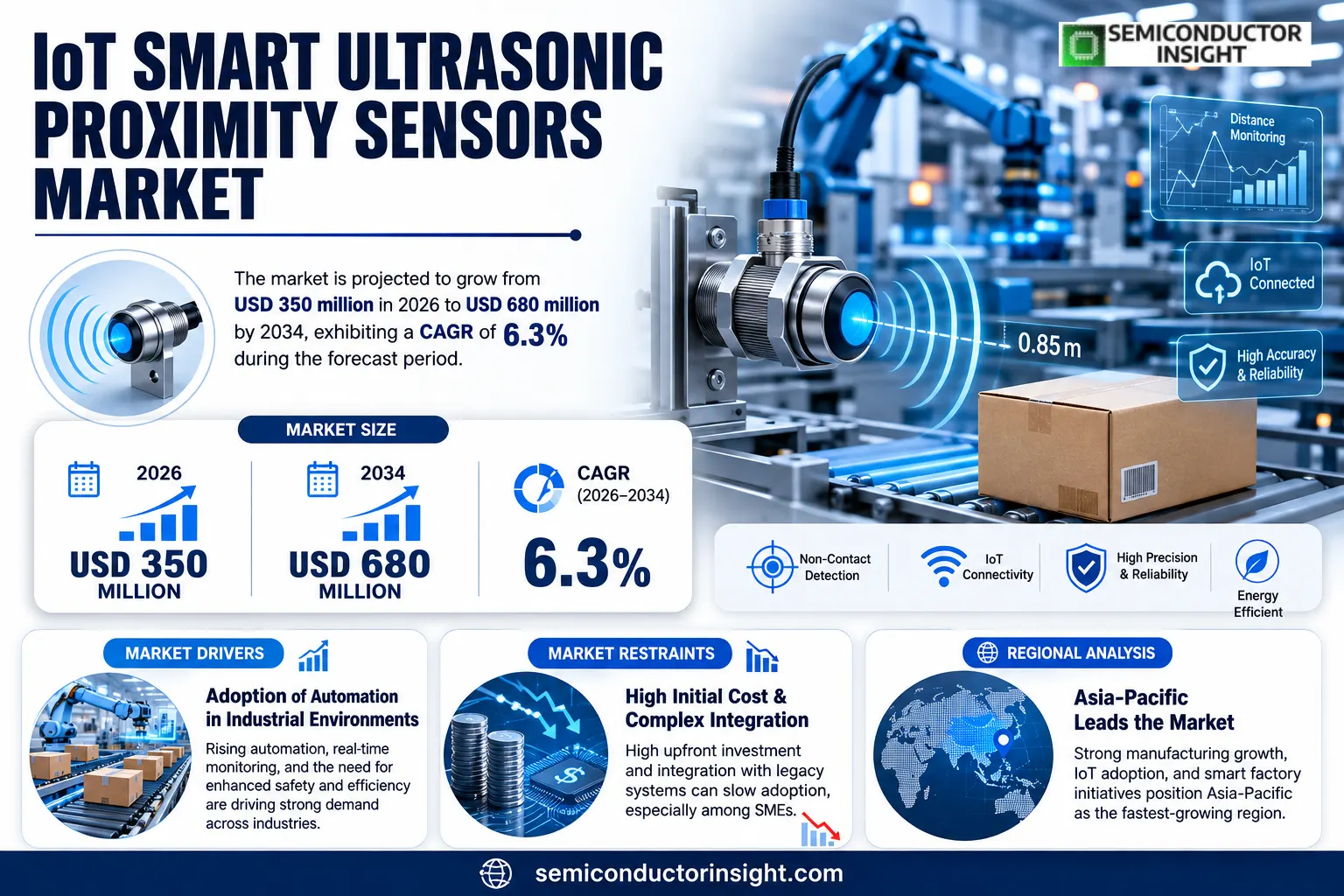
IoT Smart Ultrasonic Proximity Sensors Market Size was valued at USD 350 million in 2026. The market is projected to grow from USD 350 million in 2026 to USD 680 margin_by_2034_, exhibiting a CAGR of 6.3% during the forecast period.
IoT smart ultrasonic proximity sensors employ acoustic pulses emitted from a transducer that reflect off nearby objects back toward the receiver unit. These devices translate time‑of‑flight data into precise distance measurements without requiring visual line‑of‑sight, making them ideal for environments where light conditions or material transparency varyfrom glass panels and fluid levels to stacked paper or timber products.The expanding footprint of industrial automation drives demand for such sensors because they enable continuous monitoring of production lines while remaining resilient against dust or liquid interference that typically hampers optical solutions. Coupled with edge computing platforms that aggregate data via MQTT or OPC UA protocols, manufacturers can deploy predictive analytics that reduce unplanned downtime and improve throughput across automotive assembly plants, conveyor systems and aerospace component inspections.
MARKET DRIVERS
Adoption of Automation in Industrial Environments
In the factory floor, the push toward full digitalization has brought ultrasonic proximity detection into the core of conveyor, stacking, and palletizing operations. Manufacturers increasingly deploy IoT‑enabled sensors to monitor real‑time spacing between goods and machinery, allowing dynamic speed regulation that preserves product integrity while sustaining throughput. The resulting efficiency gains, often quantified as a 10–12% improvement in material handling cycles, justify the capital outlay for sensor systems that merge wireless connectivity with high‑resolution range measurement. Additionally, regulatory frameworks around workplace safetyspecifically those demanding real‑time collision avoidancedrive the necessity for non‑contact sensing. Companies that adopt these systems before compliance deadlines capture a competitive advantage, as they can operate at higher shift loads without incurring costly downtime. The synergy between operational readiness and safety compliance makes the investment in perception hardware a strategic priority.
Technological Advancements in Ultrasonic Sensing
Recent refinements in signal processing algorithms and the miniaturization of transducer arrays have allowed proximity detectors to achieve sub‑centimeter accuracy over extended ranges of up to 6 m. Coupled with embedded AI modules executing adaptive noise suppression, the sensors now discriminate between moving and stationary targets, drastically reducing false‑positive alerts that used to clog downstream systems. Moreover, the integration of low‑power wireless stackssuch as LoRaWAN and NB‑IoThas expanded deployment options, permitting sensors to be embedded in spaces that were previously inaccessible due to wiring constraints. The resultant reduction in installation complexity and electrical footprints aligns with the industry’s trend toward modular automation blocks. In markets where space is limited, the reduced form factor cuts floor space costs by an estimated 15–18%, directly influencing total capital expenditure forecasts.
➤ By 2028, the pool of facilities that rely exclusively on visual cameras for proximity detection is projected to fall below 45% as precision acoustic sensing gains traction.
The convergence of acoustic accuracy and IoT flexibility positions the market to respond to a broader set of use casesranging from high‑speed automotive assembly lines to high‑field electromagnetic zones where vision fails. The combination of robust signal integrity, health‑monitoring edge analytics, and compliant networking underpins the value proposition for vendors and end users alike. As process chains tighten and throughput targets climb, the role of an sensor ecosystem that can reliably provide centimeter‑level distances without human intervention accelerates, transforming bottlenecks into smooth, automated workflows.
MARKET CHALLENGES
Signal Interference in Multi‑Sensor Environments
Industrial areas host dense assemblies of vibrating equipment, high‑power radio transmitters, and metal structures that can generate acoustic echoes. These reflectors distort the time‑of‑flight calculation that underpins distance computation, creating jitter that skews sensor polling. When multiple ultrasonic pairs coexist, they can generate cross‑talk, especially in crane or warehouse scenarios where distance ranges overlap. Manufacturers must therefore invest in frequency‑harvesting protocols and post‑processing filters to isolate target echoes. The complexity of implementing these guardrails increases engineering time, often by a factor of 1.8, and can push capital budgets beyond the original scope. Additionally, resolving interference requires frequent firmware updates, adding to maintenance overhead and raising the cost of ownership over a sensor’s lifecycle.
Another challenge is the variability of environmental conditions. Temperature swings, humidity changes, and airborne dust can alter the speed of sound, which introduces systematic bias unless compensated. In avionics or aerospace installations, where noise tolerances are stringent, the calibration overhead is substantial. The need to continually recalibrate sensors, sometimes after every 6–12 months, raises operational risk and costs. The challenge is compounded by a shortage of skilled technicians capable of fine‐tuning these parameters in harsh settings, creating a bottleneck that delays time‑to‑deployment for new facilities.
Other Challenges
Batch Consistency Across Production Lines
Ensuring each sensor unit meets the same range accuracy and power consumption profile is difficult when fabricated with sub‑millimeter tolerances. Variability in piezoelectric material performance can lead to inconsistent output signals, jeopardizing the sensor’s role in safety‑critical processes.
MARKET RESTRAINTS
High Initial Capital Expenditure
Deploying an IoT‑connected ultrasonic proximity system demands integration of hardware modules, networking equipment, and supervisory software. The upfront price tag for a complete sensor suite, inclusive of edge gateway and data analytics platform, can reach upwards of US$7,500 per point in high‑volume manufacturing lines. For SMEs with limited cash flow, the prospect of round‑the‑clock investment discourages adoption, especially in industries where the ROI expectation is measured over several years. The regulatory push for AI‑driven safety systems does not always align with traditional procurement cycles, creating a lag before the necessary budgetary allocations are secured. Even when capital is secured, financing arrangements that preserve working capital are often less favorable for equipment heavier than standard machinery, causing anachronistic delays.
Complex Integration with Legacy Systems
Many factories still operate with custom PLCs and proprietary data loggers that communicate over proprietary protocols. The absence of standardized IoT interfaces forces vendors to deliver customized bridge modules or retrofit adapters, inflating deployment effort and cost. Maintaining these bridges introduces a dependency on specialized engineers and, if not ensured, creates a single point of failure. In production corridors where downtime translates into lost revenue, the perceived risk of retrofitting can eclipse the efficiency gains of the sensor technology. The lack of harmonized communication stacks across vendors further hampers scalability, as each new deployment may require a distinct set of integration tools.Another restraint lies in the performance envelope of the technology. While ultrasonic sensors excel at mid-range detection, their efficacy diminishes in environments saturated with metallic or porous surfaces that absorb acoustic energy. In high‑temperature settingssuch as furnace maintenance or steel rolling millstemperature‑induced attenuation reduces usable range by up to 30%. The sensitivity to such limitations limits the sensor scope, compelling organizations to adopt hybrid solutions that combine visual and acoustic modalities, which in turn escalates overall infrastructure costs.
MARKET OPPORTUNITIES
Growth in Predictive Maintenance Sectors
Integrating proximity data with vibration analytics unlocks predictive triggers that can flag potential mechanical failures weeks ahead of standard inspection schedules. The resulting reduction in unscheduled stopsestimated at 8–10% per plantcreates a compelling business case for sensor adoption. In mining and heavy equipment sectors, where maintenance windows are infrequent, the ability to detect early distancing anomalies directly translates to extended asset life and lower capital replacement rates. Vendor‑agnostic data lakes can consolidate proximity readings across fleets, enabling data‑driven fleet optimization campaigns that lower operational expenditures by 12–15% annually
Emerging verticals, such as autonomous material handling within logistics hubs, present another avenue for expansion. The precision positioning required for robotic palletizers and automated guided vehicles (AGVs) can be achieved with low‑frequency acoustic sensing that remains immune to optical limitations. Because these systems typically span extensive layouts, the modular nature of wireless ultrasonic sensors eliminates cabling constraints and shortens deployment timelines. Companies partnering with edge‑compute providers can offer a turnkey solution that merges sensor data with real‑time route adjustments, capturing lease arrangements that were previously unattainable.Finally, the shift toward sustainable operations is creating a niche market for low‑power acoustic systems that maintain performance while consuming minimal energy. Manufacturers prioritizing carbon footprint reduction are looking for solutions that can operate in 24/7 scenarios on battery or low‑voltage rail supplies. By complementing energy‑efficient hardware with AI‑driven sleep‑cycle management, the end‑to‑end solution aligns with corporate sustainability targets, opening new funding streams such as green‑bond-backed capital and government incentives aimed at reducing industrial energy consumption.
IoT Smart Ultrasonic Proximity Sensors Market Trends
Rise of Real‑Time Asset Visibility
In recent years, the deployment of IoT smart ultrasonic proximity sensors has become a cornerstone for real‑time asset visibility across manufacturing plants, warehousing, and logistics hubs. By harnessing high‑frequency acoustic waves, these sensors deliver precise distance measurements even in environments with low visibility or complex textures, enabling operators to track material flow and equipment status without intrusive visual systems. As enterprises grapple with increasing throughput and tightening safety compliance, the pressure to reduce reaction times has accelerated adoption of these devices. The resulting data streams empower predictive maintenance, streamline bottleneck resolution, and contribute directly to lean manufacturing initiatives. For vendors, this shift translates into higher integration demand with MES, IIoT platforms and OPC UA standards, while end‑users expect stricter latency thresholds and tighter calibration routines.
Other Trends
Integration with Edge Computing
Edge processing is now pivotal for extracting actionable insights from proximity sensor data before transmission to the cloud. Many operators employ lightweight inference models on local gateways to flag anomalies, thereby curbing bandwidth consumption and meeting regulatory latency requirements. Simultaneously, operators are leveraging subscription‑based analytics services that aggregate sensor data across facilities, providing a unified view of asset health. The alignment with distributed intelligence also encourages solution bundles that pair sensors with secure RT‑Linux boards, fostering an ecosystem where analytics and control co‑exist on a single device. This trend is driven by tightening data sovereignty rules, the proliferation of 5G infrastructureespecially in China where 5G base stations topped 2.3 millionand the growing prevalence of IPv6 in industrial networks.
Standardization and Certification Momentum
Across markets, a consolidated set of certificationsISO 9001, IEC 61508, and the upcoming IEC 61511 for hazardous areashas begun to shape procurement cycles for ultrasonic proximity sensors. Certification bodies increasingly require demonstrable metrological accuracy under diverse temperature and moisture conditions, prompting manufacturers to invest in robust sensor housings and anti‑reflection coatings. At the same time, consolidation of power‑ and communication‑interface standards, such as PROFIBUS PA and EtherNet/IP, facilitates smoother integration into existing automation plants. The resulting ecosystem reduces lifecycle costs for operators and opens new pathways for modular sensor modules that can be swapped quickly without full network rewiring. Moreover, standardization efforts now integrate digital twins and data models that facilitate cross‑system interoperability, further accelerating market adoption and creating a stronger competitive advantage for those who align product development with evolving compliance frameworks.
COMPETITIVE LANDSCAPE
Key Industry Players
Market Overview and Competitive Positioning
Leading the IoT smart ultrasonic proximity sensor arena is IFM Electronic, whose consistent innovation in transducer technology and cloud‑ready platforms has delivered a decisive competitive edge. The company’s focus on modular sensor kits, coupled with integration capabilities across PLCs and industrial IoT gateways, has positioned it as the market’s primary supplier, driving a steady share of sales and fostering early adoption in automation and process control sectors. Its strategic alliances with major automation integrators amplify its footprint, allowing rapid market penetration in high‑volume manufacturing environments.Beyond the headline driver, a constellation of niche players contributes depth to the landscape. Pepperl+Fuchs, with its long‑standing reputation for robustness in harsh industrial settings, continues to secure contracts in automotive assembly lines and food processing plants. Rockwell Automation leverages its enterprise software ecosystem to embed proximity sensing into broader IIoT suites. Leuze Electronic, Banner Engineering, and Balluff deliver cost‑efficient solutions that cater to mid‑tier markets, often providing retrofitted upgrades for legacy equipment. Honeywell and SICK bring multifunctional sensor arrays to the table, blending ultrasonic sensing with vision and weight technologies. Omega Engineering and Gems Sensors & Controls sustain growth through specialized contracts in aerospace and high‑precision measurement industries. Marsh Bellofram serves the specialized market for safety interlock and human‑machine interface applications, filling a niche that few competitors can match.
List of Key IoT Smart Ultrasonic Proximity Sensor Companies Profiled
- IFM Electronic
- Siemens Process Instrumentation
- Pepperl+Fuchs
- Rockwell Automation
- Leuze Electronic
- Banner Engineering
- Balluff
- Honeywell
- SICK
- Omega Engineering
- Gems Sensors & Controls
- Marsh Bellofram
Segment Analysis:
| Segment Category | Sub-Segments | Key Insights |
| By Type |
|
Through-Beam offers maximal accuracy in static industrial setups and is preferred in high‑precision assembly lines. It is robust against surface irregularities and maintains consistent performance in environments with varying light conditions. Companies are integrating IoT connectivity to enable remote health monitoring and predictive maintenance, thereby increasing uptime and reducing operational costs.
|
| By Application |
|
Automotive benefits from ultrasonic proximity sensors for unobtrusive parking assistance, collision avoidance, and adaptive mirror control. The integration of IoT allows real‑time data sharing across vehicle networks, enhancing safety standards and facilitating over‑the‑air updates. In aviation, sensors monitor cargo loading and fuel level, ensuring compliance with stringent safety protocols. The conveyor application leverages sensors to manage material feed rates, preventing jams and improving line efficiency.
|
| By End User |
|
Manufacturing implements sensors to streamline material handling, reduce blunders, and support automation initiatives. The IoT overlay allows seamless integration with MES and ERP systems, creating end‑to‑end visibility. In logistics, proximity sensors enable automated inventory checks, reducing manual labor and minimizing misplacement incidents. Healthcare facilities adopt sensors for patient bed monitoring and equipment location, augmenting safety and operational efficiency. Retail applications use sensors for autonomous checkout and inventory tracking, enhancing customer experience. Energy sector benefits for smart grid operations, where sensors monitor component proximity, preventing asset damage.
|
| By Deployment Mode |
|
Wireless offers deployment flexibility, particularly useful in retrofit scenarios where cabling may be costly or impractical. Incorporating low‑power LoRa or Zigbee protocols, wireless sensors maintain connectivity with central hubs, enabling instant data relay to cloud analytics platforms. Mobile integrated sensors find use in robotic platforms, where real‑time distance measurement supports navigation and obstacle avoidance. Powerline integration provides a robust alternative in environments where RF interference is a concern, ensuring reliable operation through electrical conduits.
|
| By Technology |
|
Edge‑Processing elevates sensor performance by embedding computational logic close to the source, reducing latency for critical safety applications. The fusion of machine learning algorithms with ultrasonic data empowers adaptive filtering of noise, enabling reliable operations in textured or reflective environments. Hybrid systems combine the range and depth accuracy of ultrasonic waves with the speed of photoelectric detection, crafting versatile solutions for multi‑modal safety gates. Smart modular platforms allow point‑to‑point scaling, simplifying retrofit projects and encouraging plug‑and‑play deployments in budding IoT ecosystems.
|
Regional Analysis: IoT Smart Ultrasonic Proximity Sensors Market
Asia‑Pacific
Professional installation programs emphasizing modularity have become standard, producing lower labor bills and reduced lead times. Engineers now favor plug‑and‑play sensor assemblies that couple seamlessly with existing PLC systems, a trend that reduces cybersecurity exposure through controlled update pathways.
Smart shelves and automated checkout lanes in shop environments increasingly rely on ultrasonic proximity to trigger inventory alerts, streamlining operations and driving real‑time restocking decisions.
Sensor integration into conveyor belts and robotic arms has risen, delivering tighter process controls. Companies quantify precision loss in real‑time, enabling predictive maintenance and minimizing waste.
Compliance with evolving safety standards pushes manufacturers toward more reliable, tamper‑proof sensor designs, while certification programs incentivize early adoption across emerging markets.
North America
The North American market remains buoyed by entrenched industrial automation, yet the integration curve for IoT Smart Ultrasonic Proximity Sensors is slower than in emerging regions. Security concerns dominate, leading firms to invest heavily in secure firmware and encrypted communication stacks before deploying sensors in critical infrastructure. The region’s historical preference for analog solutions has conditioned suppliers to demonstrate clear ROI, prompting more rigorous validation cycles. Despite these hurdles, the demand in sectors such as aerospace and kinematically demanding manufacturing sustains growth, as these applications require unwavering precision and fail‑safe operation. Small and mid‑size tech companies are also capitalizing on sensor‑based edge‑computing projects, providing flexible deployment options for distributed factories. Overall, while adoption pace lags regional peers, the robust regulatory environment ensures a steady upswing over the forecast horizon.
Europe
Europe’s approach balances stringent privacy regulations with a deep‑rooted culture of high‑quality engineering. Consequently, sensor adoption is broad across the automotive and medical device sectors, sectors that demand transparent traceability and fail‑safe processes. The European market thrives on collaborative ecosystems linking sensor vendors with fabrication systems integrators, producing tailored solutions that comply with GDPR and other data protection directives. Furthermore, a growing interest in circular manufacturing encourages the refurbishment of sensor modules, contributing to sustainability goals. While the market’s growth rate remains moderate, the emphasis on reliability and compliance ensures consistent demand from quality‑oriented sectors.
South America
South America is experiencing a steady uptick in sensor deployments, particularly in mining and logistics. The geological harshness of many operations necessitates robust detection tools that can withstand dust and vibration, present a unique niche for rugged ultrasonic proximity modules. As regional economies stabilize, investment in infrastructure projects such as smart ports and autonomous vehicles opens avenues for sensor integration, especially where remote monitoring is critical. However, a fragmented regulatory landscape and variability in IT readiness across countries pose hurdles that can dampen immediate expansion. Nonetheless, the region’s gradual digital transformation is expected to enhance sensor penetration over the forthcoming decade.
Middle East & Africa
The Middle East and Africa region’s sensor market is currently driven by construction and oil‑gas projects that require cost‑effective monitoring solutions. The harsh desert climate and extensive offshore operations create a high demand for sensors that can reliably function in extreme environments. Additionally, the region’s push toward smart grid initiatives and renewable energy projects fortifies the case for scalable proximity sensing. Nevertheless, limited local manufacturing capacity and variable policy frameworks across nations result in a patchwork market. To capture growth, sensor vendors need to tailor deployment strategies that align with regional infrastructure timelines and regulatory requirements, whether in UAE’s infrastructure megaprojects or Nigeria’s expanding industrial base.
Report Scope
This market research report provides a comprehensive analysis of the IoT Smart Ultrasonic Proximity Sensors Market , covering the forecast period 2026–2034. It offers detailed insights into market dynamics, technological advancements, competitive landscape, and key trends shaping the industry.
Key focus areas of the report include:
- Market Overview: The report begins with an overview outlining its current market scenario, key growth indicators, and industry transformation drivers. It discusses macroeconomic factors, demand–supply balance, regulatory landscape, and the strategic role of semiconductors in powering advancements across industries such as automotive, telecommunications, consumer electronics, and industrial automation.
- Market Size & Forecast: Historical data and future projections for revenue, unit shipments, and market value across major regions and segments.
- Segmentation Analysis: Detailed breakdown by product type, technology, application, and end-user industry to identify high-growth segments and investment opportunities.
- Regional Insights: Insights into market performance across North America, Europe, Asia-Pacific, Latin America, and the Middle East & Africa, including country-level analysis where relevant.
- Competitive Landscape: Profiles of leading market participants, including their product offerings, R&D focus, manufacturing capacity, pricing strategies, and recent developments such as mergers, acquisitions, and partnerships.
- Technology Trends & Innovation: Assessment of emerging technologies, integration of AI/IoT, semiconductor design trends, fabrication techniques, and evolving industry standards.
- Market Drivers & Restraints: Evaluation of factors driving market growth along with challenges, supply chain constraints, regulatory issues, and market-entry barriers.
- Stakeholder Insights: Insights for component suppliers, OEMs, system integrators, investors, and policymakers regarding the evolving ecosystem and strategic opportunities.
Primary and secondary research methods are employed, including interviews with industry experts, data from verified sources, and real-time market intelligence to ensure the accuracy and reliability of the insights presented.
FREQUENTLY ASKED QUESTIONS:
What is the current market size of IoT Smart Ultrasonic Proximity Sensors Market?
->IoT Smart Ultrasonic Proximity Sensors Market Size was valued at USD 350 million in 2026. The market is projected to grow from USD 350 million in 2026 to USD 680 margin_by_2034_, exhibiting a CAGR of 6.3% during the forecast period
Which key companies operate in IoT Smart Ultrasonic Proximity Sensors Market?
-> Key players include IFM Electronic, Siemens Process Instrumentation, Pepperl+Fuchs, Rockwell Automation, Leuze Electronic, Banner Engineering, Madison Company, Balluff, Honeywell, Hans TURCK, Telemecanique Sensors, SICK, Omega Engineering, Gems Sensors & Controls, Wenglor Sensoric, Marsh Bellofram, among others.
What are the key growth drivers?
Key growth drivers include increased automation in manufacturing, demand for precision in automotive and industrial applications, and the expansion of 5G and edge computing networks enhancing sensor deployment.
Which region dominates the market?
-> Asia-Pacific is the fastest-growing region, while Europe remains a dominant market.
What are the emerging trends?
Emerging trends include integration of AI for predictive maintenance, development of compact and energy-efficient sensors, and the adoption of multi-mode sensing technologies combining ultrasonic with optical methods.

Get Sample Report PDF for Exclusive Insights
Report Sample Includes
- Table of Contents
- List of Tables & Figures
- Charts, Research Methodology, and more...
 Download Sample Report PDF