Proximity Sensing System Market Insights
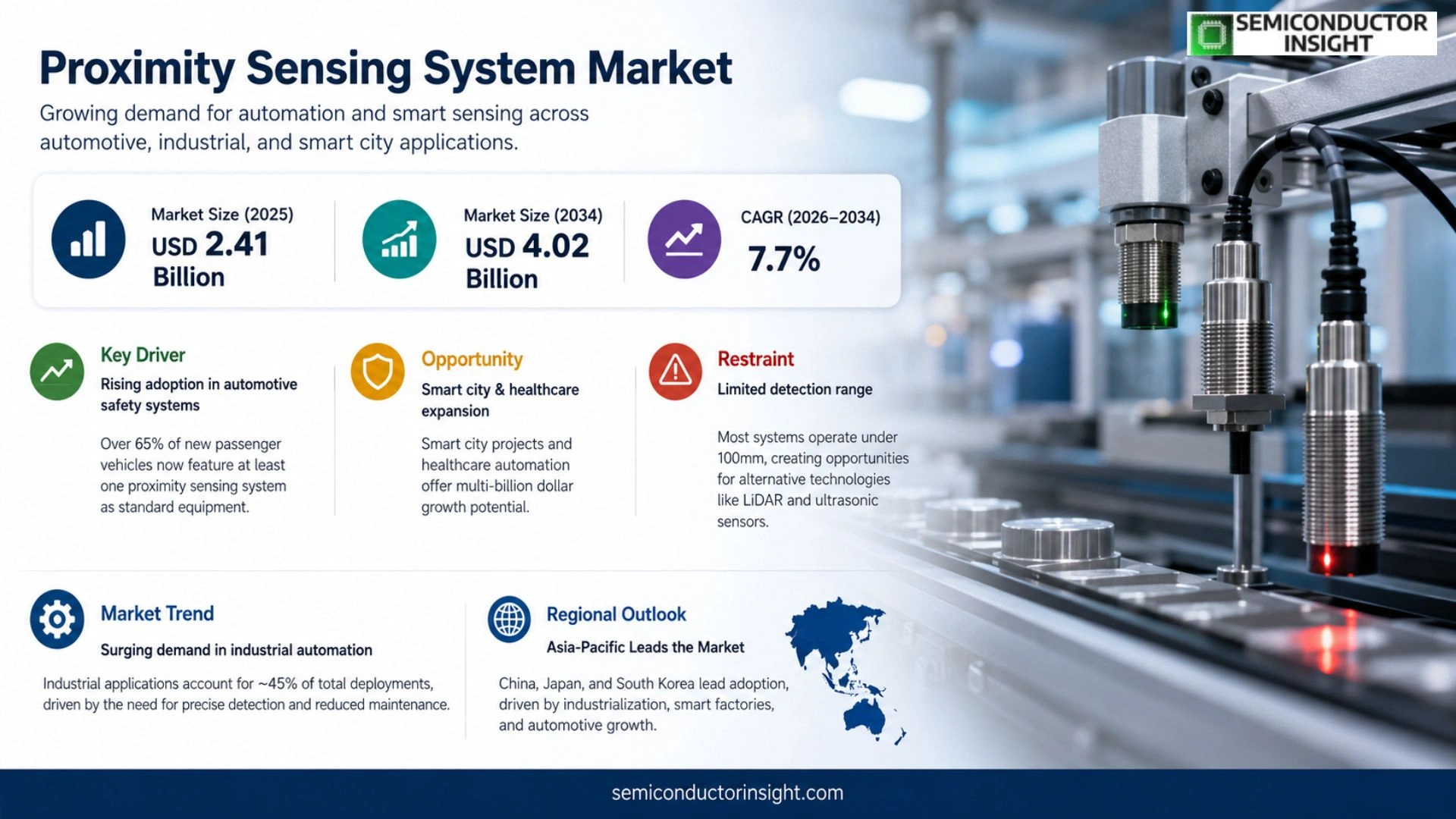
Global proximity sensing system market size was valued at USD 2.41 billion in 2025. The market is projected to grow from USD 2.59 billion in 2026 to USD 4.02 billion by 2034, exhibiting a CAGR of 7.7% during the forecast period.
Proximity sensing systems are devices that detect the presence or position of an object without physical contact, utilizing technologies such as capacitive, inductive, photoelectric, and ultrasonic sensors. These systems are widely adopted in industrial automation, robotics, automotive applications, and smart home solutions due to their reliability and non-contact operation.
The market growth is driven by increasing automation across industries, rising demand for safety and efficiency in manufacturing processes, and advancements in sensor technologies. Key players like Omron, Honeywell, and STMicroelectronics are investing in R&D to enhance sensor capabilities for diverse applications. For instance, recent innovations include ultra-compact sensors for space-constrained environments and high-precision models for critical industrial tasks.
MARKET DRIVERS
Increasing Adoption in Automotive Safety Systems
Proximity Sensing System Market is experiencing significant growth due to rising demand in vehicle safety applications. Modern automobiles integrate proximity sensors for collision avoidance, parking assistance, and blind-spot detection. Over 65% of new passenger vehicles now feature at least one proximity sensing system as standard equipment, driving market expansion.
Industrial Automation Revolution
Manufacturing facilities worldwide are deploying proximity sensing systems for equipment protection and process automation. These systems enable contactless object detection in harsh environments, reducing mechanical wear and improving operational efficiency. The industrial sector accounts for approximately 32% of total proximity sensor sales globally.
➤ Global Proximity Sensing System Market is projected to grow at 8.7% CAGR through 2030, fueled by Industry 4.0 adoption
Stringent workplace safety regulations across developed nations are mandating the use of proximity detection technologies in hazardous industrial environments, further propelling market growth.
MARKET CHALLENGES
High Implementation Costs
While proximity sensing systems offer significant benefits, their installation and maintenance expenses remain a barrier for small and medium enterprises. Advanced capacitive and inductive proximity sensors can cost 40-60% more than traditional mechanical switches, deterring price-sensitive buyers.
Other Challenges
Environmental Interference
Proximity sensors face performance degradation in extreme conditions. Magnetic field interference affects Hall-effect sensors, while capacitive sensors struggle with humidity variations, limiting their application scope.
MARKET RESTRAINTS
Technical Limitations in Detection Range
Most proximity sensing systems have limited operational ranges, typically under 100mm for inductive sensors and 60mm for capacitive variants. This restriction hampers their deployment in applications requiring long-range detection, creating opportunities for alternative technologies like LiDAR and ultrasonic systems.
MARKET OPPORTUNITIES
Smart City Infrastructure Development
Urbanization initiatives worldwide are creating substantial opportunities for proximity sensing technologies. Applications include smart traffic management, pedestrian detection systems, and intelligent lighting controls. Proximity Sensing System Market is poised to capture a $4.2 billion opportunity in smart city projects by 2027.
Healthcare Automation Expansion
Hospitals are increasingly adopting contactless proximity sensing for infection control and equipment management. Touchless interfaces using proximity technology reduce pathogen transmission while maintaining operational efficiency in medical environments.
Proximity Sensing System Market Trends
Increased Demand for Industrial Automation Solutions
Proximity Sensing System market is experiencing significant growth due to rising automation across manufacturing sectors. Industrial applications account for nearly 45% of total proximity sensor deployments, with major manufacturers like Omron and Honeywell developing specialized solutions for harsh industrial environments. These systems enable precise object detection in assembly lines while reducing mechanical wear and maintenance costs.
Other Trends
Advancements in Automotive Safety Systems
Automotive manufacturers increasingly integrate proximity sensing systems for collision avoidance and parking assistance features. The technology shows particular promise in electric vehicles, where sensor fusion with camera systems enhances detection accuracy to below 2cm tolerance levels. Europe leads automotive adoption with a 32% market share in 2024.
Emergence of Smart Factory Ecosystems
Industry 4.0 initiatives are driving demand for networked proximity sensors that communicate through IO-Link and Ethernet protocols. Modern sensing systems now incorporate self-diagnostic capabilities and predictive maintenance features, reducing unplanned downtime by up to 60% in smart factory applications. Asia-Pacific shows the fastest adoption rates with China accounting for 28% of global smart factory sensor installations.
Miniaturization Trend in Sensor Design
The market sees increasing preference for compact 16mm proximity sensors, particularly in robotics and electronics manufacturing. This form factor enables higher component density while maintaining sensing distances up to 8mm for metallic objects. Japanese manufacturers lead in miniaturized sensor development, holding five of the top ten patents in this segment.
Integration with IoT Platforms
Leading Proximity Sensing System providers are developing cloud-connected solutions that feed operational data to predictive analytics platforms. This integration allows real-time monitoring of sensor health and production line performance across multiple facilities. Edge computing capabilities are becoming standard in premium models from vendors like Pepperl+Fuchs and STMicroelectronics.
COMPETITIVE LANDSCAPEKey Industry Players
Global Proximity Sensing System Market Dominated by Electronics and Automation Leaders
Global proximity sensing system market demonstrates a competitive landscape led by established electronics and industrial automation companies. Crane Aerospace & Electronics and Omron currently maintain strong market positions, collectively accounting for a significant share of the 2025 market revenue. These leaders benefit from extensive R&D capabilities and established distribution networks across industrial automation and automotive sectors. The market structure shows tiered competition, with multinational corporations dominating the high-end industrial segment while regional players focus on niche applications.
Specialized sensor manufacturers like Pepperl+Fuchs and STMicroelectronics have carved out substantial niches in specific proximity sensing technologies. Emerging players such as Booyco Electronics and Zhejiang Eagles Comsemi are gaining traction with cost-competitive solutions, particularly in Asian markets. The competitive environment is intensifying with technological advancements in IoT-enabled sensors and increasing demand from robotics applications.
List of Key Proximity Sensing System Companies Profiled
- Crane Aerospace & Electronics
- Omron Corporation
- Honeywell International
- STMicroelectronics
- ams OSRAM
- Booyco Electronics
- Bently Nevada (Baker Hughes)
- Pepperl+Fuchs
- Berkeley Air Technology
- Renesas Electronics
- Zhejiang Eagles Comsemi
- IFM Electronic
- Balluff GmbH
- Turck
- Sick AG
Segment Analysis:
| Segment Category | Sub-Segments | Key Insights |
| By Type |
|
Photoelectric Sensors are emerging as the most versatile segment due to their:
|
| By Application |
|
Industrial Automation represents the dominant application segment driven by:
|
| By End User |
|
Manufacturing Sector shows strongest adoption patterns due to:
|
| By Detection Range |
|
Medium Range Sensors demonstrate broadest applicability because:
|
| By Technology Advancement |
|
Smart/Connected Sensors are becoming the innovation focal point with:
|
Regional Analysis: Proximity Sensing System Market
Asia-Pacific
China’s massive manufacturing sector drives demand for high-precision proximity sensors in robotic assembly lines. The country’s focus on smart manufacturing initiatives creates sustained demand for advanced sensing technologies across automotive and consumer electronics production facilities.
Japanese manufacturers continue setting global benchmarks in industrial automation, with proximity sensors playing critical roles in precision manufacturing. The country’s strong robotics industry utilizes sophisticated proximity sensing systems for collision avoidance and positioning applications.
South Korea’s advanced technology sector incorporates proximity sensors in semiconductor fabrication and consumer electronics manufacturing. The nation’s focus on miniaturization drives innovation in compact proximity sensing solutions with higher sensitivity requirements.
Emerging economies like Vietnam and Thailand show increasing adoption of proximity sensing technologies as manufacturing bases shift. Growing investments in automation infrastructure create favorable conditions for proximity sensor implementation across new industrial facilities.
North America
North America remains a technology leader in proximity sensing systems, with strong adoption across aerospace and defense applications. The region benefits from significant R&D investments in sensor technologies and early adoption of IoT solutions. U.S.-based manufacturers increasingly integrate smart proximity sensors with predictive analytics capabilities, driving premium solutions in specialized industrial applications. Canada’s growing emphasis on mining automation presents unique opportunities for rugged proximity sensing systems in harsh environments.
Europe
Europe demonstrates consistent demand for proximity sensing systems, particularly in Germany’s advanced manufacturing sector and Italy’s packaging machinery industry. Strict industrial safety regulations drive adoption of reliable proximity detection solutions. The region shows growing interest in energy-efficient sensor technologies to align with sustainability initiatives. Automotive manufacturers across Western Europe continue upgrading production lines with advanced proximity sensing capabilities.
Middle East & Africa
The Middle East shows promising adoption of proximity sensing technologies in oil & gas automation and infrastructure projects. Growing industrial diversification efforts in Gulf Cooperation Council countries create new demand for industrial sensors. Sub-Saharan Africa presents emerging opportunities in mining equipment automation, though market penetration remains limited by infrastructure challenges.
South America
South America demonstrates moderate but steady growth in proximity sensor adoption, primarily driven by Brazil’s automotive and food processing industries. Regional manufacturers increasingly recognize the value of proximity sensing for quality control applications. Infrastructure constraints and economic volatility in certain markets continue to moderate growth compared to other regions.
Report Scope
This market research report provides a comprehensive analysis of the Proximity Sensing System Market , covering the forecast period 2026–2034. It offers detailed insights into market dynamics, technological advancements, competitive landscape, and key trends shaping the industry.
Key focus areas of the report include:
- Market Overview: The report begins with an overview outlining its current market scenario, key growth indicators, and industry transformation drivers. It discusses macroeconomic factors, demand–supply balance, regulatory landscape, and the strategic role of proximity sensing systems across industries such as industrial automation, robotics, automobile, and other applications.
- Market Size & Forecast: Historical data and future projections for revenue, unit shipments, and market value across major regions and segments.
- Segmentation Analysis: Detailed breakdown by type (16mm, 25mm, 50mm), application, and end-user industry to identify high-growth segments and investment opportunities.
- Regional Insights: Insights into market performance across North America, Europe, Asia, South America, and Middle East & Africa, including country-level analysis where relevant.
- Competitive Landscape: Profiles of leading market participants, including their product offerings, R&D focus, manufacturing capacity, pricing strategies, and recent developments such as mergers, acquisitions, and partnerships.
- Technology Trends & Innovation: Assessment of emerging proximity sensing technologies including capacitive, inductive, photoelectric and ultrasonic types.
- Market Drivers & Restraints: Evaluation of factors driving market growth along with challenges, supply chain constraints, regulatory issues, and market-entry barriers.
- Stakeholder Insights: Insights for component suppliers, OEMs, system integrators, investors, and policymakers regarding the evolving ecosystem and strategic opportunities.
Primary and secondary research methods are employed, including interviews with industry experts, data from verified sources, and real-time market intelligence to ensure the accuracy and reliability of the insights presented.
FREQUENTLY ASKED QUESTIONS:
What is the current market size of Proximity Sensing System Market?
-> Proximity Sensing System Market was valued at USD 2409 million in 2025 and is expected to reach USD 4019 million by 2034.
What is the projected CAGR for Proximity Sensing System market?
-> The market is projected to grow at a CAGR of 7.7% during 2026-2034.
Which key companies operate Proximity Sensing System Market ?
-> Key players include Crane Aerospace & Electronics, Omron, Honeywell, STMicroelectronics, ams OSRAM, Booyco Electronics, Bently, Pepperl+Fuchs, Berkeley Air, and Renesas Electronics.
What are the major segments by type?
-> The market is segmented by type into 16mm, 25mm, and 50mm proximity sensors.
Which regions are analyzed in the report?
-> The report covers North America, Europe, Asia, South America, and Middle East & Africa, with country-level analysis for key markets including US, China, Germany, Japan, and others.

Get Sample Report PDF for Exclusive Insights
Report Sample Includes
- Table of Contents
- List of Tables & Figures
- Charts, Research Methodology, and more...
 Download Sample Report PDF