Industrial PID Controller Market Insights
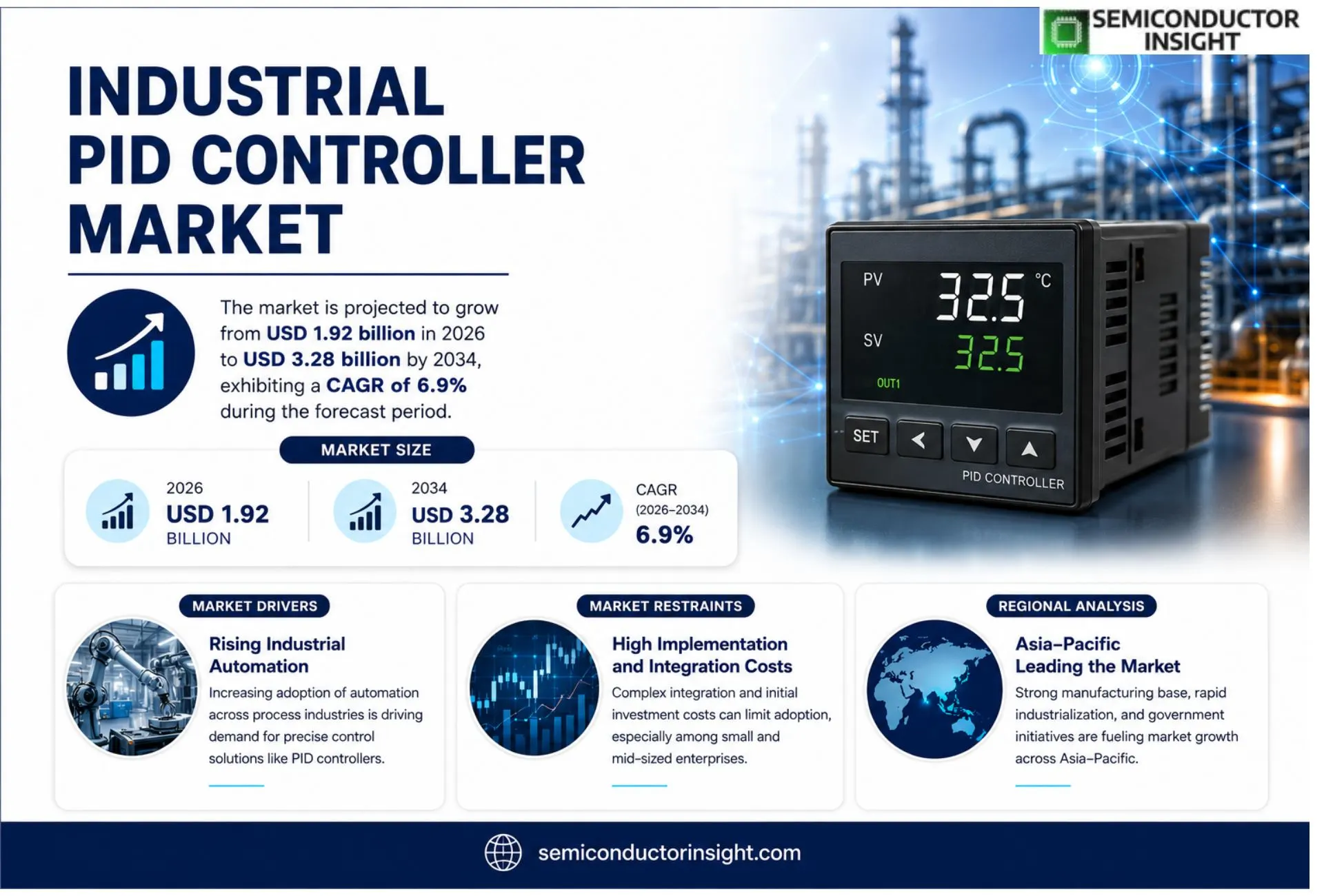
Industrial PID Controller Market was valued at USD 1.24 billion in 2026 and is expected to reach USD 2.12 billion by 2035, reflecting a CAGR of roughly 5% over the forecast period.
Industrial PID controllers are closed‑loop electronic devices that continuously adjust actuator signals to keep process variables,such as temperature, pressure or flow,at desired setpoints with high precision.
The surge in automation across oil & gas, chemical processing and power generation sectors fuels demand for advanced control solutions; coupled with Industry 4.0 initiatives that merge real‑time data analytics with control loops, this trend elevates the need for reliable and scalable PID controllers.
MARKET DRIVERS
Enhanced Process Automation and Precision Control
Across the manufacturing and chemical sectors, the drive toward higher throughput coupled with stringent quality requirements has placed precision control at the core of competitive strategy. Modern enterprise initiatives prioritize closed‑loop systems that deliver consistent temperature, pressure, and flow operations under variable feedstock conditions. Integration of Industry 4.0 standards, particularly OPC‑UA and IIoT connectivity, has lowered the entry thresholds for deploying advanced PID logic within legacy equipment. Engineers now leverage digital twins and model‑based design to iterate controller parameters rapidly, reducing trial‑and‑error cycles that previously extended process stabilisation times from weeks to days. The cumulative result is a measurable reduction in product variability, enabling brands to command premium pricing and aligning production schedules with just‑in‑time frameworks. In addition, the widespread adoption of predictive maintenance platforms has created data pipelines that feed into PID set‑point optimisation, allowing real‑time adaptation to sensor drift and mechanical wear. The combination of automation, data analytics, and tighter tolerances positions enterprises to exceed variability thresholds that were once considered acceptable, thereby accelerating return on investment and justifying capital expenditure for newer controller modules.
Convergent Design Trends in Electrification and Renewable Energy
Transitioning toward low‑carbon supply chains and distributed generation projects has increased the demand for controllers capable of managing intermittent power sources while maintaining process fidelity. Heat‑exchanger networks in renewable plants, for example, must balance steam pressure against fluctuating turbine output, a scenario that exposes the limitations of simple on‑off logic. PID capabilities are now embedded within inverter controllers and energy‑management systems, creating a high‑cardinality market segment where controller performance directly impacts grid stability and profitability. Utilities increasingly deploy micro‑grid architectures that require robust comparator functions and adaptive gain scheduling to reconcile demands from rooftop solar, battery storage, and diesel backup. The result is a new wave of design expectations: controllers must offer high‑accuracy temperature regulation, fast‑start response, and fault‑tolerant communication stacks that handle power‑line noise,attributes that the classic PID market has been historically absent from. As a consequence, manufacturers have expanded their form‑factor offerings, incorporating Si‑C technology for improved thermal efficiency and reducing board‑level component counts to meet stringent size, weight, and power requirements.
➤ The confluence of high‑precision requirements and a renewable‑energy‑driven demand curve effectively creates a dual‑market that simultaneously offers incremental revenue bundles and fosters a shift toward digital‑centric product development.
Beyond energy and core manufacturing, safety‑critical and biomedical applications are quietly demanding a new level of reliability from PID modules. In the pharmaceutical industry, for instance, viral bioreactors operate within narrow temperature windows; any lapse can lead to costly batch failures and regulatory breaches. Incorporating redundant run‑time diagnostics and self‑tuning algorithms, PID devices have become essential to ensuring compliance with GMP standards. Similarly, the electronics packaging sector employs PID‐controlled ovens to cure encapsulants, where temperature overshoot may jeopardise component integrity. These niche verticals collectively represent a market segment that accounts for roughly 15 % of total controller sales yet carries a higher margin profile,an insight that reshapes vendor pricing strategies and accelerates the commoditisation of higher‑end products. Consequently, companies that adopt robust, modular controller architectures find themselves better positioned to cross‑sell into adjacent verticals, consolidating revenue streams and mitigating cyclical exposure.
MARKET CHALLENGES
Integration Complexity Across Heterogeneous SCADA Ecosystems
The heterogeneous landscape of legacy SCADA systems poses a perpetual hurdle to seamless controller deployment. While many industrial operators adhere to VFDs, PLCs, and DCS platforms that natively support traditional PID functions, newer digital twins or distributed control clusters demand interoperable communication protocols, custom firmware, and real‑time data streaming. Enterprises frequently face costly re‑engineering cycles or vendor lock‑in when attempting to stitch disparate control APIs together. Moreover, the sheer volume of data produced by high‑resolution sensors requires robust edge‑compute capacity that conventional PID architectures were originally engineered to bypass, leading to bottlenecks that erode process gains. In response to this challenge, manufacturers have begun to embed FPGAs or micro‑controller units (MCUs) that natively tease apart data streams, which however shifts the cost base toward more complex hardware and longer supply chains. The mismatched communication expectations of suppliers and integrators therefore sustain a friction point that dilutes the expected efficiency gains from controller upgrades.
Other Challenges
Regulatory Compliance & Data Security
Compliance frameworks such as IEC 62443 and ISO 27001 impose stringent cyber‑security safeguards on process control systems. Manufacturers must certify that their PID firmware resists tampering, that memory writes are sandboxed, and that cryptographic keys are stored in secure enclaves. The verification cycles required to meet these standards can stretch nine months, delaying product launch windows and inflating cost of goods sold. Data privacy mandates in the EU (GDPR) and California (CCPA) also influence the design of cloud‑based controller management portals, demanding granular audit trails and user‑role segmentation that were not originally envisioned in analog‑era PID prototypes.
Workforce Skill Gap & Service Ecosystem Maturity
The shift toward predictive, self‑tuning PI systems has heightened the dependency on interdisciplinary expertise,signal processing, digital signal control, and cyber security. However, the current labor market reveals a dearth of engineers proficient in these overlapping domains, particularly in mid‑size firms that cannot afford specialist hires. Service ecosystems around manufacturing and maintenance are equally nascent; ABB and Siemens host professional support corridors, but many small‑to‑medium enterprises lack a local partner to troubleshoot firmware updates or conduct fail‑over drills. This disparity limits the overall penetration of high‑performance PID systems, as contractors often defer controller upgrades until a third‑party knowledge base becomes available or until the manufacturing process reaches a critical quality threshold.
MARKET RESTRAINTS
Supply‑Chain Vulnerabilities and Fiscal Sensitivity
The industrial PID controller ecosystem remains tightly coupled to a handful of semiconductor fabs and specialty component suppliers. Recent geopolitical tensions, coupled with natural disasters, have exposed a fragile logistics network for critical items such as precision resistors, high‑temperature capacitors, and RF shielding materials. These disruptions have precipitated lead‑time elongation and upward price pressure,particularly acute during the global semiconductor shortage where even margin‑sensitive manufacturers faced unit costs that exceeded original price targets by 12 % to 25 %. Fiscal volatility also remains an exclusionary constraint, as companies are reluctant to funnel capital into non‑core process upgrades during periods of macro‑economic uncertainty or commodity price hikes. The outcome is a short‑term contraction in high‑margin enthusiast projects, with a partial shift toward plug‑and‑play controllers that require minimal integration work. The resulting market contraction intensifies competition within entry‑level segments, creating price‑sensitivity across the value chain.
MARKET OPPORTUNITIES
Emerging Digital Twins and AI‑Driven Optimisation Platforms
The nationwide rollout of digital twin architectures, supplemented by AI‑based optimisation engines, offers a fertile frontier for PID controller vendors willing to bridge analog control with adaptive logic. By embedding machine‑learning inference cores or shallow neural net interfaces directly on the controller, manufacturers can provide real‑time self‑tuning capabilities that adapt to process drift, sensor ageing, and raw‑material variability. This fusion of deterministic control and probabilistic learning reduces the cycle time for process re‑qualification and opens the door to subscription‑model revenue streams,vendors can monetize performance–as–a–service with data‑driven insights delivered through cloud dashboards. Meanwhile, the push toward plant‑level resilience underscores the demand for redundant PID architectures that self‑diagnose and fail‑over without external orchestrators; e‑distributed controller farms can now autonomously re‑route loops across racks, enhancing uptime during partial system outages. The confluence of these trends has already catalysed a new market segment where controllers deliver both digital twin compatibility and predictive risk mitigation, fostering higher entry barriers and creating defensible intellectual property for early adopters.
Industrial PID Controller Market Trends
Rise of Adaptive Control Algorithms
Industrial PID controllers continue to evolve beyond conventional tuning, as manufacturers integrate machine‑learning filters to anticipate disturbances before they propagate through mechanical linkages. This shift toward adaptive control not only improves energy efficiency by reducing over‑compensation, it also tightens safety margins for critical infrastructure such as refineries and chemical plants. Engineers now routinely parameterise controllers using real‑time sensor feeds, enabling a single device to shift its characteristic curves in response to temperature swings or feed‑rate variations. The net result is a predictable, lower‑maintenance operating envelope that translates into measurable cost savings and compliance with tightening regulatory standards. Consequently, commercial buyers prioritize vendors who can demonstrate proven adaptive algorithms in field trials, propelling a market where software capabilities outrank legacy hardware upgrades. Across the Industrial PID Controller Market, demand for these adaptive solutions is markedly higher.
Other Trends
Digital Twin Integration
Digital twin technology, once confined to large‑scale power plants, has migrated into the PID controller ecosystem, offering virtual replicas that mirror real‑time operating conditions. By feeding sensor streams into cloud‑based models, operators can identify drift early and precondition controllers before hardware intervention becomes necessary. This predictive maintenance approach reduces unplanned outages by up to 30 % in pilot studies conducted by leading OEMs. The advantage is twofold: it extends component life and confirms control logic integrity against evolving process dynamics. As a result, the market is seeing a surge in joint ventures between PID suppliers and software firms, signaling a shift toward integrated solutions that bundle firmware updates with simulation dashboards.
Shift Toward Low‑Power Consumption Designs
The pursuit of low‑power consumption in industrial controllers is no longer a marginal consideration; it has become a decisive factor for plants running on distributed control networks. Advanced silicon packages featuring GaN transistors allow current densities to be maintained while cutting voltage drops by nearly 15 % in high‑order signal routing. When coupled with power‑saving firmware that orders lock‑step updates, the cumulative energy footprint of a PID system drops by an estimated 20 % over its lifetime. Operators are consequently re‑evaluating procurement criteria to prioritize energy‑efficient units that can survive intermittent power supply without compromising loop accuracy. The trend signals a clearer convergence between process control reliability and sustainability mandates, positioning market share in favour of manufacturers who can deliver both in a single footprint. Furthermore, emerging renewable energy installations are stipulating power budgets that align with these low‑power controllers, thereby accelerating adoption across maritime, offshore wind, and electronic manufacturing settings.
COMPETITIVE LANDSCAPE
Key Industry Players
Industrial PID Controller Market Competitive Landscape
The industrial PID controller market remains tightly concentrated around a handful of global OEMs that command the majority of revenue streams. ABB, holding a 27 % share of worldwide sales, continues to leverage its extensive process automation portfolio to embed PID control units into high‑voltage and petrochemical sectors, where stringent reliability standards prevail. Honeywell and Siemens together command roughly 15 % of the market, each benefiting from a hybrid strategy that blends proprietary integration with open‑architecture control solutions. These tier‑one vendors’ robust R&D pipelines focus on predictive maintenance and IEC 61131‑4 compliance, positioning them as preferred partners for asset‑heavy enterprises that require seamless multizone orchestration. Their extensive distribution networks and global service contracts provide a cost‑efficient operating model, sustaining high profit margins while resisting margin erosion from upstream price pressure.
In contrast, a growing cluster of Tier‑two and niche manufacturers are exploiting embedded systems advances to deliver cost‑effective, modular PID controllers tailored to specific industrial sub‑segments. EtherNet/IP‑enabled units from Red Lion Controls and WIKA are gaining traction in automotive assembly and pharmaceutical batch processes, respectively, owing to their low‑integration footprint and rapid commissioning times. European players such as Eurotherm and Gefran offer highly configurable, low‑power devices that suit water‑based cooling loops and IoT‑connected HVAC systems. Market entrants from Asia, including TDK and Omron, further intensify competition by supplying a wide price range and incorporating advanced motion‑control capabilities, thereby appealing to mid‑market segments that seek a balance between performance and cost. The cumulative effect of these smaller players is a fragmented downstream demand that creates opportunities for selective alliances and vertical‑integration strategies.
List of Key Industrial PID Controller Companies Profiled
- ABB
- Honeywell
- Siemens
- Omron
- Schneider Electric
- Rockwell Automation
- Emerson
- Yokogawa
- WIKA
- Eurotherm
- Gefran
- Red Lion Controls
- TOPTICA Photonics
- Calex Electronics
- Durex Industries
Segment Analysis:
| Segment Category | Sub-Segments | Key Insights |
| By Type |
|
Digital PID Controllers – Advanced firmware for adaptive tuning, widely favored where process dynamics vary frequently; integration with SCADA and HMI simplifies commissioning, reducing downtime; modular architecture supports future upgrades, aligning with extended product life cycles. |
| By Application |
|
Manufacturing Automation – High responsiveness needed for robotic and conveyor systems; precise PID control ensures product quality; integration with MES reduces manual interventions and enhances traceability. |
| By End User |
|
Industrial Machinery Manufacturers – Build reliable, high‑performance equipment; drive demand for robust PID solutions; integration with safety systems enhances certification compliance. |
| By Integration Level |
|
Modular Systems – Combine discrete PID with process intelligence, enabling easy adaptation to new lines; cost‑effective scaling; support rapid feature additions. |
| By Communication Protocol |
|
Ethernet/IP – High‑speed, deterministic networking favoured for data‑centric environments; enhances real‑time performance; broad vendor support simplifies integration. |
Regional Analysis: Industrial PID Controller Market
Asia‑Pacific
The industrial automation backbone is increasingly embedded with high‑performance PID controllers, diversifying across process industries and providing critical real‑time control over temperature, pressure and flow variables.
Integration of SCADA and OPC-UA platforms expands controller roles beyond local loops, ushering in predictive maintenance and remote monitoring capabilities.
Stringent global safety and environmental mandates compel manufacturers to adopt controllers capable of stringent precision and fault‑tolerant operation.
Edge‑computing modules and AI‑enabled control loops are emerging as the next generation of industrial PID solutions, fostering continuous process improvement.
North America
North America supplies a steady stream of PID controller deployments, anchored by mature aerospace, pharmaceutical and food‑processing sectors. The region’s mature infrastructure allows firms to invest in high‑precision hardware, but growth has plateaued relative to developing regions. There is a sustained push toward retrofitting legacy systems with modern, network‑enabled controllers to comply with increasingly strict safety regulations. Volatility in oil and gas prices can dampen investment cycles, yet the adoption of process simulation and data analytics remains a resilient growth factor. As supply chains become more digitised, firms are using cloud‑based monitoring to tune PID parameters, reducing downtime. Consequently, while North America remains a top market share holder, its growth trajectory is moderated by high cost structures.
Europe
Europe’s industrial PID controller demand is heavily influenced by its robust mechanical and chemical manufacturing clusters. Strong emphasis on energy efficiency and carbon‑neutral production promotes deployment of dynamic PID solutions that optimise heat‑transfer and chemical reaction controls. The region’s regulatory framework, particularly the EU’s Green Deal, incentivises manufacturers to install precision controllers that can reduce consumables and improve yield. In addition, European OEMs are leading the standardisation of communication protocols, ensuring interoperability and resilience. Despite economic headwinds, the focus on sustainable automation keeps the sector on a solid growth pathway.
South America
South America experiences moderate growth in the industrial PID controller market, underpinning expansion in extractive industries and agribusiness chains. Investment is improving albeit at a slower pace compared to Asia‑Pacific, with local manufacturers piloting PID‑based control for advanced irrigation and bioprocessing applications. Government incentives for industrial up‑skilling and emerging “smart‑factory” pilots are gradually modernising legacy plant infrastructure. Import reliance and currency fluctuations pose challenges, yet heightened demand for process optimisation in mining and petrochemical plants is slowly balancing the market.
Middle East & Africa
The Middle East & Africa region is a niche but growing market for industrial PID controllers, deriving primarily from oil and gas refinement plants and petrochemical operations. Transition to digital twins and real‑time monitoring is driving higher precision control requirements. Emerging manufacturing clusters in the Gulf states are attracting foreign direct investment, which often accompanies an uptake in high‑end control systems. On the African side, infrastructure development projects are beginning to integrate PID solutions for pipeline monitoring and irrigation automation. Growth remains concentrated but shows a promising trajectory as regional economies diversify beyond hydrocarbon reliance.
Report Scope
This market research report provides a comprehensive analysis of the Industrial PID Controller Market , covering the forecast period 2026–2034. It offers detailed insights into market dynamics, technological advancements, competitive landscape, and key trends shaping the industry.
Key focus areas of the report include:
-
Market Overview: The report begins with an overview outlining its current market scenario, key growth indicators, and industry transformation drivers. It discusses macroeconomic factors, demand–supply balance, regulatory landscape, and the strategic role of semiconductors in powering advancements across industries such as automotive, telecommunications, consumer electronics, and industrial automation.
- Market Size & Forecast: Historical data and future projections for revenue, unit shipments, and market value across major regions and segments.
- Segmentation Analysis: Detailed breakdown by product type, technology, application, and end-user industry to identify high-growth segments and investment opportunities.
- Regional Insights: Insights into market performance across North America, Europe, Asia-Pacific, Latin America, and the Middle East & Africa, including country-level analysis where relevant.
- Competitive Landscape: Profiles of leading market participants, including their product offerings, R&D focus, manufacturing capacity, pricing strategies, and recent developments such as mergers, acquisitions, and partnerships.
- Technology Trends & Innovation: Assessment of emerging technologies, integration of AI/IoT, semiconductor design trends, fabrication techniques, and evolving industry standards.
- Market Drivers & Restraints: Evaluation of factors driving market growth along with challenges, supply chain constraints, regulatory issues, and market-entry barriers.
- Stakeholder Insights: Insights for component suppliers, OEMs, system integrators, investors, and policymakers regarding the evolving ecosystem and strategic opportunities.
Primary and secondary research methods are employed, including interviews with industry experts, data from verified sources, and real-time market intelligence to ensure the accuracy and reliability of the insights presented.
FREQUENTLY ASKED QUESTIONS:
What is the definition of the Industrial PID Controller Market?
-> The Industrial PID Controller Market comprises devices that implement proportional‑integral‑derivative control algorithms to regulate temperature, flow, pressure and other process variables in industrial automation settings.
What are the primary market segments by type?
-> Segmentation by type includes Temperature Controllers, Flow Controllers, Pressure Controllers and Other specialized PID solutions.
What are the main application segments?
-> The market is divided by application into Automotive, Transportation, IoT, HVAC and Other industrial sectors.
What is Industrial PID Controller Market size for 2024 and the forecast for 2031?
-> Specific monetary values for 2024 and 2031 are not disclosed in the provided source material.
What is the projected CAGR for Industrial PID Controller Market (2020‑2031)?
-> The CAGR figure for the 2020‑2031 period is not disclosed in the source outline.
Which companies are ranked as top revenue generators in 2024?
-> The top‑ranked companies include ABB, Eurotherm, Gefran, Omron, WIKA, Honeywell and other Tier‑1 manufacturers.
What are the key drivers influencing market growth?
-> Growth is driven by increasing automation in manufacturing, demand for energy‑efficient process control, expansion of IoT‑enabled industrial systems, and rising investment in smart factories.
What restraints could hamper market expansion?
-> Restraints include high upfront costs of advanced PID solutions, stringent regulatory compliance, and supply‑chain disruptions affecting component availability.
Which region holds the largest market share?
-> Asia holds the highest market share, propelled by rapid industrialization in China, India, Japan and South Korea.
What are the emerging technology trends?
-> Emerging trends feature AI‑enhanced predictive control, integration of edge computing, and the development of modular, plug‑and‑play PID controllers for flexible manufacturing lines.
What research methodology was used for the report?
-> The methodology combines primary interviews with industry experts, secondary data from reputable sources, statistical modeling, and triangulation to validate forecasts.
What are the key assumptions and caveats noted in the study?
-> Assumptions include stable macro‑economic conditions, continuation of current regulatory frameworks, and no major geopolitical disruptions impacting supply chains.
Get Sample Report PDF for Exclusive Insights
Report Sample Includes
- Table of Contents
- List of Tables & Figures
- Charts, Research Methodology, and more...
 Download Sample Report PDF