Active Temperature Controller Market Insights
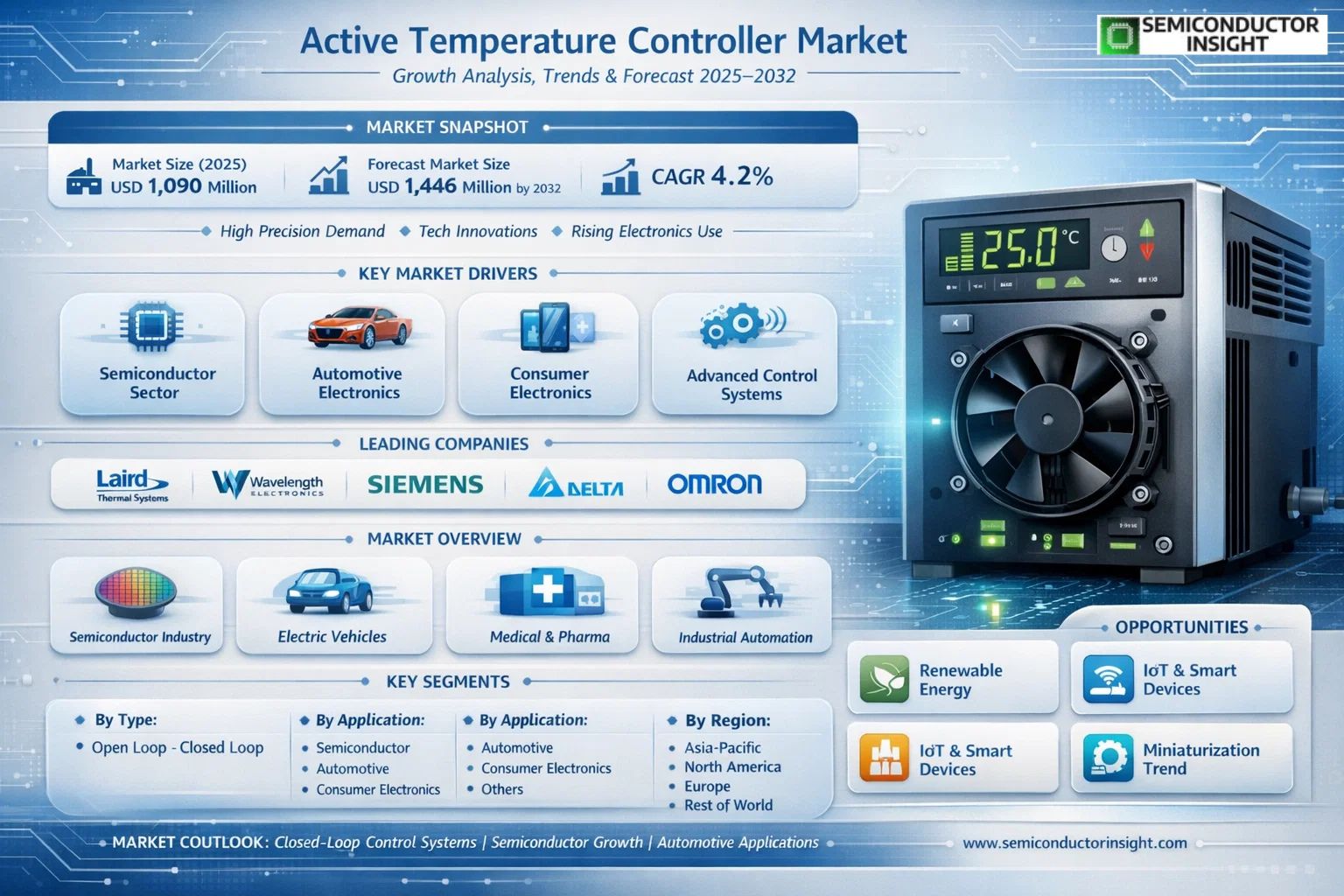
Global Active Temperature Controller market size was valued at USD 1,090 million in 2025. The market is projected to reach USD 1,446 million by 2032, exhibiting a CAGR of 4.2% during the forecast period.
An active temperature controller is a device used to regulate and maintain precise temperatures in systems or equipment by continuously monitoring and adjusting temperature variables. Unlike passive temperature control, which might only provide basic cooling or heating, active controllers use sensors, feedback loops, and sometimes complex algorithms to actively modify the environment. They do this by adjusting elements such as heaters, coolers, fans, or thermoelectric modules to maintain the desired temperature within tight tolerances.
The market is experiencing steady growth driven by rising demand in high-precision applications across semiconductors, automotive electronics, and consumer electronics. Advancements in closed-loop control systems further enhance efficiency, supporting miniaturization and higher power densities in modern devices. While challenges like supply chain disruptions persist, key players continue to innovate. Leading companies include Laird Thermal Systems, Wavelength Electronics, Siemens, Delta Electronics, Omron, Honeywell, Omega Engineering, Yokogawa, Panasonic, and Fuji Electric, which together command substantial market share through diverse product portfolios and technological expertise.
MARKET DRIVERS
Technological Advancements in Precision Control
Active Temperature Controller Market is propelled by increasing demand for precise thermal management in electronics and semiconductors. With the rise of 5G infrastructure and data centers, where temperature stability is critical to prevent overheating, adoption has surged. Innovations in PID algorithms and sensor integration enable sub-degree accuracy, driving market growth at an estimated 7.2% CAGR through 2030.
Expansion in Healthcare and Pharmaceuticals
Growth in medical devices like PCR machines and vaccine storage units relies heavily on active temperature controllers for consistent performance. The pharmaceutical sector’s push for cold chain logistics, especially post-pandemic, has boosted demand. Approximately 65% of biopharma processes now incorporate advanced controllers for compliance with stringent temperature protocols.
➤ Automotive Sector Surge: Electric vehicles require robust battery thermal management, contributing over 25% to market revenue.
Additionally, industrial automation and food processing sectors are adopting these systems to enhance efficiency and reduce downtime, solidifying Active Temperature Controller Market’s trajectory.
MARKET CHALLENGES
Integration Complexities
Implementing active temperature controllers in legacy systems poses significant hurdles due to compatibility issues and retrofit costs. Many industries face challenges in scaling from prototype to production, leading to delays. Active Temperature Controller Market encounters around 15-20% project overruns attributed to these integration bottlenecks.
Other Challenges
Supply Chain Disruptions
Global semiconductor shortages have impacted controller production, raising lead times by 30% and inflating prices. Competition from low-cost passive alternatives further pressures market share, requiring continuous innovation to maintain differentiation.
High initial investment and skilled labor shortages for maintenance exacerbate these issues, with skilled technician availability projected to lag demand by 18% in key regions.
MARKET RESTRAINTS
Regulatory and Energy Compliance
Stringent environmental regulations on energy consumption limit widespread adoption of power-intensive active systems. In the European Union, RoHS and energy efficiency directives mandate lower power usage, restraining growth in Active Temperature Controller Market to compliant, efficient models only.
High upfront costs, often 2-3 times that of passive solutions, deter small and medium enterprises from investing. Market data indicates that cost sensitivity affects 40% of potential deployments in emerging economies.
Additionally, reliability concerns in harsh environments, such as extreme humidity or vibrations, impose design constraints, with failure rates climbing up to 12% in unoptimized applications.
MARKET OPPORTUNITIES
Emerging Applications in Renewables and IoT
The shift toward renewable energy storage, particularly in solar inverters and battery systems, opens avenues for advanced controllers. IoT-enabled smart factories demand real-time thermal regulation, projected to capture 22% additional market share by 2028 in Active Temperature Controller Market.
Miniaturization trends in wearables and edge computing create demand for compact, high-precision units. Asia-Pacific’s manufacturing boom, with a 9% annual growth, positions it as a hotspot for expansion.
AI-driven predictive maintenance integrations offer customization potential, reducing operational costs by up to 25% and unlocking premium segments.
Active Temperature Controller Market Trends
Rise of Closed-Loop Control Systems
In Active Temperature Controller Market, closed-loop control systems are gaining prominence due to their superior precision in maintaining temperature stability through continuous feedback mechanisms. These systems utilize sensors and algorithms to dynamically adjust heating or cooling elements, ensuring tight tolerances essential for sensitive applications. This trend reflects the industry’s shift from basic open-loop methods toward more reliable active regulation, driven by demands for enhanced performance in complex environments.
Other Trends
Growing Adoption in Semiconductor Manufacturing
The semiconductor segment leads applications in Active Temperature Controller Market, where precise thermal management is critical during wafer fabrication and testing processes. Manufacturers rely on these controllers to prevent defects caused by thermal variations, supporting higher yields and miniaturization trends in chip production. Key players like Laird Thermal Systems and Omron are innovating with compact, high-response units tailored for cleanroom compatibility.
Expansion in Automotive Electronics
Automotive electronics represent a burgeoning area within Active Temperature Controller Market, fueled by the rise of electric vehicles and advanced driver-assistance systems. These controllers regulate temperatures in battery packs and power electronics, mitigating risks of overheating and extending component lifespans. Integration with vehicle thermal management systems underscores the need for robust, real-time control amid stricter safety standards.
Regional Dynamics and Competitive Landscape
Asia, particularly China and Japan, dominates regional growth in Active Temperature Controller Market, propelled by expansive electronics manufacturing bases and investments in high-tech industries. Europe and North America follow, emphasizing quality and innovation through companies such as Siemens, Honeywell, and Yokogawa. The competitive arena features top players holding significant revenue shares, focusing on mergers, product developments, and customized solutions to address challenges like supply chain disruptions and regulatory compliance. Overall, the market evolves with emphasis on energy-efficient designs and integration with Industry 4.0 technologies, positioning stakeholders for sustained leadership in precision temperature control.
COMPETITIVE LANDSCAPE
Key Industry Players
Top Active Temperature Controller Manufacturers and Market Share Leaders
Active Temperature Controller Market features a competitive landscape dominated by established global leaders such as Laird Thermal Systems, Wavelength Electronics, and Siemens, which collectively hold substantial revenue shares. These top players leverage advanced closed-loop and open-loop control technologies to deliver precise temperature regulation for demanding applications like semiconductors and automotive electronics. The market structure is moderately concentrated, with the top five manufacturers accounting for a significant portion of global revenues in 2025, driving innovation through feedback loops, sensors, and algorithmic adjustments amid a projected CAGR of 4.2% through 2032.
Beyond the frontrunners, niche and regional players like Delta Electronics, Omron, Honeywell, Omega Engineering, and Yokogawa provide specialized solutions tailored to consumer electronics, industrial automation, and Asia-Pacific manufacturing hubs. Companies such as Panasonic, Fuji Electric, Eurotherm, and Shinko Technos focus on high-precision controllers for diverse sectors, intensifying competition via product differentiation, mergers, and R&D investments. Emerging challengers including Chromalox, Rockwell Automation, MG CO., LTD., and Selec are gaining traction in targeted markets, contributing to a dynamic ecosystem where key firms navigate pricing pressures, supply chain challenges, and regional growth opportunities.
List of Key Active Temperature Controller Companies Profiled
- Laird Thermal Systems
- Wavelength Electronics
- Siemens
- Delta Electronics
- Omron
- Honeywell
- Omega Engineering
- Yokogawa
- Panasonic
- Fuji Electric
- Eurotherm
- MG CO., LTD.
- Shinko Technos
- Chromalox
- Rockwell Automation
- Selec
Segment Analysis:
| Segment Category | Sub-Segments | Key Insights |
| By Type |
|
Closed Loop Control dominates as it leverages continuous feedback from sensors to make real-time adjustments, ensuring precise temperature stability in dynamic environments.
|
| By Application |
|
Semiconductor leads owing to its critical role in maintaining ultra-precise temperatures during complex fabrication processes like wafer processing and deposition.
|
| By End User |
|
Industrial Automation is the frontrunner, driven by the need for robust, integrable solutions in continuous manufacturing operations.
|
| By Sensor Type |
|
RTD prevails for its exceptional accuracy and stability, making it the choice for applications demanding reliable temperature sensing over broad ranges.
|
| By Control Algorithm |
|
PID Control stands out as the preferred algorithm, delivering optimized temperature regulation by intelligently balancing proportional, integral, and derivative responses.
|
Regional Analysis: Active Temperature Controller Market
North America
North America excels in pioneering active temperature controller advancements, with focus on microcontroller-based systems offering real-time adjustments. R&D centers drive miniaturization and wireless connectivity, ideal for portable medical devices and data centers. This innovation edge supports seamless integration into Industry 4.0 frameworks.
High demand from electronics and biotech industries propels the market. Active controllers ensure thermal stability in chip fabrication and drug storage, enhancing yield rates and compliance. Aerospace applications benefit from rugged designs for extreme conditions.
Stringent standards on energy efficiency and emissions shape product development. Certifications like UL and RoHS encourage eco-friendly materials, boosting market competitiveness. Compliance fosters trust among enterprise buyers.
Intense rivalry among established firms drives continuous improvement. Strategies emphasize custom solutions and after-sales support, strengthening customer loyalty. Mergers enhance portfolio diversity in Active Temperature Controller Market.
Europe
Europe’s Active Temperature Controller Market thrives on a strong emphasis on sustainability and precision engineering. Automotive and renewable energy sectors drive demand, with controllers integral to EV battery thermal management and solar panel efficiency. The region’s fragmented yet innovative landscape features specialized SMEs collaborating on EU-funded projects for green technologies. Stringent environmental regulations promote low-power, refrigerant-free systems, aligning with circular economy goals. Business strategies revolve around cross-border partnerships, enhancing supply chain resilience amid geopolitical shifts. Advanced automation in food processing and pharmaceuticals further bolsters adoption, where active control prevents spoilage and ensures quality. Despite slower growth compared to Asia, Europe’s focus on high-value, customized solutions maintains its competitive stature, setting benchmarks for reliability and integration in smart grids and industrial IoT ecosystems.
Asia-Pacific
Asia-Pacific emerges as a dynamic force in Active Temperature Controller Market, fueled by rapid industrialization and electronics manufacturing boom. China and Japan’s prowess in consumer gadgets and semiconductors amplifies need for precise thermal regulation. Cost-effective production scales supply for global exports, while India’s pharma growth demands robust controllers for cold chain logistics. Local firms innovate affordable, scalable units, capturing emerging market shares. Government incentives for smart manufacturing accelerate IoT-enabled deployments in factories. Challenges like supply volatility are offset by diversified sourcing and vertical integration strategies. The region’s agility positions it for accelerated expansion, influencing worldwide pricing and technology diffusion in active temperature control.
South America
South America’s Active Temperature Controller Market is gaining momentum, propelled by agribusiness and expanding healthcare infrastructure. Brazil and Argentina lead in adopting controllers for food preservation amid tropical climates, ensuring export quality. Oil and gas exploration necessitates rugged units for harsh environments. Limited local manufacturing spurs imports, but rising FDI fosters tech transfers and assembly plants. Business strategies prioritize affordability and durability, with partnerships bridging skill gaps. Regulatory harmonization with international standards enhances market maturity, supporting sustainable farming and medical storage solutions through reliable temperature management.
Middle East & Africa
The Middle East & Africa Active Temperature Controller Market reflects diverse dynamics, with oil-rich Gulf states investing in petrochemical refining and desalination plants requiring advanced thermal controls. Africa’s urbanization drives demand in telecom and perishables logistics. Harsh climates underscore need for durable, energy-efficient systems. Import dependency persists, yet localization initiatives in UAE and South Africa build capacity. Strategies focus on resilience against power fluctuations, integrating solar-compatible controllers. Gradual infrastructure development promises steady growth, tailoring solutions for regional challenges in precision temperature governance.
Report Scope
This market research report provides a comprehensive analysis of Active Temperature Controller Market, covering the forecast period 2025–2032. It offers detailed insights into market dynamics, technological advancements, competitive landscape, and key trends shaping the industry.
Key focus areas of the report include:
- Market Overview: The report begins with an overview outlining its current market scenario, key growth indicators, and industry transformation drivers. It discusses macroeconomic factors, demand–supply balance, regulatory landscape, and the strategic role of active temperature controllers in maintaining precise temperatures across industries such as semiconductor, automotive electronics, consumer electronics, and industrial automation.
- Market Size & Forecast: Historical data and future projections for revenue, unit shipments, and market value across major regions and segments.
- Segmentation Analysis: Detailed breakdown by product type, technology, application, and end-user industry to identify high-growth segments and investment opportunities.
- Regional Insights: Insights into market performance across North America, Europe, Asia-Pacific, Latin America, and the Middle East & Africa, including country-level analysis where relevant.
- Competitive Landscape: Profiles of leading market participants, including their product offerings, R&D focus, manufacturing capacity, pricing strategies, and recent developments such as mergers, acquisitions, and partnerships.
- Technology Trends & Innovation: Assessment of emerging technologies, integration of AI/IoT, advanced control algorithms, sensor technologies, and evolving industry standards.
- Market Drivers & Restraints: Evaluation of factors driving market growth along with challenges, supply chain constraints, regulatory issues, and market-entry barriers.
- Stakeholder Insights: Insights for component suppliers, OEMs, system integrators, investors, and policymakers regarding the evolving ecosystem and strategic opportunities.
Primary and secondary research methods are employed, including interviews with industry experts, data from verified sources, and real-time market intelligence to ensure the accuracy and reliability of the insights presented.
FREQUENTLY ASKED QUESTIONS:
What is the current market size of Active Temperature Controller Market?
-> Active Temperature Controller Market was valued at USD 1,090 million in 2025 and is expected to reach USD 1,446 million by 2032, at a CAGR of 4.2% during the forecast period.
Which key companies operate in Active Temperature Controller Market?
-> Key players include Laird Thermal Systems, Wavelength Electronics, Siemens, Delta Electronics, Omron, Honeywell, among others.
What are the key growth drivers?
-> Key growth drivers include rising demand in semiconductor, automotive electronics, and consumer electronics sectors for precise temperature regulation.
Which region dominates the market?
-> Asia is the fastest-growing region, while North America remains a dominant market.
What are the emerging trends?
-> Emerging trends include advancements in closed-loop control systems, integration of sensors, feedback loops, and algorithms.

Get Sample Report PDF for Exclusive Insights
Report Sample Includes
- Table of Contents
- List of Tables & Figures
- Charts, Research Methodology, and more...
 Download Sample Report PDF