Film Bulk Acoustic Resonator (FBAR) Filters Market Insights
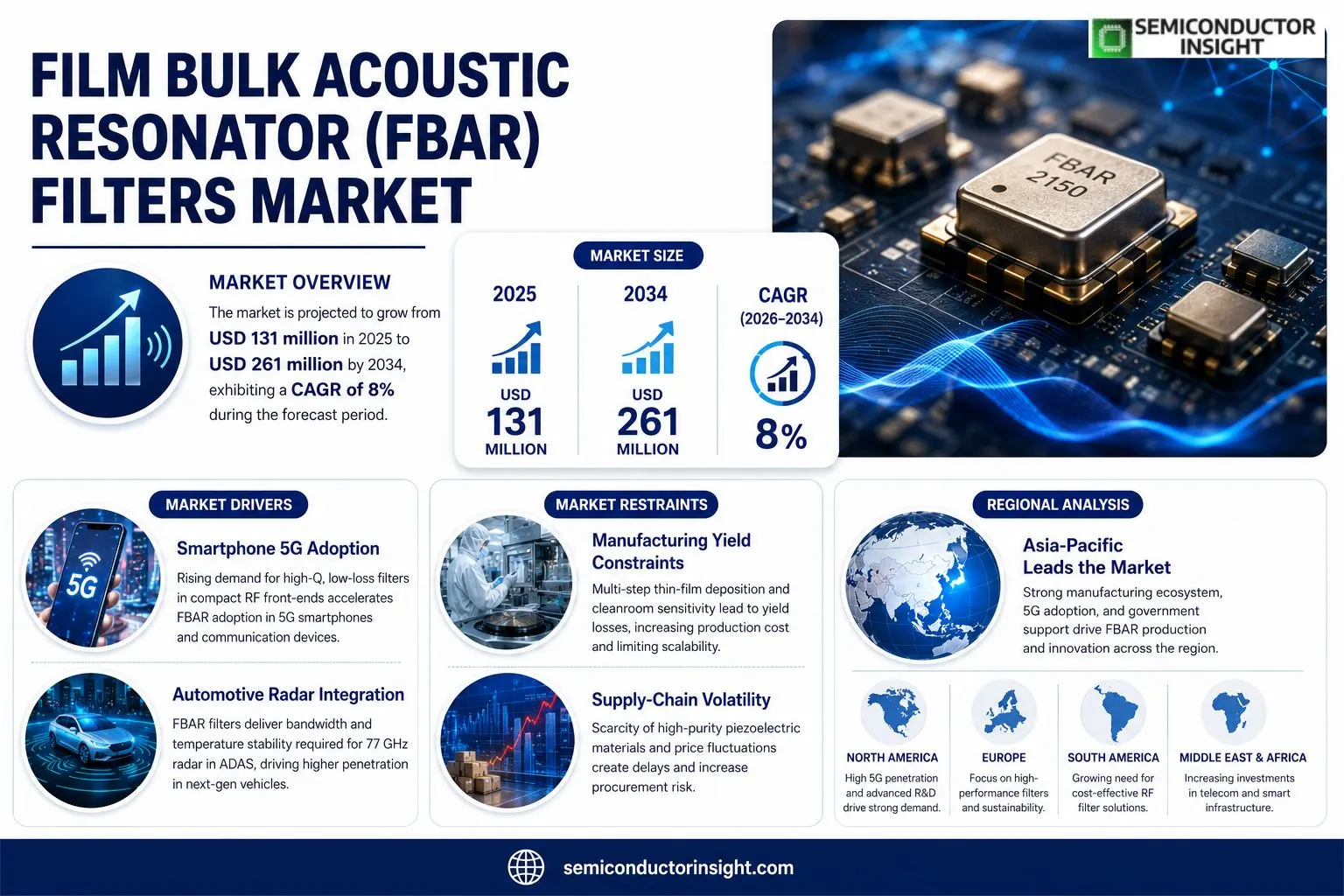
Film Bulk Acoustic Resonator (FBAR) Filters market size was valued at USD 121 million in 2024. It grows from roughly USD 131 million in 2025 to about USD 261 million by 2034, reflecting an average annual growth rate of approximately 8 % over the period.
Film bulk acoustic resonator (FBAR) is a widely‑used MEMS device that can function either as an RF filter or as a gravimetric sensor for biochemical and physical detection. Current designs employ either an acoustic mirror stack or a freestanding membrane, both fabricated as discrete components, enabling high‑Q resonances essential for modern wireless communication modules and precision sensing applications.
MARKET DRIVERS
Smartphone 5G Adoption
The rollout of 5G smartphones has accelerated demand for components that can filter millimeter‑wave frequencies with minimal loss. Film Bulk Acoustic Resonator (FBAR) Filters Market players are benefiting from the need for compact, high‑Q solutions that fit inside increasingly crowded RF front‑ends. As handset manufacturers push for thinner modules, the acoustic‑based filter architecture offers a clear advantage over conventional ceramic counterparts.
Automotive Radar Integration
Advanced driver‑assistance systems (ADAS) rely on short‑range radar operating around 77 GHz. FBAR technology provides the bandwidth and temperature stability required for reliable automotive radar performance. OEMs are embedding more radar units per vehicle, translating into a steady pipeline of orders for acoustic resonator suppliers.
➤ Regulatory pressure for reduced electromagnetic interference (EMI) is prompting OEMs to replace broadband inductors with FBAR filters, improving system efficiency.
Overall, the convergence of high‑frequency mobile standards and safety‑critical automotive applications creates a dual‑track growth engine, compelling manufacturers to expand capacity and invest in next‑generation process tools.
MARKET CHALLENGES
Manufacturing Yield Constraints
FBAR fabrication involves multiple thin‑film deposition steps, each susceptible to particulate contamination. Even a 0.5 % defect rate can erode profitability because a single faulty wafer may invalidate thousands of resonators. Companies are therefore incurring significant capital expense to upgrade cleanroom classification and automate inspection.
Other Challenges
Supply‑Chain Volatility
The scarcity of high‑purity piezoelectric materials has introduced price volatility, forcing buyers to hedge purchases or qualify secondary suppliers, which in turn lengthens lead times.Mitigating these obstacles requires a disciplined approach to yield improvement, such as implementing statistical process control and adopting in‑line metrology that can detect anomalies before costly rework.
MARKET RESTRAINTS
Design Complexity for Emerging Bands
As spectrum allocations expand into sub‑THz frequencies, the acoustic layer thickness must be reduced to maintain resonance, a move that pushes the limits of current deposition equipment. Designers face a trade‑off between achieving the required center frequency and preserving mechanical robustness, limiting the pace at which products can be qualified for new bands.Moreover, integrating FBAR filters into multi‑band modules often demands intricate matching networks, increasing bill‑of‑materials cost and complicating the validation cycle.These technical hurdles constrain the speed at which manufacturers can respond to new wireless standards, tempering overall market enthusiasm despite strong end‑user demand.
MARKET OPPORTUNITIES
Internet of Things (IoT) Edge Devices
Edge sensors and wearable modules are moving toward higher data rates while retaining low power footprints. FBAR filters, with their low insertion loss, enable these devices to meet stringent battery‑life requirements without sacrificing connectivity. The projected proliferation of billions of IoT nodes opens a sizable niche for acoustic resonators optimized for narrowband, low‑power operation.In parallel, the emergence of private 5G networks for industrial campuses creates a demand for custom‑tuned filters that can coexist with legacy equipment. Companies that can offer rapid design‐for‑manufacture services stand to capture a disproportionate share of this segment.Finally, collaborations between semiconductor foundries and acoustic filter specialists are unlocking monolithic integration pathways, hinting at a future where FBAR elements are embedded directly within RFICs, reducing package size and assembly cost.
Film Bulk Acoustic Resonator (FBAR) Filters Market Trends
Shift Toward Integrated FBAR Modules
Manufacturers are increasingly packaging FBAR devices together with matching networks and driver circuitry, turning what were once discrete components into compact, system‑on‑chip solutions. This integration reduces board real‑estate, simplifies assembly, and improves signal integrity, a combination that resonates with OEMs facing tighter electromagnetic‑interference constraints in 5G handsets and automotive radar modules. By embedding the acoustic resonator directly into the RF front‑end, designers can fine‑tune filter characteristics post‑fabrication, shortening development cycles. The trend also reflects a broader industry move toward modular RF blocks that can be sourced from a single supplier, lowering total cost of ownership while preserving performance margins.
Other Trends
Evolution of FBAR Architectures
Traditional FBAR designs rely on an acoustic mirror or a freestanding membrane, a configuration that limits scaling and adds process steps. Recent research emphasizes lattice‑type structures, which replace the mirror with a patterned phononic crystal, delivering comparable Q‑factor with a thinner stack. Ladder‑type devices, still dominant in legacy applications, are being re‑engineered to accommodate higher frequencies without compromising yield. The architectural shift is motivated by the need to align FBAR production with mainstream MEMS fabs, enabling volume runs at lower per‑unit cost. As the supply chain matures, the balance between performance and manufacturability is tilting toward lattice solutions, especially for consumer‑electronics applications where cost pressure is acute.
Application Diversification Beyond Mobile
While mobile communications remains a core driver, the FBAR ecosystem is expanding into aerospace, industrial IoT, and emerging automotive safety systems. In aerospace, the requirement for ultra‑stable filters that can survive extreme temperature swings makes FBAR an attractive candidate for satellite transceivers. Consumer‑electronics firms are exploiting the low‑profile nature of FBAR to embed filters in wearables and smart‑home hubs, where space constraints are severe. Automotive radar and Lidar modules benefit from the high‑frequency selectivity that FBAR offers, supporting advanced driver‑assistance functions. This diversification is prompting key players—Broadcom, Taiyo Yuden, Qualcomm, and Jingxun Juzhen—to tailor product roadmaps toward application‑specific packages, reinforcing the relevance of Film Bulk Acoustic Resonator (FBAR) Filters Market across multiple verticals.
COMPETITIVE LANDSCAPE
Key Industry Players
Film Bulk Acoustic Resonator (FBAR) Filters – Competitive Overview
Broadcom dominates the FBAR filter arena, leveraging its extensive semiconductor portfolio and strong relationships with handset OEMs to secure a leadership position. Its ability to integrate FBAR technology into broader system‑on‑chip solutions creates a pricing advantage and accelerates time‑to‑market for customers targeting 5G and advanced Wi‑Fi applications. Qualcomm, while primarily known for its modem chips, has been expanding its FBAR offering to lock‑in design wins within its own reference designs, a strategy that deepens its influence over the supply chain and raises entry barriers for smaller fabs.Beyond the market leaders, a cohort of specialized manufacturers is shaping niche segments. Taiyo Yuden’s expertise in high‑Q resonators sustains demand in consumer electronics where size and power efficiency are paramount. Jingxun Juzhen, a Chinese player, capitalizes on cost‑effective production and rapid scaling to serve regional smartphone manufacturers. Murata and STMicroelectronics offer complementary RF components, allowing them to bundle FBAR filters with matching inductors and capacitors, thus appealing to design houses seeking turnkey solutions. Additional contenders such as Qorvo, Skyworks, NXP, Knowles, Triad Semiconductor, Silicon Labs, and Axell contribute depth to the supply base, each focusing on differentiated market slices—ranging from aerospace‑grade ruggedness to ultra‑low‑loss lattice‑type designs.
List of Key FBAR Filters Companies Profiled
- Broadcom
- Qualcomm
- Taiyo Yuden
- Qorvo
- Jingxun Juzhen
- Murata Manufacturing
- STMicroelectronics
- Skyworks Solutions
- NXP Semiconductors
- Knowles Corporation
- Triad Semiconductor
- Silicon Labs
- Axell Inc.
Segment Analysis:
| Segment Category | Sub-Segments | Key Insights |
| By Type |
|
Ladder Type
|
| By Application |
|
Communication
|
| By End User |
|
Smartphone Manufacturers
|
| By Technology Integration |
|
Monolithic Integration
|
| By Performance Requirement |
|
High Q‑Factor Filters
|
Regional Analysis: Film Bulk Acoustic Resonator (FBAR) Filters Market
Asia-Pacific
Tier‑1 chipset vendors are co‑creating FBAR filter architectures with foundries in Shenzhen, accelerating integration cycles and reducing redesign costs for 5G smartphones.
Regional spectrum allocations for millimeter‑wave services have compelled network operators to demand tighter filter specifications, steering product development toward FBAR technologies.
Universities in Japan and South Korea supply a pipeline of acoustic‑engineering specialists, fueling innovation and protecting intellectual property within the region.
North America
North America remains a fertile ground for high‑performance FBAR deployments, buoyed by early 5G rollout among major carriers. U.S. fab operators are channeling capital toward advanced lithography that supports sub‑micron resonator geometries, a move that sustains the market’s appetite for ultra‑low loss filters. Customer demand is increasingly articulated through performance‑based contracts, compelling suppliers to demonstrate consistent quality across large production runs. For European entrants, the American landscape offers a benchmark for reliability standards, prompting cross‑border collaborations that blend design expertise with local manufacturing capacity.
Europe
European telecom equipment makers view FBAR filters as essential enablers for the continent’s transition to 5G‑Advanced services. R&D hubs in Germany and France are exploring integration of FBAR modules into base‑station front‑ends, aiming to mitigate inter‑modulation issues that arise at higher carrier frequencies. Meanwhile, stringent RoHS compliance drives the adoption of lead‑free film processes, prompting vendors to refine deposition chemistries. The resulting emphasis on environmentally friendly production aligns with the EU’s broader sustainability agenda, creating a niche where compliance and performance intersect.
South America
In South America, the rollout of 5G spectrum has been more measured, yet the market exhibits a growing appetite for cost‑sensitive FBAR solutions that can be retrofitted into existing infrastructure. Local distributors are favoring suppliers that can offer modular filter kits adaptable to a range of antenna configurations, reducing inventory complexity. As mobile operators pursue network densification in urban centers, the requirement for compact, high‑Q filters becomes a decisive factor, nudging regional manufacturers toward partnerships with Asian producers who can deliver scale at competitive pricing.
Middle East & Africa
The Middle East & Africa region is witnessing incremental adoption of FBAR filters as sovereign wealth funds allocate capital to next‑generation communication projects. In Gulf Cooperation Council nations, flagship smart‑city initiatives demand resilient RF front‑ends capable of withstanding extreme temperatures; FBAR’s thermal stability makes it a logical choice. African markets, while still nascent, are attracted by the technology’s ability to support low‑power IoT devices, a segment that aligns with expanding broadband penetration initiatives across the continent.
Report Scope
This market research report provides a comprehensive analysis of the Film Bulk Acoustic Resonator (FBAR) Filters Market , covering the forecast period 2026–2034. It offers detailed insights into market dynamics, technological advancements, competitive landscape, and key trends shaping the industry.
Key focus areas of the report include:
- Market Overview: The report begins with an overview outlining its current market scenario, key growth indicators, and industry transformation drivers. It discusses macroeconomic factors, demand–supply balance, regulatory landscape, and the strategic role of semiconductors in powering advancements across industries such as automotive, telecommunications, consumer electronics, and industrial automation.
- Market Size & Forecast: Historical data and future projections for revenue, unit shipments, and market value across major regions and segments.
- Segmentation Analysis: Detailed breakdown by product type, technology, application, and end-user industry to identify high-growth segments and investment opportunities.
- Regional Insights: Insights into market performance across North America, Europe, Asia-Pacific, Latin America, and the Middle East & Africa, including country-level analysis where relevant.
- Competitive Landscape: Profiles of leading market participants, including their product offerings, R&D focus, manufacturing capacity, pricing strategies, and recent developments such as mergers, acquisitions, and partnerships.
- Technology Trends & Innovation: Assessment of emerging technologies, integration of AI/IoT, semiconductor design trends, fabrication techniques, and evolving industry standards.
- Market Drivers & Restraints: Evaluation of factors driving market growth along with challenges, supply chain constraints, regulatory issues, and market-entry barriers.
- Stakeholder Insights: Insights for component suppliers, OEMs, system integrators, investors, and policymakers regarding the evolving ecosystem and strategic opportunities.
Primary and secondary research methods are employed, including interviews with industry experts, data from verified sources, and real-time market intelligence to ensure the accuracy and reliability of the insights presented.
FREQUENTLY ASKED QUESTIONS:
What is the current market size of Film Bulk Acoustic Resonator (FBAR) Filters Market?
-> Film Bulk Acoustic Resonator (FBAR) Filters Market was valued at USD 121 million in 2024 and is expected to reach USD 208 million by 2031, growing at a CAGR of 8.2% over the forecast period.
Which key companies operate in Film Bulk Acoustic Resonator (FBAR) Filters Market?
-> Key players include Broadcom, Taiyo Yuden, Qualcomm, Jingxun Juzhen, among others.
What are the key growth drivers?
-> Growth is driven by rising demand for high‑performance RF filters in 5G communications, smartphones, automotive radar, and IoT devices, as well as the need for miniaturized and energy‑efficient components.
Which region dominates the market?
-> Asia‑Pacific leads the market due to strong manufacturing bases and high adoption of advanced wireless technologies, while North America remains a significant contributor.
What are the emerging trends?
-> Emerging trends include integration of FBAR with CMOS processes, development of multi‑band and tunable filters, and the shift toward wafer‑scale packaging for higher volume production.
Get Sample Report PDF for Exclusive Insights
Report Sample Includes
- Table of Contents
- List of Tables & Figures
- Charts, Research Methodology, and more...
 Download Sample Report PDF