
Private 5G Network Market Insights
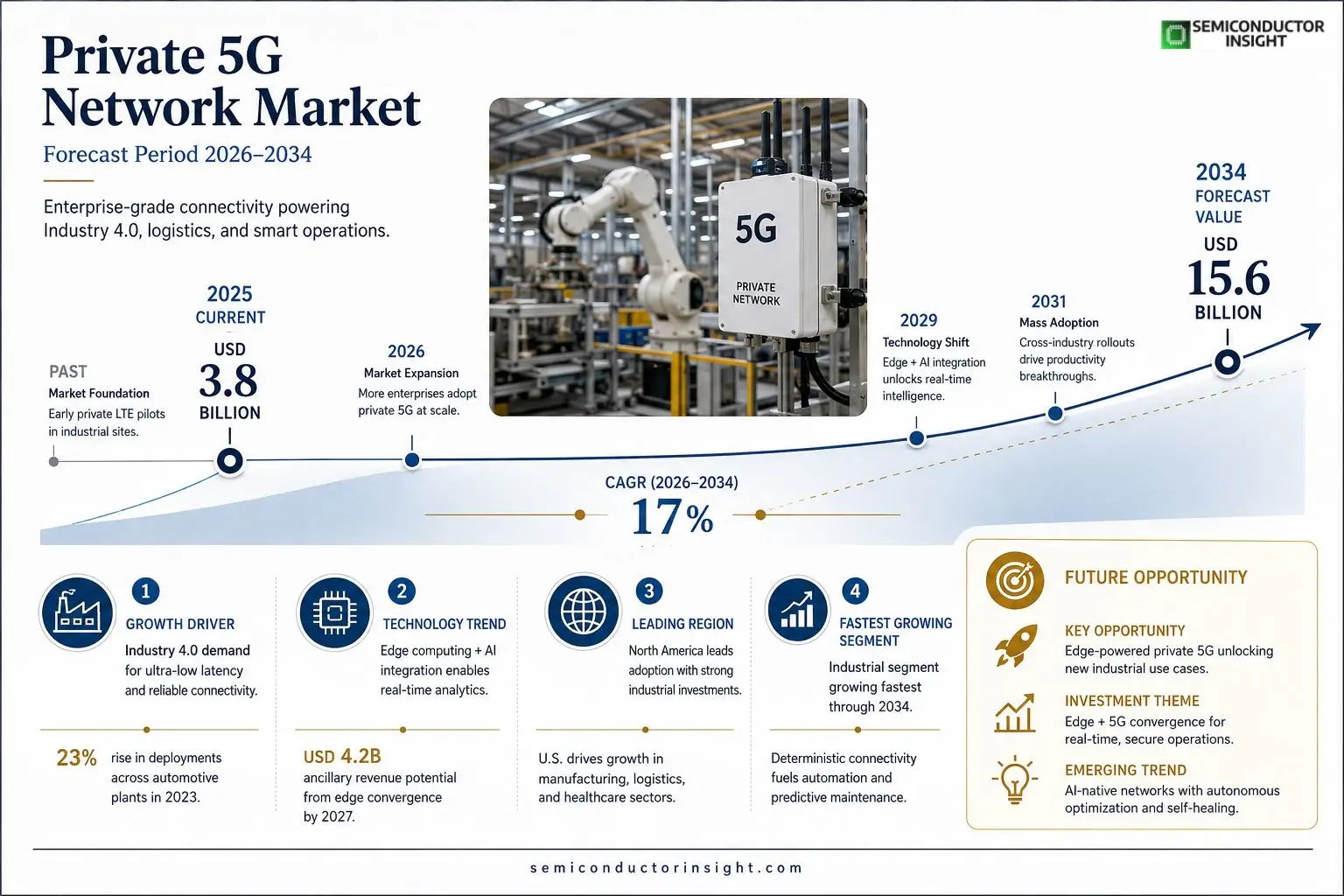
Global Private 5G Network Market size was valued at USD 3.8 billion in 2025. The market is projected to grow from USD 4.2 billion in 2026 to USD 15.6 billion by 2034, exhibiting a CAGR of 17% during the forecast period.
Private 5G networks are enterprise‑grade cellular infrastructures that operate on dedicated spectrum or licensed‑shared bands, delivering ultra‑reliable low‑latency connectivity tailored to specific sites such as factories, campuses, or logistics hubs.The market is experiencing rapid expansion because manufacturers are embracing Industry 4.0 initiatives that demand deterministic communication, while logistics providers seek real‑time asset tracking across sprawling facilities. Furthermore, the rollout of edge‑computing platforms amplifies the value proposition of private 5G by processing data locally. Key players,including Nokia, Ericsson, Huawei, Samsung and Qualcomm,are accelerating deployments through turnkey solutions and strategic partnerships with system integrators.
MARKET DRIVERS
Growing Enterprise Demand for Low‑Latency Connectivity
Private 5G Network Market is being propelled by manufacturers seeking sub‑millisecond latency for real‑time control of robotics. 2023 saw a 23% increase in deployments across automotive plants, enabling predictive maintenance and reducing downtime by 15%.
Regulatory Support and Spectrum Allocation
Government initiatives that allocate dedicated mid‑band spectrum have lowered entry barriers, allowing logistics firms to launch campus‑wide private networks. By 2025, more than 40 major ports are expected to adopt private 5G solutions, accelerating digital supply‑chain transformation.
➤ Enterprises that integrate private 5G experience up to 30% higher productivity compared with legacy Wi‑Fi networks.
Overall, the convergence of industrial IoT, increased data traffic, and cost‑effective equipment drives sustained growth in Private 5G Network Market.
MARKET CHALLENGES
High Capital Expenditure and Integration Complexity
Deploying a private 5G infrastructure often requires multi‑year investment cycles, with CAPEX ranging from $1‑2 million for mid‑size campuses. The need to integrate legacy OT systems creates engineering bottlenecks that can extend rollout timelines by 12‑18 months.
Other Challenges
Security Concerns
While private 5G offers enhanced encryption, enterprises grapple with securing edge devices against ransomware, leading to cautious adoption in sectors handling sensitive data.
MARKET RESTRAINTS
Limited Skilled Workforce
The scarcity of engineers certified in 5G radio planning hampers rapid scaling. Companies often rely on external consultants, inflating project costs and slowing time‑to‑value for private network initiatives.Recent collaborations between telecom vendors and technical universities aim to certify over 5,000 engineers by 2026, which is expected to alleviate the talent gap and accelerate network roll‑out.
MARKET OPPORTUNITIES
Edge‑Computing Integration
Combining private 5G with edge computing platforms creates new revenue streams for service providers. By 2027, the convergence is projected to generate $4.2 billion in ancillary services, fueled by demand for real‑time analytics in smart factories.Sector‑specific private 5G slices for healthcare and mining are emerging, offering differentiated QoS and compliance features that can capture additional market share in the coming years.
Private 5G Network Market Trends
Growth Driven by Industry 4.0 Adoption
Enterprises are increasingly turning to private 5G to meet the deterministic communication requirements of Industry 4.0. In manufacturing environments, the ultra‑reliable low‑latency links enable real‑time control of robotic cells, predictive maintenance sensors, and high‑speed data exchange between production lines and centralized control systems. By situating edge‑computing resources within the same premises, manufacturers can process massive data streams locally, reducing round‑trip latency and avoiding reliance on public broadband. This architecture supports closed‑loop automation, improves overall equipment effectiveness, and drives incremental productivity gains while protecting intellectual property through isolated spectrum usage. Consequently, the shift toward autonomous, data‑driven factories is a primary catalyst for expanding private 5G deployments across the industrial sector.
Other Trends
Logistics and Campus Connectivity
Logistics operators are deploying private 5G to create campus‑wide, high‑density sensor networks that deliver precise, real‑time asset visibility. Dedicated spectrum eliminates the interference common in shared Wi‑Fi environments, enabling reliable communication for autonomous guided vehicles, drone fleets, and RFID systems operating in large warehouses or distribution hubs. The technology also supports secure, low‑latency video transmission for safety monitoring and rapid response to incidents. On university and corporate campuses, private 5G provides a unified wireless backbone for research labs, IoT testbeds, and high‑throughput educational applications, replacing fragmented legacy networks and simplifying management. These deployments improve operational efficiency, lower total cost of ownership, and open new avenues for data‑centric services such as predictive logistics and smart‑building automation.
Strategic Partnerships and Turnkey Solutions
Leading equipment manufacturers,including Nokia, Ericsson, Huawei, Samsung and Qualcomm,are forging strategic alliances with system integrators and cloud service providers to deliver end‑to‑end private 5G solutions. These collaborations bundle radio access hardware, core network software, edge‑computing platforms, and managed services into single contracts, reducing deployment complexity for enterprises lacking in‑house expertise. Turnkey offerings accelerate time‑to‑value by providing pre‑tested reference architectures, streamlined licensing models, and ongoing performance monitoring. In parallel, ecosystem partners are introducing vertical‑specific application layers that translate raw connectivity into actionable insights for sectors such as manufacturing, logistics, and campus management. The growing maturity of these partnerships is expected to lower entry barriers, increase adoption rates, and shape the next phase of private 5G evolution.
COMPETITIVE LANDSCAPEKey Industry Players
Private 5G Network Market – Competitive Overview
Private 5G Network Market is currently dominated by a handful of global telecommunications giants that leverage deep R&D investments and extensive carrier‑grade portfolio assets. Nokia, Ericsson, Huawei, and Samsung lead the deployment landscape, offering end‑to‑end solutions that integrate radio units, core networking, and edge‑computing services. Their market share is reinforced by strategic partnerships with system integrators and large‑scale industrial customers seeking deterministic latency for Industry 4.0 use cases. These incumbents command robust supply chains, patented antenna technologies, and have secured multi‑year contracts across manufacturing, logistics, and campus environments, shaping a highly consolidated top tier.Beyond the headline leaders, a diverse set of niche and emerging players contributes critical specialization to the ecosystem. Qualcomm and Intel supply high‑performance modem chipsets and compute platforms that enable low‑latency device connectivity. Cisco, Dell Technologies, and HPE focus on networking infrastructure and hyper‑converged edge solutions tailored for private deployments. ZTE continues to expand its footprint in Asia‑Pacific, while Verizon, AT&T, Microsoft, Amazon Web Services, and Google Cloud bring managed private‑5G services, cloud integration, and AI‑driven analytics to the market. This layered composition of hardware, software, and service providers fosters vigorous competition and accelerates innovation across the value chain.
List of Key Private 5G Network Companies Profiled
- Nokia
- Ericsson
- Huawei
- Samsung
- Qualcomm
- Intel
- Cisco
- Dell Technologies
- HPE
- ZTE
- Verizon
- AT&T
- Microsoft
- Amazon Web Services (AWS)
- Google Cloud
Segment Analysis:
| Segment Category | Sub-Segments | Key Insights |
| By Type |
|
Industrial segment drives the market because manufacturers require deterministic, ultra‑reliable connectivity for modern production environments.
|
| By Application |
|
Smart Manufacturing is the leading application because it aligns directly with Industry 4.0 goals and leverages edge computing for immediate decision‑making.
|
| By End User |
|
Manufacturers dominate the end‑user landscape as they seek deterministic networks to support automation and data‑driven operations.
|
| By Deployment Model |
|
Turnkey Solutions are preferred because they reduce time‑to‑value and simplify integration with existing enterprise systems.
|
| By Industry |
|
Automotive emerges as a leading industry because vehicle manufacturers are establishing smart factories and testing grounds that rely on ultra‑reliable private connectivity.
|
Regional Analysis: North America
United States
The manufacturing sector in the US is at the forefront of Private 5G adoption, utilizing it for real-time monitoring, predictive maintenance, and automated guided vehicles. The need for low-latency communication is critical for these applications, making private 5G an attractive solution.
Healthcare organizations are exploring private 5G for applications like remote patient monitoring, robotic surgery, and connected medical devices. The enhanced reliability and security offered by private 5G are particularly appealing in this sector.
The logistics industry is leveraging private 5G for real-time tracking of goods, automated warehousing, and improved fleet management. The ability to handle high volumes of data and maintain consistent connectivity is a key driver.
Retailers and hospitality businesses are adopting private 5G for enhanced customer experiences, smart inventory management, and operational efficiencies. Applications include interactive displays, mobile point-of-sale systems, and connected devices.
Europe
Europe presents a diverse landscape for Private 5G Network Market, with varying adoption rates across different countries. The manufacturing sector in Germany and the UK is leading the way, while the public sector in several European nations is exploring private 5G for smart city initiatives and critical infrastructure. Business strategies often emphasize compliance with stringent data privacy regulations and the integration of private 5G with existing industrial automation platforms. The focus in Europe is on building secure and reliable private 5G networks that can support a wide range of industrial and public sector applications.
Asia-Pacific
Asia-Pacific is emerging as a high-growth market for the Private 5G Network. Countries like China and Japan are investing heavily in 5G infrastructure, creating a favorable environment for private 5G adoption. The demand for private 5G is particularly strong in manufacturing, logistics, and healthcare sectors. Business strategies in the region often involve partnerships with local technology providers and a focus on cost-effective private 5G solutions. The government support for digitalization initiatives is a significant driver of market growth in Asia-Pacific.
South America
South America is witnessing the initial stages of Private 5G Network Market development, with early adopters in industries such as mining and agriculture. The focus is on addressing connectivity challenges in remote areas and enhancing operational efficiency. Business strategies involve pilot projects and collaborations with international technology companies. While the market is relatively nascent, the long-term growth potential is significant, driven by increasing industrialization and infrastructure development.
Middle East & Africa
The Middle East & Africa region is poised for substantial growth in Private 5G Network Market. Governments across the region are investing in digital transformation initiatives, creating demand for private 5G solutions in sectors like oil & gas, transportation, and public safety. Business strategies emphasize customized private 5G deployments and partnerships with global technology providers. The region’s focus on infrastructure development and industrial diversification is expected to accelerate private 5G adoption.
Report Scope
This market research report provides a comprehensive analysis of the Private 5G Network Market , covering the forecast period 2026–2034. It offers detailed insights into market dynamics, technological advancements, competitive landscape, and key trends shaping the industry.
Key focus areas of the report include:
- Market Overview: The report begins with an overview outlining its current market scenario, key growth indicators, and industry transformation drivers. It discusses macroeconomic factors, demand–supply balance, regulatory landscape, and the strategic role of semiconductors in powering advancements across industries such as automotive, telecommunications, consumer electronics, and industrial automation.
- Market Size & Forecast: Historical data and future projections for revenue, unit shipments, and market value across major regions and segments.
- Segmentation Analysis: Detailed breakdown by product type, technology, application, and end-user industry to identify high-growth segments and investment opportunities.
- Regional Insights: Insights into market performance across North America, Europe, Asia-Pacific, Latin America, and the Middle East & Africa, including country-level analysis where relevant.
- Competitive Landscape: Profiles of leading market participants, including their product offerings, R&D focus, manufacturing capacity, pricing strategies, and recent developments such as mergers, acquisitions, and partnerships.
- Technology Trends & Innovation: Assessment of emerging technologies, integration of AI/IoT, semiconductor design trends, fabrication techniques, and evolving industry standards.
- Market Drivers & Restraints: Evaluation of factors driving market growth along with challenges, supply chain constraints, regulatory issues, and market-entry barriers.
- Stakeholder Insights: Insights for component suppliers, OEMs, system integrators, investors, and policymakers regarding the evolving ecosystem and strategic opportunities.
Primary and secondary research methods are employed, including interviews with industry experts, data from verified sources, and real-time market intelligence to ensure the accuracy and reliability of the insights presented.
FREQUENTLY ASKED QUESTIONS:
What is the current market size of Private 5G Network Market?
-> Private 5G Network Market was valued at USD 3.8 billion in 2025 and is expected to reach USD 15.6 billion by 2034.
Which key companies operate in Private 5G Network Market?
-> Key players include Nokia, Ericsson, Huawei, Samsung and Qualcomm.
What are the key growth drivers?
-> Key growth drivers include adoption of Industry 4.0 initiatives by manufacturers, real‑time asset tracking in logistics, and the rollout of edge‑computing platforms.
Which region dominates the market?
-> The reference does not specify a single dominant region, indicating a globally balanced market with significant adoption across major economies.
What are the emerging trends?
-> Emerging trends include integration of edge‑computing with private 5G, increased focus on low‑latency industrial IoT applications, and expansion of turnkey deployment solutions.

Get Sample Report PDF for Exclusive Insights
Report Sample Includes
- Table of Contents
- List of Tables & Figures
- Charts, Research Methodology, and more...
 Download Sample Report PDF



