
MEMS Semiconductor Market Insights
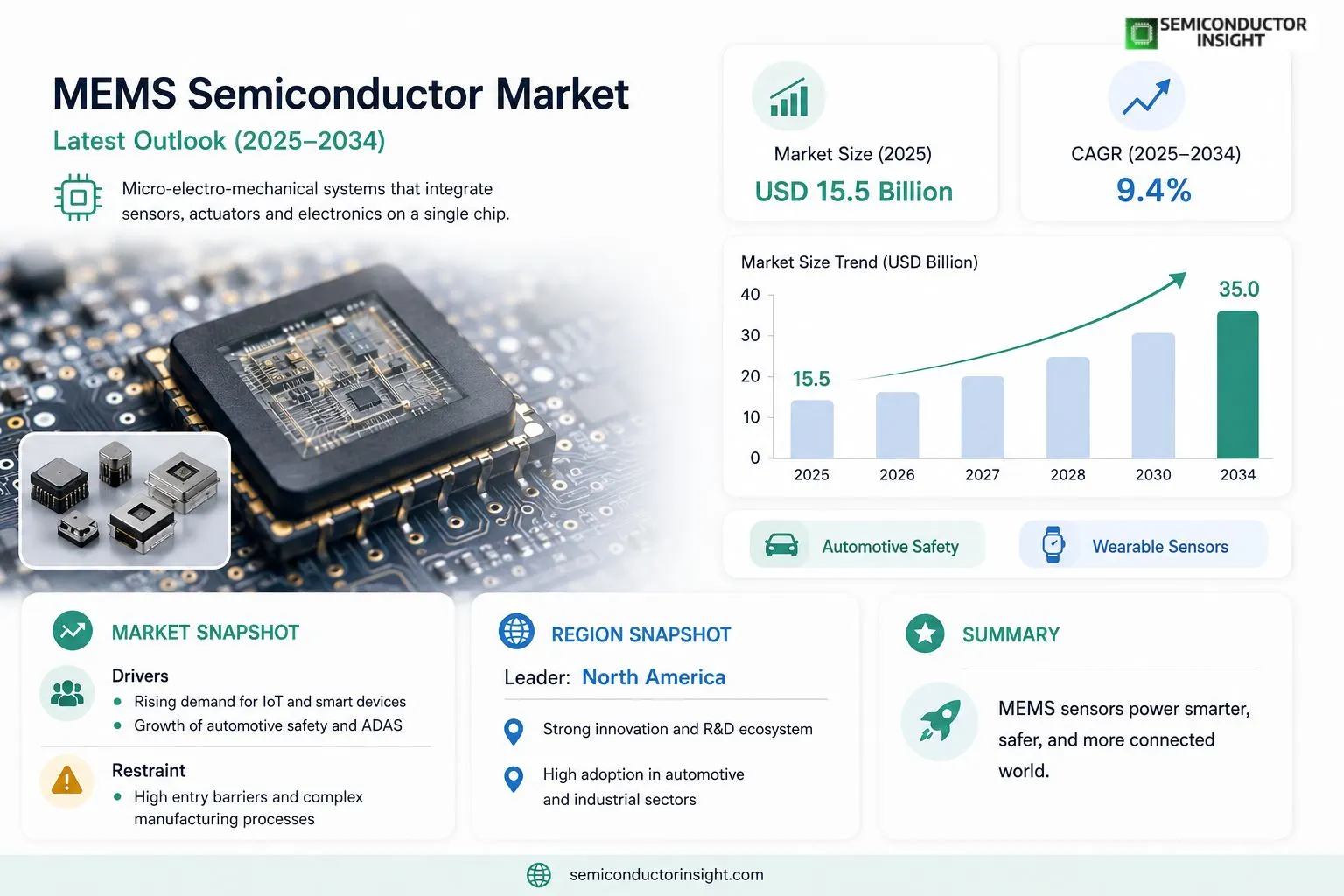
Global MEMS semiconductor market size was valued at USD 15.5 billion in 2025. The market is projected to grow from USD 15.5 billion in 2025 to USD 35.0 billion by 2034, exhibiting a CAGR of 9.4% during the forecast period.
MEMS semiconductors are micro‑electro‑mechanical systems that integrate mechanical elements, sensors, actuators, and electronics on a single silicon chip. They enable precise motion control and sensing functions in applications such as inertial measurement units, pressure sensors, acoustic devices, and optical switches.The market is accelerating because of expanding demand for smart‑connected devices in automotive safety systems, consumer electronics, industrial automation, and health‑monitoring wearables. Furthermore, ongoing cost reductions in wafer‑level packaging and increased R&D investment by leading firms,such as STMicroelectronics, Bosch Sensortec, and Texas Instruments,are driving adoption across sectors.
MARKET DRIVERS
Growth of Internet‑of‑Things (IoT) Devices
MEMS Semiconductor Market is being propelled by the rapid expansion of IoT ecosystems, where miniature sensors enable real‑time data capture in smart homes, wearables, and industrial automation. Forecasts show that IoT‑enabled MEMS deployments will increase by more than 20% annually through 2030, creating a robust demand pipeline for high‑performance micro‑electromechanical components.
Automotive Safety and ADAS Integration
Advanced driver‑assistance systems (ADAS) require precise motion and pressure sensing, positioning MEMS as a critical technology in vehicle safety architectures. Industry analysts project that MEMS‑based airbag and stability‑control modules will account for over 35% of new vehicle sensor installations by 2028, reinforcing market growth.
➤ Strategic partnerships between semiconductor foundries and automotive OEMs are accelerating product cycles and reducing time‑to‑market for next‑generation MEMS solutions.
In addition, the convergence of 5G connectivity with edge computing is driving demand for low‑power, high‑accuracy MEMS sensors that can operate reliably under diverse environmental conditions, further expanding the addressable market.
MARKET CHALLENGES
Complexity of Manufacturing Processes
MEMS fabrication requires intricate batch‑processing steps, including wafer thinning, etching, and packaging, which increase capital intensity and limit scalability for smaller firms. This complexity can result in longer lead times and higher unit costs, slowing adoption in price‑sensitive segments.
Other Challenges
Supply‑Chain Volatility
Fluctuations in raw material availability,particularly high‑purity silicon and specialized polymers,have introduced bottlenecks that affect production schedules and exacerbate cost pressures across MEMS Semiconductor Market.
Regulatory compliance for safety‑critical applications, especially in automotive and medical devices, adds another layer of scrutiny, requiring extensive validation and certification that can extend product development timelines.
MARKET RESTRAINTS
High Entry Barriers for New Players
Significant R&D investment, proprietary fabrication equipment, and stringent quality standards create formidable entry barriers, limiting competitive pressure and concentrating market share among established semiconductor manufacturers.
MARKET OPPORTUNITIES
Emergence of Flexible and Wearable Electronics
Advancements in flexible substrates and low‑temperature MEMS processes open new opportunities in health‑monitoring wearables and textile‑integrated sensors. By 2027, flexible MEMS devices are projected to capture more than 10% of the overall sensor market, offering a high‑growth niche for innovators.
MEMS Semiconductor Market Trends
Smart‑Connected Device Demand Fuels Adoption
MEMS Semiconductor Market is experiencing a clear upward trajectory as manufacturers of smart‑connected devices increase orders for integrated sensors and actuators. Automotive safety systems, consumer electronics, industrial automation, and health‑monitoring wearables all require the precise motion control and sensing capabilities that MEMS chips provide. The convergence of Internet‑of‑Things connectivity and miniaturized form factors amplifies the need for reliable micro‑electro‑mechanical components, prompting original equipment manufacturers to prioritize MEMS integration early in product development cycles. This momentum is reinforced by growing consumer expectations for real‑time data and responsive feedback, which directly translate into higher component volumes across multiple end‑markets.
Other Trends
Automotive Safety Systems
Within the automotive sector, MEMS Semiconductor Market participants are delivering inertial measurement units, pressure sensors, and acoustic devices that enable advanced driver‑assistance functions. Airbag deployment systems rely on rapid pressure sensing, while electronic stability control benefits from precise accelerometer data. Recent model generations of connected vehicles embed multiple MEMS sensors to support lane‑keeping, adaptive cruise control, and collision avoidance, creating a robust demand pipeline for suppliers that can combine high reliability with automotive‑grade ruggedness.
Cost‑Effective Wafer‑Level Packaging Advances
Packaging economics have become a decisive factor in MEMS Semiconductor Market as wafer‑level techniques drive down per‑unit costs while preserving performance. Leading firms such as STMicroelectronics, Bosch Sensortec, and Texas Instruments have invested heavily in wafer‑scale bonding and thin‑film encapsulation, which reduce material waste and shorten time‑to‑market. These cost efficiencies, paired with continuous R&D spending, allow manufacturers to offer competitively priced solutions to both high‑volume consumer segments and niche industrial applications, reinforcing the overall growth narrative for MEMS technologies.
COMPETITIVE LANDSCAPEKey Industry Players
MEMS Semiconductor Market – Competitive Overview
MEMS Semiconductor Market is currently led by a handful of globally integrated firms that command both design expertise and high‑volume manufacturing capacity. STMicroelectronics, Bosch Sensortec, and Texas Instruments together capture a substantial share of automotive safety, consumer wearable, and industrial automation segments. Their dominance is reinforced by extensive R&D pipelines, strategic wafer‑level packaging investments, and deep customer relationships that enable rapid deployment of inertial measurement units, pressure sensors, and acoustic devices. The market structure reflects a moderate level of consolidation, where the top three players maintain competitive advantage through differentiated sensor portfolios and cross‑industry collaborations, while still leaving room for specialization among emerging entrants.Beyond the leading trio, a robust cohort of niche and specialist companies enriches the ecosystem. Analog Devices and Infineon Technologies leverage analog‑front‑end expertise to serve high‑precision industrial applications. NXP Semiconductors focuses on automotive connectivity, whereas TDK and Murata Manufacturing excel in miniaturized acoustic and optical MEMS modules. AMS AG, Honeywell International, Samsung Electronics, and Apple Inc. contribute innovative product forms, ranging from optical motion sensors to consumer‑grade health‑monitoring solutions, fostering competitive pressure that drives technology advancement and cost efficiencies across the sector.
List of Key MEMS Semiconductor Companies Profiled
- STMicroelectronics
- Bosch Sensortec
- Texas Instruments
- Analog Devices
- Infineon Technologies
- NXP Semiconductors
- TDK Corporation
- Murata Manufacturing
- AMS AG
- Honeywell International
- Samsung Electronics
- Apple Inc.
Segment Analysis:
| Segment Category | Sub-Segments | Key Insights |
| By Type |
|
Capacitive MEMS
|
| By Application |
|
Automotive Safety
|
| By End User |
|
Vehicle Manufacturers
|
| By Technology |
|
Wafer‑Level Packaging
|
| By Market Trend |
|
IoT Integration
|
Regional Analysis: North America
United States
The strong intellectual property ecosystem and a well-established supply chain further solidify the US position as a dominant force in the MEMS Semiconductor Market. The prevalence of research institutions and a skilled workforce contribute significantly to the ongoing development of cutting-edge MEMS technologies. Furthermore, the robust venture capital funding available fuels the growth of innovative MEMS startups, expanding the product portfolio and driving market diversification. The integration of MEMS with other advanced technologies like AI and IoT is creating new opportunities for growth.
The automotive sector is a major driver for MEMS in North America, with increasing demand for sensors used in ADAS, airbag systems, and engine management. Growth is fueled by stricter safety regulations and the push towards autonomous driving.
Applications such as pressure sensors for tire monitoring and accelerometers for vehicle stability control are witnessing substantial uptake.
The industrial segment benefits from MEMS sensors used for process control, environmental monitoring, and predictive maintenance. Demand is rising across sectors like manufacturing, energy, and oil & gas.
Applications like flow sensors, vibration sensors, and pressure sensors are becoming increasingly important for optimizing industrial operations and improving efficiency.
MEMS sensors are widely used in consumer electronics, including smartphones, wearables, and gaming consoles. The demand for accelerometers, gyroscopes, and pressure sensors in these devices continues to grow.
Integration of MEMS into virtual and augmented reality devices presents significant future opportunities.
The healthcare sector is experiencing rapid growth in MEMS applications, particularly in areas like wearable health monitors, implantable devices, and diagnostic tools.
MEMS sensors are used for monitoring vital signs, delivering drugs, and performing minimally invasive procedures.
Europe
The European MEMS semiconductor market demonstrates steady growth, underpinned by a strong emphasis on innovation and a supportive regulatory environment. Countries like Germany, France, and the UK are key players in the region, fostering collaborations between research institutions and industry. Focus areas include automotive safety, industrial automation, and healthcare. The European market is particularly attuned to stringent data privacy regulations, which are influencing the development of secure MEMS solutions.
The region is witnessing increasing adoption of MEMS in electric vehicles and smart infrastructure projects. Challenges include navigating complex regulatory frameworks and competing with lower-cost manufacturing options from Asia. The MEMS Semiconductor Market in Europe is leaning towards sustainable and energy-efficient solutions.
Asia-Pacific
Asia-Pacific is the largest and fastest-growing market for MEMS semiconductors globally. China, Japan, South Korea, and Taiwan are dominant players, driven by strong manufacturing capabilities and burgeoning domestic demand. The region sees widespread use in consumer electronics, automotive, and industrial applications. Government initiatives promoting domestic semiconductor manufacturing are further fueling growth.
The competitive landscape in Asia-Pacific is characterized by a large number of players, ranging from established multinational corporations to local manufacturers. Focus is shifting towards high-performance MEMS sensors for advanced applications. The MEMS Semiconductor Market in Asia-Pacific exhibits a strong trend toward integration with 5G and IoT technologies.
South America
South America represents a smaller but growing market for MEMS semiconductors. Brazil and Mexico are key markets, driven by expanding automotive and industrial sectors. The demand for MEMS sensors is increasing in areas like agriculture, mining, and infrastructure monitoring.
Challenges include limited domestic manufacturing capabilities and reliance on imports. However, increasing investments in infrastructure development are expected to drive future growth in the MEMS Semiconductor Market across the region.
Middle East & Africa
The Middle East & Africa market for MEMS semiconductors is characterized by moderate growth, primarily driven by increasing investments in infrastructure and industrial development. The automotive sector in countries like Saudi Arabia and the UAE is a key driver of demand.
Opportunities exist in areas like oil and gas exploration, environmental monitoring, and smart city initiatives. The MEMS Semiconductor Market in this region is projected to experience significant expansion in the coming years, fueled by government initiatives promoting technological advancement.
Report Scope
This market research report provides a comprehensive analysis of the MEMS Semiconductor Market , covering the forecast period 2026–2034. It offers detailed insights into market dynamics, technological advancements, competitive landscape, and key trends shaping the industry.
Key focus areas of the report include:
- Market Overview: The report begins with an overview outlining its current market scenario, key growth indicators, and industry transformation drivers. It discusses macroeconomic factors, demand–supply balance, regulatory landscape, and the strategic role of semiconductors in powering advancements across industries such as automotive, telecommunications, consumer electronics, and industrial automation.
- Market Size & Forecast: Historical data and future projections for revenue, unit shipments, and market value across major regions and segments.
- Segmentation Analysis: Detailed breakdown by product type, technology, application, and end-user industry to identify high-growth segments and investment opportunities.
- Regional Insights: Insights into market performance across North America, Europe, Asia-Pacific, Latin America, and the Middle East & Africa, including country-level analysis where relevant.
- Competitive Landscape: Profiles of leading market participants, including their product offerings, R&D focus, manufacturing capacity, pricing strategies, and recent developments such as mergers, acquisitions, and partnerships.
- Technology Trends & Innovation: Assessment of emerging technologies, integration of AI/IoT, semiconductor design trends, fabrication techniques, and evolving industry standards.
- Market Drivers & Restraints: Evaluation of factors driving market growth along with challenges, supply chain constraints, regulatory issues, and market-entry barriers.
- Stakeholder Insights: Insights for component suppliers, OEMs, system integrators, investors, and policymakers regarding the evolving ecosystem and strategic opportunities.
Primary and secondary research methods are employed, including interviews with industry experts, data from verified sources, and real-time market intelligence to ensure the accuracy and reliability of the insights presented.
FREQUENTLY ASKED QUESTIONS:
What is the current market size of MEMS Semiconductor Market?
-> MEMS Semiconductor Market was valued at USD 15.5 billion in 2025 and is expected to reach USD 35.0 billion by 2034, representing a CAGR of 9.4% over the forecast period.
Which key companies operate in MEMS Semiconductor Market?
-> Key players include STMicroelectronics, Bosch Sensortec, and Texas Instruments, among others actively investing in MEMS research and development.
What are the key growth drivers?
-> Key growth drivers include expanding demand for smart‑connected devices in automotive safety systems, consumer electronics, industrial automation, and health‑monitoring wearables.
Which region dominates the market?
-> The reference does not specify a single dominant region; however, demand is strong across major markets including North America, Europe, and the fast‑growing Asia‑Pacific.
What are the emerging trends?
-> Emerging trends include integration of MEMS with AI and IoT platforms, cost reductions in wafer‑level packaging, and increased adoption of MEMS in autonomous vehicle sensors and wearable health devices.

Get Sample Report PDF for Exclusive Insights
Report Sample Includes
- Table of Contents
- List of Tables & Figures
- Charts, Research Methodology, and more...
 Download Sample Report PDF


