Key Statistics
Key Takeaways
- Single-crystal diamond devices represent the most strategically important type because high-purity, low-defect material is required for active power, RF, detector and quantum applications where carrier transport and electric-field strength determine device performance.
- Power conversion is the leading commercial application because diamond combines a very wide bandgap, extremely high thermal conductivity and high breakdown field, creating a path toward smaller, higher-power switches and thermal architectures for demanding converters.
- North America is the leading current market through its concentration of defense programs, AI/HPC thermal-management demand, quantum-technology commercialization and wafer-scale diamond manufacturing activity in the United States.
- Wafer scale is the principal industrialization challenge. Progress from small single crystals toward reproducible 2-inch, 3-inch and eventually 4-inch wafers is essential before active diamond devices can move from specialized demonstrations into repeatable semiconductor production.
- Thermal management is commercializing faster than fully active diamond electronics. Copper-diamond composites and CVD heat spreaders can be integrated beneath GaN RF devices and AI accelerators without waiting for mature n-type diamond transistor manufacturing.
- Quantum networking and sensing create a parallel demand path because engineered diamond can host color centers and quantum memories; recent foundry-compatible thin-film work reduces one of the barriers to scaling diamond quantum devices.
Diamond Semiconductor Market Overview
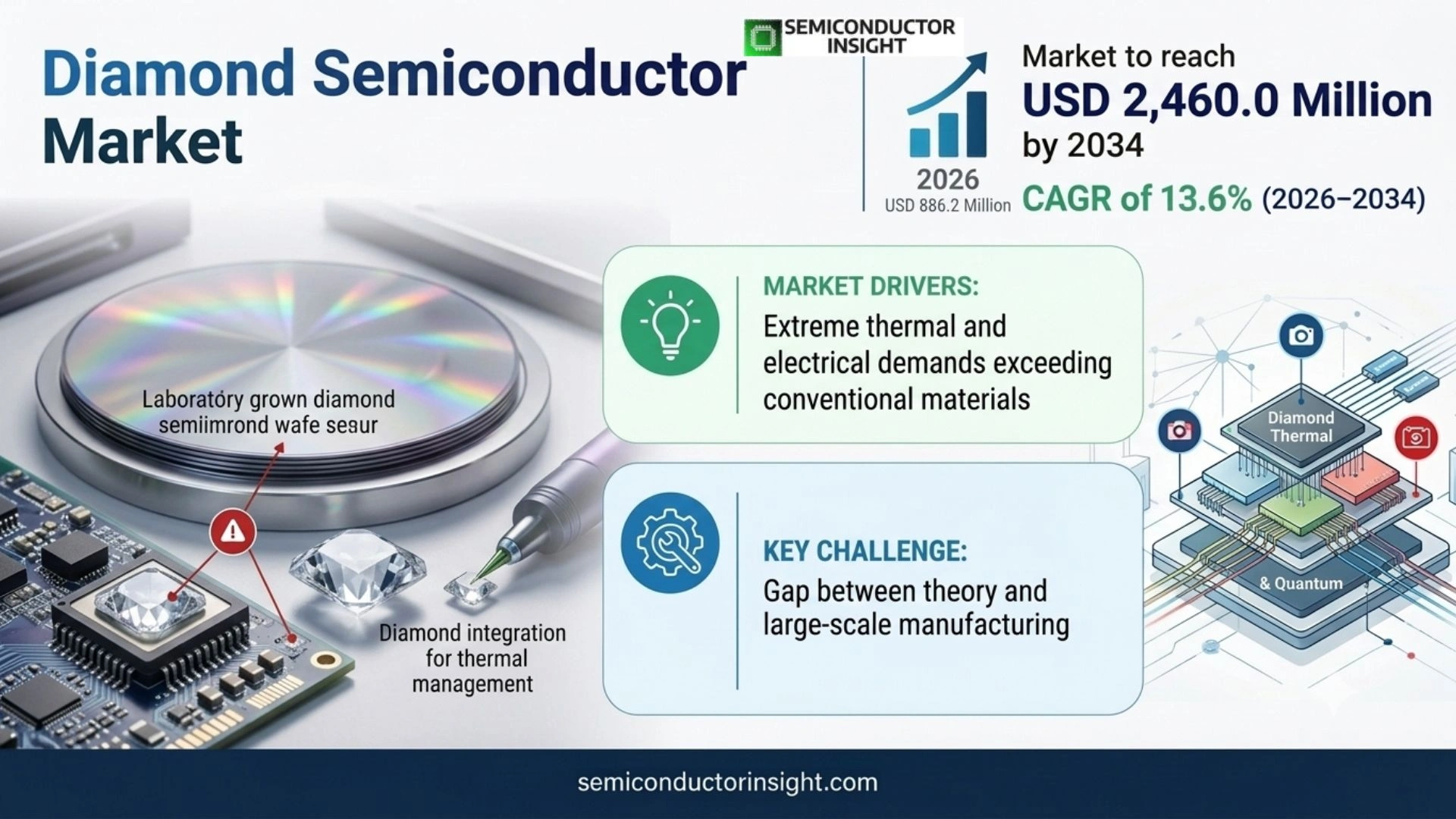
Diamond Semiconductor Market was valued at USD 780.0 million in 2025, is estimated at USD 886.2 million in 2026, and is projected to reach USD 2,460.0 million by 2034, representing a CAGR of 13.6% during 2026–2034. North America is the largest regional market in 2025, while the commercial growth mechanism is increasingly shaped by wafer-scale CVD diamond, thermal management for AI and RF electronics, ultra-wide-bandgap power devices, radiation-hard sensing, and diamond-enabled quantum systems.
Diamond semiconductor technology uses synthetic diamond as an electronic, thermal or quantum material rather than as a mechanical abrasive. Diamond has an ultra-wide bandgap of roughly 5.5 eV, very high breakdown field, exceptional thermal conductivity and strong radiation resistance. These properties make it attractive for high-voltage switches, high-frequency RF electronics, particle detectors, extreme-environment devices, thermal spreading and quantum technologies. The market spans both active semiconductor structures and diamond substrates or composites that improve the performance of conventional silicon, GaN and other devices.
The industry is at a transition point between specialist material supply and scalable semiconductor manufacturing. Electronic-grade CVD diamond is already used in detectors, thermal management and research devices, while active diamond transistors remain constrained by wafer size, doping control, contacts and process reproducibility. Recent work on larger single-crystal wafers and foundry-compatible diamond films addresses these bottlenecks directly, giving device developers a clearer path toward conventional lithography, packaging and high-volume process integration.
Commercial adoption will not occur uniformly. AI accelerators and high-power RF systems can use diamond primarily as a heat-spreading material, allowing immediate value without replacing the active semiconductor. Power electronics requires reliable p-type and n-type devices, stable contacts and cost-effective wafer supply. Quantum systems have different purity and defect-engineering requirements again. The market therefore rewards suppliers able to tailor CVD growth, crystal orientation, defect density, doping and surface preparation to a specific end application rather than selling diamond as a single generic material.
Segment Analysis: By Type
By type, the market is segmented into Single-crystal Diamond Devices and Polycrystalline Diamond Substrates. Single-crystal material is central to active semiconductor and quantum applications because crystal quality directly affects carrier mobility, breakdown performance and coherence. Polycrystalline diamond is already important for thermal spreading and robust substrate functions where very high thermal conductivity matters more than transistor-grade lattice perfection.
| Type | Technical role | Market position |
|---|---|---|
| Single-crystal Diamond Devices | Electronic-grade single-crystal diamond provides the controlled lattice, low defect density and carrier-transport performance needed for transistors, Schottky diodes, radiation detectors, quantum devices and advanced RF structures. CVD growth and heteroepitaxial approaches are being developed to increase wafer area while preserving purity and uniformity. | The strategic growth segment. Active electronics and quantum technologies require single-crystal material, so progress in wafer scale creates disproportionate market impact. The segment carries high value per area but remains limited by substrate size, repeatability, doping and device-process maturity. |
| Polycrystalline Diamond Substrates | Polycrystalline CVD diamond combines very high thermal conductivity with the ability to scale to larger areas more readily than single-crystal material. It is used as a heat spreader, RF thermal-management layer, optical window and mechanical substrate where grain boundaries do not prevent the target function. | The more commercially mature volume segment for thermal management. Large-area material can be incorporated beneath GaN RF devices, AI accelerators and other power-dense electronics. Growth is supported by rising heat flux even before active diamond transistor production reaches scale. |
Why does wafer size determine the pace of commercialization?
Semiconductor manufacturing economics depend on processing many repeatable devices on standardized wafers. Small diamond plates can demonstrate excellent transistor or detector performance, but they do not fit conventional fab handling, lithography and automated packaging flows efficiently. Element Six and Orbray have established a reproducible 3-inch single-crystal diamond process and are developing 4-inch substrates, while 2-inch wafers are being prepared for epitaxial and thermal-bonding applications. Each increase in diameter improves the potential number of devices per run and makes integration with established semiconductor equipment more practical.
Segment Analysis: By Application
By application, the market includes Power Conversion for Electric-Vehicle Charging Infrastructure, High-Frequency RF Amplifiers for Communications, Quantum-Computing Qubit Substrates, and Others. Power conversion has the clearest active-device opportunity because diamond can theoretically support higher electric fields and power density, while RF thermal management and quantum devices provide important early commercial routes that use different parts of the material’s performance envelope.
| Application | Demand characteristics |
|---|---|
| Power Conversion for Electric-Vehicle Charging Infrastructure | High-power chargers, industrial converters and future traction systems benefit from switches that can operate at high voltage, high junction temperature and high power density. Diamond’s wide bandgap and thermal conductivity could reduce conduction losses and cooling requirements, but commercial adoption depends on reproducible doping, reliable contacts, large substrates and device qualification. |
| High-Frequency RF Amplifiers for Communications | GaN RF amplifiers used in radar, satellite communications, telecom infrastructure and future 6G systems generate extreme heat flux. Diamond can be used as a substrate or heat spreader close to the active region, lowering junction temperature and allowing higher RF power density. This route avoids the need to replace GaN as the active semiconductor and is therefore closer to volume deployment. |
| Quantum-Computing Qubit Substrates | Diamond can host nitrogen-vacancy and other color centers used for quantum sensing, memories and photonic interconnects. Quantum-grade material requires controlled impurities and engineered defects rather than simply maximum thermal conductivity. Foundry-compatible diamond films are important because they allow photonic and quantum structures to be fabricated using established semiconductor tools and heterogeneous integration. |
| Others | Additional applications include radiation-hard particle detectors, deep-ultraviolet optoelectronics, high-temperature sensing, space electronics, thermal management beneath AI accelerators and specialized scientific instrumentation. These markets are smaller individually but can support premium material pricing because conventional semiconductors may fail under the required heat, radiation or electric-field conditions. |
Why is thermal management a nearer-term opportunity than an all-diamond power switch?
A diamond heat spreader can improve an existing GaN, silicon or advanced-package architecture without requiring designers to solve every challenge of diamond transistor fabrication. Element Six is commercializing CVD and copper-diamond products for RF, AI and HPC thermal management, while active diamond devices still face doping, contact and wafer-scale process hurdles. Thermal integration therefore monetizes diamond’s strongest physical property immediately and builds manufacturing scale that can later support active-device markets. This creates a staged commercialization path rather than a single abrupt replacement of SiC or GaN.
Regional Analysis
North America is the leading current Diamond Semiconductor market because the United States combines wafer-scale CVD diamond manufacturing, defense-backed ultra-wide-bandgap programs, AI and HPC thermal-management demand, quantum-networking development and advanced semiconductor research. Asia Pacific is a major technology center through Japan’s diamond-wafer and transistor research, while Europe contributes strong materials, quantum and industrial programs.
How do regional diamond-semiconductor ecosystems differ?
North America combines end-market demand with government-backed semiconductor and defense research, giving it the strongest current commercialization ecosystem. Asia Pacific contributes critical materials and device development, especially in Japan, while also offering large future markets in power electronics and communications. Europe has leading synthetic-diamond and quantum expertise through the United Kingdom, Germany and other research centers. South America remains an early research and import market, and the Middle East and Africa are more closely tied to quantum, defense and advanced-technology diversification programs than to domestic wafer production.
| Region | Position | Growth outlook | Demand profile | What decides supplier selection |
|---|---|---|---|---|
| North America | Largest current market | Strong | Defense, AI/HPC, quantum and advanced semiconductor led | Material quality, wafer scale, security of supply and demonstrated device performance |
| Asia Pacific | Major technology and growth region | Very strong | Wafer technology, power electronics and communications led | Crystal quality, manufacturability, cost and device integration |
| Europe | Research and specialty-material stronghold | Strong | Quantum, industrial, RF and advanced-material led | Research partnerships, qualification, sustainability and precision material control |
| South America | Early-stage market | Long-term | Research, energy and imported advanced electronics | Access to material, funding, technical partnerships and application proof |
| Middle East & Africa | Emerging innovation market | Selective | Quantum, defense, telecom and sovereign-technology led | Partnerships, skills, import access and mission-specific performance |
Competitive Landscape
Competition spans synthetic-diamond material producers, semiconductor-device researchers, quantum-technology companies and specialized detector or substrate suppliers. Element Six and Sumitomo Electric bring scale and long materials experience, while companies such as Applied Diamond, Diamond Materials and New Diamond Materials focus on high-purity substrates and engineered forms. IBM Research and quantum specialists influence the device roadmap even when they do not operate as conventional diamond wafer vendors.
Element Six has the broadest combination of CVD material development, large-area production and end-market programs, including thermal management, RF, quantum and ultra-wide-bandgap semiconductor research. Its partnership with Orbray is particularly important because wafer scale is a critical barrier to active-device economics. Sumitomo Electric brings advanced-material and electronics expertise, while Diamond Materials, Applied Diamond and other specialists serve detector, substrate and research customers with high-purity material.
Quantum applications introduce a different competitive structure. IBM Research, Quantum Diamond Inc., QDI Technologies and other developers work on device architectures, color centers and quantum sensing rather than simply selling raw diamond. Element Six’s collaboration with IonQ demonstrates how material companies can become embedded in a semiconductor-like platform by engineering film thickness, purity and bonding so that customers can use established lithography and photonic integration.
The market is likely to remain partnership intensive because no single company controls every step from crystal growth through doped epitaxy, device fabrication, packaging and system qualification. Material suppliers need semiconductor process partners, power-device companies need reliable wafers, and quantum developers need defect-engineered films. Companies that create reproducible specifications and scalable interface standards can capture more value than suppliers of undifferentiated synthetic diamond.
| Competitive tier | Representative companies | Commercial basis |
|---|---|---|
| Integrated synthetic-diamond leaders | Element Six, Sumitomo Electric, Diamond Materials | CVD or high-quality diamond growth, electronic-grade material, application engineering and the ability to support semiconductor, RF, detector or thermal-management customers. |
| Specialist substrate and detector suppliers | Applied Diamond, Silex Systems, Scionix, Boston Diamond, New Diamond Materials, Advanced Diamond Technologies | High-purity plates, detector materials, specialized processing, radiation applications and custom engineering for smaller high-value markets. |
| Quantum and advanced-device innovators | IBM Research, Quantum Diamond Inc., QDI Technologies, NanoDiamond, Oxford Instruments (Diamond Division), Furukawa Electric (Diamond Devices) | Quantum devices, advanced characterization, photonics, specialty semiconductor research and integration technologies that extend diamond beyond passive thermal use. |
Key Market Participants
Element Six, Sumitomo Electric, IBM Research, Diamond Materials, Applied Diamond, Silex Systems, Scionix, Boston Diamond, Quantum Diamond Inc., NanoDiamond, QDI Technologies, Oxford Instruments (Diamond Division), Advanced Diamond Technologies, Furukawa Electric (Diamond Devices), New Diamond Materials.
Production Capacity Analysis
Diamond-semiconductor capacity is constrained by crystal growth quality rather than raw carbon availability. Semiconductor-grade single-crystal CVD requires long growth cycles, low contamination, controlled defects and precise polishing. The decisive capacity milestone is the shift from small plates to repeatable wafer-scale material. Polycrystalline diamond can already be produced in larger areas for thermal management, but active power and quantum devices require tighter material specifications.
CVD growth systems create diamond by depositing carbon atoms onto a seed under tightly controlled plasma conditions. Semiconductor applications require much lower impurity and defect levels than cutting tools or general industrial diamond. Growth uniformity becomes harder as diameter increases, so a 3-inch wafer is not simply a scaled version of a small crystal. Thickness, stress, dislocations and surface quality must remain within limits across the full area.
Doping is a second capacity constraint. Boron-doped p-type diamond is relatively well established, while reliable n-type material has historically been far more difficult. Without both conductivity types, complementary logic and many efficient power-device structures remain limited. NIMS work on n-channel diamond devices demonstrates progress, but industrial production requires repeatability across wafers, contact resistance control and stable electrical behavior over temperature and lifetime.
Polishing, bonding and integration add further bottlenecks because diamond is extremely hard and chemically robust. Thermal-management applications need low thermal boundary resistance between diamond and the active semiconductor, while quantum films must be bonded without damaging defect states. As wafer size rises, equipment for thinning, surface preparation, metrology and automated handling becomes increasingly important to yield and cost.
| Capacity layer | Where it concentrates | Commercial constraint |
|---|---|---|
| Electronic-grade CVD growth | United States, United Kingdom/Europe, Japan and specialist global facilities | Large-area single-crystal uniformity, impurity control, long growth cycles and capital-intensive plasma reactors limit rapid expansion. |
| Doping & epitaxy | Research and specialist semiconductor centers in Japan, United States and Europe | Reliable n-type material, low-resistance contacts and repeatable junction formation remain core active-device challenges. |
| Polishing, bonding & substrate preparation | Specialist diamond processors and semiconductor integration partners | Extreme hardness, surface damage, thermal-interface resistance and flatness control determine usable wafer yield. |
| Device fabrication & qualification | Defense, quantum and power-electronics research fabs | Process compatibility, reliability data, packaging and customer qualification must mature before high-volume active devices can scale. |
Market Dynamics
The market is pulled by extreme thermal and electrical requirements that are exceeding conventional material limits, but it is restrained by the gap between diamond’s theoretical properties and semiconductor-grade manufacturability. The fastest commercial progress occurs where diamond can be inserted into an existing device or package as a thermal or quantum material, while fully active diamond power electronics requires a longer qualification and process-development cycle.
Market Drivers
| Factor | Directional impact | Why it matters |
|---|---|---|
| AI and HPC thermal density | High | Higher accelerator power and chiplet integration increase heat flux, creating demand for materials that move heat closer to the junction. |
| High-power RF and 6G systems | High | GaN amplifiers benefit from diamond heat spreading, while future RF devices can exploit diamond’s high breakdown field and carrier transport. |
| Ultra-wide-bandgap power electronics | High | Higher voltage and temperature requirements create a long-term opportunity for diamond switches beyond the limits of silicon, SiC and GaN. |
| Quantum sensing and networking | Medium-High | Color centers and engineered diamond films enable quantum memories, sensors and photonic interconnects with high-value performance requirements. |
AI packages are approaching conventional thermal limits
Accelerator packages combine large silicon die, HBM stacks and high-current power delivery in increasingly dense assemblies. Removing heat through conventional copper and ceramic structures becomes more difficult as local heat flux rises. Diamond can provide much higher thermal conductivity close to the junction, allowing lower temperature or higher sustained performance. This gives the material an immediate commercial role even if the active transistor remains silicon.
RF power density makes diamond valuable beneath GaN
High-power GaN amplifiers used in radar, satellite communications and future wireless infrastructure are often thermally limited before the semiconductor reaches its electrical potential. CVD diamond beneath or adjacent to GaN can reduce channel temperature and improve lifetime. Because the active RF device architecture remains familiar, this hybrid approach can scale earlier than a fully diamond transistor while still capturing significant system value.
Power conversion creates the largest long-term active-device opportunity
Diamond’s high breakdown field and thermal conductivity could allow switches to operate at higher voltage and current density with smaller cooling systems. Fast chargers, grid converters and extreme-environment power supplies are natural targets. The opportunity is large, but commercialization requires wafer-scale material, controlled doping and contacts that remain stable under high fields and temperature cycling.
Quantum applications value defects rather than perfect crystals alone
Quantum sensing and networking use engineered color centers such as nitrogen-vacancy defects that can store or manipulate quantum information. The manufacturing challenge is to create those defects with the correct density and position while preserving coherence. Foundry-compatible diamond films open a path to integrate quantum memories with silicon photonics, creating a high-value application that follows different economics from power electronics.
Market Restraints
| Factor | Directional impact | Why it matters |
|---|---|---|
| Wafer-scale single-crystal availability | High | Small substrates limit device count, process compatibility and manufacturing economics for active semiconductor applications. |
| Doping and contact control | High | Reliable n-type diamond and low-resistance contacts remain difficult, constraining practical transistor architectures. |
| High material and processing cost | High | Long CVD growth, polishing and low yields keep semiconductor-grade diamond expensive relative to established SiC and GaN. |
| Competing wide-bandgap technologies | Medium-High | SiC and GaN already have mature supply chains, qualified devices and falling costs in many power and RF applications. |
Small wafers prevent conventional semiconductor economics
A few square centimeters of excellent diamond can demonstrate a device but cannot deliver the cost structure of standardized wafer processing. Lithography tools, deposition systems and automated packaging are designed around repeatable wafer formats. As a result, crystal-growth companies must improve diameter, flatness, stress and uniformity simultaneously. Progress to 3-inch and 4-inch formats is strategically more important than isolated record device performance.
N-type doping remains a fundamental technical barrier
Boron provides useful p-type conductivity, but creating stable, high-quality n-type diamond has been much harder. This limits complementary electronics and several power-device structures. Research has made meaningful progress, including n-channel transistors, yet commercial production requires controlled carrier concentration, low contact resistance and reproducibility across large wafers. Until these conditions are routine, active diamond devices will remain more specialized than SiC or GaN.
Cost must be justified at the system level
Electronic-grade CVD diamond is expensive because growth is slow and polishing is difficult. The material therefore needs to eliminate enough cooling hardware, improve lifetime or enable enough power density to offset its price. AI accelerators, radar and space electronics can support this premium earlier than cost-sensitive consumer electronics. As manufacturing scales, larger wafers and composite products can broaden the addressable market by lowering cost per usable area.
SiC and GaN keep improving
Diamond is not entering an empty market. SiC has large automotive and industrial power-device production, while GaN is established in RF and expanding in power conversion. Both technologies benefit from mature foundries, packaging and qualification data. Diamond must therefore target performance conditions where the existing materials face clear thermal, voltage or radiation limits rather than competing on theoretical figures of merit alone.
Market Opportunities
Wafer-scale single-crystal diamond
Reproducible 3-inch and future 4-inch wafers create the foundation for conventional semiconductor processing. Suppliers that can deliver consistent electronic-grade substrates with low dislocation density and predictable orientation can become strategic partners to power, RF and quantum device developers. Scale also lowers the cost of qualification because customers can run more devices through a standardized process flow.
AI accelerator thermal management
Thermal constraints are becoming a limiting factor in AI package performance. CVD diamond and copper-diamond composites can move heat from GPU and accelerator hotspots into cold plates or package lids more efficiently than conventional materials. This application can reach meaningful revenue without waiting for active diamond electronics and can use larger-area polycrystalline or composite materials.
6G and high-power RF electronics
Future radio systems will increase frequency, bandwidth and power density, while radar and satellite platforms already operate under severe thermal limits. Diamond substrates and heat spreaders can raise GaN amplifier performance today, and active diamond RF devices may become viable as wafer and doping technology improve. Defense and telecom customers can justify high material prices when size, weight and power are mission critical.
Quantum networking and sensing
Diamond color centers support quantum memories, magnetic sensing and photonic interconnects. Foundry-compatible thin films make it possible to combine diamond with silicon and silicon-nitride photonics using standard semiconductor tools. Companies that control both quantum-grade material and scalable bonding can participate in emerging networked quantum-computing architectures before the broader power-semiconductor market fully matures.
Supply Chain Analysis
CVD Growth & Crystal Engineering. Value is concentrated in the ability to grow large areas with repeatable material properties. Electronic-grade applications require much tighter control than industrial diamond, so plasma chemistry, seed quality, temperature and growth stress are closely managed. Suppliers with established CVD reactors and years of defect-control knowledge have a significant barrier to entry.
Doping, Polishing & Surface Prep. Diamond must be transformed from a grown crystal into a semiconductor-ready surface. Doping establishes conductivity, while polishing removes roughness without creating subsurface damage. Bonding applications need flat, clean interfaces with low thermal resistance, and quantum films require processing that preserves engineered defect states. These steps can determine final yield as much as the original CVD growth.
Device / Package Integration. Active devices require lithography, etch, dielectric deposition, contacts and passivation adapted to diamond chemistry. Thermal products instead need high-quality metal or semiconductor bonding. Quantum products may be transferred onto silicon or silicon-nitride photonic circuits. The integration route therefore varies by application, making application engineering a major part of the supplier value proposition.
Qualification & End Systems. Customers adopt diamond only when it delivers a measurable system advantage. Power companies test switching loss and lifetime, RF developers measure channel temperature and output power, AI designers evaluate junction temperature, and quantum companies measure coherence and optical coupling. Qualification data converts exceptional material properties into an engineering specification that purchasing teams can defend.
Recent Developments in the Diamond Semiconductor Market
Developments tracked to September 2026. Entries are dated to the official publication date where available.
- 16 June 2026 Wafer scale
Element Six and Orbray announced a reproducible 3-inch wafer-scale single-crystal diamond process and continued development toward 4-inch substrates. Two-inch wafers for epitaxial and thermal-bonding applications are also moving toward production. Larger standardized wafers are a critical step toward conventional semiconductor processing and lower cost per device. Source - 4 September 2025 Quantum
IonQ and Element Six reported foundry-compatible quantum-grade diamond films. The films can be bonded to silicon and silicon-nitride substrates and processed with standard semiconductor manufacturing tools, supporting scalable quantum memories, sensors and photonic interconnects. The development addresses the gap between bespoke diamond quantum devices and repeatable chip-scale manufacturing. Source - 7 April 2025 Joint venture
Bosch and Element Six established a company focused on diamond-enabled quantum sensing. The partnership combines engineered synthetic diamond with Bosch sensor development and targets commercial applications in medicine and mobility. It provides a direct industrial route for diamond color-center technologies beyond academic research. Source - 22 March 2025 Device
NIMS highlighted development of an n-channel diamond field-effect transistor. Reliable n-type conduction has been one of the major obstacles to complementary diamond electronics, so progress in n-channel devices broadens the architectures available for future power devices and integrated circuits. Source - 22 January 2025 Thermal
Element Six introduced a copper-diamond composite for advanced semiconductor thermal management. The company positions the material for AI, high-performance computing and GaN RF devices, with thermal conductivity around 800 W/mK. Composite products create a practical near-term route to diamond adoption by improving existing semiconductor packages rather than requiring a new transistor technology. Source
Report Scope & Segmentation
| Attribute | Coverage |
|---|---|
| Report title | Diamond Semiconductor Market, Trends, Business Strategies 2026-2034 |
| Base / estimate / forecast | 2025 base year; 2026 estimated year; 2034 forecast end year; CAGR measured for 2026–2034. |
| By Type | Single-crystal diamond devices; Polycrystalline diamond substrates |
| By Application | Power conversion for electric-vehicle charging infrastructure; High-frequency RF amplifiers for communications; Quantum-computing qubit substrates; Others |
| By End User | Automotive manufacturers; Aerospace and defense contractors; Telecommunications equipment suppliers |
| By Technology | Chemical vapor deposition (CVD) growth; High-pressure high-temperature (HPHT) synthesis; Hybrid integration techniques |
| By Performance Attribute | Thermal conductivity; Breakdown voltage; Radiation hardness |
| Regions | North America, Europe, Asia-Pacific, South America, and Middle East & Africa, with country-level analysis across the principal national markets. |
| Companies | Element Six, Sumitomo Electric, IBM Research, Diamond Materials, Applied Diamond, Silex Systems, Scionix, Boston Diamond, Quantum Diamond Inc., NanoDiamond, QDI Technologies, Oxford Instruments (Diamond Division), Advanced Diamond Technologies, Furukawa Electric (Diamond Devices), New Diamond Materials |
| Customization Scope | Free report customization (equivalent to up to 4 analyst working days) with purchase. Addition or alteration to country, regional and segment scope. |
Frequently Asked Questions
What is the size of the Diamond Semiconductor market?
The global Diamond Semiconductor market is valued at approximately USD 780.0 million in 2025, is estimated at USD 886.2 million in 2026, and is projected to reach USD 2,460.0 million by 2034. This represents a 13.6% CAGR during 2026–2034, supported by wafer-scale CVD progress, AI and RF thermal management, ultra-wide-bandgap power electronics and quantum applications.
Why is diamond attractive as a semiconductor material?
Diamond combines an ultra-wide bandgap of roughly 5.5 eV with very high breakdown field, exceptional thermal conductivity and strong radiation resistance. These properties allow engineers to consider higher voltage, higher power density, high-frequency operation and extreme environments. The challenge is converting those theoretical advantages into large, doped, process-compatible wafers and reliable devices at a cost customers can justify.
Which region leads the Diamond Semiconductor market?
North America is the leading current market because the United States combines advanced CVD diamond manufacturing, defense-backed ultra-wide-bandgap programs, AI and HPC thermal-management demand, satellite and RF applications, and quantum-networking commercialization. Asia Pacific is also strategically important through Japanese wafer-scale growth and transistor research, while Europe has strong synthetic-diamond and quantum-sensing capability.
What is the most important Diamond Semiconductor type?
Single-crystal diamond devices are the most strategically important type because active power, RF, detector and quantum applications require highly controlled crystal quality. Polycrystalline diamond is more mature for thermal management because it can be produced over larger areas and still delivers very high heat spreading even when grain boundaries prevent transistor-grade electronic performance.
What is the leading application for diamond semiconductors?
Power conversion is the leading long-term active-device application because diamond could support very high voltage and power density with reduced cooling. In the near term, thermal management for GaN RF devices and AI accelerators may commercialize faster because diamond can be added as a heat spreader without requiring a complete diamond transistor process.
What is the biggest manufacturing challenge for diamond semiconductors?
The biggest challenge is wafer-scale, semiconductor-grade single-crystal material. Small diamond plates can demonstrate excellent devices, but conventional fabs need repeatable wafers with controlled flatness, defects, thickness and surface quality. Progress to reproducible 3-inch wafers and future 4-inch substrates is therefore a major industrialization milestone, alongside better n-type doping and reliable electrical contacts.
Why is n-type diamond important?
Complementary electronics and many efficient transistor structures require both p-type and n-type conduction. Boron-doped p-type diamond is relatively well established, but n-type diamond has historically been much more difficult to control. Recent n-channel transistor progress expands the possible device architectures, yet industrial adoption still requires stable carrier concentration, low-resistance contacts and reproducibility across large wafers.
How can diamond help AI accelerators?
AI accelerators and HBM-based packages generate very high local heat flux. Diamond has far higher thermal conductivity than most conventional package materials, so a CVD diamond or copper-diamond component can move heat away from hotspots and lower junction temperature. This can improve sustained performance, reliability or cooling-system size without changing the underlying silicon compute die.
Who are the major companies in the Diamond Semiconductor market?
Companies profiled include Element Six, Sumitomo Electric, IBM Research, Diamond Materials, Applied Diamond, Silex Systems, Scionix, Boston Diamond, Quantum Diamond Inc., NanoDiamond, QDI Technologies, Oxford Instruments, Advanced Diamond Technologies, Furukawa Electric and New Diamond Materials. Their roles range from crystal growth and substrates to detectors, quantum devices and advanced semiconductor integration.
Where are the strongest future opportunities for diamond semiconductors?
The strongest opportunities are in wafer-scale single-crystal substrates, AI accelerator thermal management, high-power RF and 6G systems, ultra-wide-bandgap power conversion, quantum networking and radiation-hard sensing. Commercial timing will differ by application: thermal and detector uses can scale earlier, while fully active diamond power devices require additional progress in wafer size, doping, contacts and process qualification.
Research Sources & Evidence Base
Get Sample Report PDF for Exclusive Insights
Report Sample Includes
- Table of Contents
- List of Tables & Figures
- Charts, Research Methodology, and more...
 Download Sample Report PDF