Space Electronics & Radiation-Hardened Semiconductor Market Insights
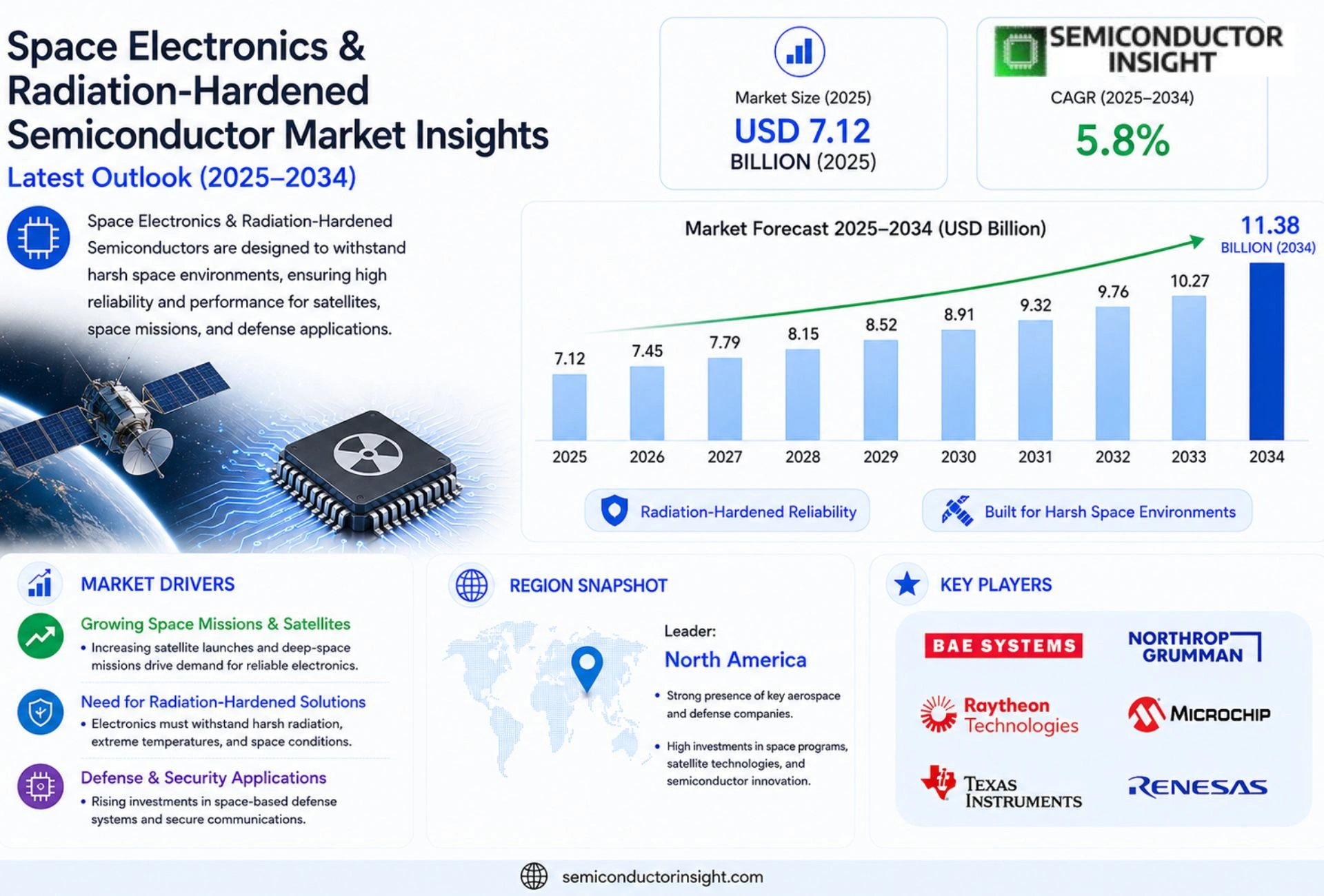
Global Space Electronics & Radiation-Hardened Semiconductor market size was valued at USD 7.12 billion in 2025. The market is projected to grow from USD 7.45 billion in 2026 to USD 11.38 billion by 2034, exhibiting a CAGR of 5.8% during the forecast period.
Space electronics comprise ruggedized components,such as power converters, sensors, and processors,designed for operation in vacuum, extreme temperature cycles, and high‑radiation environments. Radiation‑hardened semiconductors are specially fabricated silicon devices that maintain functionality under ionizing radiation levels encountered in orbit or deep‑space missions.
The market is accelerating because satellite constellations are expanding rapidly, defense budgets are allocating more funds to resilient space assets, and commercial launch activity is reaching record levels. Furthermore, advancements in silicon‑on‑insulator (SOI) technology and increased demand for autonomous navigation drive adoption. Key players such as BAE Systems, Northrop Grumman, Airbus Defence and Space, L3Harris Technologies (formerly Cobham), and Teledyne e2v are actively investing in next‑generation radiation‑hardening solutions.
MARKET DRIVERS
Increasing Satellite Constellations
Space Electronics & Radiation-Hardened Semiconductor market is being propelled by a rapid expansion of low‑Earth‑orbit constellations. Operators are launching hundreds of small satellites, creating sustained demand for radiation‑tolerant components that can endure prolonged exposure to the harsh space environment.
Government Investments in Deep‑Space Exploration
National space agencies have announced multi‑year programs for lunar bases and Mars missions, directly driving procurement of hardened semiconductors. These initiatives require electronics that retain functionality under high‑energy particle flux, reinforcing market growth.
➤ “Radiation‑hardening is now a baseline requirement for any spacecraft destined for beyond‑LEO missions,” a senior analyst noted.
In addition, the convergence of miniaturization trends and advanced packaging technologies is enabling more power‑efficient, high‑performance modules, further expanding the addressable market for space‑grade electronics.
MARKET CHALLENGES
Supply Chain Vulnerabilities
Reliance on a limited number of specialized foundries creates bottlenecks. Any disruption,whether geopolitical or natural,can delay delivery of critical radiation‑hardening services, affecting mission timelines.
Other Challenges
Manufacturing Complexity
The fabrication of radiation‑hardened chips involves additional screening, annealing, and testing steps, driving up unit costs and extending lead times compared with commercial counterparts.
MARKET RESTRAINTS
Stringent Certification Requirements
Space‑grade components must meet rigorous aerospace standards such as ECSS and NASA‑STD. Achieving certification demands extensive validation, which raises development expenses and limits the pool of qualified suppliers.
Moreover, the necessity for long‑duration reliability testing can extend product qualification cycles by years, slowing time‑to‑market for innovative designs.
Limited access to high‑energy radiation testing facilities also constrains smaller firms, reinforcing market concentration among established players.
MARKET OPPORTUNITIES
Emerging Commercial Space Activities
The rise of commercial lunar landers and on‑orbit servicing missions opens new niches for hardened electronics. Companies are seeking reliable, low‑mass components to support high‑precision navigation and autonomous operations.
Advances in system‑in‑package (SiP) and 3D‑IC architectures are enabling higher functionality per unit volume, which aligns with the payload constraints of small‑satellite platforms.
Strategic partnerships between defense contractors and private launch providers present collaborative avenues for co‑development, accelerating technology transfer and broadening market reach.
Space Electronics & Radiation-Hardened Semiconductor Market Trends
Revenue Expansion Fueled by Mega‑Constellations
The global market recorded a valuation of USD 7.12 billion in 2025 and is projected to reach USD 11.38 billion by 2034, reflecting a steady compound annual growth rate of 5.8 %. The primary catalyst is the rapid deployment of large‑scale satellite constellations, which demand high‑reliability power converters, sensors, and processors capable of surviving harsh orbital conditions. Parallel growth in commercial launch cadence and heightened defense spending on resilient space platforms further reinforce demand for ruggedized components. These dynamics collectively drive a robust upward trajectory for Space Electronics & Radiation-Hardened Semiconductor market.
Other Trends
Silicon‑On‑Insulator (SOI) Innovation
Advancements in silicon‑on‑insulator technology have become a cornerstone of radiation‑hardening strategies. SOI wafers provide an inherent isolation layer that reduces charge collection during ionizing events, enabling semiconductor devices to maintain functional integrity in high‑radiation environments. Recent process refinements have improved yield and lowered production costs, encouraging broader adoption across both defense and commercial satellite programs. The resulting performance gains are evident in enhanced signal‑to‑noise ratios for navigation payloads and increased lifespan for power management circuitry.
Defense‑Sector Investment in Radiation‑Hardening
National security agencies are allocating a growing share of their budgets to hardening space assets against electromagnetic and particle threats. Leading firms such as BAE Systems, Northrop Grumman, Airbus Defence and Space, L3Harris Technologies, and Teledyne e2v have announced multi‑year R&D programs focused on next‑generation hardened processors and memory modules. These initiatives aim to secure command‑and‑control links, maintain mission‑critical data integrity, and extend the operational lifespan of high‑value reconnaissance satellites. The convergence of strategic defense imperatives and commercial supply‑chain improvements positions the sector for sustained expansion.
COMPETITIVE LANDSCAPE
Key Industry Players
Navigating the Competitive Terrain of the Global Space Electronics & Radiation-Hardened Semiconductor Market
The global Space Electronics & Radiation-Hardened Semiconductor market is characterized by a concentrated competitive structure, with a handful of technologically advanced defense and aerospace conglomerates commanding significant market influence. BAE Systems stands out as one of the foremost leaders in radiation-hardened microelectronics, offering a broad portfolio of space-grade ASICs, FPGAs, and processors specifically engineered to withstand high-energy particle environments encountered in low Earth orbit and deep-space missions. Northrop Grumman and Airbus Defence and Space similarly occupy dominant positions, leveraging decades of heritage in space system integration to deliver mission-critical electronic subsystems to government, defense, and commercial satellite operators worldwide. L3Harris Technologies, following its acquisition of Cobham’s space electronics division, has further consolidated its position as a tier-one supplier of radiation-tolerant power management and signal processing solutions. These market leaders continuously invest in silicon-on-insulator (SOI) fabrication technology and advanced packaging methods to extend device reliability across the full spectrum of orbital radiation environments, sustaining their competitive advantage as satellite constellation deployments reach unprecedented scale.
Beyond the market frontrunners, several specialized and niche players contribute meaningfully to the competitive ecosystem of Space Electronics & Radiation-Hardened Semiconductor market. Teledyne e2v has carved out a distinguished position through its radiation-hardened imaging sensors, analog-to-digital converters, and power transistors used across both institutional and commercial space programs. Texas Instruments and Microchip Technology (formerly Microsemi/Actel) offer established product lines of radiation-tolerant logic, memory, and mixed-signal devices that cater to cost-sensitive small satellite developers. Renesas Electronics, Maxwell Technologies (acquired by AVX), and Cobham Advanced Electronic Solutions (CAES) supply a range of rad-hard power regulators and discrete components integral to satellite bus architectures. Additionally, Xilinx (now part of AMD) and Honeywell Aerospace provide space-grade FPGAs and inertial measurement units, respectively, addressing the growing demand for reconfigurable onboard processing and autonomous navigation in next-generation spacecraft. The combined activity of these players reflects an intensely innovative competitive landscape driven by increasing launch cadences and the strategic imperative to deliver resilient electronics for both civil and national security space missions.
List of Key Space Electronics & Radiation-Hardened Semiconductor Companies Profiled
- BAE Systems
- Northrop Grumman
- Airbus Defence and Space
- L3Harris Technologies
- Teledyne e2v
- Texas Instruments
- Microchip Technology (Microsemi)
- Renesas Electronics
- Cobham Advanced Electronic Solutions (CAES)
- Maxwell Technologies (AVX)
- Xilinx (AMD)
- Honeywell Aerospace
- STMicroelectronics
- Infineon Technologies
- Data Device Corporation (DDC)
Segment Analysis:
| Segment Category | Sub-Segments | Key Insights |
| By Type |
|
Radiation‑Hardened ASICs
|
| By Application |
|
Satellite Communications
|
| By End User |
|
Government Space Agencies
|
| By Process Technology |
|
Silicon‑on‑Insulator (SOI)
|
| By Qualification Level |
|
NASA Qualification
|
Regional Analysis: North America
United States
Government funding and strategic partnerships are key drivers for technological advancements and market expansion in the US space sector, directly impacting the demand for advanced semiconductors.
The substantial aerospace and defense industries in the US represent a significant portion of the market, consistently requiring high-reliability, radiation-tolerant electronic components.
Ongoing investments in R&D, particularly in areas like advanced materials and novel semiconductor architectures, are crucial for the future growth of the market in the US.
Efforts to strengthen and diversify the supply chain for critical space electronics are gaining momentum in the US to mitigate potential disruptions.
Europe
Europe is witnessing steady growth in its Space Electronics & Radiation-Hardened Semiconductor Market. The region’s commitment to space exploration, exemplified by the European Space Agency’s (ESA) ambitious programs, is fueling demand. Key players in Europe are focused on developing advanced components for Earth observation, satellite communication, and planetary exploration missions. Business strategies often involve collaborative efforts within the European Union to pool resources and expertise. The market in Europe is characterized by a strong emphasis on innovation and a focus on developing sustainable space technologies. The increasing adoption of commercial satellite services is also contributing to market expansion.
Asia-Pacific
Asia-Pacific is emerging as a high-growth region for Space Electronics & Radiation-Hardened Semiconductor market. Countries like China, India, and Japan are significantly increasing their investments in space programs, creating substantial demand for radiation-hardened components. China’s rapid advancements in space technology are particularly noteworthy, with ambitious plans for lunar exploration and the development of a national space station. The region benefits from a large and cost-effective manufacturing base, which is attracting investment in semiconductor production. Business strategies in Asia-Pacific often prioritize cost competitiveness and rapid deployment of technologies. The growing commercial space sector in the region is also driving market growth.
South America
South America presents a relatively smaller but growing market for Space Electronics & Radiation-Hardened Semiconductors. Countries like Brazil and Argentina have national space programs focused on satellite development and Earth observation. While the market size is currently modest, increasing investments in space infrastructure and the development of local expertise are expected to drive future growth. Business strategies in the region often involve partnerships with international players to access technology and expertise. The potential for commercial applications of space technology is also creating new opportunities for market expansion.
Middle East & Africa
The Middle East & Africa region represents a nascent but promising market for Space Electronics & Radiation-Hardened Semiconductors. Countries like the UAE and Saudi Arabia are investing heavily in space exploration and satellite technology as part of their economic diversification strategies. The establishment of national space agencies and the launch of ambitious space missions are driving demand for advanced components. Business strategies in the region often involve attracting foreign investment and developing local talent. The potential for applications in areas like remote sensing and disaster management is also contributing to market growth.
Report Scope
This market research report provides a comprehensive analysis of the Space Electronics & Radiation-Hardened Semiconductor Market , covering the forecast period 2026–2034. It offers detailed insights into market dynamics, technological advancements, competitive landscape, and key trends shaping the industry.
Key focus areas of the report include:
- Market Overview: The report begins with an overview outlining its current market scenario, key growth indicators, and industry transformation drivers. It discusses macroeconomic factors, demand–supply balance, regulatory landscape, and the strategic role of semiconductors in powering advancements across industries such as automotive, telecommunications, consumer electronics, and industrial automation.
- Market Size & Forecast: Historical data and future projections for revenue, unit shipments, and market value across major regions and segments.
- Segmentation Analysis: Detailed breakdown by product type, technology, application, and end-user industry to identify high-growth segments and investment opportunities.
- Regional Insights: Insights into market performance across North America, Europe, Asia-Pacific, Latin America, and the Middle East & Africa, including country-level analysis where relevant.
- Competitive Landscape: Profiles of leading market participants, including their product offerings, R&D focus, manufacturing capacity, pricing strategies, and recent developments such as mergers, acquisitions, and partnerships.
- Technology Trends & Innovation: Assessment of emerging technologies, integration of AI/IoT, semiconductor design trends, fabrication techniques, and evolving industry standards.
- Market Drivers & Restraints: Evaluation of factors driving market growth along with challenges, supply chain constraints, regulatory issues, and market-entry barriers.
- Stakeholder Insights: Insights for component suppliers, OEMs, system integrators, investors, and policymakers regarding the evolving ecosystem and strategic opportunities.
Primary and secondary research methods are employed, including interviews with industry experts, data from verified sources, and real-time market intelligence to ensure the accuracy and reliability of the insights presented.
FREQUENTLY ASKED QUESTIONS:
What is the current market size of Space Electronics & Radiation-Hardened Semiconductor Market?
-> Global Space Electronics & Radiation-Hardened Semiconductor Market was valued at USD 7.12 billion in 2025 and is expected to reach USD 11.38 billion by 2034.
Which key companies operate Space Electronics & Radiation-Hardened Semiconductor market?
-> Key players include BAE Systems, Northrop Grumman, Airbus Defence and Space, L3Harris Technologies, and Teledyne e2v, among others.
What are the key growth drivers?
-> Key growth drivers include expanding satellite constellations, increasing defense investments in resilient space assets, and rising commercial launch activity.
Which region dominates the market?
-> North America holds a leading share, while Asia-Pacific shows the fastest growth rate.
What are the emerging trends?
-> Emerging trends include advancements in silicon‑on‑insulator (SOI) technology, autonomous navigation demand, and next‑generation radiation‑hardening solutions.

Get Sample Report PDF for Exclusive Insights
Report Sample Includes
- Table of Contents
- List of Tables & Figures
- Charts, Research Methodology, and more...
 Download Sample Report PDF