RF Power Supply Market Insights
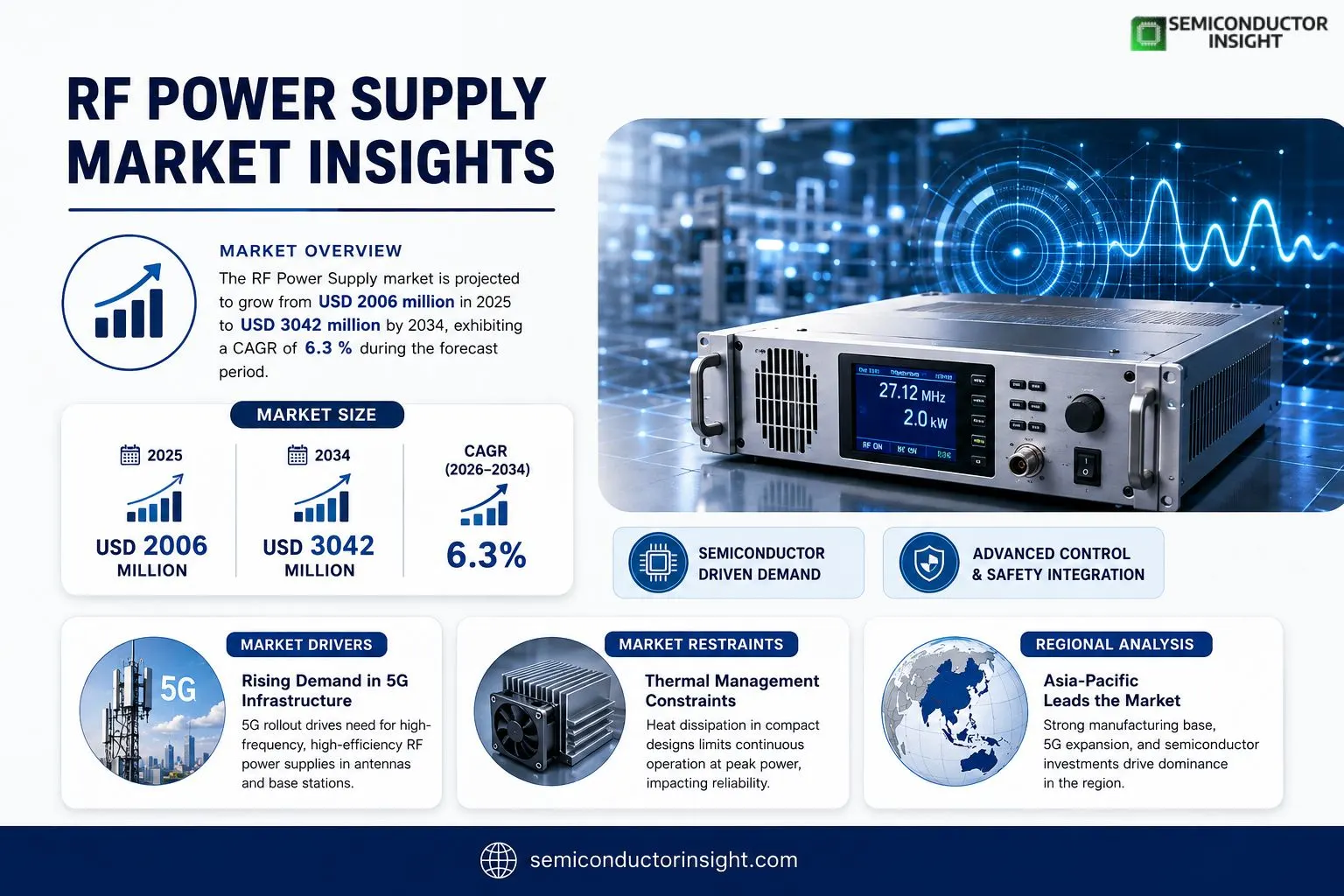
RF Power Supply market size was valued at USD 2006 million in 2025. The market is projected to grow from USD 2006 million in 2025 to USD 3042 million by 2034, exhibiting a CAGR of 6.3 % during the forecast period.
RF power supplies generate a fixed‑frequency sine‑wave voltage within the radio‑frequency band (approximately 3 kHz to 300 GHz). Typical units deliver between 0.3 kW and 15 kW across frequencies such as 2 MHz, 13.56 MHz, 27.12 MHz and higher bands up to 60 MHz, providing stable current and voltage for semiconductor processing, photovoltaics, display manufacturing, medical equipment and sensing applications.The sector’s expansion reflects heightened investment in semiconductor fabrication lines; frequencies of 2 MHz, 13.56 MHz and 27.12 MHz together account for more than sixty percent of demand as of 2024. Core manufacturersincluding Wan Advanced Energy, DAIHEN Corporation, TRUMPF, Adtec Plasma Technology and XP Powercontinue to broaden product portfolios and introduce modular designs that improve efficiency and safety through integrated interlock controls.
MARKET DRIVERS
Rising Demand in 5G Infrastructure
The rollout of 5G networks has forced carriers to upgrade antenna arrays and base‑station modules, each of which relies on high‑frequency, high‑efficiency rf power supplies. Operators are now ordering modules that can handle up to 2 kW at 3 GHz, a capability that was rarely required a decade ago. This shift forces suppliers to expand their product lines, creating a cascade of engineering investment and revenue growth for RF Power Supply Market.
Growth in Industrial Automation
Smart factories increasingly embed microwave heating, plasma etching, and precision welding stationsapplications where a compact, rugged rf power source is indispensable. Manufacturers report a 12 % year‑over‑year increase in equipment orders that specify built‑in power modules, prompting original equipment manufacturers to partner with specialized supply vendors. The convergence of IoT monitoring and deterministic power delivery amplifies this demand curve.
➤ “The next wave of adoption will be driven less by sheer power and more by integration density, forcing a redesign of traditional power architectures.”
At the same time, defense programs are modernizing radar and electronic‑warfare suites, which demand survivable, low‑noise rf power supplies capable of withstanding harsh environments. Budget allocations for next‑generation radar have risen by roughly 8 %, nudging the overall market toward higher‑specification units and opening avenues for premium‑priced solutions.
MARKET CHALLENGES
Thermal Management Constraints
As output levels climb, dissipating heat within constrained form factors becomes a technical bottleneck. Engineers must balance copper‑based heat sinks against electromagnetic interference, and many designs still rely on passive cooling that limits continuous operation at peak power. Failure to resolve these heat‑removal issues can erode reliability metrics, driving customers to defer purchases.
Other Challenges
Regulatory Compliance
Stringent electromagnetic‑compatibility (EMC) standards in Europe and North America force manufacturers to redesign layouts, adding cost and lengthening time‑to‑market. Small and medium‑sized suppliers often lack the certification infrastructure, putting them at a competitive disadvantage.
MARKET RESTRAINTS
Capital‑Intensive Development Cycles
Designing a new rf power supply that meets both high‑efficiency and tight‑size specifications requires multi‑year R&D programs and sophisticated silicon‑on‑silicon processes. The upfront spend often exceeds $15 million, a barrier that discourages entry of new players and can stall innovation pipelines when funding dries up.
MARKET OPPORTUNITIES
Emerging Applications in Renewable Energy
Inverter‑based solar farms and wind‑turbine converters are beginning to incorporate rf power modules for grid‑support functions such as harmonic mitigation and fault‑ride‑through. Early adopters project a 6 % uplift in overall system efficiency, creating a niche yet rapidly expanding segment that could boost RF Power Supply Market’s topline.
RF Power Supply Market Trends
Semiconductor‑Centric Demand Fuels Market Upswing
RF Power Supply Market is currently shaped by the intensive needs of semiconductor fabrication. Frequencies of 2 MHz, 13.56 MHz and 27.12 MHz together command more than 60 % of unit shipments in 2024, reflecting the centrality of these bands in etching, CVD, PVD and ion‑implantation tools. Engineers favour HF supplies for their ability to generate dense plasma, while LF supplies provide the bias needed for energetic ion bombard‑ment. This technical split creates a steady flow of orders for modular supplies that can be tuned to specific process windows, prompting manufacturers to optimise power‑amplifier stages and PID‑controlled detection circuits. The implication for vendors is a pressure to shorten design cycles while maintaining tight tolerance on output power and frequency stability, a prerequisite for yield improvement in advanced nodes.
Other Trends
Expansion into Renewable‑Energy and Display Segments
Beyond semiconductor fabs, RF Power Supply Market is witnessing measurable traction in photovoltaics, LCD production and medical instrumentation. Solar‑cell manufacturing benefits from RF‑driven plasma cleaning, which enhances wafer surface quality and improves conversion efficiency. Display‑panel fabs employ mid‑frequency supplies to drive sputtering processes, enabling finer control of thin‑film thickness. In the medical arena, RF generators support imaging and therapeutic devices where precise waveform shaping is essential. These adjacent applications diversify revenue streams, reduce dependence on a single end‑use, and motivate suppliers to broaden their product portfolios with more compact, low‑power variants that satisfy safety interlock requirements.
Intensified Competition and Technological Innovation
The competitive arena of RF Power Supply Market is crowded with specialists such as Advanced Energy, DAIHEN Corporation, TRUMPF, XP Power and a host of China‑based firms. Their offerings share a common architecture: a DC module feeding an oscillator, a solid‑state power‑amplifier, a detection unit and an interlock controller. Recent product cycles show a shift toward silicon‑based transistors that deliver higher efficiency at reduced thermal load, a trend that aligns with tighter energy‑consumption mandates in high‑volume fabs. Companies that can integrate predictive diagnostics into the interlock module are gaining an edge, as downtime translates directly into lost wafer throughput. For customers, the evolving landscape means greater leverage in negotiating supply contracts, but also a need to assess long‑term serviceability of increasingly sophisticated modules.
COMPETITIVE LANDSCAPEKey Industry Players
RF Power Supply Market – Competitive Outlook
RF Power Supply Market is anchored by a handful of manufacturers that dominate the high‑frequency segment used in semiconductor processing. Advanced Energy (formerly Wan Advanced Energy) holds a disproportionate share thanks to its deep portfolio of solid‑state amplifiers and its ability to integrate control electronics across a 2 MHz to 60 MHz frequency band. Its strategic focus on reliability for plasma etch tools gives it leverage over OEMs that prioritize uptime in fabs. MKS Instruments, another heavyweight, complements its product line with precision DC modules that feed oscillator and amplifier stages, enabling tighter PID loops for bias control. Both firms benefit from long‑term supply agreements with the top three semiconductor equipment makers, translating into recurring revenue streams that reinforce barrier‑to‑entry for new entrants.Beyond the dominant duo, a diverse set of niche players address specialized frequency ranges or regional markets. Companies such as DAIHEN Corporation and TRUMPF excel in the 13.56 MHz and 27.12 MHz bands preferred for thin‑film deposition, while Kyosan Manufacturing and XP Power concentrate on compact, modular supplies for medical and display‑panel applications. Chinese manufacturersincluding Shenzhen Hengyunchang Vacuum Technology, Sichuan Yingjie Electric, and Beijing Huacheng Electronicsare gaining traction in the domestic photovoltaic and LCD sectors by offering cost‑competitive variants that meet local regulatory standards. Smaller outfits like Aifak and Coaxial Power Systems focus on custom interlock and detection modules, carving out value in equipment where safety interlocks are a regulatory necessity.
List of Key RF Power Supply Companies Profiled
- Advanced Energy
- MKS Instruments
- DAIHEN Corporation
- TRUMPF
- Adtec Plasma Technology
- Kyosan Manufacturing
- XP Power
- Shenzhen Hengyunchang Vacuum Technology Co., Ltd.
- Sichuan Yingjie Electric
- Beijing Huacheng Electronics
- ULVAC
- JEOL
- Coaxial Power Systems
- Gmpower
- Generator Research Limited
Segment Analysis:
| Segment Category | Sub-Segments | Key Insights |
| By Type |
|
Solid‑state dominates due to its reliability and compact design.
|
| By Application |
|
Semiconductor manufacturing drives the majority of demand.
|
| By End User |
|
Equipment manufacturers lead because they integrate RF supplies directly into production lines.
|
| By Frequency |
|
Mid‑frequency is most prevalent in current market offerings.
|
| By Integration Technology |
|
Integrated control platforms are gaining traction.
|
Regional Analysis: RF Power Supply Market
Asia‑Pacific
Telecom back‑haul, satellite communications, and advanced radar dominate current deployments, while the rise of smart factories and autonomous systems is nudging manufacturers toward higher‑efficiency designs. Clients are prioritising supplies that can sustain continuous high‑power output without compromising signal integrity, prompting suppliers to refine thermal management and linearity.
Regional standards bodies are tightening emission limits and spectrum allocation rules, especially for millimetre‑wave bands. Compliance requirements are forcing OEMs to adopt more sophisticated shielding and filtering solutions, which in turn drives a shift toward modular architectures that can be quickly re‑qualified across multiple jurisdictions.
The proximity of silicon wafer producers to end‑device assembly plants shortens the procurement cycle, yet geopolitical tensions occasionally ripple through component availability. Companies are hedging risk by diversifying source bases and increasing inventory buffers for critical transistors and high‑Q resonators.
Emerging silicon‑on‑insulator (SOI) processes and wide‑bandgap materials such as GaN are reshaping design philosophies. These technologies enable higher power density and faster switching, which are essential for next‑generation radar and high‑throughput satellite payloads.
North America
North America retains a strategic edge in RF Power Supply Market through its deep R&D capabilities and the presence of several defense contractors. The United States, in particular, is channeling federal funding into next‑generation communications for the armed forces, fostering a demand for rugged, high‑power RF modules that can endure hostile environments. Commercially, the push for private‑5G networks in enterprise campuses and data‑center interconnects is stimulating niche growth, encouraging vendors to develop customizable power solutions that balance performance with tight form‑factor constraints.
Europe
European players leverage stringent regulatory frameworks to assure quality and reliability, which appeals to automotive and aerospace manufacturers seeking certified RF components. The EU’s focus on sustainability is prompting suppliers to improve efficiency metrics and integrate renewable‑energy‑compatible designs. Moreover, collaborations across the continent’s tech clustersespecially in Germany, France, and the Nordic regionare accelerating the adoption of advanced packaging techniques, thereby enhancing power density while reducing thermal footprints.
South America
In South America, market momentum is anchored by expanding mobile broadband penetration and government‑backed initiatives to modernise public safety communications. Countries such as Brazil and Colombia are upgrading legacy networks, which creates a modest but steady demand for medium‑power RF supplies. While the region faces challenges related to import tariffs and limited local manufacturing, strategic partnerships with Asian firms are beginning to alleviate supply constraints and introduce more competitive pricing.
Middle East & Africa
The Middle East & Africa region is witnessing a gradual shift from oil‑centric economies toward diversified digital infrastructures. High‑visibility projectsincluding satellite ground stations in the United Arab Emirates and smart‑city pilots in Kenyarequire resilient RF power solutions capable of operating in extreme temperatures. Although the overall market size remains modest, the willingness of sovereign wealth funds to invest in telecom and defence upgrades signals a growing appetite for sophisticated, high‑reliability RF power supplies.
Report Scope
This market research report provides a comprehensive analysis of the RF Power Supply Market , covering the forecast period 2026–2034. It offers detailed insights into market dynamics, technological advancements, competitive landscape, and key trends shaping the industry.
Key focus areas of the report include:
- Market Overview: The report begins with an overview outlining its current market scenario, key growth indicators, and industry transformation drivers. It discusses macroeconomic factors, demand–supply balance, regulatory landscape, and the strategic role of semiconductors in powering advancements across industries such as automotive, telecommunications, consumer electronics, and industrial automation.
- Market Size & Forecast: Historical data and future projections for revenue, unit shipments, and market value across major regions and segments.
- Segmentation Analysis: Detailed breakdown by product type, technology, application, and end-user industry to identify high-growth segments and investment opportunities.
- Regional Insights: Insights into market performance across North America, Europe, Asia-Pacific, Latin America, and the Middle East & Africa, including country-level analysis where relevant.
- Competitive Landscape: Profiles of leading market participants, including their product offerings, R&D focus, manufacturing capacity, pricing strategies, and recent developments such as mergers, acquisitions, and partnerships.
- Technology Trends & Innovation: Assessment of emerging technologies, integration of AI/IoT, semiconductor design trends, fabrication techniques, and evolving industry standards.
- Market Drivers & Restraints: Evaluation of factors driving market growth along with challenges, supply chain constraints, regulatory issues, and market-entry barriers.
- Stakeholder Insights: Insights for component suppliers, OEMs, system integrators, investors, and policymakers regarding the evolving ecosystem and strategic opportunities.
Primary and secondary research methods are employed, including interviews with industry experts, data from verified sources, and real-time market intelligence to ensure the accuracy and reliability of the insights presented.
FREQUENTLY ASKED QUESTIONS:
What is the current market size of RF Power Supply Market?
-> RF Power Supply Market was valued at USD 2006 million in 2025 and is expected to reach USD 3042 million by 2034. The projected CAGR for the forecast period is 6.3%.
Which key companies operate in RF Power Supply Market?
-> Key players include Wan Advanced Energy, Wanji Instruments, Comed, DAIHEN Corporation, TRUMPF, Adtec Plasma Technology, Kyosan Manufacturing, XP Power, Aifak, Shenzhen Hengyunchang Vacuum Technology, Sichuan Yingjie Electric, Beijing Huacheng Electronics, among others.
What are the key growth drivers?
-> Key growth drivers include expanding semiconductor manufacturing, increasing demand for RF power in photovoltaic and display panel production, and rising adoption of RF sensing in medical and industrial applications.
Which region dominates the market?
-> Asia commands the largest market share, driven by major semiconductor hubs in China, Japan, and South Korea, while Europe and North America remain significant contributors.
What are the emerging trends?
-> Emerging trends include the growing use of 2 MHz, 13.56 MHz and 27.12 MHz frequency modules for semiconductor processes, integration of HF and LF power supplies for enhanced plasma control, and development of compact solid‑state RF generators.
Get Sample Report PDF for Exclusive Insights
Report Sample Includes
- Table of Contents
- List of Tables & Figures
- Charts, Research Methodology, and more...