Solid-State Microwave Generator Market Insights
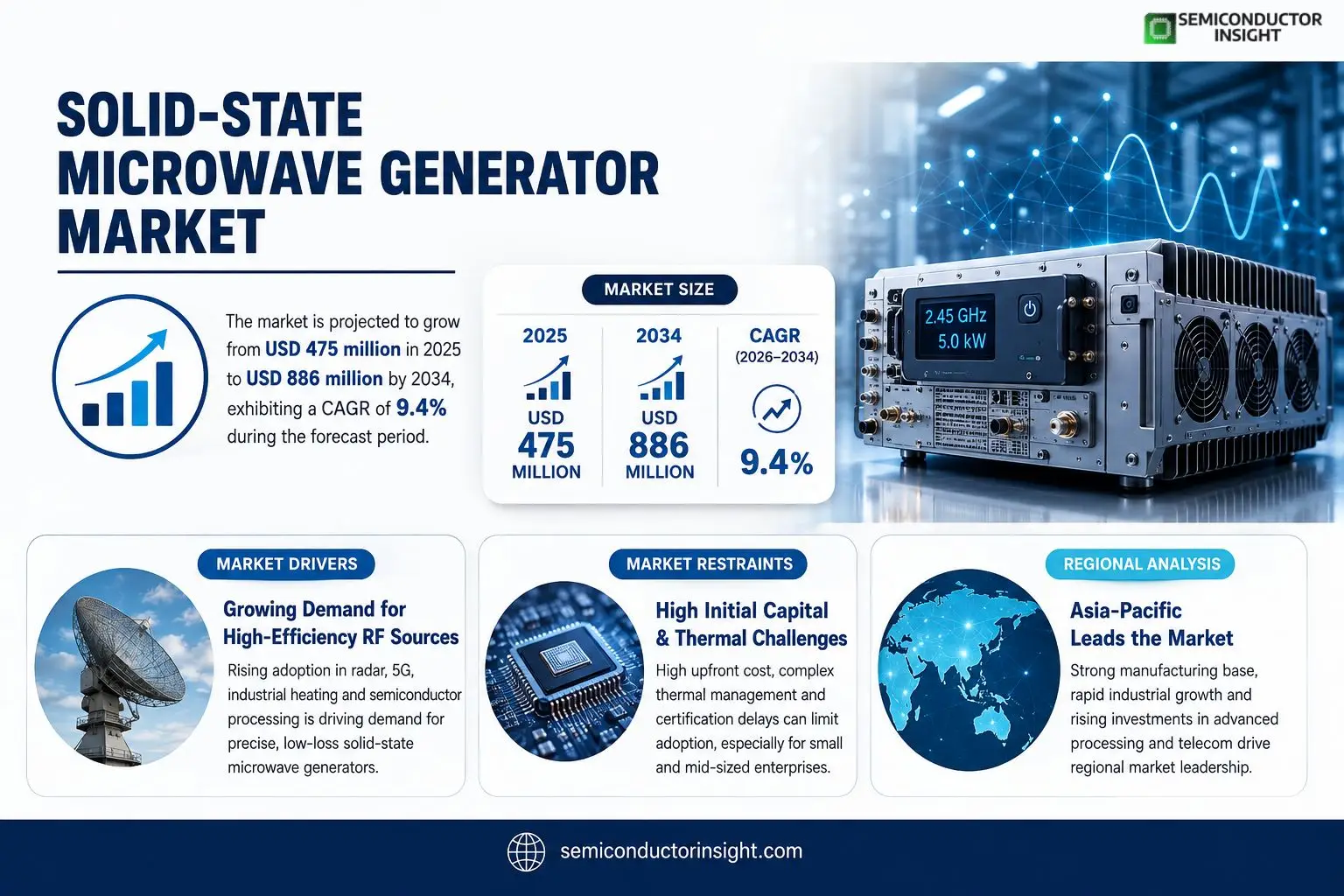
Solid-State Microwave Generator market size was valued at USD 475 million in 2025 and is projected to reach USD 886 million by 2034, exhibiting a CAGR of 9.4% during the forecast period.
Solid-state microwave generators are microwave energy sources that employ semiconductor power devices and digital control architectures instead of traditional magnetrons. They deliver stable, adjustable high‑frequency power for industrial heating, research laboratories, semiconductor processing, and selected medical applications. Typical systems provide precise power regulation, tunable or sweeping frequency (commonly around 915 MHz, 2.45 GHz, and 5.8 GHz), phase control, pulsed operation, reflected‑power monitoring and layered protection while allowing modular power combining from hundreds of watts up to tens of kilowatts.The market expands because manufacturers are shifting from simple magnetron replacements toward programmable process‑energy platforms that emphasize stability, controllability and repeatability. Industrial heating and drying remain core uses, yet demand is rising for plasma generation, materials processing and semiconductor/display manufacturing where tight frequency control and pulse strategies improve yield and equipment uptime. Regional supply basesNorth America and Europe offering mature control expertise; Japan and South Korea providing high‑frequency components; China delivering rapid engineering supportgive end users diverse sourcing options. As digitalization drives tighter process control across factories, products that integrate software‑centric interfaces and closed‑loop management are expected to capture incremental demand.
MARKET DRIVERS
Growing Demand for High‑Efficiency RF Sources
Solid-State Microwave Generator Market is being propelled by a surge in applications that require precise, low‑loss RF power, such as advanced radar systems and 5G base stations. Customers are replacing traditional vacuum‑tube solutions because solid‑state devices offer quicker start‑up times, reduced maintenance, and scalable power architecture.
Shift Toward Compact Defense Platforms
Modern combat vehicles and unmanned aerial systems are constrained by space and weight budgets. Solid‑state microwave generators meet these constraints while delivering the power density required for electronic warfare and high‑resolution imaging. The transition is also driven by defense procurement policies that prioritize lifecycle cost reduction.
➤ “Adoption of solid‑state technology is reshaping power‑distribution strategies across civilian and military sectors.”
Integration of semiconductor materials such as gallium nitride (GaN) and silicon carbide (SiC) is lowering the barrier to entry for manufacturers. As these materials mature, the cost per watt continues to decline, encouraging mid‑size OEMs to incorporate solid‑state generators into new product lines.
MARKET CHALLENGES
Complex Thermal Management Requirements
High‑power solid‑state devices generate significant heat, demanding sophisticated cooling solutions that add to system cost and design complexity. Many end‑users lack in‑house expertise to engineer reliable thermal pathways, leading to longer development cycles.
Other Challenges
Supply‑Chain Vulnerabilities
The reliance on rare‑earth compounds and specialized semiconductor fabs creates exposure to geopolitical tensions and capacity constraints, which can delay deliveries and compress margins.
MARKET RESTRAINTS
High Initial Capital Outlay
Although operating expenses drop after deployment, the upfront investment for solid‑state microwave generators remains substantial. Small enterprises often postpone adoption until the technology reaches a more mature price point.
Regulatory Certification Delays
Medical and aerospace applications require rigorous certification processes. The time required to obtain approvals can restrict market entry, especially for firms launching innovative designs that push existing standards.
Limited Skilled Workforce
Designing and testing solid‑state microwave systems demand a niche set of engineering skills. The scarcity of professionals proficient in high‑frequency semiconductor design hampers rapid scaling for many manufacturers.
MARKET OPPORTUNITIES
Emerging Applications in Autonomous Vehicles
Autonomous navigation relies on lidar and high‑resolution radar, both of which benefit from solid‑state microwave generators that deliver stable, tunable frequencies. Early pilots suggest that integrating these generators could improve detection range while keeping power consumption modest.
Expansion into Renewable‑Energy Infrastructure
Microwave power transmission experiments for offshore wind farms are exploring solid‑state sources to reduce loss and enhance beam steering capabilities. Successful demonstration projects would open a new revenue stream for vendors.
Partnerships with Semiconductor Innovators
Collaborative programs between generator manufacturers and GaN/SiC foundries are accelerating product roadmaps. These alliances lower R&D risk and enable rapid rollout of next‑generation units that meet the increasing power‑density expectations of telecom operators.
Solid-State Microwave Generator Market Trends
Programmable Control Elevates Market Position
Solid-State Microwave Generator Market is transitioning from a simple power source to a sophisticated, software‑driven process tool. Digital control loops now enable fine‑grained power regulation, frequency sweeping, and phase coordination, turning microwave energy into a measurable parameter rather than a black‑box input. This evolution matters because manufacturers can embed closed‑loop feedback directly into production recipes, reducing waste and improving yield in semiconductor and advanced materials lines. The heightened controllability also aligns with broader factory‑floor digitalization initiatives, where equipment must communicate status, alarms, and performance metrics in real time. Companies that invest in these capabilities are able to command higher price points and differentiate themselves through service contracts that include remote monitoring and predictive maintenance.
Other Trends
Modular Power Scaling
Modularity has become a decisive factor in Solid-State Microwave Generator Market. Vendors now offer combined‑module architectures that let end users start with a few hundred watts and expand to multi‑kilowatt configurations without redesigning the whole system. This approach satisfies both small‑batch specialty producers and large‑scale industrial users, providing a cost‑effective path to capacity upgrades. From a business perspective, modularity shortens sales cycles because customers can purchase an initial package, assess performance, and then add modules as demand grows, fostering recurring revenue streams for suppliers.
Geographic Supply Diversification Fuels Resilience
Supply chains for solid‑state microwave technology are spreading across North America, Europe, East Asia, and emerging hubs in China. Regional specialists bring distinct strengths: North American firms excel in long‑term reliability engineering, European companies focus on precision control standards, while Japanese and Korean players dominate high‑frequency component manufacturing. This geographic spread reduces dependency on any single source and encourages competitive pricing. For end users, the broader supplier base translates into faster engineering support, localized spares, and the ability to tailor solutions to regional regulatory requirements. As digital manufacturing expands ly, this diversification is likely to become a core competitive advantage for firms that can seamlessly integrate components from multiple regions into a unified system.
COMPETITIVE LANDSCAPEKey Industry Players
Solid‑State Microwave Generator Market: Competitive Overview
The market is anchored by a handful of incumbents that command the bulk of revenue through integrated product families covering module, rack and standalone formats. MKS Instruments leads the field with a portfolio that blends high‑frequency semiconductor technology and a robust software layer for closed‑loop control. Its strategic focus on scalabilityranging from sub‑kilowatt research units to multi‑kilowatt production systemshas entrenched the company as a preferred supplier for semiconductor and advanced materials manufacturers. The firm’s footprint, supported by a network of application engineers, enables it to capture large OEM contracts while also offering custom‑development services that lock in long‑term revenue streams. Competitive pressure revolves around the ability to deliver precise power regulation, rapid frequency sweep capability, and built‑in protection, attributes that differentiate MKS’s high‑value solutions from lower‑cost alternatives.Beyond the dominant tier, a diverse set of regional specialists sustains market vitality. European firms such as SAIREM and Fricke und Mallah Microwave Technology GmbH leverage deep heritage in industrial heating, providing niche products for food processing and pharmaceutical drying. Asian manufacturersincluding RFHIC, TOKYO KEIKI INC., and Chengdu Wattsine Electronic Technology Co., Ltd.excel in high‑frequency component integration and rapid prototyping, often capturing contracts that demand bespoke frequency bands or compact form factors. Smaller North‑American players like Elite RF LLC and Mildtech UK Ltd focus on modular designs for plasma generation and research labs, carving out profitable segments through application‑specific engineering. This layered competitive environment creates a marketplace where large‑scale system integrators coexist with agile innovators that respond to emerging process‑control requirements.
List of Key Solid‑State Microwave Generator Companies Profiled
- MKS Instruments
- SAIREM
- RFHIC
- Crescend Technologies
- Chengdu Wattsine Electronic Technology Co., Ltd.
- Kuhne electronic
- MKS Instruments
- Fricke und Mallah Microwave Technology GmbH
- TRUMPF Hüttinger GmbH + Co. KG
- Mildtech UK Ltd
- Elite RF LLC
- TOKYO KEIKI INC.
- NIHON KOSHUHA Co., Ltd.
- Analog Devices
- Keysight Technologies
Segment Analysis:
| Segment Category | Sub-Segments | Key Insights |
| By Type |
|
High Power Type
|
| By Application |
|
Industrial Heating and Drying
|
| By End User |
|
Industrial Equipment Manufacturers
|
| By Frequency Band |
|
2.45 GHz
|
| By Delivery Form |
|
Module Type
|
Regional Analysis: Solid-State Microwave Generator Market
North America
Parallel to technological progress, the supply chain has become more localized; foundries in the United States and Canada now offer dedicated high‑power gallium nitride (GaN) processing lines, reducing lead times that previously stretched across continents. This proximity enables rapid prototyping and supports the growing demand for compact, high‑efficiency generators in unmanned aerial systems and point‑defence platforms.
From a commercial perspective, the convergence of defense spending, telecom rollout of 5G/6G, and industrial heating applications creates a diversified revenue base. Firms that can bundle custom firmware, testing services, and after‑sale support are gaining leverage, prompting a wave of strategic alliances and intellectual‑property licensing arrangements that reshape competitive dynamics.
Federal grants and corporate venture arms concentrate on expanding silicon‑on‑insulator platforms, targeting frequency agility for next‑generation radar. Collaborative labs between universities and Tier‑1 manufacturers accelerate proof‑of‑concept cycles, allowing early market entry for high‑power modules.
Domestic semiconductor fabs now host dedicated GaN lines, mitigating overseas logistics bottlenecks. Parallel stockpiling of rare‑earth substrates and diversified logistics partners further stabilizes component flow to assembly plants.
Defense programs prioritise low‑size, high‑efficiency generators for drone swarms, while telecom operators seek solid‑state solutions to meet the power density demands of emerging 6G infrastructure.
Market leaders are bundling design‑software suites with hardware, creating integrated value propositions that make it harder for new entrants lacking service depth to capture share.
Europe
European manufacturers are capitalising on stringent emissions standards and a policy push toward greener technologies. The aerospace sector, especially in Germany and France, favours solid‑state generators for satellite payloads due to their lower thermal footprints. Simultaneously, the defence landscape, shaped by NATO initiatives, drives adoption of modular microwave sources that can be retrofitted into legacy platforms. Companies that navigate the complex certification regime while offering scalable production volumes stand to secure long‑term contracts, prompting a wave of joint‑venture agreements across the continent.
Asia‑Pacific
Asia‑Pacific remains a hotbed for cost‑effective manufacturing, with China, South Korea, and Taiwan hosting dense semiconductor clusters. Government incentives aimed at boosting domestic high‑frequency component production are fostering a surge in design capability, especially in semiconductor‑on‑insulator technologies. The region’s rapid urbanisation fuels demand for high‑power microwave sources in industrial heating and telecommunications, while emerging defense budgets allocate resources to solid‑state radar upgrades. Players that can reconcile low‑cost fabrication with stringent performance metrics are well‑positioned to capture export‑driven growth.
South America
In South America, mining and renewable‑energy projects are the primary catalysts for market activity. Countries such as Chile and Brazil are experimenting with microwave generators for mineral processing, where precise energy delivery improves extraction efficiency. Renewable‑energy developers also explore solid‑state solutions for plasma‑based grid‑support applications. However, the limited local supplier base means many projects rely on imports, creating opportunities for regional distributors to develop value‑added services such as on‑site integration and after‑sales support.
Middle East & Africa
The Middle East and Africa see modest but strategic engagement with Solid-State Microwave Generator Market. Oil‑field service firms are testing solid‑state generators for trenchless pipe‑inspection tools, attracted by the technology’s reliability in harsh environments. Defense ministries in the Gulf are beginning to replace legacy magnetron systems with more efficient solid‑state units for air‑defence radar. Market growth is hampered by limited manufacturing infrastructure, yet partnerships with European and North American firms are opening pathways for technology transfer and local capacity building.
Report Scope
This market research report provides a comprehensive analysis of the Solid-State Microwave Generator Market , covering the forecast period 2026–2034. It offers detailed insights into market dynamics, technological advancements, competitive landscape, and key trends shaping the industry.
Key focus areas of the report include:
- Market Overview: The report begins with an overview outlining its current market scenario, key growth indicators, and industry transformation drivers. It discusses macroeconomic factors, demand–supply balance, regulatory landscape, and the strategic role of semiconductors in powering advancements across industries such as automotive, telecommunications, consumer electronics, and industrial automation.
- Market Size & Forecast: Historical data and future projections for revenue, unit shipments, and market value across major regions and segments.
- Segmentation Analysis: Detailed breakdown by product type, technology, application, and end-user industry to identify high-growth segments and investment opportunities.
- Regional Insights: Insights into market performance across North America, Europe, Asia-Pacific, Latin America, and the Middle East & Africa, including country-level analysis where relevant.
- Competitive Landscape: Profiles of leading market participants, including their product offerings, R&D focus, manufacturing capacity, pricing strategies, and recent developments such as mergers, acquisitions, and partnerships.
- Technology Trends & Innovation: Assessment of emerging technologies, integration of AI/IoT, semiconductor design trends, fabrication techniques, and evolving industry standards.
- Market Drivers & Restraints: Evaluation of factors driving market growth along with challenges, supply chain constraints, regulatory issues, and market-entry barriers.
- Stakeholder Insights: Insights for component suppliers, OEMs, system integrators, investors, and policymakers regarding the evolving ecosystem and strategic opportunities.
Primary and secondary research methods are employed, including interviews with industry experts, data from verified sources, and real-time market intelligence to ensure the accuracy and reliability of the insights presented.
FREQUENTLY ASKED QUESTIONS:
What is the current market size of Solid-State Microwave Generator Market?
-> Solid-State Microwave Generator Market was valued at USD 475 million in 2025 and is expected to reach USD 886 million by 2034, at a CAGR of 9.4% during the forecast period.
Which key companies operate in Solid-State Microwave Generator Market?
-> Key players include SAIREM, Muegge, RFHIC, Crescend Technologies, Chengdu Wattsine Electronic Technology Co., Ltd., Kuhne electronic, MKS Instruments, Fricke und Mallah Microwave Technology GmbH, TRUMPF Hüttinger GmbH + Co. KG, Mildtech UK Ltd, Elite RF LLC, TOKYO KEIKI INC., NIHON KOSHUHA Co., Ltd.
What are the key growth drivers?
-> Key growth drivers include industrial heating and drying, plasma generation, semiconductor and display manufacturing, demand for stable and programmable microwave energy, and the shift toward energy‑efficient and greener manufacturing processes.
Which region dominates the market?
-> Asia-Pacific is the largest market region, supported by strong manufacturing bases and growing adoption in industrial processing, while North America and Europe also hold significant market shares.
What are the emerging trends?
-> Emerging trends include the transition to programmable process‑energy platforms, modular power combining, software‑centric control, integration with AI/IoT for closed‑loop management, and expanded use in advanced materials and precision manufacturing.
Get Sample Report PDF for Exclusive Insights
Report Sample Includes
- Table of Contents
- List of Tables & Figures
- Charts, Research Methodology, and more...
 Download Sample Report PDF