Polycrystalline CVD Diamond Window Market Insights
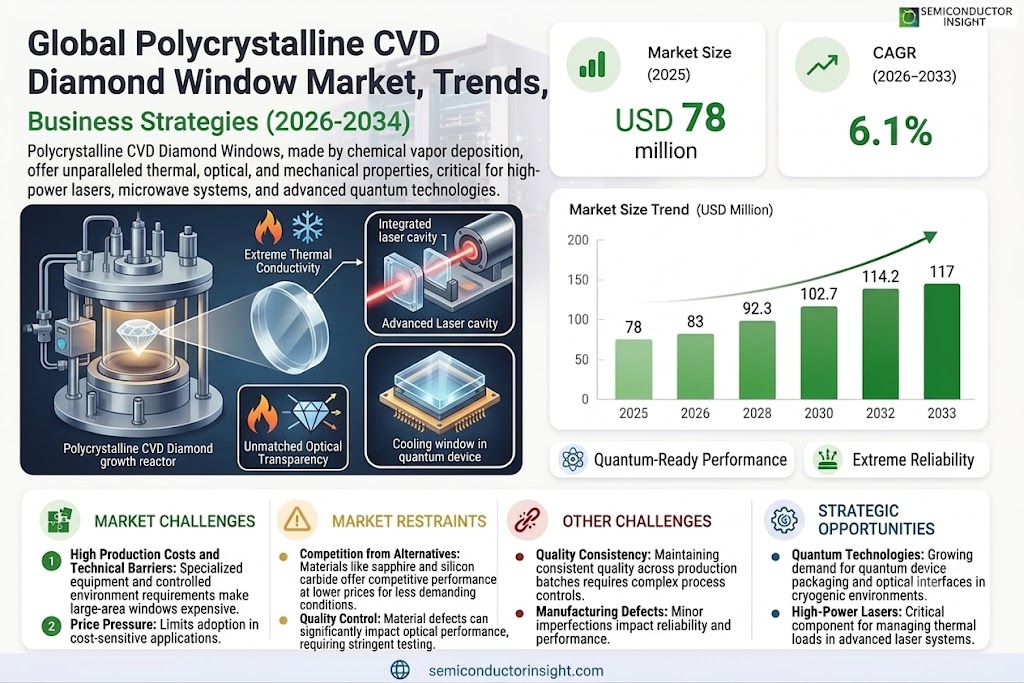
The global Polycrystalline CVD Diamond Window market was valued at USD 78 million in 2024. The market is projected to grow from USD 83 million in 2025 to USD 117 million by 2032, exhibiting a CAGR of 6.1% during the forecast period.
Polycrystalline CVD Diamond Windows are advanced optical components manufactured using chemical vapor deposition (CVD) technology, which deposits carbon-containing gases onto a substrate to form a thin diamond film. These windows exhibit exceptional properties such as high thermal conductivity, extreme hardness, broad optical transparency (from ultraviolet to far-infrared), and resistance to harsh environments. Their unique characteristics make them indispensable in applications like high-power lasers, spectroscopy, aerospace systems, and industrial sensors where durability and performance under extreme conditions are critical.
The market growth is driven by increasing demand for high-performance optical components in defense and aerospace sectors, alongside advancements in laser technologies. Additionally, rising investments in semiconductor manufacturing and quantum computing applications further propel adoption. Key players such as Coherent, Thorlabs, and Element Six dominate the market with continuous innovations—for instance, in March 2024, II-VI Incorporated (now Coherent) expanded its diamond optics portfolio for next-generation laser systems targeting industrial and scientific applications.
MARKET DRIVERS
Growing Demand in Scientific and Industrial Applications
The Polycrystalline CVD Diamond Window market is witnessing significant growth due to increasing adoption in high-power laser systems and synchrotron radiation facilities. These windows offer superior thermal conductivity and optical transparency, making them ideal for extreme environments. The aerospace and defense sectors are also driving demand for durable, high-performance optical components.
Advancements in Diamond Synthesis Technology
Recent improvements in chemical vapor deposition (CVD) techniques have enhanced the quality and affordability of synthetic diamond windows. Manufacturers are achieving higher purity levels and larger window diameters, expanding potential applications. This technological progress is reducing production costs while maintaining the material’s exceptional properties.
➤ The global Polycrystalline CVD Diamond Window market is projected to grow at 7.2% CAGR through 2030, driven by industrial and research applications.
Medical imaging systems utilizing X-ray and laser technologies are increasingly incorporating diamond windows due to their radiation hardness and biocompatibility. This emerging application segment represents a growing revenue stream for market players.
MARKET CHALLENGES
High Production Costs and Technical Barriers
While CVD technology has advanced, the production of large-area Polycrystalline CVD Diamond Windows remains expensive. The specialized equipment and controlled environment requirements translate to higher costs compared to alternative materials. This pricing pressure limits adoption in cost-sensitive applications.
Other Challenges
Material Defects and Quality Control
Even minor imperfections in the diamond lattice can significantly impact optical performance. Maintaining consistent quality across production batches requires stringent process controls and testing protocols, adding to operational complexity.
MARKET RESTRAINTS
Competition from Alternative Materials
Materials like sapphire and silicon carbide offer competitive performance at lower price points for certain applications. While diamond windows excel in extreme conditions, many industrial users opt for these alternatives when operating within less demanding parameters. This price competition limits market expansion potential.
MARKET OPPORTUNITIES
Emerging Applications in Quantum Technologies
The development of quantum computing and sensing systems presents new opportunities for Polycrystalline CVD Diamond Windows. Their unique combination of thermal, mechanical, and optical properties makes them suitable for quantum device packaging and optical interfaces in cryogenic environments.
Polycrystalline CVD Diamond Window Market Trends
Rising Demand in High-Power Laser Applications
The Polycrystalline CVD Diamond Window market is experiencing significant growth driven by increasing adoption in high-power laser systems. These windows provide exceptional thermal conductivity and optical transparency, making them ideal for managing extreme heat loads. The global market was valued at $78 million in 2024, with lasers accounting for over 35% of total demand, according to industry estimates.
Other Trends
Expansion in Aerospace and Defense Sectors
Military and aerospace applications are adopting Polycrystalline CVD Diamond Windows for radar systems and infrared optics due to their durability in harsh environments. The U.S. defense sector alone is projected to account for $22 million of the market by 2027, growing at 7.2% CAGR.
Technological Advancements in Manufacturing
Major players like Coherent and Element Six are investing in CVD process improvements, enhancing quality while reducing production costs. Uncoated Polycrystalline CVD Diamond Windows represent 68% of current shipments, but coated variants are growing faster at 8.4% annually due to improved performance characteristics.
Other Trends
Asia-Pacific Emerging as Key Growth Region
China’s Polycrystalline CVD Diamond Window market is projected to reach $29 million by 2032, driven by electronics manufacturing expansion. Regional manufacturers are capturing 24% of global production capacity, with South Korea and Japan following closely behind in technological adoption.
Supply Chain Challenges and Solutions
Recent U.S. tariff policies have prompted market leaders to establish localized production facilities, with three new diamond window manufacturing plants announced in North America since 2023. This aligns with broader industry efforts to strengthen supply chain resilience while meeting rising quality standards across optics and semiconductor applications.
Other Trends
Competitive Landscape Consolidation
The top five Polycrystalline CVD Diamond Window manufacturers control 62% of the global market revenue. Recent mergers, including Thorlabs’ acquisition of a German specialist in 2024, demonstrate strategic moves to expand technological capabilities and geographic reach within this high-value niche market.
COMPETITIVE LANDSCAPE
Key Industry Players
Polycrystalline CVD Diamond Window Market Dominated by Specialty Material Giants
The global polycrystalline CVD diamond window market is characterized by strong presence of advanced material specialists and optical component manufacturers, with Coherent, Element Six, and Thorlabs collectively holding significant market share. These leaders have established technological superiority in diamond synthesis and precision machining capabilities, supporting critical applications across defense, aerospace, and high-power laser industries. Market concentration remains moderate, with the top 5 players accounting for approximately 60% revenue share in 2024 through proprietary CVD growth techniques and vertical integration strategies.
Emerging competitors like Diamond Materials and IMAT are gaining traction through specialized offerings in niche infrared optics and microwave transmission segments. Regional players such as Optic-Well Photoelectric in Asia-Pacific and Labrilliante in Europe are expanding their production capacity to cater to growing demand from semiconductor fabrication and space technology sectors. Recent technological advancements in large-area diamond deposition and anti-reflective coatings are intensifying competition among established vendors.
List of Key Polycrystalline CVD Diamond Window Companies Profiled
- Coherent, Inc.
- Thorlabs, Inc.
- Stanford Advanced Materials
- Diamond Materials GmbH
- IMAT Innovations
- Element Six (De Beers Group)
- Optic-Well Photoelectric Technology
- Labrilliante
- CVD Diamond Corporation
- Advanced Diamond Technologies
- Diamond Coatings Limited
- NeoCoat SA
- II-VI Incorporated
- AKHAN Semiconductor
- Engis Corporation
Segment Analysis:
| Segment Category | Sub-Segments | Key Insights |
| By Type |
|
Uncoated Polycrystalline CVD Diamond Window dominates due to:
|
| By Application |
|
Optics and Defense applications show strongest demand because:
|
| By End User |
|
Military organizations represent the most demanding segment:
|
| By Manufacturing Process |
|
Microwave Plasma CVD is the preferred method for commercial production:
|
| By Quality Grade |
|
Optical Grade Diamond Windows command premium positioning:
|
Regional Analysis: Global Polycrystalline CVD Diamond Window Market
North America
The United States accounts for over 60% of North American demand, driven by its laser technology sector and defense applications. Silicon Valley startups increasingly integrate CVD diamond windows into quantum computing hardware.
Canada’s specialized research centers focus on diamond window applications in harsh environments. Universities collaborate with mining companies to develop ruggedized optical components for extreme condition monitoring.
Advanced CVD deposition techniques developed in Massachusetts and California enable larger diameter windows with fewer impurities. Production scalability improvements help meet defense sector specifications for missile domes.
Streamlined certification processes for optical components in North America accelerate commercial deployment. The region maintains strict export controls on high-grade diamond windows for strategic applications.
Europe
Europe shows strong growth in polycrystalline CVD diamond window adoption, particularly in Germany and France. The region’s focus on green energy drives demand for diamond windows in laser-based manufacturing systems. Collaborative EU research initiatives improve diamond film deposition techniques for X-ray applications. Strict environmental regulations push manufacturers toward CVD diamond solutions as mercury-free alternatives in UV optics. Automotive laser sensors and industrial measurement systems account for the bulk of regional consumption.
Asia-Pacific
Japan and China lead Asia-Pacific’s booming polycrystalline CVD diamond window market. Japanese electronics manufacturers incorporate diamond windows in high-power laser diodes, while China’s military modernization fuels demand for optical components. South Korea focuses on semiconductor applications, with major investments in diamond-coated wafer inspection systems. Southeast Asian nations show growing adoption in industrial laser processing equipment as manufacturing bases expand.
Middle East & Africa
The Middle East invests heavily in diamond window technologies for oil & gas exploration equipment. High-temperature resistant optical components find applications in desert operations and refinery monitoring systems. Africa records niche adoption in mining sector analysis tools, with South Africa developing localized capabilities in diamond window production for geological instruments.
South America
Brazil drives regional demand through its aerospace and medical equipment sectors. Research institutions collaborate with diamond producers to develop cost-effective CVD solutions. Argentina shows potential growth in synchrotron research facilities adopting diamond beamline components for advanced material studies.
Report Scope
This market research report provides a comprehensive analysis of the Polycrystalline CVD Diamond Window Market, covering the forecast period 2024–2032. It offers detailed insights into market dynamics, technological advancements, competitive landscape, and key trends shaping the industry.
Key focus areas of the report include:
- Market Overview: The report begins with an overview outlining its current market scenario, key growth indicators, and industry transformation drivers. It discusses macroeconomic factors, demand–supply balance, regulatory landscape, and the strategic role of polycrystalline CVD diamond windows in advanced applications such as high-power laser systems, spectroscopy, aerospace, and defense.
- Market Size & Forecast: Historical data and future projections for revenue, unit shipments, and market value across major regions and segments.
- Segmentation Analysis: Detailed breakdown by product type, application, and end-user industry to identify high-growth segments and investment opportunities.
- Regional Insights: Insights into market performance across North America, Europe, Asia-Pacific, Latin America, and the Middle East & Africa, including country-level analysis where relevant.
- Competitive Landscape: Profiles of leading market participants, including their product offerings, R&D focus, manufacturing capacity, pricing strategies, and recent developments such as mergers, acquisitions, and partnerships.
- Technology Trends & Innovation: Assessment of emerging technologies, material advancements, fabrication techniques, and evolving industry standards.
- Market Drivers & Restraints: Evaluation of factors driving market growth along with challenges, supply chain constraints, regulatory issues, and market-entry barriers.
- Stakeholder Insights: Insights for component suppliers, OEMs, system integrators, investors, and policymakers regarding the evolving ecosystem and strategic opportunities.
Primary and secondary research methods are employed, including interviews with industry experts, data from verified sources, and real-time market intelligence to ensure the accuracy and reliability of the insights presented.
FREQUENTLY ASKED QUESTIONS:
What is the current market size of Polycrystalline CVD Diamond Window Market?
-> The Polycrystalline CVD Diamond Window Market was valued at USD 78 million in 2024 and is expected to reach USD 117 million by 2032.
What is the growth rate of the Polycrystalline CVD Diamond Window Market?
-> The market is projected to grow at a CAGR of 6.1% during the forecast period (2024-2032).
Which key companies operate in Polycrystalline CVD Diamond Window Market?
-> Key players include Coherent, Thorlabs, Stanford Advanced Materials, Diamond Materials, IMAT, Element Six, Optic-Well Photoelectric, and Labrilliante, among others.
What are the key applications of Polycrystalline CVD Diamond Windows?
-> Key applications include electronics, optics, defense, aerospace, and others, thanks to their exceptional thermal conductivity and optical properties.
Which region dominates the Polycrystalline CVD Diamond Window Market?
-> Asia shows significant growth potential, while North America and Europe remain key markets for advanced optical applications.

Get Sample Report PDF for Exclusive Insights
Report Sample Includes
- Table of Contents
- List of Tables & Figures
- Charts, Research Methodology, and more...
 Download Sample Report PDF