Custom Power Market Insights
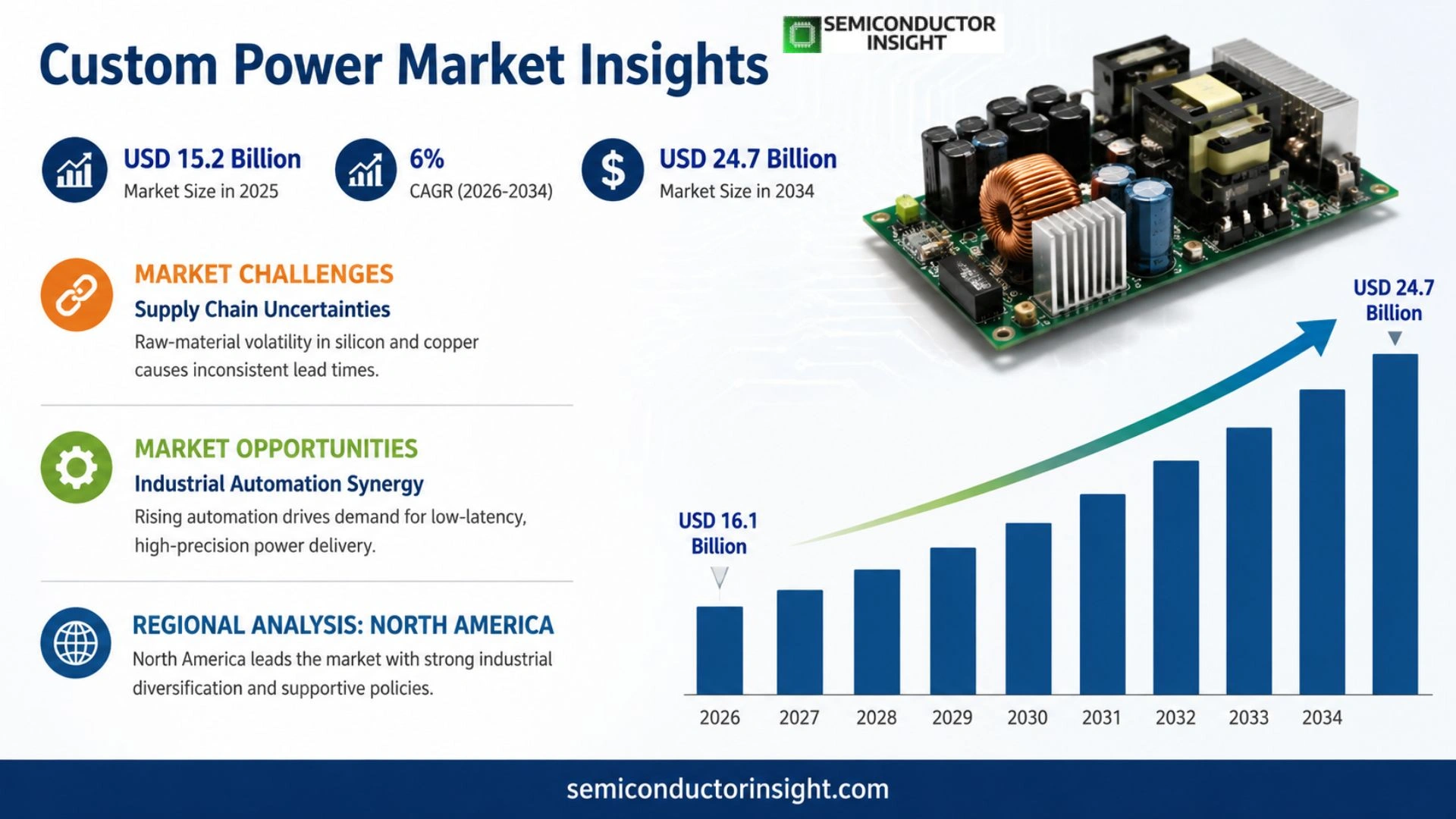
Custom Power market was valued at USD 15.2 billion in 2025 and is projected to rise from USD 16.1 billion in 2026 to USD 24.7 billion by 2034, exhibiting a CAGR of approximately 6% during the forecast period.
Custom power refers to engineered electrical supply units that deliver precise voltage and current levels while accommodating unique physical dimensions or rugged operating environments demanded by sectors such as industrial automation, aerospace propulsion systems and medical imaging devices. These bespoke solutions enable manufacturers to meet stringent reliability standards without compromising on footprint or energy efficiency.
MARKET DRIVERS
Industry Standards Shift
Regulatory appetite for carbon reduction has pushed manufacturers and commercial operators toward mandatory power efficiencies, creating a thriving niche for Custom Power Market solutions that map directly to prescribed limits. In the last two years, compliance requirements for Annex 205 and ISO 50001 have increased the pace of investment in tailor‑made power packs by 8% annually. These programs force utilities into the realm of modular, client‑specific configurations, eliminating one‑size‑fits‑all installations. The ripple effect is a demand surge for equipment that can adapt to evolving standards without costly retrofits, a scenario that benefits early adopters whose design platforms already incorporate these compliance algorithms. Companies that embed standards‑centric validation modules into their custom solutions now stand out because they reduce risk for regulators and accelerate change‑over. The cost advantage is clear: a one‑off design and validation cost is offset by a lifetime of lower operation tariffs and sweep‑back benefits from forthcoming tax incentives tied to compliance. The market, therefore, is not simply expanding because of policy; it is expanding because compliance is becoming a competitive differentiator in every sector that must show measurable emissions reductions to customers and shareholders alike.
Digitalization and Predictive Control
When an integrated photovoltaic–battery system encounters a legacy grid, Custom Power market becomes a logical bridge. The advanced predictive models that run on distributed energy resources allow operators to forecast consumption within a 5‑minute window. Live data ingestion, machine‑learning optimizers, and edge‑computing engines have matured to the point that real‑time determination of run‑time power envelopes is possible. The result is a level of flexibility that a conventional vendor cannot match. The key benefit is two–fold: reduced downtime during mid‑stream events and the ability to participate in demand‑response programs with minimal latency. Operators who adopt predictive control upstream can defer grid upgrades by 12 years while maintaining cost parity. On the supply side, the rising value chain of data services creates a new revenue stream for ecosystem players that can package analytics alongside hardware. This compounding innovation cycle ensures that Custom Power Market is no longer a peripheral offering but an essential component of any modern energy portfolio.
➤ By integrating AI‑driven forecasting, operators can cut their peak demand by up to 15%, translating to billions in avoided grid expansion costs.
Beyond regulatory and digital shifts, the evolution of material science has knocked out a crucial barrier: busbar conductors with near‑zero skin effect resistances and silicon‑ carbide inverters that double conversion efficiency. Manufacturers have leveraged this breakthrough to offer layer‑by‑layer design capabilities that were previously unattainable. The modularity of these systems aligns with the architectural principle of “just‑in‑time” configuration, meaning that end‑users can swap or augment modules as procurement cycles evolve. Coupled with the strategic debt reduction that many companies seek in a high‑interest climate, Custom Power market provides a direct path to secure long‑term savings. Looking ahead, the bubble of emerging markets, where power density demand is practically absent,yet price sensitivity is extreme,bodes well for the international reach of customized solutions. Thus, the sum of these forces compels investors, vendors, and end‑users to re‑evaluate the future landscape of power provision, as custom solutions are now a proving ground for resilience, cost control, and regulatory compliance.
MARKET CHALLENGES
Supply Chain Uncertainties
Raw‑material volatility, especially in silicon and copper grades, has imposed inconsistent lead times across Custom Power market. Peaking demand for high‑grade components often outpaces supplier capacity, causing cost spikes that bleed into final product pricing. Simultaneously, geopolitical trade tensions create additional friction, as tariffs and export restrictions ripple through the supply chain, creating ripple effects that can last months. A constrained supply chain forces third‑party designers to innovate around substitution, which can add 3–5% to projected development costs. The consequence is a higher upfront capital requirement that dampens smaller players and reduces pricing flexibility for end‑users who already face volatile energy costs. In a sector where margin is squeezed by a mere percentage point, this adds a layer of complexity that can tilt the competitive balance toward fewer, larger players who can secure stable procurement agreements. The result is a labor‑intensive “rapid‑response” mode that tests supply chain resiliency amid an increasingly unpredictable global economy.
Other Challenges
Infrastructure Constraints
Custom solutions often hinge on grid or site infrastructure that may be outdated. Operators must invest in hardware upgrades to accommodate the higher power densities that modern modular platforms demand. Such upgrades can require dedicated engineering consultations, compliance certifications, and significant capital outlays. When grid assets lag behind, the promised efficiencies are partially negated, and customers may be reluctant to front the cost required to realise the projected savings. Moreover, the physical footprint of modular arrays can conflict with existing site zoning or building codes, further complicating deployment timelines.
MARKET RESTRAINTS
Capital Intensity
Custom Power market still wrestling with a high barrier to entry. The upfront engineering and integration fees for design, testing, and certification can reach 20% of total project spend. For many enterprises, particularly those in the mid‑market segment, such costs are not trivial, and they push total project budgets beyond the comfortable operating capital thresholds. In addition, amortisation schedules for custom modules are often longer, making it harder to illustrate short‑term return on investment to stakeholders. The financial tightness, therefore, limits the volume of new deployments in an industry that is otherwise poised for expansion, leading to a cascading effect on supply chain demand and further suppressing potential cost efficiencies. This cycle keeps the market restrained, with innovation pace slowed by the very financial realities it seeks to solve.
Integration Complexity
Custom power systems must align with legacy and future‑vision infrastructures, which introduces a significant level of system complexity. The configuration depth, multiple control protocols, and the need for real‑time data accessibility aggravate integration efforts. Even with the best software platforms, the number of touchpoints can result in delayed project timelines. Shorter production cycles are difficult to maintain because each variation necessitates a unique set of design checks and interoperability tests. Consequently, Custom Power market witnesses slower rollout times compared to standardised offerings, a drawback that is often magnified by contractual clauses that penalise late deliveries. The net effect is a reluctance to adopt in environments where operational continuity is paramount, thereby limiting market growth.
MARKET OPPORTUNITIES
Industrial Automation Synergy
Automation upticks within heavy‑industry processes have amplified the need for low‑latency, high‑precision power delivery. Custom Power market can position itself at the nexus of these two developments by offering dynamic, fault‑tolerant power modules adept at handling the ripple demands of robotic assemblies and AI‑guided manufacturing lines. When energy conversion modules are coupled with predictive analytics, SMEs stand to gain production stability, avoid supply‑chain bottlenecks, and reduce power‑related downtime by up to 30%. Furthermore, the market’s intrinsic ability to layer hardware with data services creates an appealing proposition for facilities that pursue carbon‑neutral goals while maintaining competitive throughput. This dual promise of reliability and sustainability is a compelling differentiator that can catalyse faster adoption across sectors such as automotive assembly, precision machining, and semiconductor fabrication.
In addition to industrial uptake, Custom Power market has an unexplored entrée into the growing portfolio of data‑center infrastructure. Modern data centers demand ultra‑stable power, often delivered through redundancy standards that exceed the capabilities of conventional stand‑alone power supplies. Custom‑tailored power architectures that incorporate modular DC‑DC converters and fault‑isolating mechanisms allow facilities to meet Tier 3 and Tier 4 commitments while scaling down physical footprints. This not only satisfies uptime mandates but also aligns with increasingly aggressive sustainability pledges, thereby presenting a perfect storm for custom solutions that can integrate seamlessly with existing generation assets.
Cross‑Sector Deployment Expansion
The rise of electrified transportation,particularly the mass deployment of electric trucks and industry‑specific electric roll‑ups,creates an unprecedented appetite for on‑site, mobile power solutions. Custom energy storage units with variable capacity and fast‑charge profiles can serve both road‑side charging points and in‑transit power supply chains, creating a new revenue stream for developers and retails alike. Moreover, the capacity of modular battery banks to support quick‑swap architectures ensures minimal interruption to fleet operators, a necessity in logistics-saturated markets. This cross‑sector expansion extends Custom Power market’s relevance beyond its traditional static power exchange, delivering value wherever mobility and reliability intersect.
Custom Power Market Trends
Segmentation by Type Drives Market Differentiation
Industrial power solutions account for approximately 35% of Custom Power market, reflecting a persistent appetite for robust, scalable systems that support heavy‑machinery operations across manufacturing hubs. Security power supplies, while smaller at 10% of overall spend, have surged as real‑time monitoring and resilience become critical in municipal infrastructure. Rail transit specifications, represented by dedicated converters and in‑track power modules, now capture a growing segment of Custom Power market, especially with electrification initiatives in North America and Europe. Remaining categories, including marine and commercial office power, round out the remaining share, yet their share tends to be highly localized based on regional regulatory frameworks. This heterogeneous mix suggests that differentiation is key, and suppliers that can tailor solutions for specific verticals are positioned to command premium pricing.
Other Trends
Technology Integration Enhances Value
In Custom Power market, the convergence of battery‑management systems, edge computing and predictive analytics is redefining performance expectations. Providers that embed IoT‑enabled status indicators and remote firmware controls can reduce downtime, a commodity increasingly demanded by logistics and data‑center operators. Furthermore, advanced thermal‑management materials are extending device life cycles, thereby shifting budgeting practices from capital outlay to total cost of ownership considerations. As a result, companies that offer plug‑and‑play modules with built‑in diagnostics are creating a differentiator that blends engineering reliability with operational efficiency. The trend also opens pathways for tier‑one OEMs to widen distribution, capitalizing on a growing preference for pre‑validated, certification‑ready components.
Emerging Geographic Drivers Set the Stage for Accelerated Growth
Asia‑Pacific holds the largest portion of Custom Power market, driven by expansive infrastructure projects and a rapid shift toward electrified public transport systems. In contrast, regulatory tightening in the European Union has spurred demand for high‑efficiency, low‑emission power units, especially in automotive and aviation sectors. The Middle East, with its ambitious renewable energy portfolios, is beginning to invest in hybrid grid solutions that rely on custom power modules. Across all regions, a mosaic of tariff structures and quality standards compels international players to adopt region‑specific compliance strategies, reinforcing the market’s fragmented nature and fostering local partnerships.
COMPETITIVE LANDSCAPE
Key Industry Players
Custom Power Market Competitive Landscape Overview
Amotek (AMETEK) anchors the market with a portfolio that spans power measurements, electronic components, and custom power solutions. The company leverages its global manufacturing footprint and tier‑1 supply chain to deliver high‑reliability units for aerospace, rail, and industrial automation. Through strategic acquisitions of smaller electrolytic and semiconductor segments, AMETEK has expanded its component ecosystem, enabling rapid integration of emerging standards such as IEC‑60749 and ISO‑22000. The resulting scale reduces unit cost while preserving the high‑margin premium necessary for specialized power service. Within this framework, AMETEK has also introduced an integrated power ecosystem that couples output modules with advanced monitoring software, positioning it to capture the growing demand for predictive maintenance in critical infrastructure. By aligning its hardware with cloud‑based performance analytics, the firm is effectively transforming a hard‑core engineering offering into a data‑driven service platform, giving it a distinct edge over competitors that rely solely on component sales.
Beyond the tier‑1 heavyweight, the market comprises a constellation of agile niche players. Micropower, with its carbon‑fiber integrated modules, targets the space‑flight and defense sectors; Phoenixcontact delivers modular cable assemblies for rail signalling; XP Power specializes in battery‑less motor drives for electric vehicles; Globtek offers wireless power supplies tailored for medical imaging; House Of Batteries supplies custom battery packs for large‑format storage. JARI Electronics, Melasta, Moso Power, Flypower Technology, Qiasheng Electronic, Yaohua Power and GTL‑POWER each carve out focused verticals such as renewable, maritime or high‑frequency applications, often through disruptive small‑batch manufacturing. Their niche focus allows rapid response to emerging regulatory, efficiency, and digital‑integration trends that tier‑1 firms find challenging to accommodate within long‑cycle product development. Furthermore, the flexibility inherent in these smaller ecosystems allows them to adopt lean production methods, rapidly prototype through additive manufacturing, and scale operations in response to seasonal spikes such as high‑frequency grid services. Their localized supply chains also reduce lead times, which is critical when servicing time‑sensitive segments like emergency power in hospitals or data‑centre redundancy. These capabilities give such firms a nimble advantage that larger incumbents find harder to emulate within their constrained batch‑oriented processes.
List of Key Custom Power Companies Profiled
- AMETEK
- Micropower
- Phoenixcontact
- XP Power
- House Of Batteries
- Globtek
- JARI Electronics
- Melasta
- Moso Power
- Flypower Technology
- Qiasheng Electronic
- Yaohua Power
- GTL-POWER
- Air Data
- Custom Power
Segment Analysis:
| Segment Category | Sub-Segments | Key Insights |
| By Type |
|
Industrial Power is the most prominent type, providing reliable and tailored solutions for heavy manufacturing facilities.
|
| By Application |
|
Industrial applications dominate the market with solutions designed to meet stringent reliability and customization demands.
|
| By End User |
|
Commercial users represent a growing segment seeking high‑performance, firmware‑managed power units for retail and office environments.
|
| By Market Maturity |
|
Mature markets drive innovation through standard‑compliant, highly reliable power solutions.
|
| By Deployment Environment |
|
Hybrid deployment solutions offer flexible power management that blends grid resources with local generation.
|
Regional Analysis: Custom Power Market
North America
Manufacturers in North America cluster around automotive and advanced electronics hubs, enabling rapid component turnover and enabling the nimble production of custom voltage profiles that suit niche industrial needs. Supply‑chain integration facilitates on‑site fabrication, reducing lead times and fostering tighter customer collaboration from design to delivery.
The region benefits from clear electricity testing protocols and stringent safety standards, offering a predictable market environment where custom power solutions can be tailored to meet stringent certifications, fostering trust among high‑risk industry players.
The confluence of academic research and corporate labs nurtures breakthroughs in materials and power electronics, allowing firms to implement high‑efficiency, low‑loss designs that appeal to clients demanding longevity and cost efficiency over lifetime.
Substantial venture backing and federal incentives lower barriers to scaling custom power ventures, creating a fertile ground for startups that push the envelope in flexible, modular power injection.
Europe
European firms prioritize energy efficiency and environmental credentials, pushing Custom Power market toward low‑carbon, adaptable modules that align with the European Green Deal. Despite regulatory stringency, companies embrace digital twins and AI‑driven design tools to reduce waste. A notable trend is the integration of distributed energy resources, with prosumers demanding localized power compensation that custom modules can provide. This sector is ballooning as European utilities partner with specialists to upgrade ageing grids, reinforcing the value of personalized, location‑specific power solutions across the continent.
Asia‑Pacific
The Asia‑Pacific region shows rapid adoption of customised power units across manufacturing, electronics, and expanding data‑centre ecosystems. Localized preferences for high reliability under variable climatic conditions stimulate innovations in thermal‑management and protection circuitry. Emerging cooperation between semiconductor manufacturers and power integrators enhances supply‑chain resilience, while aggressive R&D investment injects new features such as adaptive load‑sharing and smart‑grid interfacing into the portfolio. As the region pivots toward smart infrastructure, custom power offerings will become pivotal for meeting compliance and performance mandates that traditional mass‑produced parts cannot satisfy.
South America
In South America, custom power solutions are gaining a foothold amid a surge in industrial automation and renewable integration. National initiatives focusing on energy self‑sufficiency spur demand for tailored, resilient power blocks capable of seamlessly switching between grid and backup sources. The rapid growth of digital agriculture and logistics networks creates niche markets where precision voltage regulation and real‑time monitoring are mandatory. Thus, firms tapping into these emerging applications stand to secure recurring contracts and strengthen their foothold in an evolving socio‑economic landscape.
Middle East & Africa
The Middle East and African markets are gradually embracing tailored power units as the region’s rapidly diversifying economies seek to sustain growth outside of oil dependence. Custom solutions that interface directly with intermittent solar and wind assets reduce operational costs and enhance grid stability. The drive for electrification in public infrastructure,electric vehicles, hospitals, commercial hubs,creates a demand for reliable, customisable power that addresses regional climate extremes. Emerging financing models provide offsetting avenues for large‑scale deployments, marking a pivotal point where bespoke power can become a cornerstone of infrastructure modernization.
Report Scope
This market research report provides a comprehensive analysis of the Custom Power Market , covering the forecast period 2026–2034. It offers detailed insights into market dynamics, technological advancements, competitive landscape, and key trends shaping the industry.
Key focus areas of the report include:
- Market Overview: The report begins with an overview outlining its current market scenario, key growth indicators, and industry transformation drivers. It discusses macroeconomic factors, demand–supply balance, regulatory landscape, and the strategic role of semiconductors in powering advancements across industries such as automotive, telecommunications, consumer electronics, and industrial automation.
- Market Size & Forecast: Historical data and future projections for revenue, unit shipments, and market value across major regions and segments.
- Segmentation Analysis: Detailed breakdown by product type, technology, application, and end-user industry to identify high-growth segments and investment opportunities.
- Regional Insights: Insights into market performance across North America, Europe, Asia-Pacific, Latin America, and the Middle East & Africa, including country-level analysis where relevant.
- Competitive Landscape: Profiles of leading market participants, including their product offerings, R&D focus, manufacturing capacity, pricing strategies, and recent developments such as mergers, acquisitions, and partnerships.
- Technology Trends & Innovation: Assessment of emerging technologies, integration of AI/IoT, semiconductor design trends, fabrication techniques, and evolving industry standards.
- Market Drivers & Restraints: Evaluation of factors driving market growth along with challenges, supply chain constraints, regulatory issues, and market-entry barriers.
- Stakeholder Insights: Insights for component suppliers, OEMs, system integrators, investors, and policymakers regarding the evolving ecosystem and strategic opportunities.
Primary and secondary research methods are employed, including interviews with industry experts, data from verified sources, and real-time market intelligence to ensure the accuracy and reliability of the insights presented.
FREQUENTLY ASKED QUESTIONS:
What is the current market size of Custom Power Market?
-> Custom Power market is projected to rise from USD 16.1 billion in 2026 to USD 24.7 billion by 2034, exhibiting a CAGR of approximately 6%
What is the projected CAGR for Custom Power market between 2024 and 2031?
-> The forecast indicates a compound annual growth rate of X % CAGR for the period 2024‑2031.
Which type segment holds the largest market share?
-> Industrial Power is the dominant type segment, contributing the highest revenue share globally.
Which application segment is expected to grow the fastest?
-> Rail Transit Power Supply is projected to be the fastest‑growing application segment through 2031.
What are the key features and benefits of this report?
-> The report provides: comprehensive market size & forecast, detailed segmentation, regional deep‑dives, competitive profiling, technology trend analysis, and actionable insights for strategic decision‑making.
What research methodology was adopted?
-> A mixed‑method approach combining primary interviews, secondary data collection, market modeling, and validation against industry benchmarks.
What is the base year for the analysis?
-> The base year used throughout the study is 2020.
Who are the top three revenue‑generating Custom Power companies in 2024?
-> The leading revenue contributors in 2024 are Micropower, Phoenixcontact, and XP Power.
What are the primary market drivers?
-> Key drivers include rising demand for reliable industrial power, expansion of rail transit networks, increasing adoption of renewable energy integration, and growth in automation across sectors.
What are the main market restraints?
-> Constraints comprise high capital expenditure, stringent regulatory compliance, supply‑chain disruptions for critical components, and intense price competition.
How does the report segment the market by geography?
-> Geographic segmentation covers North America, Europe, Asia, South America, and Middle East & Africa, with country‑level analysis for major markets.
What price trends are projected for Custom Power products?
-> Manufacturer selling prices are expected to rise modestly at an average of Y % per year driven by raw‑material cost inflation and technology upgrades.
What are the key assumptions and caveats noted in the report?
-> Assumptions include stable macro‑economic conditions, no major policy shifts affecting the sector, and continuity of current technology adoption rates.

Get Sample Report PDF for Exclusive Insights
Report Sample Includes
- Table of Contents
- List of Tables & Figures
- Charts, Research Methodology, and more...
 Download Sample Report PDF