DC-DC Charge Pump Market Insights
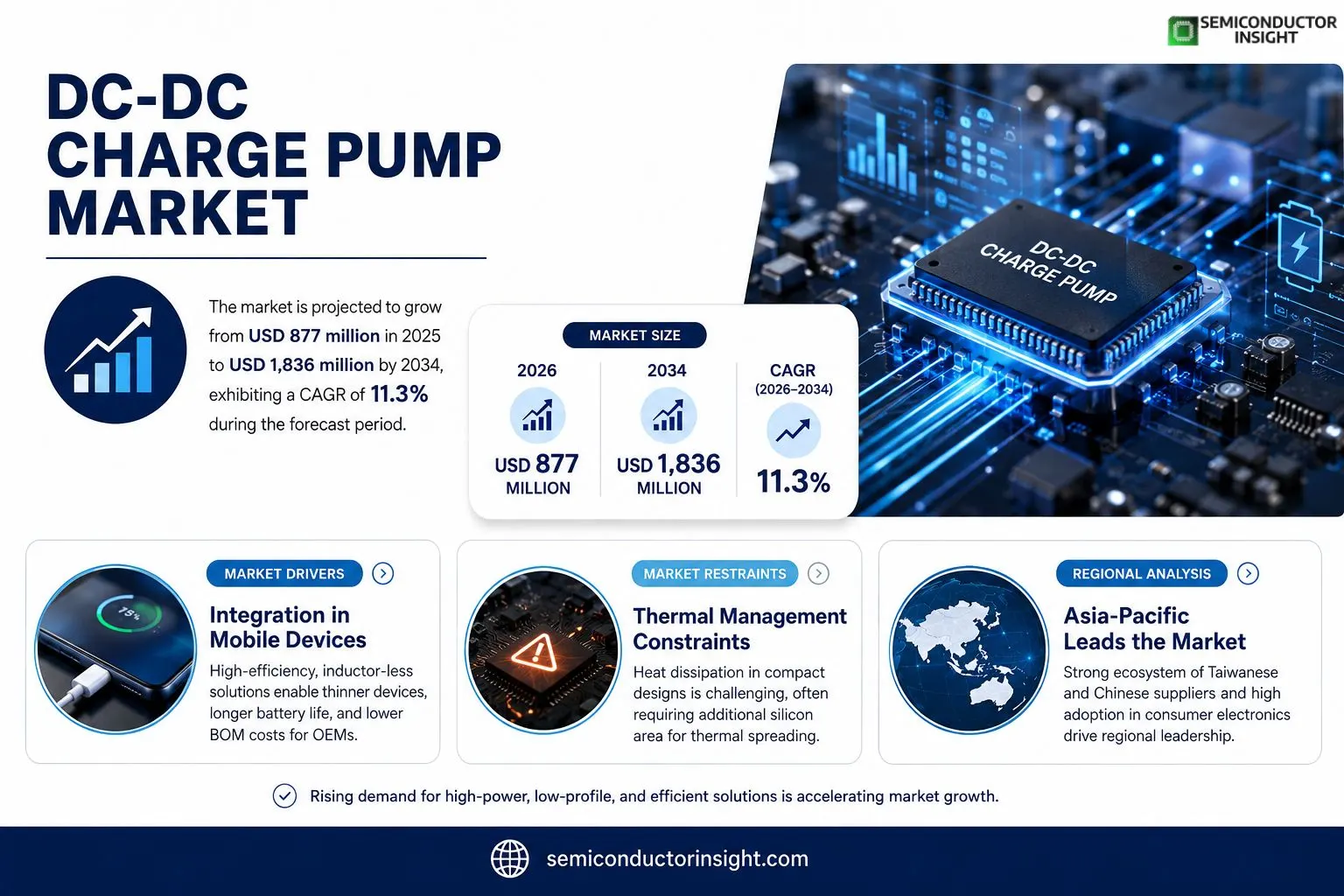
DC-DC Charge Pump market size was valued at USD 877 million in 2025. The market is projected to grow from USD 877 million in 2025 to USD 1,836 million by 2034, exhibiting a CAGR of 11.3% during the forecast period.
A DC-DC charge pump is a class of power device centered on switched‑capacitor energy transfer and switching‑matrix control, converting DC voltage through voltage doubling, inversion, step‑down, buck‑boost, or fixed‑ratio division while avoiding inductors or minimizing magnetic components. It serves thin portable devices, space‑constrained systems, high‑current fast‑charging paths, and 48 V intermediate‑bus architectures where low profile, low EMI, limited external components, and high efficiency are critical.The market is expanding because consumer electronics demand higher charging power and thinner form factors, while data‑center and communications infrastructure seek efficient 48 V power distribution. Regional players such as U.S./Japanese firms focus on general‑purpose and industrial charge pumps; Taiwanese suppliers dominate smartphone and display modules; Chinese companies are pushing high‑power multi‑phase chargers. Recent product launches integrate bidirectional conversion and protocol protection, reinforcing the shift from auxiliary boosters to core power solutions.
MARKET DRIVERS
Integration in Mobile Devices
Smartphone manufacturers are constantly seeking to extend battery life while reducing board real‑estate. DC-DC Charge Pump Market solutions that deliver high conversion efficiency without magnetic components fit that need perfectly, allowing thinner designs and lower BOM costs. This technical advantage translates into longer screen‑on time for end‑users, reinforcing demand from tier‑one OEMs.
Expansion of IoT Deployments
Edge sensors and wearables often operate on sub‑1 V rails and cannot accommodate bulky inductors. Charge‑pump architectures enable these low‑voltage platforms to harvest energy from small cells, making large‑scale IoT roll‑outs viable. As enterprises push for nationwide sensor coverage, the need for compact power‑management ICs accelerates.
➤ Modern charge‑pump topologies achieve efficiencies above 90 % while maintaining a footprint under 1 mm².
Beyond the two primary motives, the push for greener electronics drives designers toward solid‑state solutions that eliminate magnetic hysteresis losses. Companies that embed such technology gain competitive leverage, prompting a steady influx of new product introductions across DC-DC Charge Pump Market.
MARKET CHALLENGES
Thermal Management Constraints
Charge‑pump circuits dissipate heat proportional to current load, and the lack of an inductor limits passive cooling options. In high‑density applications, manufacturers must allocate additional silicon area for thermal spreading, which can erode the cost advantage originally offered by the technology.
Other Challenges
Supply Chain Volatility
The semiconductor industry’s recent wafer‑fab capacity crunch has lengthened lead times for specialty processes. Fabless firms that rely on niche MOSFETs for charge‑pump cells find production schedules susceptible to sudden disruptions, forcing them to hold higher safety stock.
MARKET RESTRAINTS
Regulatory Compliance Hurdles
Electromagnetic‑compatibility (EMC) standards in automotive and aerospace sectors impose strict limits on switching noise. Since charge‑pump converters switch at high frequencies, designers must incorporate additional filtering, which can offset the simplicity advantage and raise certification costs.The necessity to meet RoHS and REACH restrictions further narrows the pool of permissible encapsulants and lead‑frame alloys. Vendors that cannot quickly adapt material inventories face delayed product launches, curbing market momentum.
MARKET OPPORTUNITIES
Electrification of Vehicle Sub‑Systems
Modern electric vehicles integrate a multitude of low‑voltage subsystemshead‑up displays, interior lighting, and sensor clustersall of which require compact step‑up and step‑down converters. Charge‑pump ICs that satisfy automotive‑grade reliability can capture a niche that traditional inductive converters struggle to service due to size constraints.Similarly, the rise of micro‑mobility platforms (e‑bikes, scooters) presents a fresh arena where lightweight power‑management becomes a decisive factor. Early entrants that tailor charge‑pump architectures for rugged, vibration‑prone environments stand to secure long‑term supply agreements.
DC-DC Charge Pump Market Trends
Shift Toward High‑Power Integrated Charge Pumps
DC-DC Charge Pump Market is moving beyond its traditional role as a low‑current booster. Modern designs now embed multi‑phase architectures and bidirectional conversion within a single IC, enabling direct‑charging of smartphone batteries and support for 48 V intermediate‑bus systems in compact form factors. This transition is driven by the relentless demand for thinner devices, lower electromagnetic interference, and the need to reduce bill‑of‑materials through fewer external components. Manufacturers that combine high efficiency with integrated protection are gaining traction among OEMs seeking to differentiate their products on charging speed and thermal performance.
Other Trends
Regional Competitive Landscape
In North America and Japan, long‑established analog power specialists maintain a foothold in industrial‑grade and high‑reliability charge pumps, emphasizing robust regulation and extensive packaging options. Taiwanese suppliers dominate the smartphone and display segments, leveraging deep relationships with handset assemblers to supply LED and camera flash drivers. Chinese firms are rapidly extending into high‑power charging solutions, focusing on thermal management and footprint minimization to meet aggressive consumer expectations. Companies that can bridge the efficiency gap between these regions are positioned to become platform‑level power solution providers.
Emerging Applications in Data‑Center Power Architecture
Data‑center operators are increasingly adopting capacitor‑divider modules that replace traditional inductive converters in 48 V distribution networks. The appeal lies in the modules’ low profile, reduced magnetic interference, and ability to operate at higher frequencies, which together improve rack density and simplify cooling strategies. As server power densities climb, these modules provide a reliable means to step down voltage with minimal loss, aligning with the broader industry push for energy‑efficient infrastructure. The implication for DC-DC Charge Pump Market is a new revenue stream that values system‑level integration as much as raw conversion efficiency.
COMPETITIVE LANDSCAPE
Key Industry Players
DC-DC Charge Pump Competitive Overview
The upper tier of the market is dominated by long‑standing analog power specialists that leverage deep design expertise and extensive support networks. Texas Instruments leads the segment with a portfolio that spans ultra‑compact boost converters for smartphones to 48 V intermediate‑bus modules for data‑center power distribution. Analog Devices follows closely, emphasizing precision regulation and high‑efficiency architectures that suit industrial automation and networking equipment. ON Semiconductor and Microchip Technology round out the top tier, each offering differentiated line‑ups that cater to automotive‑grade reliability and cost‑sensitive consumer segments. This concentration of capability creates a tiered supply chain where the largest firms act as platform providers, while midsize OEMs source reference designs and application‑specific support from them.Beyond the headline names, a cluster of regional innovators is reshaping niche markets. Taiwanese firms such as MediaTek, Mixed‑Mode Technology and Fitipower focus on high‑density display drivers and fast‑charging ASICs that fit tightly into smartphone and tablet supply chains. Mainland‑Chinese playersincluding Southchip Semiconductor, Halo Microelectronics, and SG Microare advancing multi‑phase charge‑pump chargers and protocol‑integrated solutions that target emerging 48 V charging standards. Japanese entities like Renesas and ROHM retain strong footholds in automotive and high‑reliability industrial applications, while European contributors such as STMicroelectronics and ams‑OSRAM bring expertise in LED/display power management and integrated passive modules. Collectively, these companies expand the functional envelope of charge‑pump technology, translating incremental efficiency gains into tangible system‑level benefits.
List of Key DC-DC Charge Pump Companies Profiled
- Texas Instruments
- Analog Devices
- ON Semiconductor
- Microchip Technology
- Renesas Electronics
- ROHM Co., Ltd.
- STMicroelectronics N.V.
- ams‑OSRAM AG
- MediaTek Inc.
- Mixed‑Mode Technology Inc.
- Fitipower Integrated Technology Inc.
- SG Micro Corp.
- Southchip Semiconductor Technology (Shanghai) Co., Ltd.
- Halo Microelectronics Co., Ltd.
- Murata Manufacturing Co., Ltd.
Segment Analysis:
| Segment Category | Sub-Segments | Key Insights |
| By Type |
|
Regulated charge pump ICs drive market momentum through several qualitative factors:
|
| By Application |
|
Smartphone direct‑charging modules stand out because:
|
| By End User |
|
Consumer electronics manufacturers gain strategic advantage due to:
|
| By Technology |
|
Switched‑capacitor multi‑ratio converters are pivotal because:
|
| By Market Trend |
|
Shift toward integrated power‑management platforms reflects:
|
Regional Analysis: DC-DC Charge Pump Market
North America
Silicon‑on‑insulator and advanced CMOS platforms enable designers to push conversion efficiency past traditional limits, a capability that many North American labs have pioneered. The proximity of research universities fuels a pipeline of patents focused on adaptive control loops and ultra‑low ripple designs.
Recent disruptions prompted manufacturers to diversify wafer sources and develop in‑house testing capabilities. This agility reduces dependency on single suppliers and shortens time‑to‑market for new pump families.
Energy‑efficiency directives for consumer electronics drive demand for higher‑efficiency charge‑pump modules. Compliance testing labs across the United States provide rapid certification pathways that attract OEMs.
End‑users in wearables and autonomous‑vehicle sectors view charge‑pump solutions as a route to extending battery life without increasing device volume, reinforcing purchasing decisions that prioritize integrated power‑management chips.
Europe
European manufacturers capitalize on a strong automotive base, where charge‑pump modules enable low‑voltage distribution for electric‑drive architectures. Sustainability targets encourage system integrators to adopt multi‑phase pump topologies that reduce thermal load in compact enclosures. Collaborative standards bodies streamline cross‑border component qualification, allowing smaller firms to enter markets previously dominated by incumbents.
Asia‑Pacific
The Asia‑Pacific region benefits from expansive consumer‑electronics production lines that demand cost‑effective power solutions. While volume drives pricing pressure, firms are experimenting with silicon‑carbide substrates to improve efficiency at higher frequencies. Growing smart‑city projects also call for charge‑pump driven sensor networks, prompting local suppliers to tailor designs for rugged, low‑maintenance applications.
South America
In South America, emerging renewable‑energy installations create a niche for charge‑pump converters that manage distributed‑generation interfaces. Utility‑scale battery farms rely on precise voltage regulation, positioning the market as a strategic enabler for grid‑stabilization efforts. Regional partnerships with North American design houses accelerate technology transfer and skill development.
Middle East & Africa
The Middle East & Africa exhibit rising interest in off‑grid telecom infrastructure, where charge‑pump solutions support solar‑powered repeaters and remote monitoring stations. Energy‑constrained environments demand highly efficient, low‑loss topologies, prompting local OEMs to co‑develop bespoke modules with IP holders. Investment in training programs is beginning to close the expertise gap, laying groundwork for longer‑term market participation.
Report Scope
This market research report provides a comprehensive analysis of the DC-DC Charge Pump Market , covering the forecast period 2026–2034. It offers detailed insights into market dynamics, technological advancements, competitive landscape, and key trends shaping the industry.
Key focus areas of the report include:
- Market Overview: The report begins with an overview outlining its current market scenario, key growth indicators, and industry transformation drivers. It discusses macroeconomic factors, demand–supply balance, regulatory landscape, and the strategic role of semiconductors in powering advancements across industries such as automotive, telecommunications, consumer electronics, and industrial automation.
- Market Size & Forecast: Historical data and future projections for revenue, unit shipments, and market value across major regions and segments.
- Segmentation Analysis: Detailed breakdown by product type, technology, application, and end-user industry to identify high-growth segments and investment opportunities.
- Regional Insights: Insights into market performance across North America, Europe, Asia-Pacific, Latin America, and the Middle East & Africa, including country-level analysis where relevant.
- Competitive Landscape: Profiles of leading market participants, including their product offerings, R&D focus, manufacturing capacity, pricing strategies, and recent developments such as mergers, acquisitions, and partnerships.
- Technology Trends & Innovation: Assessment of emerging technologies, integration of AI/IoT, semiconductor design trends, fabrication techniques, and evolving industry standards.
- Market Drivers & Restraints: Evaluation of factors driving market growth along with challenges, supply chain constraints, regulatory issues, and market-entry barriers.
- Stakeholder Insights: Insights for component suppliers, OEMs, system integrators, investors, and policymakers regarding the evolving ecosystem and strategic opportunities.
Primary and secondary research methods are employed, including interviews with industry experts, data from verified sources, and real-time market intelligence to ensure the accuracy and reliability of the insights presented.
FREQUENTLY ASKED QUESTIONS:
What is the current market size of DC-DC Charge Pump Market?
-> DC-DC Charge Pump Market was valued at USD 877 million in 2025 and is expected to reach USD 1836 million by 2034 at a CAGR of 11.3%.
Which key companies operate in DC-DC Charge Pump Market?
-> Key players include Texas Instruments, Microchip Technology, Analog Devices, onsemi, Monolithic Power Systems, Inc., Renesas Electronics, ROHM Co., Ltd., Torex Semiconductor Ltd., Nisshinbo Holdings Inc., MinebeaMitsumi Inc., Murata Manufacturing Co., Ltd., Silicon Mitus Co., Ltd., MediaTek Inc., Mixed-mode Technology Inc., Fitipower Integrated Technology Inc., SG Micro Corp., Southchip Semiconductor Technology (Shanghai) Co., Ltd., Halo Microelectronics Co., Ltd., ams-OSRAM AG, STMicroelectronics N.V..
What are the key growth drivers?
-> Key growth drivers include increasing demand for higher charging power in smartphones and portable devices, need for low‑profile and low‑EMI solutions, expansion of 48 V intermediate‑bus architectures in data‑centers and communications equipment, and the shift toward multi‑phase high‑power charge pump chargers.
Which region dominates the market?
-> Asia-Pacific leads the market due to a strong ecosystem of Taiwanese and Chinese suppliers and high adoption in consumer electronics, while North America and Europe remain significant contributors.
What are the emerging trends?
-> Emerging trends include multi‑ratio switched‑capacitor charging, bidirectional energy conversion, integration of advanced protection functions, and the deployment of charge pumps in 48 V‑to‑12 V intermediate‑bus modules for data‑center power distribution.
Get Sample Report PDF for Exclusive Insights
Report Sample Includes
- Table of Contents
- List of Tables & Figures
- Charts, Research Methodology, and more...