
Data Center Power Systems Market Insights
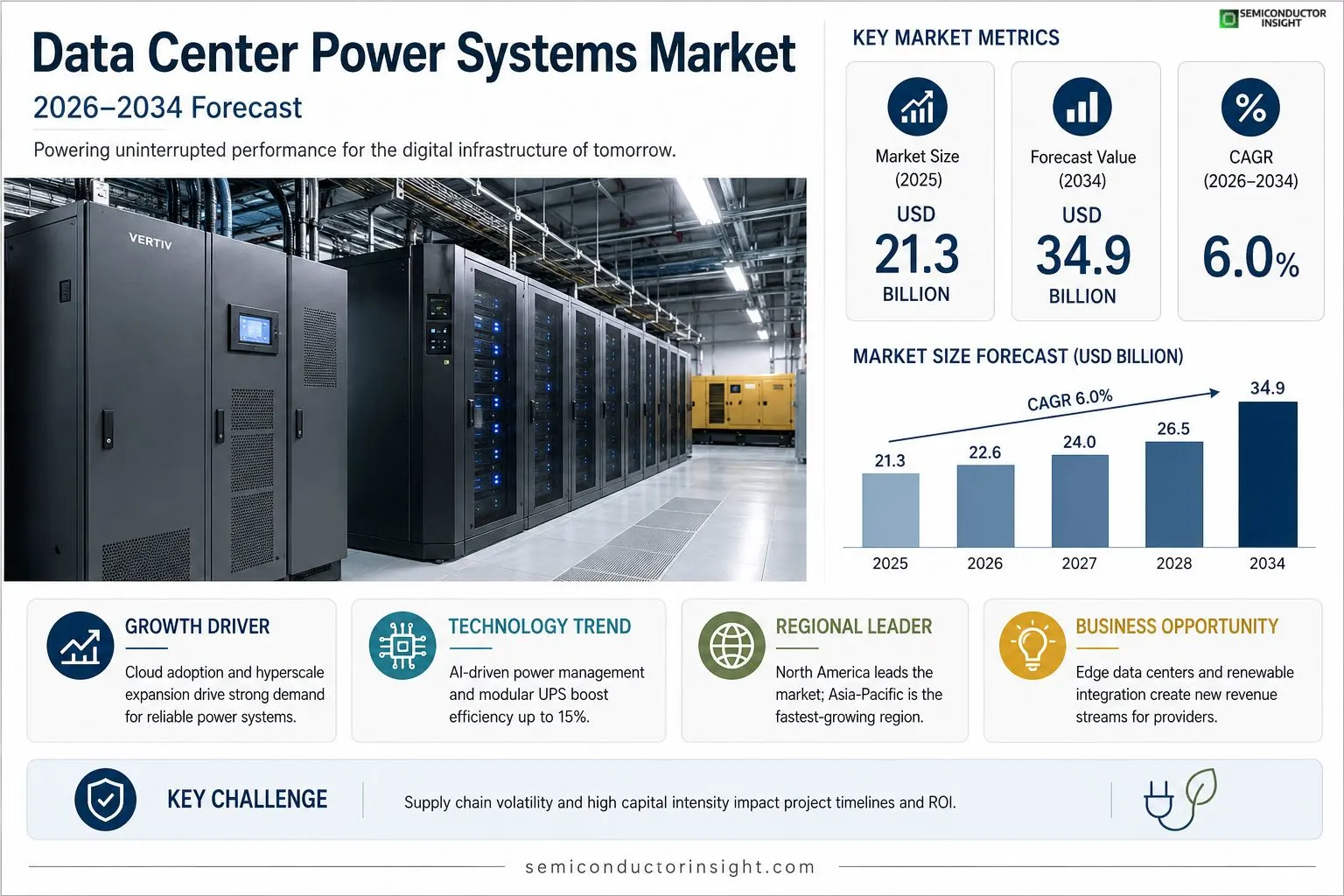
Global Data Center Power Systems Market size was valued at USD 21.3 billion in 2025. The market is projected to grow from USD 21.3 billion in 2025 to USD 34.9 billion by 2034, exhibiting a CAGR of 6.0% during the forecast period.
Data Center Power Systems encompass uninterruptible power supplies (UPS), power distribution units (PDU), backup generators, and energy‑storage solutions that ensure continuous, reliable electricity for mission‑critical IT equipment. These systems manage voltage regulation, load balancing, and seamless transition during outages, thereby safeguarding server uptime and operational efficiency.The market is experiencing robust expansion because cloud adoption accelerates demand for resilient infrastructure, while rising energy‑efficiency standards push operators toward modular UPS and renewable‑energy integration. Furthermore, increasing capital expenditure on hyperscale facilities and heightened focus on sustainability are driving investments in advanced power‑management technologies.
MARKET DRIVERS
Rising Digital Infrastructure Demand
Data Center Power Systems Market is being propelled by a surge in cloud adoption and edge computing, which together account for an estimated 35% of global data traffic in 2024. Enterprises are expanding footprint footprints, creating a steady need for reliable, scalable power solutions that can handle higher density loads without downtime.
Shift Toward Renewable Energy Integration
Regulatory incentives and corporate sustainability goals are driving data center operators to integrate on‑site solar, wind, and battery storage. This trend fuels demand for modular UPS and high‑efficiency transformer systems that can seamlessly switch between grid and renewable sources.
➤ “Over 60% of Tier‑IV data centers plan to increase renewable energy usage by 2027, directly boosting sales of advanced power conversion equipment.”
Consequently, manufacturers are accelerating R&D in AI‑enabled power management platforms, which promise up to 15% energy savings and underpin the next wave of growth in Data Center Power Systems Market.
MARKET CHALLENGES
Capital Intensity and Return on Investment
Deploying high‑capacity UPS and cooling‑integrated power units demands significant upfront capital. Operators often face a 3‑5 year payback horizon, creating hesitation especially in emerging markets where financing options are limited.
Other Challenges
Regulatory Compliance Complexity
Stringent local codes for fire safety, electromagnetic interference, and energy efficiency vary widely, requiring bespoke engineering that can slow project timelines and increase costs.
MARKET RESTRAINTS
Supply Chain Volatility
Global shortages of semiconductor components and copper have led to lead times of up to 12 weeks for critical power modules, constraining the ability of suppliers to meet rapid expansion needs.Furthermore, geopolitical tensions affecting key manufacturing hubs introduce price volatility, which can deter investment in new power infrastructure projects.
MARKET OPPORTUNITIES
Emergence of Edge Data Centers
Edge deployments require compact, high‑efficiency power solutions that can operate in constrained spaces. This creates a niche for modular, plug‑and‑play UPS systems that promise rapid installation within weeks.Additionally, the rise of AI‑driven workload orchestration is expected to increase demand for intelligent power distribution units (PDUs) capable of real‑time load balancing, opening new revenue streams for system integrators.
Data Center Power Systems Market Trends
Growth Driven by Cloud Adoption and Energy‑Efficiency Standards
Data Center Power Systems Market is witnessing accelerated growth as enterprises expand cloud footprints and demand uninterrupted service levels. Continuous power availability, voltage regulation, and rapid fault recovery are critical for maintaining server uptime, which in turn pushes operators to adopt advanced UPS, PDU, and backup generator solutions. Energy‑efficiency mandates further reinforce the shift toward modular UPS architectures that reduce losses and improve load balancing, delivering lower operational expenditure while meeting sustainability goals.
Other Trends
Modular UPS Adoption
Modular UPS designs are gaining traction because they allow capacity scaling in line with incremental workload increases. This flexibility reduces upfront capital outlay and simplifies maintenance through hot‑swap modules. Operators also benefit from enhanced mean‑time‑between‑failures (MTBF) figures and the ability to integrate battery‑type energy‑storage technologies that support peak‑shaving strategies during utility price spikes.
Renewable Energy Integration and Hybrid Power Architectures
A parallel trend within Data Center Power Systems Market is the growing incorporation of renewable‑energy sources such as solar and wind into hybrid power configurations. By coupling on‑site generation with intelligent energy‑management software, facilities can prioritize clean energy use, lower carbon footprints, and smooth transitions between renewable input and conventional backup systems. The trend is further supported by regulatory incentives that reward lower emissions and by corporate sustainability commitments, prompting data center owners to invest in inverter‑based solutions and grid‑interactive storage that maintain seamless power continuity.
COMPETITIVE LANDSCAPEKey Industry Players
Data Center Power Systems – Competitive Overview
Data Center Power Systems Market is anchored by a handful of multinational OEMs that control the majority of UPS, PDU and backup generator solutions for hyperscale and enterprise facilities. Schneider Electric leads the segment with a broad portfolio that spans modular UPS platforms, advanced energy‑storage, and integrated power‑distribution architectures, leveraging its strong service network to capture high‑margin projects. Close behind, Eaton and Vertiv command sizable shares through vertically integrated offerings that combine power conditioning, rack‑mount PDUs and remote monitoring, enabling operators to meet stringent uptime requirements while optimizing energy efficiency. Siemens and ABB complement the landscape with high‑power converter technology and grid‑interactive solutions, often selected for large‑scale, mission‑critical deployments where reliability and scalability are paramount.Beyond the tier‑one giants, a diverse set of niche and regionally focused manufacturers enriches the competitive environment. Delta Electronics and Mitsubishi Electric deliver cost‑effective UPS designs that appeal to mid‑market data centers in Asia‑Pacific, while Emerson Electric and Legrand specialize in intelligent PDU and power‑management software that address growing automation needs. Emerging players such as Huawei and Cisco are expanding their footprint by integrating power‑hardware with software‑defined infrastructure, targeting next‑gen edge sites. Smaller innovators like Riello UPS and Powertron concentrate on modular, renewable‑ready solutions, providing flexible alternatives for customers pursuing sustainability goals without sacrificing reliability.
List of Key Data Center Power Systems Companies Profiled
- Schneider Electric
- Eaton
- Vertiv
- Siemens
- ABB
- Delta Electronics
- Mitsubishi Electric
- Emerson Electric
- Legrand
- Huawei
- Cisco Systems
- Riello UPS
- Powertron
- General Electric
- Tripp Lite
Segment Analysis:
| Segment Category | Sub-Segments | Key Insights |
| By Type |
|
UPS Systems
|
| By Application |
|
Cloud Service Providers
|
| By End User |
|
Hyperscale Operators
|
| By Power Architecture |
|
Modular Systems
|
| By Energy Source |
|
Renewable Integration
|
Regional Analysis: North America
United States
The demand for advanced power distribution units is surging, focusing on higher density and enhanced reliability for modern data center deployments.
The market for UPS systems continues to grow, with a strong emphasis on lithium-ion battery technology and modular designs for improved efficiency and scalability.
Innovative cooling solutions, including direct-to-chip liquid cooling, are gaining traction to manage the increasing power densities in data centers.
Sophisticated power monitoring and management systems are becoming crucial for optimizing energy usage and ensuring data center operational efficiency.
Europe
Europe exhibits a steady growth trajectory in Data Center Power Systems Market, fueled by increasing cloud adoption across the region and government initiatives promoting digital infrastructure development. The market is characterized by a strong focus on energy efficiency and sustainability, driven by stringent environmental regulations. Key trends include investments in renewable energy integration and the adoption of advanced power management technologies. While the pace of growth might be moderate compared to North America, the European market presents significant opportunities for specialized power solutions tailored to the unique requirements of data centers in the region. Data Center Power Systems Market in Europe is further segmented by countries like the UK, Germany, France, and the Netherlands, each with its distinct market dynamics and regulatory environment.
Asia-Pacific
The Asia-Pacific region is emerging as the fastest-growing market for data center power systems, driven by rapid digital transformation and the expansion of data center infrastructure in countries like China, India, and Japan. The increasing adoption of cloud services, e-commerce, and social media platforms is fueling the demand for robust and reliable power systems. The market is witnessing a surge in investments in hyperscale data centers, particularly in China, which is becoming a major hub for data center development. Key trends include the adoption of modular data center designs, energy-efficient cooling technologies, and smart power management solutions. The region’s growth is also influenced by government support for digital infrastructure and the increasing focus on data security and compliance.
South America
South America represents a developing market for data center power systems, with growth potential driven by increasing internet penetration and the expansion of digital services. The region is witnessing a gradual increase in data center deployments in countries like Brazil, Mexico, and Argentina. However, the market faces challenges related to infrastructure development, regulatory complexities, and limited investment capital. Key trends include the adoption of cost-effective power solutions and the focus on improving energy efficiency. The demand for data center power systems is expected to increase steadily in the coming years as the digital economy continues to expand.
Middle East & Africa
The Middle East and Africa region presents a promising market for data center power systems, driven by increasing investment in digital infrastructure and the growth of cloud computing. Countries like the UAE, Saudi Arabia, and South Africa are witnessing significant data center development. The region’s growth is fueled by government initiatives promoting technology adoption and the increasing demand for data storage and processing. Key trends include the adoption of high-density power solutions, energy-efficient cooling technologies, and power monitoring systems. The region’s data center power systems market is expected to witness robust growth in the coming years, driven by the expanding digital economy and the increasing reliance on data-intensive applications.
Report Scope
This market research report provides a comprehensive analysis of the Data Center Power Systems Market , covering the forecast period 2026–2034. It offers detailed insights into market dynamics, technological advancements, competitive landscape, and key trends shaping the industry.
Key focus areas of the report include:
- Market Overview: The report begins with an overview outlining its current market scenario, key growth indicators, and industry transformation drivers. It discusses macroeconomic factors, demand–supply balance, regulatory landscape, and the strategic role of semiconductors in powering advancements across industries such as automotive, telecommunications, consumer electronics, and industrial automation.
- Market Size & Forecast: Historical data and future projections for revenue, unit shipments, and market value across major regions and segments.
- Segmentation Analysis: Detailed breakdown by product type, technology, application, and end-user industry to identify high-growth segments and investment opportunities.
- Regional Insights: Insights into market performance across North America, Europe, Asia-Pacific, Latin America, and the Middle East & Africa, including country-level analysis where relevant.
- Competitive Landscape: Profiles of leading market participants, including their product offerings, R&D focus, manufacturing capacity, pricing strategies, and recent developments such as mergers, acquisitions, and partnerships.
- Technology Trends & Innovation: Assessment of emerging technologies, integration of AI/IoT, semiconductor design trends, fabrication techniques, and evolving industry standards.
- Market Drivers & Restraints: Evaluation of factors driving market growth along with challenges, supply chain constraints, regulatory issues, and market-entry barriers.
- Stakeholder Insights: Insights for component suppliers, OEMs, system integrators, investors, and policymakers regarding the evolving ecosystem and strategic opportunities.
Primary and secondary research methods are employed, including interviews with industry experts, data from verified sources, and real-time market intelligence to ensure the accuracy and reliability of the insights presented.
FREQUENTLY ASKED QUESTIONS:
What is the current market size of Data Center Power Systems Market?
-> Data Center Power Systems Market was valued at USD 21.3 billion in 2025 and is expected to reach USD 34.9 billion by 2034.
Which key companies operate in Data Center Power Systems Market?
-> Key players include Schneider Electric, Eaton, Vertiv, ABB, Mitsubishi Electric, and Delta Electronics, among others.
What are the key growth drivers?
-> Key growth drivers include increasing cloud adoption, rising energy‑efficiency standards, hyperscale data‑center capital expenditures, and sustainability‑focused power‑management initiatives.
Which region dominates the market?
-> North America remains the dominant market due to mature data‑center ecosystems, while Asia‑Pacific is the fastest‑growing region.
What are the emerging trends?
-> Emerging trends include AI‑driven power‑optimization, modular UPS architectures, renewable‑energy integration, and edge‑data‑center power solutions.
Get Sample Report PDF for Exclusive Insights
Report Sample Includes
- Table of Contents
- List of Tables & Figures
- Charts, Research Methodology, and more...




