Key Statistics
Key Takeaways
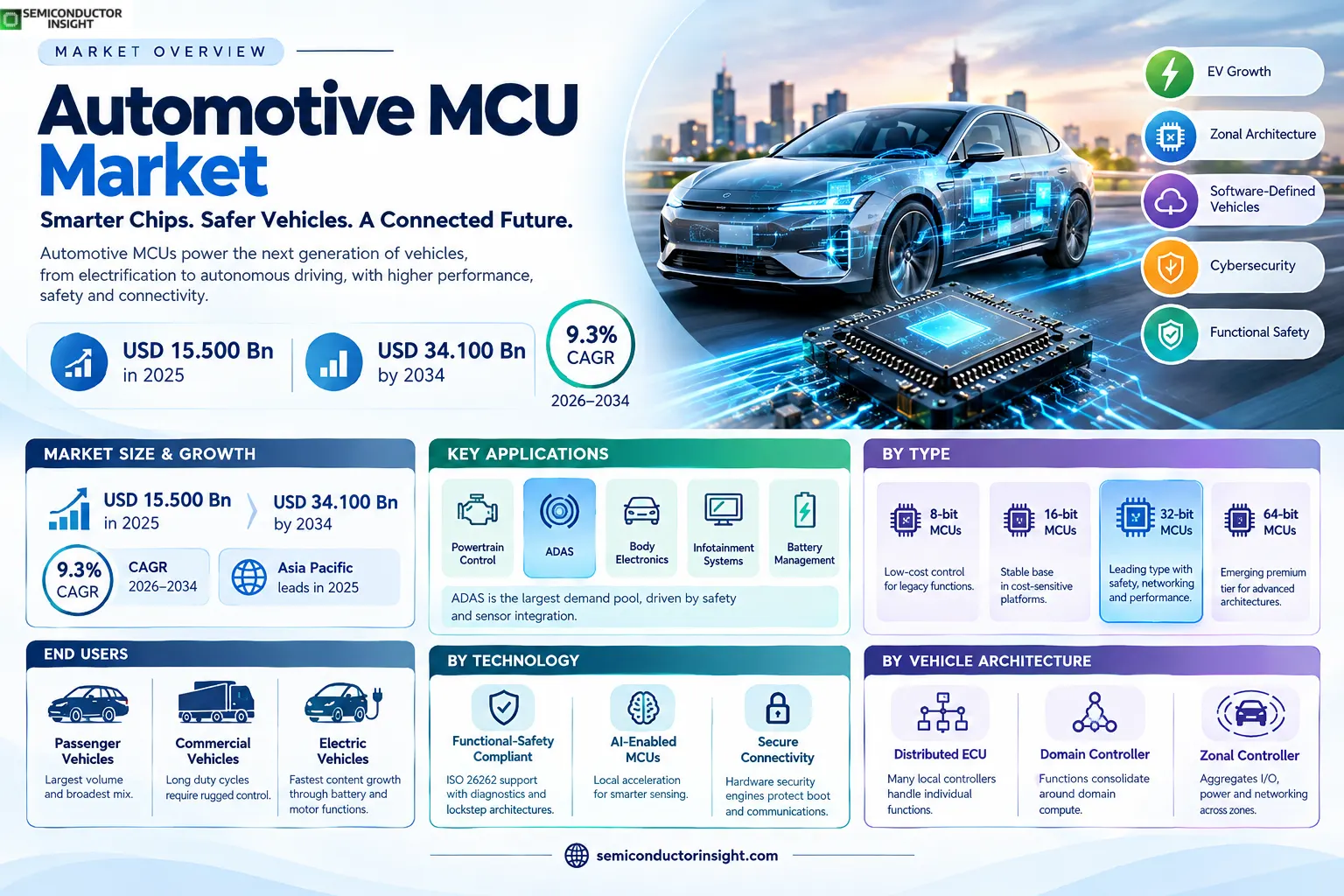
- Market size and growth: the market is valued at USD 15.500 billion in 2025 and is projected to reach USD 34.100 billion by 2034, with a 9.3% CAGR over 2026–2034.
- 32-bit MCUs leads by type because 32-bit devices balance real-time performance, safety, memory and cost across body, powertrain, chassis and zonal control.
- ADAS is the principal application because sensor fusion, safety functions and increasingly centralized architectures require higher-performance real-time controllers.
- Asia Pacific is the largest regional market, while Asia Pacific has the strongest incremental growth profile.
- Primary driver: EVs, ADAS and zonal architectures are increasing MCU performance requirements and the number of controlled vehicle functions
- Principal restraint: automotive qualification, long lifecycle support and cybersecurity make new MCU platforms expensive and slow to introduce
Market Overview
The automotive MCU market was valued at USD 15.500 billion in 2025 and is projected to reach USD 34.100 billion by 2034, expanding at a 9.3% CAGR over 2026–2034. Asia Pacific leads in 2025, while market structure is being reshaped by EV growth, zonal architectures, software-defined vehicles, stronger cybersecurity and functional-safety requirements..
Automotive MCUs combine CPU cores, flash or MRAM, RAM, analog peripherals, timers, networking interfaces and safety mechanisms on one qualified device. They execute deterministic control for powertrain, chassis, body electronics, battery systems, gateways and selected ADAS functions. Automotive parts differ from general-purpose MCUs through extended temperature operation, traceability, long supply commitments and extensive functional-safety and cybersecurity support.
The move toward zonal and software-defined vehicle architectures is raising MCU requirements. NXP’s S32K5 family adds higher performance, larger memory, Ethernet, CAN FD, MRAM and ASIL D support for zone and domain controllers. Infineon in 2026 expanded AURIX TC3x to a 400 MHz performance class and strengthened cybersecurity compliance across its automotive MCU portfolio, showing how real-time control platforms are evolving.
Vehicle electrification adds another demand layer. The IEA reported global electric-car sales above 20 million in 2025, with one in four new cars sold being electric. Each EV requires control for battery management, motor drive, charging, thermal systems and high-voltage safety, increasing MCU content even before advanced driver-assistance and connectivity features are considered.
Segment Analysis: By Type
By type, the market is segmented into 8-bit MCUs, 16-bit MCUs, 32-bit MCUs, 64-bit MCUs. 32-bit MCUs holds the leading position.
| Type | Role | Commercial position |
|---|---|---|
| 8-bit MCUs | Simple low-cost control for switches and legacy body functions. | Mature segment pressured by integration. |
| 16-bit MCUs | Mid-range real-time control for established power and body functions. | Stable installed base in cost-sensitive platforms. |
| 32-bit MCUs | Mainstream control with strong safety, networking and performance. | Leading type across body, chassis, powertrain and zonal control. |
| 64-bit MCUs | Higher-performance real-time control for advanced architectures. | Emerging premium tier as software complexity grows. |
Commercial implications by type
32-bit MCUs dominate because they provide enough compute for modern safety and networking requirements without the power and cost of a larger application processor. 8- and 16-bit devices remain in simple functions, while 64-bit and multi-core architectures gain share where centralized controllers consolidate many ECUs.
Segment Analysis: By Application
By application, the market includes Powertrain Control, ADAS, Body Electronics, Infotainment Systems, Battery Management. ADAS is the largest demand pool.
| Application | Demand characteristics |
|---|---|
| Powertrain Control | Real-time engine, motor and transmission control requires deterministic processing. |
| ADAS | Leading growth application for safety-oriented sensor and actuator control. |
| Body Electronics | Doors, lighting, HVAC and zone functions create the highest MCU unit count. |
| Infotainment Systems | MCUs manage peripherals and power around larger application processors. |
| Battery Management | EV packs require distributed sensing, balancing and safety communications. |
By End User
| End User | Commercial relevance |
|---|---|
| Passenger Vehicles | Largest volume and broadest MCU mix. |
| Commercial Vehicles | Long duty cycles require rugged control. |
| Electric Vehicles | Fastest content growth through battery and motor functions. |
By Technology
| Technology | Commercial relevance |
|---|---|
| Functional-Safety Compliant | Diagnostics and lockstep architectures support ISO 26262. |
| AI-Enabled MCUs | Local acceleration supports smarter sensing. |
| Secure Connectivity | Hardware security engines protect boot and communications. |
By Vehicle Architecture
| Vehicle Architecture | Commercial relevance |
|---|---|
| Distributed ECU | Many local controllers handle individual functions. |
| Domain Controller | Functions consolidate around domain compute. |
| Zonal Controller | Regional controllers aggregate I/O, power and networking. |
Regional Analysis
Asia Pacific leads the market because the source analysis identifies Asia Pacific as dominant because China, Japan and South Korea combine large vehicle production, EV adoption and semiconductor supply. Asia Pacific has the strongest growth profile through rapid EV penetration, local semiconductor investment and scaling of zonal architectures.
How does regional demand differ across this market?
Asia Pacific leads total demand, Europe remains strong in premium vehicles and safety-critical control, and North America is a major innovation market for software-defined vehicles and ADAS. South America and the Middle East & Africa are smaller but gain MCU content as vehicles add safety and connectivity.
| Region | Position | Growth outlook | Demand profile | Supplier selection |
|---|---|---|---|---|
| North America | Second | Strong | Automotive electronics, EVs and software-defined vehicles | Technology, support, lifecycle |
| Europe | Third | Moderate | Automotive electronics, EVs and software-defined vehicles | Compliance, efficiency, reliability |
| Asia Pacific | Largest | Fastest | Automotive electronics, EVs and software-defined vehicles | Cost, scale, local supply |
| South America | Smaller | Moderate | Automotive electronics, EVs and software-defined vehicles | Cost and availability |
| Middle East & Africa | Emerging | Moderate | Automotive electronics, EVs and software-defined vehicles | Ruggedness, service, availability |
Competitive Landscape
Competition is concentrated among semiconductor vendors with deep automotive qualification, software ecosystems and long-standing Tier-1 relationships.
Infineon, NXP, Renesas, STMicroelectronics and Texas Instruments lead broad automotive MCU families. Their advantage comes from safety documentation, cybersecurity, networking IP and long product lifecycles as much as CPU performance.
NXP’s S32K5 targets zonal and domain control with Cortex-M7 and Cortex-R52 cores, Ethernet, CAN FD and MRAM. Infineon’s 2026 AURIX updates add performance and cybersecurity enhancements without forcing customers to abandon proven platform architectures.
OEM software strategy is becoming more important. A scalable MCU family that can serve several vehicle zones reduces software fragmentation and validation work, giving suppliers an advantage as automakers consolidate ECUs.
| Competitive tier | Representative participants | Competitive focus |
|---|---|---|
| Global automotive MCU leaders | Infineon, NXP, Renesas, STMicroelectronics | Safety-certified broad portfolios and OEM relationships |
| Broad mixed-signal suppliers | Texas Instruments, Microchip, onsemi | Control, analog and power integration |
| Regional / specialized suppliers | Toshiba, ROHM, Silicon Labs | Selected body and emerging-market applications |
Companies Profiled
Infineon Technologies, NXP Semiconductors, Renesas Electronics, STMicroelectronics, Texas Instruments, Microchip Technology, onsemi, Toshiba, ROHM Semiconductor, Silicon Labs
Production Capacity Analysis
Automotive MCU supply spans mature embedded-flash nodes and newer MRAM or advanced-process products, with qualification and backend test often more restrictive than nominal wafer capacity.
A qualified automotive MCU is tied to a specific process, package and reliability history, so production cannot be moved between fabs quickly. Mature embedded-flash capacity remains strategically important even as new zonal controllers adopt newer nodes and nonvolatile memory technologies.
Back-end test must cover temperature, timing, safety monitors and traceability. Long vehicle platform lifecycles require suppliers to reserve assembly and test capacity for many years, making supply planning more conservative than in consumer electronics.
Market Dynamics
The market is shifting from many small local controllers toward fewer but more capable zone and domain controllers, while simple MCUs remain necessary at the edge.
This architectural consolidation does not necessarily reduce MCU revenue. Zonal controllers use higher-value multi-core devices with more memory, Ethernet and security, while local actuators and sensors still need inexpensive microcontrollers. The result is a barbell market: high-volume edge control plus increasingly sophisticated centralized devices.
Market Drivers
Drivers Impact Analysis
| Driver | Impact | Commercial mechanism |
|---|---|---|
| Vehicle electrification | High | Battery, motor, charging and thermal systems add control functions. |
| ADAS growth | High | Safety and sensing increase compute and diagnostic requirements. |
| Software-defined vehicles | High | OTA updates demand secure scalable controllers. |
| Zonal architecture | High | Zone controllers need stronger networking and isolation. |
Vehicle electrification
Battery, motor, charging and thermal systems add control functions.
ADAS growth
Safety and sensing increase compute and diagnostic requirements.
Software-defined vehicles
OTA updates demand secure scalable controllers.
Zonal architecture
Zone controllers need stronger networking and isolation.
Market Restraints
Restraints Impact Analysis
| Restraint | Impact | Commercial mechanism |
|---|---|---|
| Qualification burden | High | ISO 26262 and reliability validation extend development cycles. |
| Cybersecurity complexity | High | Connected vehicles require secure boot and updates. |
| Supply-chain rigidity | Medium | Qualified process and package changes are difficult. |
| Software migration cost | Medium | OEMs remain on proven MCU families to preserve validated code. |
Qualification burden
ISO 26262 and reliability validation extend development cycles.
Cybersecurity complexity
Connected vehicles require secure boot and updates.
Supply-chain rigidity
Qualified process and package changes are difficult.
Software migration cost
OEMs remain on proven MCU families to preserve validated code.
Market Opportunities
Zonal controllers
Higher-performance MCUs can replace multiple small ECUs while aggregating local I/O.
48 V architectures
New power distribution creates control and diagnostic needs.
Secure OTA updates
Hardware security engines protect software-defined vehicle lifecycles.
Battery management
EV growth increases distributed sensing and control.
Supply Chain Analysis
Embedded flash, MRAM, mixed-signal CMOS
CPU, memory, safety, security, networking
AEC-Q100, temperature test, traceability
Tier 1 ECUs, zones, BMS, powertrain
Foundry
Process stability and nonvolatile-memory availability are critical to long automotive lifecycles.
MCU design
Real-time performance must coexist with functional safety and hardware security.
Packaging and test
Automotive qualification extends beyond basic electrical test.
Vehicle integration
Reference software and safety packages reduce OEM design effort.
Recent Developments
2026 — Infineon strengthens automotive MCU cybersecurity
Infineon expanded ISO/SAE 21434 compliance and PQC-ready features across automotive MCU families. Source
2026 — Infineon adds 400 MHz AURIX TC3x option
The update provides more real-time compute headroom without platform migration. Source
2026 — NXP S32K5 targets zonal and domain control
S32K5 adds performance, MRAM, Ethernet, CAN FD and ASIL D support. Source
2026 — Global electric-car sales exceed 20 million in 2025
IEA reports one in four new cars sold globally was electric in 2025. Source
Report Scope & Segmentation
| Attribute | Coverage |
|---|---|
| Market | Automotive MCU (Microcontroller) |
| Base Year | 2025 |
| Estimated Year | 2026 |
| Forecast Period | 2026–2034 |
| 2025 Market Size | USD 15.500 billion |
| 2026 Estimated Size | USD 16.800 billion |
| 2034 Forecast Size | USD 34.100 billion |
| CAGR | 9.3% (2026–2034) |
| By Type | 8-bit MCUs, 16-bit MCUs, 32-bit MCUs, 64-bit MCUs |
| By Application | Powertrain Control, ADAS, Body Electronics, Infotainment Systems, Battery Management |
| By End User | Passenger Vehicles, Commercial Vehicles, Electric Vehicles |
| By Technology | Functional-Safety Compliant, AI-Enabled MCUs, Secure Connectivity |
| By Vehicle Architecture | Distributed ECU, Domain Controller, Zonal Controller |
| Regions | North America, Europe, Asia Pacific, South America, Middle East & Africa |
| Companies Profiled | Infineon Technologies, NXP Semiconductors, Renesas Electronics, STMicroelectronics, Texas Instruments, Microchip Technology, onsemi, Toshiba, ROHM Semiconductor, Silicon Labs |
Frequently Asked Questions
What is the automotive MCU market size in 2025?
The market is valued at USD 15.500 billion in 2025.
What is the projected market size by 2034?
The market is projected to reach USD 34.100 billion by 2034.
What is the CAGR from 2026 to 2034?
The market is expected to expand at a 9.3% CAGR.
Which region leads the market?
Asia Pacific is the largest regional market in 2025.
Which type leads the market?
32-bit MCUs is the leading type.
Which application leads demand?
ADAS is the leading application.
What is the primary growth driver?
EVs, ADAS and zonal architectures are increasing MCU performance requirements and the number of controlled vehicle functions.
What is the principal restraint?
automotive qualification, long lifecycle support and cybersecurity make new MCU platforms expensive and slow to introduce.
Where are the strongest opportunities?
zonal controllers, 48 V architectures, secure OTA updates and battery-management MCUs.
Which companies are active in the market?
Infineon Technologies, NXP Semiconductors, Renesas Electronics, STMicroelectronics, Texas Instruments, Microchip Technology, onsemi, Toshiba.
Research Sources & Evidence Base
View primary and official evidence used in this overview
- NXP Semiconductors: S32K5 Automotive Microcontrollers — Current zonal-control MCU architecture.
- Infineon Technologies: Automotive MCU cybersecurity update — 2026 cybersecurity developments.
- International Energy Agency: Global EV Outlook 2026 — 2025 electric-vehicle sales.

Get Sample Report PDF for Exclusive Insights
Report Sample Includes
- Table of Contents
- List of Tables & Figures
- Charts, Research Methodology, and more...
 Download Sample Report PDF