Digital Signal ASIC Market Insights
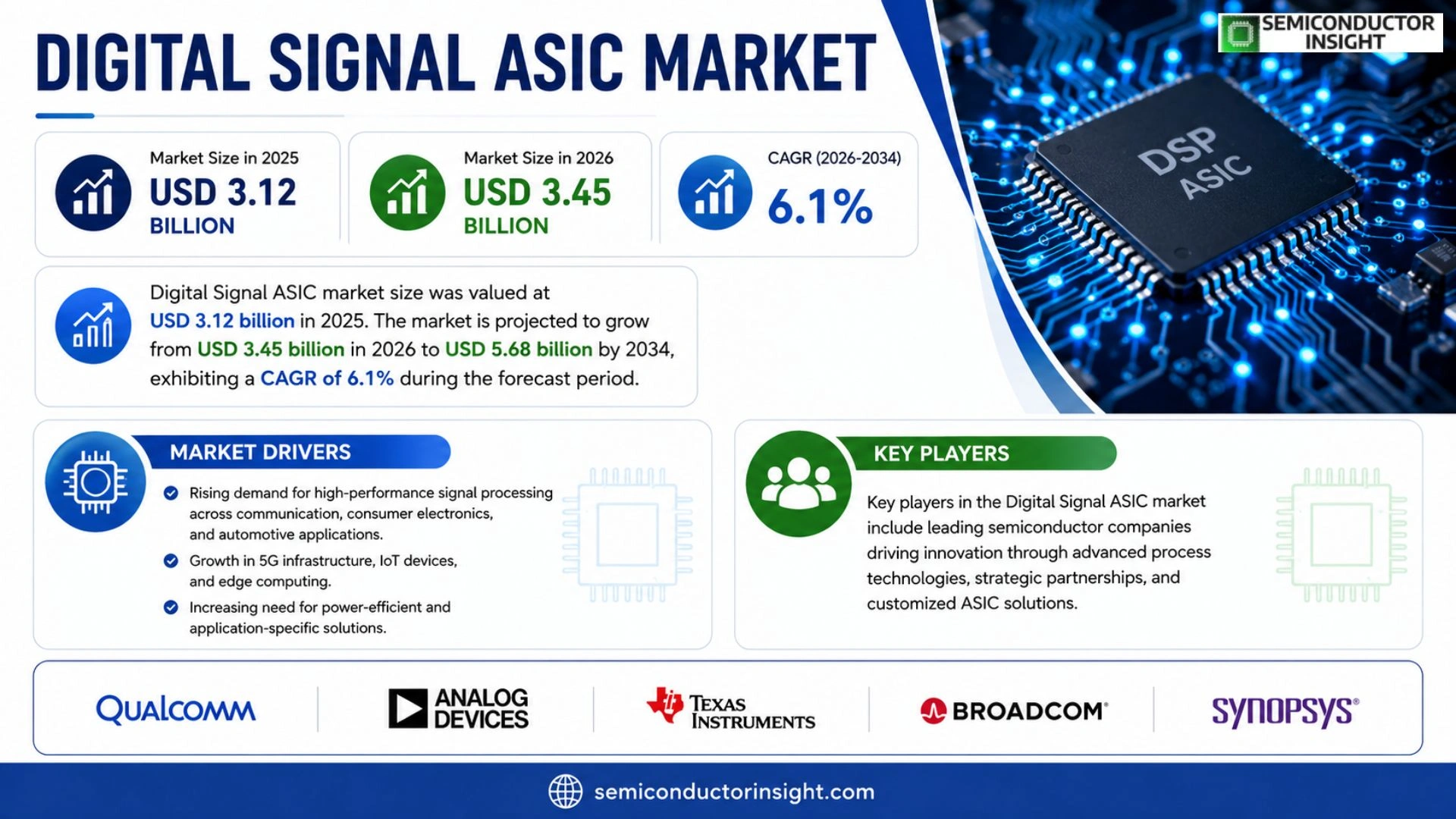
Global Digital Signal ASIC market size was valued at USD 3.12 billion in 2025. The market is projected to grow from USD 3.45 billion in 2026 to USD 5.68 billion by 2034, exhibiting a CAGR of 6.1% during the forecast period.
Digital Signal Application‑Specific Integrated Circuits (ASICs) are custom‑designed semiconductor chips optimized for high‑performance signal processing tasks such as filtering, modulation, and conversion in telecommunications, automotive radar, and IoT devices. Unlike general‑purpose processors, these ASICs deliver lower latency, reduced power consumption, and higher integration density because they are tailored to specific algorithmic workloads.
The market is accelerating due to rising demand for 5G infrastructure, autonomous vehicle sensor suites, and edge‑AI compute where efficient signal handling is critical. Furthermore, advances in silicon‑photonic integration and emerging AI‑driven design automation are enabling faster time‑to‑market for new ASIC families. Key players such as Qualcomm, Intel’s Mobileye division, Broadcom, and NXP are expanding their portfolios through strategic acquisitions and collaborations, further fueling growth.
MARKET DRIVERS
Rising Demand for High‑Performance DSPs
Digital Signal ASIC Market is being propelled by the proliferation of data‑intensive applications such as 5G communications, autonomous vehicles, and advanced radar systems. Enterprises are increasingly seeking custom ASIC solutions that deliver lower latency and higher energy efficiency compared to generic processors.
Integration of AI and Edge Computing
AI inference at the edge requires ASICs optimized for matrix‑multiply operations, leading to a surge in specialized digital signal ASIC designs. Forecasts suggest that AI‑enabled ASIC deployments will grow at a compound annual growth rate (CAGR) of about 16% through 2030.
➤ “Custom digital signal ASICs now achieve up to 30% lower power consumption than conventional SoCs, unlocking longer battery life for IoT devices.”
In addition, the push toward miniaturization in consumer electronics is encouraging manufacturers to adopt ASICs that combine multiple signal‑processing functions on a single die, thereby reducing board space and BOM costs.
MARKET CHALLENGES
Escalating Design Complexity
Designing advanced digital signal ASICs demands sophisticated EDA tools and highly skilled engineering teams. The steep learning curve can extend time‑to‑market, especially for small and midsize firms lacking deep expertise.
Other Challenges
Supply Chain Volatility
Global semiconductor shortages have intermittently constrained wafer availability, leading to longer lead times and higher unit costs for Digital Signal ASIC Market. Companies are therefore investing in diversified fab partnerships to mitigate risk.
Regulatory compliance, particularly in defense and aerospace sectors, imposes additional certification hurdles that can increase development overhead and delay product launches.
MARKET RESTRAINTS
High Upfront Capital Expenditure
Fabrication of custom ASICs involves significant non‑recurring engineering (NRE) costs, often exceeding $5 million for advanced nodes. This financial barrier deters entry of new players and can limit the expansion of Digital Signal ASIC Market in price‑sensitive segments.
The long design cycles, typically ranging from 12 to 24 months, also restrict the ability of companies to rapidly respond to shifting market demands, thereby slowing overall market momentum.
Furthermore, the rapid evolution of competing technologies such as programmable logic devices and high‑performance GPUs offers alternative pathways for signal processing, which can divert investment away from ASIC solutions.
MARKET OPPORTUNITIES
Emergence of 6G and Beyond
Anticipated deployment of 6G networks will demand unprecedented bandwidth and ultra‑low latency, creating a fertile ground for next‑generation digital signal ASICs that can handle terabit‑per‑second data rates.
Another promising avenue lies in the automotive sector, where increasingly sophisticated driver‑assist and autonomous systems rely on ASICs for real‑time sensor fusion and high‑resolution radar processing.
Finally, the growth of quantum‑ready signal processing hardware presents a niche yet high‑value market, with early adopters seeking ASICs capable of interfacing conventional digital signals with emerging quantum platforms.
Digital Signal ASIC Market Trends
Rising Demand from 5G and Edge‑AI
The rollout of 5G networks has generated a surge in high‑frequency signal processing requirements. Custom‑designed ASICs provide the low latency and power efficiency essential for dense antenna arrays and massive MIMO deployments. Simultaneously, edge‑AI workloads demand real‑time preprocessing of sensor data, where dedicated signal‑handling cores reduce system overhead and enable autonomous decision‑making in devices ranging from smart cameras to industrial IoT nodes. These forces combine to accelerate adoption of application‑specific solutions across telecom operators and equipment manufacturers.
Other Trends
Integration of Silicon‑Photonic Technology
Silicon‑photonic integration is moving from research prototypes to volume production, allowing signal ASICs to process optical inputs directly on chip. This reduces conversion stages, lowers energy consumption, and shortens signal paths, which is especially valuable in data‑center interconnects and high‑speed transceiver modules. Early adopters report up to 30 % power savings compared with traditional electrical interfaces, driving broader interest in hybrid electronic‑photonic ASIC families.
Strategic Portfolio Expansion by Leading Vendors
Key players such as Qualcomm, Intel’s Mobileye division, Broadcom, and NXP are broadening their ASIC portfolios through acquisitions and collaborative design programs. These moves aim to bundle signal‑processing IP with system‑level AI accelerators, creating turnkey solutions for autonomous‑vehicle sensor suites and next‑generation radar platforms. By leveraging shared design automation tools and AI‑driven layout optimization, development cycles have shortened, enabling faster market entry for new product generations.
COMPETITIVE LANDSCAPE
Key Industry Players
Competitive dynamics shaping Digital Signal ASIC Market
Digital Signal ASIC Market is currently anchored by a handful of technology powerhouses that command the majority of high‑performance design wins. Qualcomm leverages its 5G modem expertise to deliver signal‑processing ASICs that integrate advanced filtering and modulation blocks, while Intel’s Mobileye division focuses on automotive radar and vision ASICs that meet stringent latency requirements. Broadcom’s portfolio is distinguished by high‑density networking ASICs optimized for data‑center and carrier‑grade signal workloads. These leaders benefit from deep IP libraries, extensive design‑automation ecosystems, and strategic acquisitions that expand their silicon‑photonic and AI‑accelerated capabilities. Consequently, the market structure exhibits a classic tiered hierarchy: a core of globally integrated firms with end‑to‑end design‑to‑fab capabilities, supported by a network of specialized foundry partners that accelerate time‑to‑market.
Beyond the core tier, a vibrant cohort of niche innovators intensifies competition across verticals such as automotive, IoT, and edge‑AI. NXP and STMicroelectronics concentrate on sensor‑fusion ASICs for autonomous vehicles, while Texas Instruments and Analog Devices excel in mixed‑signal front‑ends that bridge analog sensing with digital processing. MediaTek and Samsung provide cost‑effective ASIC solutions for consumer‑grade 5G devices, and Renesas targets automotive safety ASICs with robust functional safety features. AMD’s Xilinx unit adds reconfigurable ASICs for rapid prototyping, whereas Marvell, Infineon and Lattice Semiconductor supply low‑power ASICs for edge compute nodes. GlobalFoundries and other pure‑play foundries enable fab‑agnostic designs, further diversifying the supply chain and fostering innovation among smaller design houses.
List of Key Digital Signal ASIC Companies Profiled
- Qualcomm
- Intel (Mobileye)
- Broadcom
- NXP Semiconductors
- Texas Instruments
- Analog Devices
- MediaTek
- Samsung Electronics
- STMicroelectronics
- Renesas Electronics
- AMD (Xilinx)
- Marvell Technology
- Infineon Technologies
- Lattice Semiconductor
- GlobalFoundries
Segment Analysis:
| Segment Category | Sub-Segments | Key Insights |
| By Type |
|
Fixed‑Function DSP ASICs dominate the market due to their highly optimized data paths and deterministic latency. – Engineers favor them for mission‑critical telecom and radar applications where timing certainty is paramount. – Their design simplicity enables faster time‑to‑market and lower power consumption compared with more flexible alternatives. – Strong ecosystem support from leading foundries reinforces adoption across multiple verticals. |
| By Application |
|
Telecommunications remains the primary catalyst for ASIC adoption. – High‑throughput, low‑latency signal chains in 5G base stations rely on dedicated ASIC blocks for filtering and modulation. – Automotive radar systems demand robust, radiation‑tolerant ASICs to sustain real‑time object detection. – Edge‑AI devices benefit from ASICs that integrate DSP with AI inference engines, delivering power‑efficient compute at the network edge. |
| By End User |
|
Network Equipment Manufacturers lead the demand curve. – They require ASICs that can be tightly integrated with RF front‑ends to meet stringent spectral efficiency goals. – Preference for modular ASIC families that allow incremental upgrades as standards evolve. – Close collaboration with silicon vendors fosters co‑development of custom IP blocks tailored to emerging protocols. |
| By Architecture |
|
Pure Digital DSP ASICs are emerging as the most versatile architecture. – Their absence of analog blocks simplifies scaling to advanced process nodes. – They enable seamless integration with AI accelerators, supporting next‑generation edge compute workloads. – Design teams appreciate the clean digital flow that reduces verification complexity. |
| By Deployment |
|
Edge Devices are shaping the future topology of DSP ASIC adoption. – Compact form‑factor ASICs allow integration directly into sensors and smart cameras. – Power‑efficiency constraints drive innovations in low‑leakage design methodologies. – Proximity to data sources reduces latency, a critical factor for autonomous driving and real‑time analytics. |
Regional Analysis: North America
The telecommunications sector in North America is undergoing rapid transformation with the rollout of 5G infrastructure. This necessitates high-performance digital signal ASICs for base stations, network infrastructure, and mobile devices, driving significant market opportunities. The demand for advanced modulation schemes and increased network capacity directly impacts the adoption of sophisticated ASIC solutions.
The automotive industry is increasingly reliant on digital signal ASICs for advanced driver-assistance systems (ADAS), infotainment systems, and vehicle-to-everything (V2X) communication. The trend towards autonomous vehicles further intensifies the demand for high-reliability and high-performance ASIC solutions capable of processing vast amounts of sensor data.
The aerospace and defense sectors in North America represent a substantial market for digital signal ASICs, utilizing them in radar systems, electronic warfare systems, and satellite communication equipment. The stringent performance and reliability requirements of these applications drive the demand for specialized ASIC designs and high-quality components.
Digital signal ASICs find increasing application in industrial automation, control systems, and medical imaging equipment within North America. The need for real-time data processing and efficient signal conditioning in these sectors contributes to market growth.
Europe
Europe exhibits a steady and evolving digital signal ASIC market. While not as rapidly growing as North America, the region benefits from strong foundations in automotive, industrial, and telecommunications sectors. Key drivers include the ongoing transition to 5G, the increasing adoption of electric vehicles with advanced driver assistance systems, and investments in smart infrastructure. European focus on energy efficiency and sustainable technologies also presents opportunities for specialized digital signal ASIC solutions.
Asia-Pacific
Asia-Pacific is poised for significant expansion Digital Signal ASIC Market, fueled by rapid industrialization, increasing 5G deployment across numerous countries, and a burgeoning consumer electronics sector. China, in particular, is a major market and manufacturing hub, driving demand for a wide range of digital signal ASICs. The growth of the automotive industry in the region, coupled with government initiatives promoting technological self-reliance, further strengthens market prospects.
South America
Digital Signal ASIC Market in South America is gradually gaining traction, driven by increasing investments in telecommunications infrastructure and the growing adoption of connected devices. The expansion of 4G and the initial phases of 5G rollout are key factors. Automotive electronics and industrial automation are emerging as significant application areas within the region.
Middle East & Africa
The Middle East & Africa region presents a moderate but growing market for digital signal ASICs. Infrastructure development projects, particularly in telecommunications and transportation, are key drivers. The increasing adoption of smart city initiatives and the expansion of the automotive sector are also contributing to market growth.
Report Scope
This market research report provides a comprehensive analysis of the Digital Signal ASIC Market , covering the forecast period 2026–2034. It offers detailed insights into market dynamics, technological advancements, competitive landscape, and key trends shaping the industry.
Key focus areas of the report include:
- Market Overview: The report begins with an overview outlining its current market scenario, key growth indicators, and industry transformation drivers. It discusses macroeconomic factors, demand–supply balance, regulatory landscape, and the strategic role of semiconductors in powering advancements across industries such as automotive, telecommunications, consumer electronics, and industrial automation.
- Market Size & Forecast: Historical data and future projections for revenue, unit shipments, and market value across major regions and segments.
- Segmentation Analysis: Detailed breakdown by product type, technology, application, and end-user industry to identify high-growth segments and investment opportunities.
- Regional Insights: Insights into market performance across North America, Europe, Asia-Pacific, Latin America, and the Middle East & Africa, including country-level analysis where relevant.
- Competitive Landscape: Profiles of leading market participants, including their product offerings, R&D focus, manufacturing capacity, pricing strategies, and recent developments such as mergers, acquisitions, and partnerships.
- Technology Trends & Innovation: Assessment of emerging technologies, integration of AI/IoT, semiconductor design trends, fabrication techniques, and evolving industry standards.
- Market Drivers & Restraints: Evaluation of factors driving market growth along with challenges, supply chain constraints, regulatory issues, and market-entry barriers.
- Stakeholder Insights: Insights for component suppliers, OEMs, system integrators, investors, and policymakers regarding the evolving ecosystem and strategic opportunities.
Primary and secondary research methods are employed, including interviews with industry experts, data from verified sources, and real-time market intelligence to ensure the accuracy and reliability of the insights presented.
FREQUENTLY ASKED QUESTIONS:
What is the current market size of Digital Signal ASIC Market?
-> Digital Signal ASIC market size was valued at USD 3.12 billion in 2025. The market is projected to grow from USD 3.45 billion in 2026 to USD 5.68 billion by 2034.
Which key companies operate Digital Signal ASIC Market?
-> Key players include Qualcomm, Intel’s Mobileye division, Broadcom, and NXP, among others.
What are the key growth drivers?
-> Key growth drivers include rising demand for 5G infrastructure, autonomous vehicle sensor suites, edge‑AI compute, and advances in silicon‑photonic integration.
Which region dominates the market?
-> North America remains the largest market in terms of revenue, while Asia‑Pacific is the fastest‑growing region.
What are the emerging trends?
-> Emerging trends include silicon‑photonic integration, AI‑driven design automation, and edge‑AI enabled signal processing.
Get Sample Report PDF for Exclusive Insights
Report Sample Includes
- Table of Contents
- List of Tables & Figures
- Charts, Research Methodology, and more...
 Download Sample Report PDF