
Radar Signal Processing Market Insights
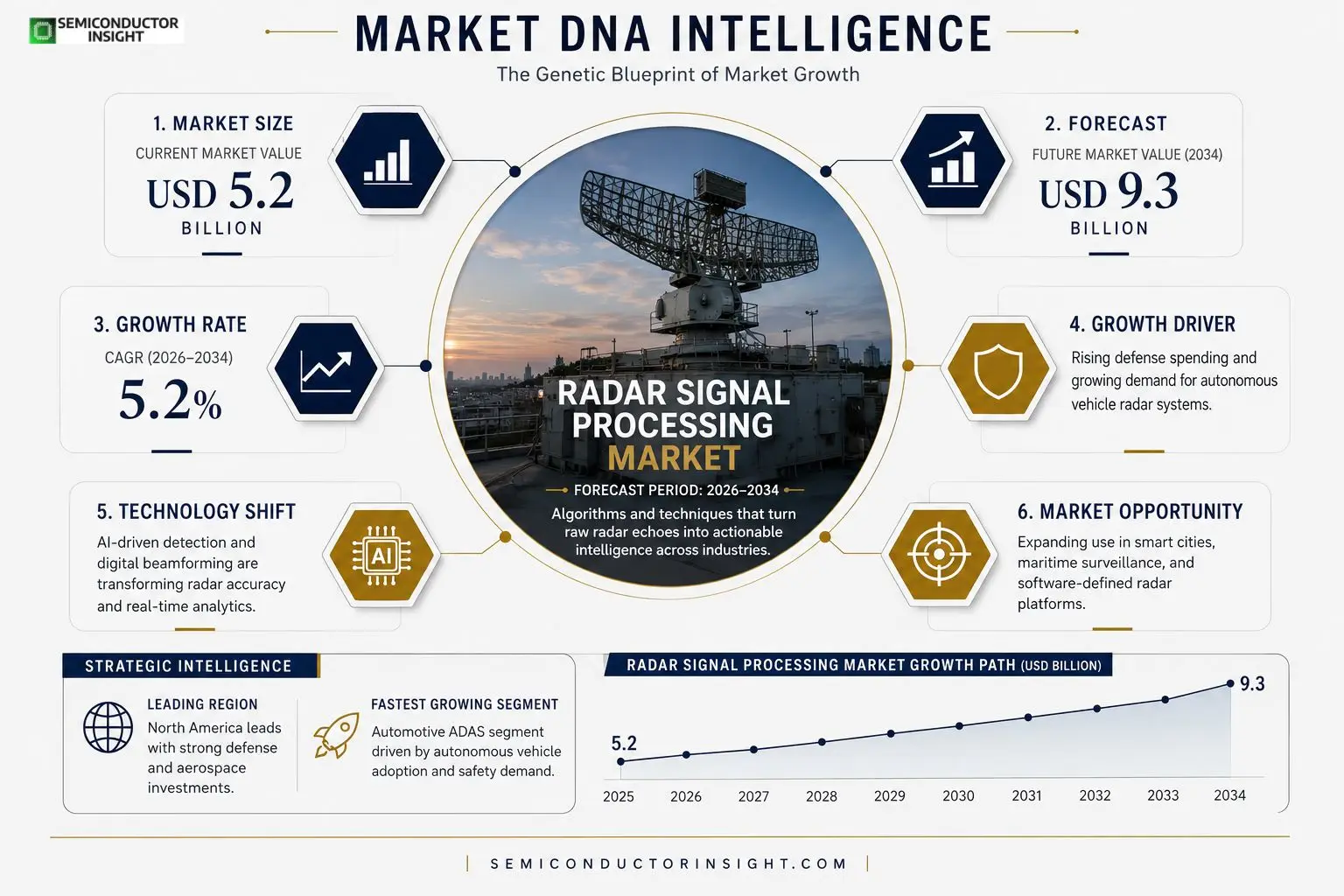
Radar Signal Processing Market size was valued at USD 5.2 billion in 2025. The market is projected to grow from USD 5.6 billion in 2026 to USD 9.3 billion by 2034, exhibiting a CAGR of 5.2% during the forecast period.
Radar signal processing comprises algorithms and techniques that convert raw echo data into actionable information such as range, velocity, angle and target classification. Core functions include pulse compression, Doppler filtering, clutter suppression, beamforming and increasingly AI‑driven detection that enable high‑resolution imaging for defense, automotive and aerospace applications.The market is experiencing rapid growth because defense spending continues to rise ly while autonomous vehicle manufacturers demand reliable millimeter‑wave radars for safety systems. Furthermore, advances in digital beamforming and machine‑learning analytics are expanding use cases in commercial aviation surveillance and maritime monitoring. Key players,including Raytheon Technologies, Lockheed Martin, Northrop Grumman, Thales Group and Saab,are driving expansion through strategic partnerships and technology upgrades.
MARKET DRIVERS
Advancements in Phased‑Array Radar Technology
Radar Signal Processing Market is being propelled by rapid improvements in phased‑array architectures that enable higher resolution and faster scan rates. These technical gains reduce hardware size while enhancing detection accuracy, satisfying the requirements of modern defense and civilian platforms.
Growing Demand in Autonomous Vehicles
Automotive manufacturers are integrating sophisticated radar modules to support advanced driver‑assistance systems (ADAS) and fully autonomous driving. The need for reliable object detection in all weather conditions creates a strong pull for high‑performance signal‑processing algorithms.
➤ Industry analysts forecast that Radar Signal Processing Market will maintain double‑digit growth through the next decade, driven by defense modernization and automotive electrification.
Additionally, the expansion of air traffic management and unmanned aerial systems (UAS) contributes to increased investment in clutter‑suppression and multi‑target tracking solutions, further cementing the market’s upward trajectory.
MARKET CHALLENGES
Complexity of Algorithm Development
Designing algorithms that can process high‑frequency data streams in real time remains a significant technical hurdle. The need for specialized expertise and long development cycles can slow product launches, especially for niche defense applications.
Other Challenges
High Development Costs
The integration of cutting‑edge processors and AI‑driven analytics demands substantial capital investment, which can be prohibitive for startups and mid‑size firms seeking market entry.
MARKET RESTRAINTS
Stringent Regulatory Approvals
Export controls and certification requirements for radar systems in defense and aerospace sectors limit rapid commercialization. Companies must navigate complex compliance frameworks, extending time‑to‑market.Regulatory scrutiny also affects civilian automotive deployments, where safety standards demand rigorous testing before mass adoption of radar‑based ADAS features.These procedural barriers can deter smaller innovators and concentrate market power among established players with the resources to meet compliance obligations.
MARKET OPPORTUNITIES
Integration of AI and Machine Learning
Applying AI techniques to radar signal processing unlocks new capabilities such as predictive tracking, adaptive clutter mitigation, and autonomous threat classification. Companies that successfully fuse AI with traditional radar pipelines are positioned to capture premium market share.Emerging sectors like smart cities and maritime surveillance present untapped application spaces where low‑cost, high‑performance radar sensors can provide critical situational awareness.Furthermore, the shift toward software‑defined radar platforms offers a modular approach, allowing OEMs to upgrade functionality via firmware updates, thereby extending product lifecycles and opening recurring revenue streams.
Radar Signal Processing Market Trends
Defense Sector Expansion
The defense segment continues to drive Radar Signal Processing Market as governments increase funding for next‑generation air‑ and missile‑defense systems. Modern radars rely on high‑resolution pulse compression and Doppler filtering to detect low‑observable threats, prompting OEMs to upgrade firmware and adopt digital beamforming architectures. In 2025, defense procurement for radar capabilities accounted for roughly 55 % of total market activity, and the trend is reinforced by joint ventures among Raytheon Technologies, Lockheed Martin and Northrop Grumman, which are integrating AI‑enhanced clutter suppression to improve target classification under contested environments.
Other Trends
Automotive Safety Integration
Automotive manufacturers are a fast‑growing user of radar signal processing to support advanced driver‑assistance systems (ADAS). Millimeter‑wave radar units, embedded with real‑time beam steering and machine‑learning based object detection, enable reliable distance and velocity measurements for collision avoidance and adaptive cruise control. In 2026, more than 40 % of new electric‑vehicle platforms incorporated radar stacks that combine traditional clutter suppression with AI‑driven classification, a shift that accelerates demand for compact, low‑power processing ASICs. This sub‑segment fuels diversification of Radar Signal Processing Market beyond its legacy defense focus.
AI‑Driven Signal Analytics
Artificial‑intelligence techniques are reshaping how raw echo data are interpreted across commercial aviation, maritime surveillance and space‑based sensing. Deep‑learning models applied to Doppler‑filtered returns improve target discrimination, reduce false alarms, and enable predictive maintenance of radar hardware. Industry leaders such as Thales Group and Saab are deploying edge‑AI processors that run inference directly on the sensor, shortening latency and expanding the range of actionable insights. This evolution marks a strategic pivot toward software‑centric revenue streams and positions Radar Signal Processing Market for sustained growth through 2034.
COMPETITIVE LANDSCAPEKey Industry Players
Radar Signal Processing Market: Competitive Overview
Radar Signal Processing Market is currently anchored by a handful of large defense and aerospace contractors that dominate high‑performance algorithm development and system integration. Raytheon Technologies, Lockheed Martin, and Northrop Grumman together command the bulk of revenue in the defense segment, leveraging extensive R&D budgets to advance digital beamforming, clutter suppression, and AI‑enhanced target classification. In parallel, Thales Group and Saab have built strong aftermarket and OEM relationships, enabling them to capture growing demand from automotive manufacturers seeking millimeter‑wave radar solutions for advanced driver‑assistance systems. This concentration of market share creates a tiered structure where a few leaders set technology standards while smaller niche firms focus on specialized applications and component supply.Beyond the tier‑one players, a diverse set of niche innovators is expanding the ecosystem through specialized semiconductor IP, sensor designs, and software‑defined radar platforms. Companies such as Texas Instruments and Analog Devices provide key mixed‑signal and RF components that underpin next‑generation signal‑processing chains. Meanwhile, firms like Vayyar Imaging, Uhnder, and Hensoldt are delivering compact, solid‑state radar modules for automotive and maritime use cases. European defense specialist Leonardo, BAE Systems, and L3Harris Technologies contribute sophisticated signal‑processing software for aerospace surveillance, while NXP Semiconductors and Qorvo supply high‑frequency transceiver technologies that enable higher resolution imaging. These niche players intensify competition by offering differentiated performance, cost advantages, and rapid integration cycles.
List of Key Radar Signal Processing Companies Profiled
- Northrop Grumman
- Raytheon Technologies
- Lockheed Martin
- Saab
- Thales Group
- Analog Devices
- Vayyar Imaging
- Uhnder
- Hensoldt
- Leonardo
- BAE Systems
- L3Harris Technologies
- Texas Instruments
- NXP Semiconductors
Segment Analysis:
| Segment Category | Sub-Segments | Key Insights |
| By Type |
|
Digital Beamforming
|
| By Application |
|
Defense Surveillance
|
| By End User |
|
Defense Agencies
|
| By Technology |
|
Machine Learning Algorithms
|
| By Deployment Mode |
|
Edge Embedded Solutions
|
Regional Analysis: North America
North America
The defense sector in North America remains a dominant consumer of radar signal processing technologies. Ongoing modernization efforts by armed forces necessitate advanced systems for air defense, missile defense, and surveillance. This translates into consistent demand for high-performance signal processing solutions to manage complex radar data.
The aerospace industry in North America heavily relies on radar signal processing for navigation, weather forecasting, and collision avoidance systems. The development of next-generation aircraft and unmanned aerial vehicles (UAVs) further expands the application scope of advanced radar technologies.
The automotive sector is witnessing a significant influx of radar signal processing applications, particularly in advanced driver-assistance systems (ADAS) and autonomous driving technologies. Reliable radar systems are crucial for features like adaptive cruise control, blind-spot detection, and automatic emergency braking.
Radar signal processing plays a vital role in environmental monitoring, including weather forecasting, flood detection, and ice detection. Sophisticated signal processing algorithms enable accurate data analysis for improved prediction and timely response to environmental hazards.
Europe
Europe presents a dynamic market for Radar Signal Processing, driven by a growing emphasis on cybersecurity and infrastructure development. The region’s commitment to technological advancement and its collaborative approach to research and development are key factors shaping the market’s evolution. Increased investment in smart cities and intelligent transportation systems is creating new opportunities for radar-based solutions. Furthermore, European nations are actively pursuing initiatives to enhance their defense capabilities, which in turn boosts demand for advanced radar systems. The focus on energy efficiency and sustainable development is also influencing the adoption of radar technologies for environmental monitoring and resource management.
Asia-Pacific
Asia-Pacific is poised to become the fastest-growing market for Radar Signal Processing, fueled by rapid industrialization and increasing defense spending. Countries like China, India, and Japan are investing heavily in upgrading their radar infrastructure and developing indigenous technologies. The expanding aerospace and automotive industries in the region are also contributing significantly to market growth. Moreover, the growing need for surveillance and security solutions in densely populated urban areas is driving the adoption of radar technologies. The increasing adoption of 5G and IoT technologies will further enhance the capabilities of radar systems, creating new market opportunities.
South America
South America represents a relatively nascent market for Radar Signal Processing, but it holds significant potential for future growth. Increased investment in infrastructure projects, particularly in transportation and energy sectors, is creating demand for radar-based solutions. The growing need for border security and surveillance is also driving adoption in the defense sector. While the market is currently dominated by imports, there is a growing trend towards local manufacturing and development of radar technologies.
Middle East & Africa
The Middle East & Africa region is witnessing increasing demand for Radar Signal Processing systems, primarily driven by defense spending and infrastructure development. The region’s geopolitical landscape and security concerns are fueling investments in advanced radar systems for air defense and border security. The expanding oil and gas industry is also utilizing radar technologies for exploration and monitoring purposes. Furthermore, increasing urbanization and infrastructure projects are creating new opportunities for radar-based solutions in transportation and smart city applications.
Report Scope
This market research report provides a comprehensive analysis of the Radar Signal Processing Market , covering the forecast period 2026–2034. It offers detailed insights into market dynamics, technological advancements, competitive landscape, and key trends shaping the industry.
Key focus areas of the report include:
- Market Overview: The report begins with an overview outlining its current market scenario, key growth indicators, and industry transformation drivers. It discusses macroeconomic factors, demand–supply balance, regulatory landscape, and the strategic role of semiconductors in powering advancements across industries such as automotive, telecommunications, consumer electronics, and industrial automation.
- Market Size & Forecast: Historical data and future projections for revenue, unit shipments, and market value across major regions and segments.
- Segmentation Analysis: Detailed breakdown by product type, technology, application, and end-user industry to identify high-growth segments and investment opportunities.
- Regional Insights: Insights into market performance across North America, Europe, Asia-Pacific, Latin America, and the Middle East & Africa, including country-level analysis where relevant.
- Competitive Landscape: Profiles of leading market participants, including their product offerings, R&D focus, manufacturing capacity, pricing strategies, and recent developments such as mergers, acquisitions, and partnerships.
- Technology Trends & Innovation: Assessment of emerging technologies, integration of AI/IoT, semiconductor design trends, fabrication techniques, and evolving industry standards.
- Market Drivers & Restraints: Evaluation of factors driving market growth along with challenges, supply chain constraints, regulatory issues, and market-entry barriers.
- Stakeholder Insights: Insights for component suppliers, OEMs, system integrators, investors, and policymakers regarding the evolving ecosystem and strategic opportunities.
Primary and secondary research methods are employed, including interviews with industry experts, data from verified sources, and real-time market intelligence to ensure the accuracy and reliability of the insights presented.
FREQUENTLY ASKED QUESTIONS:
What is the current market size of Radar Signal Processing Market?
-> Radar Signal Processing Market was valued at USD 5.2 billion in 2025 and is expected to reach USD 9.3 billion by 2034.
Which key companies operate in Radar Signal Processing Market?
-> Key players include Raytheon Technologies, Lockheed Martin, Northrop Grumman, Thales Group and Saab.
What are the key growth drivers?
-> Key growth drivers include rising defense spending, increasing demand for autonomous‑vehicle radar systems, advances in digital beamforming, AI‑driven detection, and expanding applications in aviation surveillance and maritime monitoring.
Which region dominates the market?
-> The reference does not specify a dominant region.
What are the emerging trends?
-> Emerging trends include AI‑driven detection algorithms, digital beamforming, machine‑learning analytics, and deeper integration of radar technology into automotive and aerospace platforms.
Get Sample Report PDF for Exclusive Insights
Report Sample Includes
- Table of Contents
- List of Tables & Figures
- Charts, Research Methodology, and more...





