Key Statistics
Key Takeaways
- Power management and signal-chain analog represent the largest functional value pools because nearly every electronic system needs voltage regulation, sensing, amplification, conversion and interface functions around its digital processors. Mixed-signal integration increasingly combines these functions with digital calibration and embedded intelligence.
- Industrial and automotive applications form the most important end markets for leading diversified suppliers. Analog Devices generated 45% of fiscal 2025 revenue from industrial and 30% from automotive, while Texas Instruments’ long-term manufacturing strategy is explicitly oriented toward industrial, automotive and data-center demand.
- Asia Pacific is the largest regional market because China, Japan, South Korea and Taiwan concentrate electronics production and a significant share of automotive, industrial and consumer manufacturing. North America captures disproportionate design and supplier revenue through Texas Instruments, Analog Devices, Microchip and other major analog companies.
- 300 mm analog manufacturing is a major structural cost advantage. Texas Instruments states that an unpackaged chip built on a 300 mm wafer costs about 40% less than one built on a 200 mm wafer and continued ramping new 300 mm fabs in Richardson, Sherman and Lehi during 2025.
- Industrial analog front ends are becoming software configurable. NXP’s 2025 NAFE33352 combines precision input and output functions for factory automation, showing how mixed-signal devices are reducing board complexity while supporting machine-learning-driven process control.
- AI is creating new analog and power content outside the accelerator itself. Analog Devices completed its USD 1.5 billion acquisition of Empower Semiconductor in July 2026 to expand integrated voltage regulators and silicon-capacitor technology for high-density AI power delivery.
Analog and Mixed Signal Device Market Overview
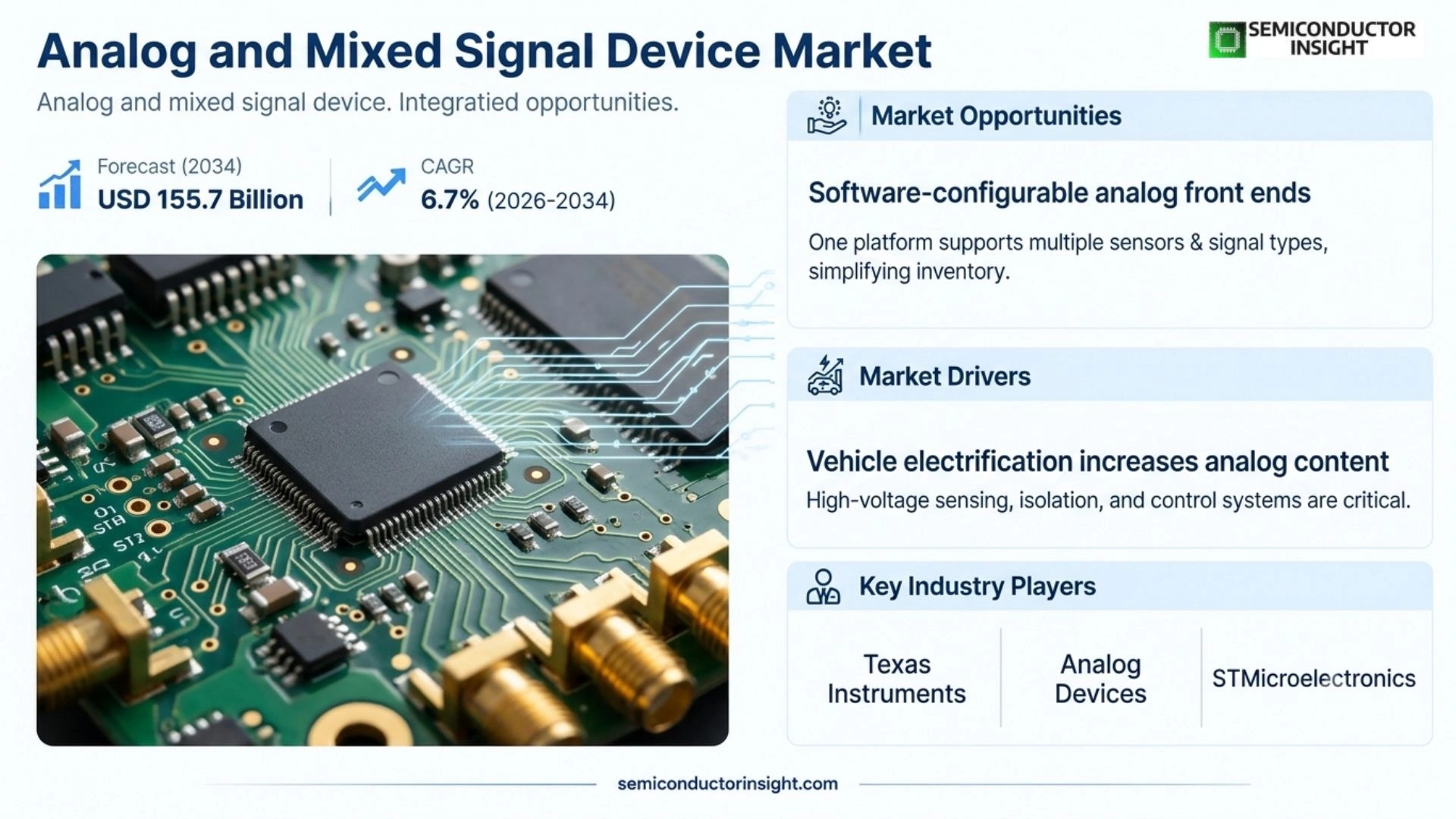
Analog and Mixed Signal Device Market was valued at approximately USD 86.5 billion in 2025 and is projected to reach approximately USD 155.7 billion by 2034, representing a 6.7% CAGR during 2026–2034. Asia Pacific is the largest regional market because it concentrates electronics, automotive and industrial production, while North America remains a major center of analog semiconductor design, intellectual property and high-value system innovation.
Analog and mixed-signal devices connect the physical world to digital processing. They amplify and condition sensor signals, convert between analog and digital domains, manage voltage and current, drive actuators, interface communications buses and protect systems against electrical faults. The market therefore includes operational amplifiers, comparators, data converters, analog front ends, power-management ICs, interface devices, clocking, motor drivers, automotive system-basis chips and many application-specific mixed-signal products.
The category is commercially broad because analog content scales with system complexity rather than transistor count alone. A factory automation controller requires precision input and output, isolation, power, timing and interface devices; an electric vehicle needs battery monitoring, current sensing, gate drivers, power management and in-vehicle networking; an AI server requires high-density voltage regulation and telemetry around processors and memory. This diversity makes analog demand less concentrated in one end market than memory or leading-edge logic.
WSTS reported global analog semiconductor sales of about USD 86.5 billion in 2025, up 8.7% year over year from USD 79.6 billion in 2024. Texas Instruments alone generated USD 14.0 billion of analog revenue in 2025, while STMicroelectronics reported USD 5.085 billion of revenue in its Analog Products, MEMS and Sensors segment. These supplier data illustrate both the size of the category and the importance of broad product portfolios serving many thousands of customers.
The market is moving toward higher integration and software configurability. NXP’s next-generation NAFE3 analog front end combines high-precision input and output functions for industrial control, Analog Devices’ MxFE family integrates multiple RF ADCs, DACs and digital processing, and automotive vendors increasingly combine regulators, communication transceivers, sensor interfaces and protected drivers in multifunction ICs. Integration reduces component count and software-configurable functions allow one device to serve several hardware variants.
Segment Analysis: By Type
By type, the market is segmented into Power Management ICs, Amplifiers and Comparators, Data Converters, Interface ICs, Analog Front Ends, Timing/Clock Devices, Sensor and Motor Interface ICs, and Other Mixed-Signal Devices. Power management is the largest functional category because every electronic system requires multiple regulated rails, while data converters and analog front ends command premium value in applications where precision or bandwidth determines system performance.
| Type | Function and technical role | Market position |
|---|---|---|
| Power Management ICs | Includes linear regulators, switching regulators, PMICs, hot-swap controllers, supervisors, battery-management devices and integrated voltage regulators. These products convert and sequence power rails and increasingly incorporate telemetry, digital interfaces and protection logic. | Largest functional value pool. Growth is supported by EV electrification, industrial automation, portable electronics and AI data-center power. Analog Devices’ Empower acquisition specifically expands high-density AI power delivery through integrated voltage regulators and silicon capacitors. |
| Amplifiers and Comparators | Operational amplifiers, instrumentation amplifiers, current-sense amplifiers and comparators condition low-level analog signals before conversion or control. Key selection criteria include offset, noise, input bias current, bandwidth, common-mode range, quiescent current and temperature drift. | A mature but highly fragmented segment. Precision industrial, medical and automotive designs create premium opportunities, while commodity low-voltage amplifiers face strong price competition. The broad installed base supports long product lifecycles and recurring replacement demand. |
| Data Converters | ADCs and DACs translate signals between physical analog domains and digital processors. Converter value rises with resolution, sample rate, linearity, power efficiency and channel count. High-speed devices support communications and instrumentation, while precision converters serve industrial measurement and medical equipment. | High-value strategic segment. Analog Devices and Texas Instruments maintain strong positions. AI, software-defined radio, industrial sensing and medical imaging increase demand for faster or more accurate conversion and integrated digital calibration. |
| Interface ICs | Transceivers, isolators, serializers, USB, Ethernet, CAN/LIN, RS-485 and other interface products connect devices and protect signal integrity across systems. Mixed-signal interfaces increasingly include diagnostics, protection and power-delivery functions. | A steady growth segment benefiting from higher connectivity per system. Automotive Ethernet, industrial Ethernet and USB/PCIe complexity add content, while isolated interfaces are important in factories, energy and EV systems. |
| Analog Front Ends | AFEs combine amplifiers, filters, multiplexers, ADCs/DACs, references and sometimes digital control around a sensor or signal path. NXP’s NAFE33352 is a software-configurable input/output device for industrial automation, while ADI MxFE integrates high-speed RF conversion and digital processing. | Fast-growing integration segment. Customers use AFEs to reduce board area and calibration effort. Industrial automation, communications, healthcare and instrumentation are the strongest value applications. |
| Timing and Clock Devices | Oscillators, PLLs, clock generators, jitter cleaners and real-time clocks synchronize digital and mixed-signal systems. Performance is defined by jitter, phase noise, frequency accuracy, power and environmental stability. | A specialized segment with strong communications, data-center and industrial demand. Higher-speed interfaces and distributed systems increase timing requirements even as device counts consolidate. |
| Sensor and Motor Interface ICs | Includes bridge interfaces, resolvers, motor drivers, actuator drivers and signal-conditioning devices used between physical sensors or motors and digital controllers. Products often combine analog measurement, protection and embedded diagnostics. | A fast-growing automotive and industrial segment. Robotics, factory automation, EV auxiliaries and smart appliances increase the number of motors and sensors per system, raising analog content. |
| Other Mixed-Signal Devices | Includes application-specific automotive, audio, RF, touch, medical and consumer mixed-signal ICs that combine analog blocks with logic or embedded control. These devices are optimized around a particular system function rather than sold as general-purpose catalog products. | A broad innovation category where integration creates strong design lock-in. Unit volumes can be high in consumer devices or lower but premium in automotive and medical systems. |
Process-technology segmentation
Analog devices use a wider range of semiconductor processes than leading-edge digital chips, including 300 mm and 200 mm CMOS, BCD, bipolar, BiCMOS, SOI and specialty high-voltage nodes. Mature geometry can be an advantage because analog performance depends on voltage handling, matching, passives and noise rather than minimum transistor size. The economic shift toward 300 mm therefore focuses on lowering die cost while retaining specialized analog process modules.
Segment Analysis: By Application
By application, the market is segmented into Industrial, Automotive, Consumer Electronics, Communications, Data Center & Computing, Healthcare, and Aerospace & Defense. Industrial and automotive are the two most important diversified analog markets because they require large numbers of sensing, power, interface and control functions and value long product lifecycles. Data centers are the fastest-growing incremental application as AI raises power-delivery and high-speed signal-chain content.
| Application | Demand characteristics |
|---|---|
| Industrial | Largest diversified end market. Factory automation, robotics, process control, energy, test and measurement need precision sensing, isolation, motor control, data conversion and industrial networking. Analog Devices generated 45% of fiscal 2025 revenue from industrial, demonstrating the importance of this end market to premium analog suppliers. |
| Automotive | Vehicles use analog and mixed-signal ICs in powertrain, battery systems, chassis, body electronics, infotainment, ADAS, lighting and connectivity. EVs increase high-voltage sensing and power-management content, while software-defined vehicles increase zonal power, networking and diagnostic functions. Long qualification cycles create durable design wins. |
| Consumer Electronics | Smartphones, wearables, TVs, appliances and audio systems use PMICs, audio amplifiers, sensor interfaces, touch controllers and connectivity devices. Volumes are high but ASP pressure is intense. Suppliers win by integrating more functions into smaller packages and lowering quiescent power. |
| Communications | Wireless infrastructure, optical networks and broadband systems require high-speed converters, RF front ends, clocking and power-management devices. ADI’s MxFE portfolio directly serves communications and aerospace systems that need multi-gigahertz direct RF sampling and software-defined operation. |
| Data Center & Computing | Fastest-growing incremental application. AI servers require high-current voltage regulation, hot-swap protection, telemetry, clocks, high-speed interfaces and thermal sensing. ADI’s 2026 acquisition of Empower targets exactly this grid-to-core power-delivery opportunity. |
| Healthcare | Medical imaging, diagnostics, patient monitoring and portable devices use precision amplifiers, converters, isolation and low-noise power. Customers prioritize reliability, low drift and lifecycle support, and regulatory qualification makes component changes expensive. |
| Aerospace & Defense | Radar, electronic warfare, communications and instrumentation use high-speed ADC/DACs, RF mixed-signal front ends, precision analog and radiation-tolerant power. Unit volumes are lower but ASPs and qualification value can be materially higher than consumer electronics. |
Customer and sales model
The market is also segmented between broadline catalog suppliers and application-specific mixed-signal vendors. Broadline companies sell tens of thousands of products across fragmented customers and benefit from distribution scale. Application-specific suppliers concentrate on automotive, audio, RF or industrial niches and often capture higher content per platform through custom integration. The commercial model determines inventory strategy, sales channel and product-lifecycle management.
Regional Analysis
Asia Pacific is the largest analog and mixed-signal device market, North America is the leading supplier and design region, and Europe has an unusually high automotive and industrial mix. Regional demand follows electronics production and system design. China is the largest manufacturing market, the United States hosts several global analog leaders, Japan has deep mixed-signal and automotive expertise, and Europe remains strategically important in automotive, industrial and power applications.
How does regional analog demand differ?
Analog demand is more geographically diversified than leading-edge logic because every manufacturing region uses mature-node, power and interface devices. Asia captures high unit volumes through electronics assembly. North America captures high-value industrial, communications and data-center design wins. Europe is strongly tied to automotive and factory automation. Emerging regions consume analog devices mainly inside finished equipment rather than through local semiconductor fabrication.
| Region | Position | Growth outlook | Demand profile | What decides supplier selection |
|---|---|---|---|---|
| Asia Pacific | Largest | High | Electronics production and automotive led | Cost, local supply, breadth, distributor support and manufacturing continuity |
| North America | Major supplier/design region | High | Industrial, AI, aerospace and automotive design led | System expertise, software/tools, 300 mm capacity and long product life |
| Europe | High-value automotive/industrial market | Moderate to high | Automotive, industrial and energy led | Functional safety, precision, lifecycle, local engineering and regulatory fit |
| South America | Developing | Moderate | Automotive, industrial and consumer led | Price, distributor inventory, local technical support and import availability |
| Middle East & Africa | Emerging | Moderate | Industrial, energy, telecom and defense led | Ruggedness, service support, security and long-term supply |
Key Analog and Mixed Signal Device Manufacturers and Competitive Landscape
Competition is led by broadline analog suppliers with extensive product catalogs and decades-long customer relationships. Texas Instruments and Analog Devices are the two most influential global suppliers across signal chain and power. STMicroelectronics, Infineon, NXP, Renesas, onsemi and Microchip combine analog products with embedded, power or automotive portfolios, while more specialized companies compete in audio, RF, power management and interfaces.
Scale creates several advantages that are unusual in other semiconductor categories. Broad catalogs allow suppliers to sell multiple components into one design, distribution networks reach fragmented industrial customers, and long product lifecycles create recurring revenue with relatively low redesign frequency. Texas Instruments has deliberately invested in 300 mm internal manufacturing to lower unit cost and strengthen geopolitically dependable capacity, converting manufacturing structure into a commercial differentiator.
System knowledge is becoming more important as products integrate. NXP combines analog front ends with MCU/MPU platforms, Analog Devices positions mixed-signal front ends around complete RF signal chains, and ST integrates analog, power and communication functions in automotive ICs. Customers increasingly evaluate reference designs, software tools and functional-safety documentation alongside device specifications, which raises switching costs for qualified platforms.
Key Industry Players
- Texas Instruments
- Analog Devices
- STMicroelectronics
- Infineon Technologies
- NXP Semiconductors
- Renesas Electronics
- onsemi
- Microchip Technology
- ROHM Semiconductor
- Skyworks Solutions
- Cirrus Logic
- Monolithic Power Systems
- Silicon Laboratories
- Diodes Incorporated
- Semtech Corporation
Analog and Mixed Signal Device Production Capacity Analysis
Analog production uses both 200 mm and 300 mm wafer fabs across mature and specialty processes. The most important capacity shift is the expansion of 300 mm manufacturing for devices that historically used 200 mm wafers. Texas Instruments states that an unpackaged chip built on a 300 mm wafer costs about 40% less than the same chip on a 200 mm wafer, creating a structural cost advantage when volume is sufficient to fill the larger fab.
Texas Instruments continued qualifying and ramping 300 mm fabs in Richardson and Sherman, Texas, and Lehi, Utah during 2025. These sites support analog and embedded products and are intended to serve long-term industrial, automotive and data-center growth. The company’s integrated manufacturing model gives it direct control over process technology, capacity timing and geographic diversification rather than relying entirely on external foundries.
Other suppliers use mixed manufacturing models. STMicroelectronics operates front-end fabs in Europe and Singapore and assembly/test sites across several countries. Analog Devices combines internal fabs with foundry partners, while NXP, Infineon and Renesas maintain substantial specialty manufacturing. Analog products frequently require BCD, bipolar, SOI, embedded flash or high-voltage process modules that cannot be moved easily between generic foundries without requalification.
Packaging and test capacity are equally important because analog devices use a wide range of packages-from tiny wafer-level consumer products to automotive power packages and precision ceramic or leaded formats. Automotive and industrial customers require long-term package availability and controlled changes. A fab can have wafer capacity available while effective shipments remain constrained by a qualified package, test flow or substrate, making back-end diversification a strategic part of analog supply planning.
Analog and Mixed Signal Device Market Dynamics
Market growth is supported by higher electronic content in vehicles and factories, AI power delivery, more sensors and faster connectivity. Growth is restrained by industrial and automotive cyclicality, long product lifecycles and strong price competition in commodity functions. The strongest opportunities are software-configurable analog front ends, 300 mm cost reduction, high-density AI power, precision sensing and integrated automotive system-basis devices.
MARKET DRIVERS
Drivers Impact Analysis*
| Market Factor | Directional Impact on CAGR Forecast* | Commercial Mechanism |
|---|---|---|
| Automotive electrification and electronics content | +1.3 to +1.9 percentage points | EVs and software-defined vehicles increase sensing, power management, networking and actuator-control functions per vehicle. |
| Industrial automation and physical AI | +1.1 to +1.6 percentage points | Robotics and smart factories require more precision sensing, conversion, isolation and motor-control ICs. |
| AI data-center power and telemetry | +0.8 to +1.3 percentage points | High-density accelerators require integrated voltage regulation, hot-swap, monitoring and signal-chain devices around the compute silicon. |
Electrification increases analog content per vehicle
Battery electric and hybrid vehicles require current and voltage sensing, isolated communications, gate drivers, battery monitoring, motor control and multiple regulated power rails. Software-defined architectures add Ethernet, zonal power and diagnostic functions. Even if vehicle unit growth is modest, semiconductor value per vehicle can increase materially because analog devices sit at every electrical interface between sensors, actuators, batteries and processors.
Industrial automation needs precision at the physical edge
Factories are adding more sensors, closed-loop control, robotics and machine learning. These systems still need accurate real-world data before software can act. NXP’s NAFE33352 combines 24-bit input and 18-bit output capability for programmable industrial I/O, illustrating how analog integration supports smarter automation. Higher precision and software configurability create value without requiring advanced digital process nodes.
AI infrastructure creates a new high-growth power market
AI accelerators consume enormous current at low voltages, making power delivery one of the main constraints on performance. Analog Devices acquired Empower Semiconductor for USD 1.5 billion to add integrated voltage regulator and silicon-capacitor technology, explicitly targeting grid-to-core AI power. This demonstrates that analog content is expanding around the accelerator as power density rises.
More connected devices require more interfaces and timing
Automotive Ethernet, industrial Ethernet, USB, PCIe, CAN and other buses increase the number and performance requirements of interface ICs. High-speed links also require clocks, retimers and power sequencing. Analog and mixed-signal suppliers benefit because connectivity growth creates multiple support functions around every processor or controller rather than replacing them.
MARKET RESTRAINTS
Restraints Impact Analysis*
| Market Factor | Directional Impact on CAGR Forecast* | Commercial Mechanism |
|---|---|---|
| Industrial and automotive inventory cycles | −0.8 to −1.2 percentage points | Broad analog demand can weaken when customers correct inventory, producing multi-quarter revenue volatility despite long-term content growth. |
| Long product lifecycles and slower replacement | −0.6 to −0.9 percentage points | Many analog functions remain qualified for years, limiting rapid technology turnover compared with digital processors. |
| Commodity price competition | −0.5 to −0.8 percentage points | Basic regulators, amplifiers and interfaces face competition from regional suppliers, especially in high-volume consumer applications. |
Analog markets remain cyclical despite fragmented demand
Industrial and automotive customers often hold inventory to protect production, then reduce orders sharply when end demand slows. This was visible in 2023–2024 when analog sales weakened even as long-term electronics content continued rising. Suppliers with broad customer bases and strong balance sheets can manage the cycle better, but fab utilization and pricing still fluctuate.
Long-qualified designs reduce replacement frequency
An industrial controller or vehicle platform may use the same amplifier, ADC or transceiver for ten years because redesign creates engineering and qualification cost. This stability benefits incumbent suppliers but limits the rate at which newer higher-performance parts penetrate the installed base. Growth therefore depends more on new functions and end-system content than on frequent replacement of existing analog ICs.
Low-complexity devices face aggressive competition
Basic LDOs, amplifiers, switches and interface devices can be manufactured on mature nodes by many suppliers. Chinese and other regional vendors are expanding catalogs and can compete strongly on price in consumer and local industrial markets. Global leaders defend share through breadth, quality, lifecycle and technical support, but margin pressure remains significant in functions with limited differentiation.
MARKET OPPORTUNITIES
Software-configurable analog front ends
Factories and instrumentation companies want one hardware platform to support multiple sensors and signal types. Software-configurable inputs and outputs reduce board variants and simplify inventory. NXP’s NAFE3 family illustrates this opportunity. Suppliers can capture more value by integrating converters, amplifiers, diagnostics and digital control into configurable channels rather than selling each function separately.
300 mm analog manufacturing scale
Migrating suitable products to 300 mm wafers lowers die cost and creates capacity for long-term growth. Texas Instruments’ cost estimate of about 40% lower unpackaged-chip cost versus 200 mm demonstrates the potential economics. Suppliers that fill large 300 mm fabs can use lower structural cost to compete in broad catalog products while preserving margins.
AI grid-to-core power delivery
High-current accelerators need voltage regulation closer to the processor and better telemetry throughout the power chain. Integrated voltage regulators, silicon capacitors, multiphase controllers and current sensors can become a major analog growth area. ADI’s Empower transaction demonstrates willingness to invest heavily for technology that reduces power-delivery loss and board area.
Physical AI and robotics
Robots and autonomous machines need precision sensing, motor control, power management and real-time conversion. Analog Devices describes this trend as physical intelligence: AI systems that perceive and act in the physical world. Every additional camera, force sensor, motor and battery adds analog content around the digital compute platform.
Analog and Mixed Signal Device Supply Chain Analysis
The value chain spans process technology and wafers, analog IC design, packaging and test, distribution, and final system qualification. Unlike leading-edge digital markets, thousands of products may share a fab and individual product volumes can vary widely. Efficient supply therefore depends on flexible mature-node manufacturing, standardized package platforms and a broad distribution network capable of serving customers that purchase anywhere from hundreds to millions of units.
Stage 1 – Specialty wafer processes
Analog devices use process features that are not optimized purely for transistor density. High-voltage transistors, precision resistors, capacitors, low-noise bipolar devices and embedded flash may all be required. This makes process recipes sticky and creates barriers to moving products between foundries. Integrated manufacturers can optimize device design with their own process technology, while fabless suppliers depend on foundry stability.
Stage 2 – Circuit and mixed-signal integration
Design value is created by precision and robustness across voltage, temperature and process variation. Mixed-signal products add digital calibration or control to compensate analog imperfections. Experienced design teams and reusable IP are difficult to replicate quickly, which is why analog companies often maintain products for decades and extend families incrementally rather than replace entire architectures every few years.
Stage 3 – Packaging and test
Analog test can be expensive because every device may require measurement of offset, noise, gain, linearity, leakage, timing and protection thresholds. Automotive products add high-temperature qualification and traceability. Packaging also affects thermal and electrical performance. Efficient automated test and broad package capability are therefore important competitive advantages.
Stage 4 – Distribution and design-in
Analog customers are highly fragmented. Broadline distributors provide inventory, technical support and small-quantity access, while large automotive or smartphone customers buy directly. Once a device is designed into a platform, switching can be expensive because PCB layout, calibration and compliance may change. This creates long product tails and makes application engineering a core part of the supply chain.
Recent Developments in the Analog and Mixed Signal Device Market
Analog Devices completed its acquisition of Empower Semiconductor, adding integrated voltage regulator and silicon-capacitor technology for high-density AI power delivery. ADI said the transaction expands its grid-to-core power capabilities and addresses one of the major constraints in AI infrastructure: delivering very high current efficiently close to processors.
Analog Devices described 2026 as a transition toward physical intelligence in which AI systems perceive and act through motion, sound, RF and other real-world signals. The company tied this trend directly to its strengths in precision sensing, mixed-signal design and physical-edge computing, supporting long-term analog content growth in robotics and intelligent machines.
Texas Instruments reported full-year 2025 analog revenue of USD 14.006 billion, up 15% from USD 12.161 billion in 2024. The result demonstrates recovery across broad analog markets and reinforces TI’s position as the largest diversified analog semiconductor supplier by revenue.
NXP introduced the NAFE33352 as the first product in its next-generation analog input/output family for industrial measurement and control. The device supports 24-bit precision input and 18-bit output with high sample rates, targeting machine-learning-driven factory automation and reducing the need for multiple fixed-function analog channels.
Texas Instruments reported continued qualification and production ramp at its 300 mm fabs in Richardson and Sherman, Texas, and Lehi, Utah. TI states that an unpackaged chip produced on a 300 mm wafer costs about 40% less than a comparable chip produced on a 200 mm wafer, supporting a long-term manufacturing cost advantage.
REPORT SCOPE & SEGMENTATION
| Study Period | 2021–2034 |
| Base Year | 2025 |
| Estimated Year | 2026 |
| Forecast Period | 2026–2034 |
| Historical Period | 2021–2025 |
| Market Size 2025 | USD 86.5 Billion |
| Market Size 2034 | USD 155.7 Billion |
| Growth Rate | CAGR of 6.7% from 2026–2034 |
| Largest Market 2025 | Asia Pacific |
| Unit | Value (USD Billion) and unit shipments |
| Segmentation | By Type, Application, Manufacturing Model and Region |
| By Type | Power Management ICs · Amplifiers & Comparators · Data Converters · Interface ICs · Analog Front Ends · Timing/Clock Devices · Sensor & Motor Interface ICs · Other Mixed-Signal Devices |
| By Application | Industrial · Automotive · Consumer Electronics · Communications · Data Center & Computing · Healthcare · Aerospace & Defense |
| By Manufacturing Model | Integrated Device Manufacturer · Fabless/Foundry · Hybrid |
| By Region | North America · Europe · Asia Pacific · South America · Middle East & Africa |
| Companies Profiled | Texas Instruments · Analog Devices · STMicroelectronics · Infineon Technologies · NXP Semiconductors · Renesas Electronics · onsemi · Microchip Technology · ROHM Semiconductor · Skyworks Solutions · Cirrus Logic · Monolithic Power Systems · Silicon Laboratories · Diodes Incorporated · Semtech Corporation |
| Customization Scope | Country, product category, process node, end market, manufacturing model, supplier and customer-level customization can be added for customer-specific analog and mixed-signal requirements. |
Frequently Asked Questions
What is the size of the analog and mixed signal device market in 2025?
The global market was valued at approximately USD 86.5 billion in 2025. WSTS reported analog semiconductor sales of about USD 86.5 billion for 2025, up 8.7% from 2024, providing a strong industry benchmark for the addressable analog and mixed-signal device market.
What is the projected market size by 2034?
The market is projected to reach approximately USD 155.7 billion by 2034, representing a 6.7% CAGR during 2026–2034. Growth is supported by automotive electrification, industrial automation, AI power delivery, more sensors and higher connectivity per system.
Which region leads the market?
Asia Pacific is the largest market because China, Japan, South Korea, Taiwan and Southeast Asia manufacture a large share of global electronics and vehicles. North America remains a major design and supplier region through Texas Instruments, Analog Devices and other leading companies.
Which product category is largest?
Power management ICs are the largest functional value pool because virtually every electronic system requires voltage conversion, sequencing and protection. Data converters, amplifiers, analog front ends and interfaces form other major categories.
Which end markets are most important?
Industrial and automotive are the most important diversified analog markets. Analog Devices generated 45% of fiscal 2025 revenue from industrial and 30% from automotive, while Texas Instruments’ manufacturing strategy is similarly focused on long-term industrial and automotive growth.
Why is 300 mm manufacturing important for analog chips?
A larger wafer produces more dies per fabrication cycle. Texas Instruments states that an unpackaged chip built on 300 mm costs about 40% less than a comparable chip built on 200 mm, creating a structural manufacturing advantage when production volumes justify the larger fab.
How is AI affecting analog semiconductor demand?
AI increases demand for high-current voltage regulation, hot-swap protection, telemetry, clocks and signal conditioning around accelerators. Analog Devices’ USD 1.5 billion acquisition of Empower Semiconductor is a direct example of analog suppliers investing in high-density AI power delivery.
What are the main market restraints?
The main restraints are industrial and automotive inventory cycles, long product replacement cycles and strong price competition in simple mature-node functions. Analog markets are diverse but can still experience multi-quarter corrections when customers reduce inventory.
Which companies are profiled?
The report profiles Texas Instruments, Analog Devices, STMicroelectronics, Infineon, NXP, Renesas, onsemi, Microchip, ROHM, Skyworks, Cirrus Logic, Monolithic Power Systems, Silicon Laboratories, Diodes Incorporated and Semtech.
What is the strongest long-term opportunity?
The strongest opportunities are software-configurable analog front ends, 300 mm manufacturing, AI grid-to-core power delivery, physical AI and robotics, and highly integrated automotive mixed-signal devices that combine power, sensing, communication and diagnostics.

Get Sample Report PDF for Exclusive Insights
Report Sample Includes
- Table of Contents
- List of Tables & Figures
- Charts, Research Methodology, and more...
 Download Sample Report PDF