Isolated Interface ICs Market Insights
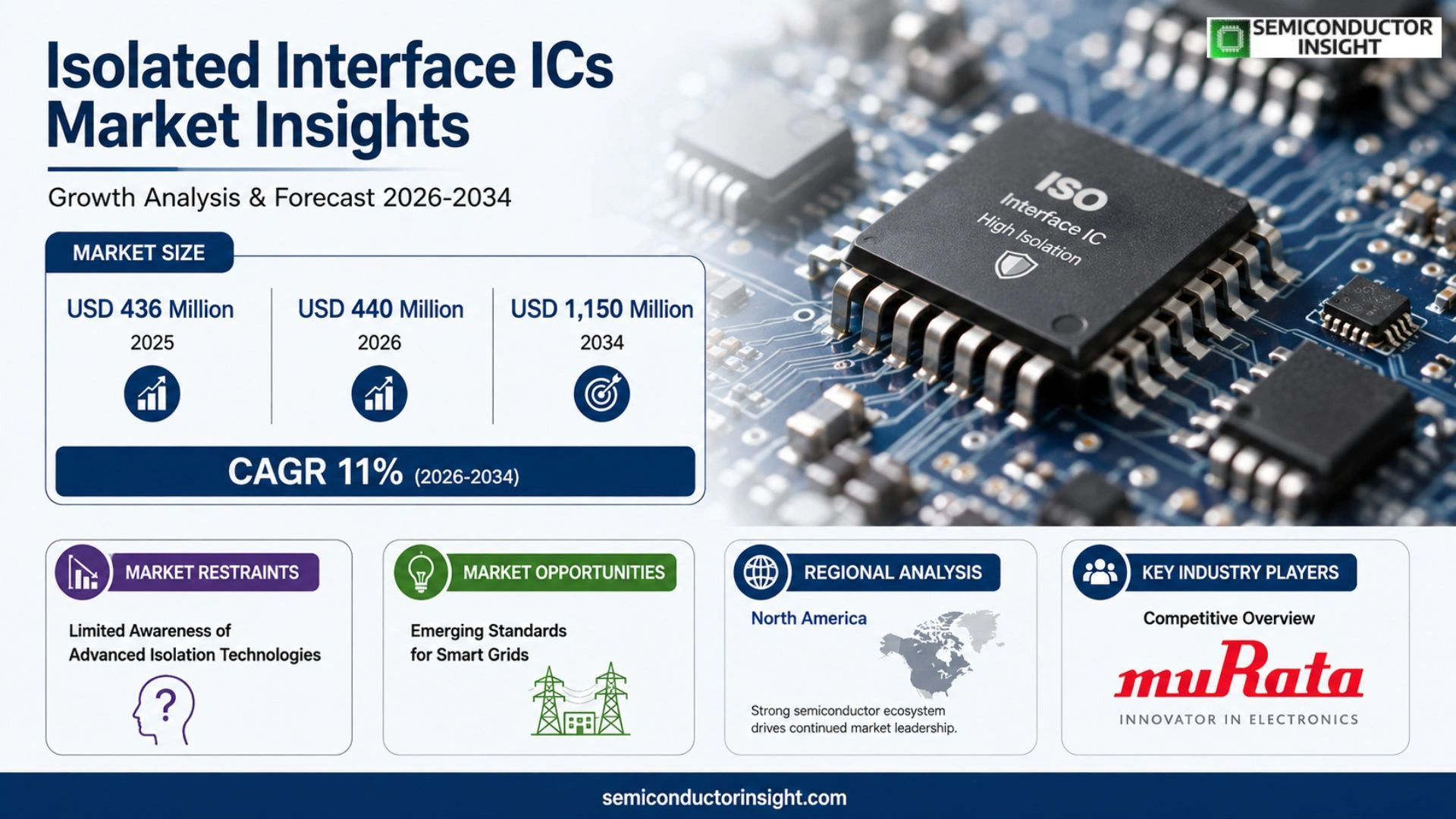
Global Isolated Interface ICs market size was valued at USD 436 million in 2025. The market is projected to grow from USD 440 million in 2026 to USD 1,150 million by 2034, exhibiting a CAGR of 11 % during the forecast period.
Isolated Interface ICs are integrated circuits that create galvanic separation between high‑voltage and low‑voltage domains while allowing data or power transfer through an insulating barrier. In 2025 production reached roughly 280 million units, with an average selling price of about USD 1,705 per k‑units. By isolating signal paths these devices suppress noise, voltage spikes and ground loops, thereby improving safety and reliability in industrial automation, automotive electrification and high‑voltage power systems. Typical implementations embed standard communication protocols such as CAN, I²C, USB or RS‑485 together with isolation stages, which simplifies board layout and reduces component count.
MARKET DRIVERS
Industrial Automation and Safety Standards
Manufacturers of motor drives, robotics, and factory equipment increasingly demand robust isolation to meet stringent safety certifications. Isolated Interface ICs provide the required barrier against high‑voltage transients, allowing designers to consolidate circuitry while preserving personnel protection. The shift toward modular, plug‑and‑play architectures accelerates adoption because a single isolated component can replace several discrete optocouplers and transformers.
Electrification of Transportation
Electric‑vehicle powertrains generate voltages that exceed traditional control‑signal limits, prompting OEMs to embed isolation directly into power‑module interfaces. This integration reduces board real‑estate and improves reliability under harsh thermal cycles. As vehicle manufacturers strive for higher efficiency, the demand for compact isolated interfaces becomes a decisive factor in component selection.
➤ Design engineers cite integration simplicity and compliance assurance as the two most compelling reasons for choosing isolated interface solutions.
Beyond hardware, the rise of Industry 4.0 creates a data‑centric environment where high‑speed digital communication must coexist with hazardous power domains. Isolated Interface ICs enable seamless data exchange without compromising isolation, thereby supporting predictive maintenance platforms that rely on uninterrupted telemetry.
MARKET CHALLENGES
Cost Sensitivity in Tier‑1 Supply Chains
While isolation delivers clear safety benefits, the additional silicon and testing steps raise component prices. Tier‑1 suppliers, pressured by thin margins, often prioritize cost over performance, leading to slower spec adoption in cost‑driven markets such as consumer electronics.
Other Challenges
Design Complexity
Integrating an isolated interface into mixed‑signal designs requires careful layout to avoid parasitic coupling. Engineers must balance isolation voltage, bandwidth, and power consumption, a trade‑off that can extend development cycles.
MARKET RESTRAINTS
Limited Awareness of Advanced Isolation Technologies
Many design teams continue to rely on legacy optocouplers, viewing newer isolated interface ICs as niche solutions. This perception restricts market penetration, especially in regions where engineering training lags behind rapid component evolution.
MARKET OPPORTUNITIES
Emerging Standards for Smart Grids
Smart‑grid deployments call for secure, high‑bandwidth communication across substations operating at tens of kilovolts. Isolated Interface ICs designed for IEC‑61850 and similar protocols can capture a sizable share of this nascent segment, offering manufacturers a pathway to differentiate their grid‑monitoring products.
Isolated Interface ICs Market Trends
Industrial Automation and Automotive Electrification
The surge in factory‑floor connectivity and the shift toward electric drivetrains have created a steady stream of orders for components that can safely separate high‑voltage domains from low‑voltage control logic. Customers in these sectors prioritize signal integrity and protection against voltage spikes, which positions isolated interface circuitry as a non‑negotiable element in system architecture. Manufacturers such as Texas Instruments are embedding isolation directly into battery‑management and on‑board‑charger modules, thereby reducing board‑level complexity while meeting stringent safety standards demanded by OEMs.
Other Trends
Integration and Single‑Chip Solutions
Design houses are consolidating multiple functions,multi‑channel isolation, signal conditioning, and protocol handling,into a single silicon die. This evolution trims component counts, frees valuable PCB real‑estate, and shortens time‑to‑market for new vehicle platforms and IoT sensor networks. The move toward monolithic solutions also eases thermal management, as fewer discrete parts generate less localized heating. As a result, engineering teams are reallocating resources from peripheral selection to firmware optimization, which accelerates product differentiation.
Regulatory and Certification Landscape
Entry into automotive and medical markets now hinges on compliance with rigorous standards such as AEC‑Q100 and IEC 60601. The certification process adds layers of testing for electromagnetic immunity, temperature cycling, and failure‑mode analysis, inflating development timelines and raising the cost of entry. Established semiconductor groups leverage long‑standing qualification portfolios to secure design wins, while emerging domestic firms focus on niche applications where localized supply chains and rapid iteration offset the lack of broad certification coverage. This dynamic pushes the industry toward collaborative development models, wherein smaller players partner with test labs or larger OEMs to share the burden of compliance.
COMPETITIVE LANDSCAPE
Key Industry Players
Isolated Interface ICs: Competitive Overview 2025‑2032
The market is anchored by a handful of multinational semiconductor firms that dominate design pipelines, intellectual‑property portfolios and high‑volume production lines. Texas Instruments leads with a broad portfolio that spans single‑channel to multi‑channel isolation solutions, leveraging deep relationships in automotive battery‑management and factory‑floor networking. Analog Devices follows closely, differentiating its offering through mixed‑signal architectures that combine high‑speed data rates with robust galvanic isolation, a mix that appeals to OEMs seeking to shrink board footprints while preserving reliability. Infineon’s strength lies in its automotive‑centric safety certifications, enabling it to capture a sizable share of the electric‑vehicle power‑train segment. Collectively, these players command the majority of global revenue, set pricing benchmarks, and shape the technology roadmap toward integrated, single‑chip isolation platforms.
Beyond the core tier, a vibrant cohort of regional and specialist manufacturers injects competitive pressure by targeting niche applications and cost‑sensitive markets. Companies such as Novosense, Shanghai Chipanalog Microelectronics, and Shanghai Belling focus on tailored solutions for the Industrial Internet of Things, offering customized isolation levels for sensor clusters and edge devices. Emerging entrants like 3PEAK, GLW, and Rongmei Semiconductor are exploiting the push for supply‑chain localization in Asia, delivering short‑lead‑time parts that meet local safety standards. European and Japanese veterans,Renesas, NXP, STMicroelectronics, and Microchip Technology,maintain a steady presence across automotive, communication and energy sectors, often partnering with system integrators to co‑develop application‑specific modules. This layered competitive structure creates a dynamic where large incumbents compete on breadth and integration, while smaller firms vie on agility, application focus, and regional support.
List of Key Isolated Interface ICs Companies Profiled
- Texas Instruments
- Analog Devices, Inc.
- Infineon Technologies AG
- Novosense
- Shanghai Chipanalog Microelectronics Co., Ltd.
- Shanghai Belling
- 3PEAK Electronics
- GLW (Guangzhou Lianwei)
- Rongmei Semiconductor (Shanghai)
- Renesas Electronics Corporation
- NXP Semiconductors N.V.
- STMicroelectronics
- Microchip Technology Inc.
Segment Analysis:
| Segment Category | Sub-Segments | Key Insights |
| By Type |
|
I2C Interface IC is emerging as the leading type because:
|
| By Application |
|
Industrial dominates application focus because:
|
| By End User |
|
Electronics OEMs are the primary end‑users due to:
|
| By Integration Level |
|
Single‑Chip Integrated is gaining traction because:
|
| By Certification Requirement |
|
AEC‑Q100 Certified devices lead because:
|
Regional Analysis: Isolated Interface ICs Market
The automotive sector in North America drives demand for isolated interfaces that safeguard powertrain control units from voltage spikes. OEMs prioritize architectures that can reliably separate high‑voltage traction systems from low‑voltage infotainment modules, prompting suppliers to tailor products for this niche.
Factories embracing Industry 4.0 rely on isolated interfaces to protect PLCs and sensor networks from electromagnetic interference. The trend toward modular machine design amplifies the need for compact, high‑performance isolation solutions.
Renewable‑energy installations and smart‑grid components increasingly incorporate isolated ICs to prevent fault propagation. North American utilities favor devices that combine low power loss with robust dielectric strength.
Close partnerships between silicon designers and OEMs accelerate time‑to‑market for custom isolation blocks. Collaborative roadmaps ensure that new safety standards are embedded early in the product lifecycle.
Europe
European manufacturers benefit from a cohesive regulatory framework that emphasizes electromagnetic compatibility and functional safety. This alignment pushes system integrators toward isolated interfaces that can meet both automotive and industrial directives without redesign. The region’s strong emphasis on modular platforms encourages component suppliers to develop generic isolation blocks that can be reused across multiple product families, reducing development overhead for end users.
Asia‑Pacific
The Asia‑Pacific landscape is shaped by rapid scaling of consumer electronics and aggressive cost targets. While price pressure is intense, manufacturers compensate by adopting advanced silicon‑on‑insulator processes that deliver isolation at lower expense. Growing investment in electric‑vehicle production hubs amplifies demand for high‑voltage isolation, creating a fertile ground for niche players to introduce differentiated technologies.
South America
In South America, the market is still emerging, yet rising investments in renewable‑energy projects are creating pockets of demand for reliable isolation. Local OEMs, often operating with constrained budgets, lean on standardized modules that balance performance with affordability. Cross‑border collaborations with North American firms are beginning to transfer know‑how, gradually elevating the region’s technical baseline.
Middle East & Africa
The Middle East & Africa region displays a mixed picture: affluent Gulf markets drive high‑end industrial installations that require premium isolated interfaces, while many African economies focus on cost‑effective solutions for basic power distribution. Infrastructure upgrades, especially in smart‑grid pilots, are prompting a modest but steady uptake of isolation technologies that can endure harsh environmental conditions.
Report Scope
This market research report provides a comprehensive analysis of the Isolated Interface ICs Market , covering the forecast period 2026–2034. It offers detailed insights into market dynamics, technological advancements, competitive landscape, and key trends shaping the industry.
Key focus areas of the report include:
- Market Overview: The report begins with an overview outlining its current market scenario, key growth indicators, and industry transformation drivers. It discusses macroeconomic factors, demand–supply balance, regulatory landscape, and the strategic role of semiconductors in powering advancements across industries such as automotive, telecommunications, consumer electronics, and industrial automation.
- Market Size & Forecast: Historical data and future projections for revenue, unit shipments, and market value across major regions and segments.
- Segmentation Analysis: Detailed breakdown by product type, technology, application, and end-user industry to identify high-growth segments and investment opportunities.
- Regional Insights: Insights into market performance across North America, Europe, Asia-Pacific, Latin America, and the Middle East & Africa, including country-level analysis where relevant.
- Competitive Landscape: Profiles of leading market participants, including their product offerings, R&D focus, manufacturing capacity, pricing strategies, and recent developments such as mergers, acquisitions, and partnerships.
- Technology Trends & Innovation: Assessment of emerging technologies, integration of AI/IoT, semiconductor design trends, fabrication techniques, and evolving industry standards.
- Market Drivers & Restraints: Evaluation of factors driving market growth along with challenges, supply chain constraints, regulatory issues, and market-entry barriers.
- Stakeholder Insights: Insights for component suppliers, OEMs, system integrators, investors, and policymakers regarding the evolving ecosystem and strategic opportunities.
Primary and secondary research methods are employed, including interviews with industry experts, data from verified sources, and real-time market intelligence to ensure the accuracy and reliability of the insights presented.
FREQUENTLY ASKED QUESTIONS:
What is the current market size of Isolated Interface ICs Market?
-> Isolated Interface ICs market is projected to grow from USD 440 million in 2026 to USD 1,150 million by 2034, exhibiting a CAGR of 11 %
Which key companies operate in Isolated Interface ICs Market?
-> Key players include Texas Instruments, ADI, Infineon, NOVOSENSE, Shanghai Chipanalog Microelectronics, Shanghai Belling, 3PEAK, GLW, Rongmei Semiconductor (Shanghai).
What are the key growth drivers?
-> Key growth drivers include industrial automation, automotive electrification, stringent safety and data‑integrity requirements, adoption of new‑energy vehicles and 800 V platforms, and the expansion of the Industrial Internet of Things (IIoT).
Which region dominates the market?
-> Asia-Pacific leads the market, driven by strong automotive and industrial manufacturing bases, while North America and Europe also show robust demand.
What are the emerging trends?
-> Emerging trends include integration of multi‑channel isolation with signal‑conditioning functions in single‑chip solutions, higher data‑rate capabilities, lower power consumption designs, and increasing focus on compliance with safety standards such as AEC‑Q100 and IEC 60601.
Get Sample Report PDF for Exclusive Insights
Report Sample Includes
- Table of Contents
- List of Tables & Figures
- Charts, Research Methodology, and more...
 Download Sample Report PDF