Key Statistics
Key Takeaways
- MOS capacitors lead the type segmentation because semiconductor processing can deliver high capacitance density, tight tolerance and low parasitic behavior for RF and integrated electronics.
- Telecommunication is the leading application, supported by RF front ends, high-speed data links, networking equipment and the continuing shift toward higher operating frequencies.
- Asia Pacific is the largest regional market and the strongest growth region because it concentrates semiconductor fabrication, electronics assembly and telecommunications equipment production.
- Semiconductor manufacturers are the largest end-user group as silicon capacitors are increasingly integrated close to active devices or into advanced packages.
- Cost and application specificity restrain substitution for conventional ceramic capacitors in less demanding circuits, keeping silicon strongest where density, frequency performance and stability justify the premium.
Silicon Capacitors Market Overview
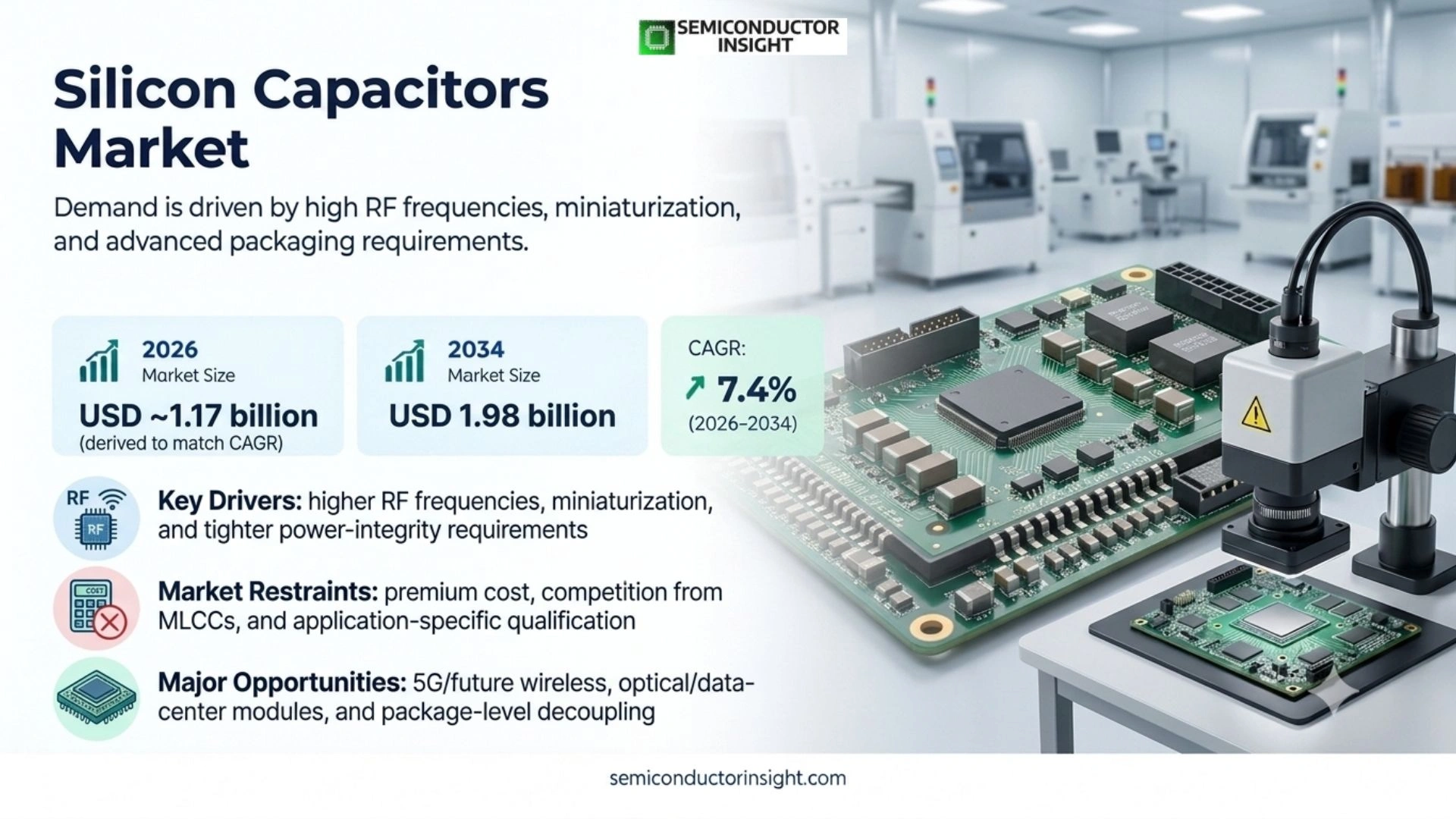
Silicon Capacitors Market was valued at USD 1.04 billion in 2025 and is projected to reach USD 1.98 billion by 2034, representing a 7.4% CAGR during 2026–2034. The 2026 estimated market size is USD 1.12 billion. Asia Pacific is the largest market in 2025 and also has the strongest manufacturing-led growth profile.
Silicon capacitors are semiconductor-fabricated passive components that use silicon processing to create compact capacitance structures with precise electrical characteristics. The source scope includes MOS, MIS, trench, silicon-on-insulator and other silicon capacitor architectures across telecommunication, automotive, medical, industrial and consumer-electronics applications, with semiconductor manufacturers and component suppliers among the principal end users. This matters commercially because qualification, integration effort, supplier continuity and total system risk shape purchasing decisions as strongly as component price, so vendors that solve deployment constraints can retain specification positions even when technically similar alternatives exist.
The value proposition is strongest where conventional multilayer ceramic or film capacitors become constrained by parasitic inductance, footprint, tolerance or high-frequency behavior. Silicon processing can create very small, repeatable structures and can place capacitance close to an IC or inside a package, reducing interconnect length. That makes the technology relevant to RF modules, high-speed data, power delivery and miniaturized medical electronics.
Manufacturing scale is linked to semiconductor process capability rather than traditional ceramic capacitor production. Deep-trench or three-dimensional structures increase effective electrode area, while wafer-level processing supports tight dimensional control and array integration. The commercial result is a component that often carries a higher unit price but can reduce board area, simplify matching networks or improve signal and power integrity in demanding systems.
Segment Analysis: By Type
The source page segments the market into MOS capacitors, MIS capacitors, trench silicon capacitors, silicon-on-insulator capacitors and other silicon capacitor structures. MOS capacitors lead because metal-oxide-semiconductor processing is mature, scalable and compatible with the precision and integration requirements of RF, mixed-signal and advanced-package applications. This matters commercially because qualification, integration effort, supplier continuity and total system risk shape purchasing decisions as strongly as component price, so vendors that solve deployment constraints can retain specification positions even when technically similar alternatives exist.
| Type | Technical / purchasing role | Market position |
|---|---|---|
| MOS Capacitors | Metal-oxide-semiconductor structures; the source further distinguishes thin-film, thick-film and other variants. | Leading type because established semiconductor processes support precise capacitance and compact integration across RF and mixed-signal applications. |
| MIS Capacitors | Metal-insulator-semiconductor structures tailored through dielectric and electrode engineering. | Used where designers require specific voltage, leakage, frequency or integration characteristics that differ from standard MOS implementations. |
| Trench Silicon Capacitors | Deep-trench and shallow-trench structures increase effective electrode area in a small footprint. | High-density segment suited to decoupling, power integrity and package-level applications where board area is constrained. |
| Silicon-on-Insulator Capacitors | Capacitor structures fabricated on SOI platforms to control isolation and parasitic behavior. | Specialized high-performance segment used where RF isolation, stability and process integration justify the substrate cost. |
| Others | Additional silicon-based structures and application-specific capacitor architectures. | Niche products address specialized voltage, packaging, sensing or integrated-passive requirements not covered by the main categories. |
End-user and integration model
The source also segments demand among semiconductor manufacturers, electronic component suppliers, research institutions, system integrators and other end users. Semiconductor manufacturers are the leading group because silicon capacitors increasingly sit close to active devices, within RF modules or inside advanced packages, making co-design with the IC and package architecture more valuable than treating the capacitor as a generic board-level purchase.
Segment Analysis: By Application
Applications are segmented into telecommunication, automotive, medical devices, industrial and consumer electronics. Telecommunication leads because 5G and high-speed network equipment require compact components with predictable behavior at high frequencies, while automotive and medical systems add demand for stable, space-efficient capacitors with strong reliability and traceability. This matters commercially because qualification, integration effort, supplier continuity and total system risk shape purchasing decisions as strongly as component price, so vendors that solve deployment constraints can retain specification positions even when technically similar alternatives exist.
| Application | Demand characteristics |
|---|---|
| Telecommunication | RF front ends, base-station equipment, optical modules and high-speed networking use silicon capacitors where low parasitics, tight tolerance and compact dimensions can improve matching, filtering, biasing and signal integrity. Higher operating frequencies make package and interconnect effects more important, increasing the value of capacitor technologies designed with semiconductor-level dimensional control. This matters commercially because qualification, integration effort, supplier continuity and total system risk shape purchasing decisions as strongly as component price, so vendors that solve deployment constraints can retain specification positions even when technically similar alternatives exist. |
| Automotive | Vehicle electrification and advanced electronics increase the number of compact control, sensing, communications and power-management circuits. Silicon capacitors are most relevant where high reliability, temperature stability or miniaturization outweigh unit cost, including RF connectivity, radar-related electronics, advanced driver-assistance modules and tightly integrated power-delivery functions. This matters commercially because qualification, integration effort, supplier continuity and total system risk shape purchasing decisions as strongly as component price, so vendors that solve deployment constraints can retain specification positions even when technically similar alternatives exist. |
| Medical Devices | Implantable, wearable and diagnostic systems often impose strict size, leakage and reliability constraints. Silicon capacitors can support miniaturized filtering, decoupling and RF functions while benefiting from semiconductor manufacturing traceability. Qualification cycles are long, but successful design wins can persist because medical-device makers avoid unnecessary component changes after regulatory and reliability validation. This matters commercially because qualification, integration effort, supplier continuity and total system risk shape purchasing decisions as strongly as component price, so vendors that solve deployment constraints can retain specification positions even when technically similar alternatives exist. |
| Industrial | Industrial controls, instrumentation and communications systems use silicon capacitors selectively where precision, high-frequency performance or space constraints justify their cost. Demand is specification driven rather than volume driven, and suppliers benefit from long product lifecycles, stable electrical characteristics and the ability to provide detailed reliability data for harsh or safety-relevant installations. This matters commercially because qualification, integration effort, supplier continuity and total system risk shape purchasing decisions as strongly as component price, so vendors that solve deployment constraints can retain specification positions even when technically similar alternatives exist. |
| Consumer Electronics | Smartphones, wearables and other compact electronics create demand for high-density passive integration, but price pressure is intense. Silicon capacitors gain share in functions where they reduce module size or improve RF and power performance enough to offset their premium, making design-in economics dependent on system-level savings rather than component price alone. This matters commercially because qualification, integration effort, supplier continuity and total system risk shape purchasing decisions as strongly as component price, so vendors that solve deployment constraints can retain specification positions even when technically similar alternatives exist. |
Regional Analysis
Asia Pacific leads the silicon capacitors market because the region concentrates semiconductor fabrication, RF-module production, telecommunications equipment and consumer-electronics assembly. North America and Europe remain important high-value design markets, while South America and the Middle East & Africa are primarily served through imported components used in communications, industrial and specialized electronic systems.
How does regional demand differ across the silicon capacitors market?
Regional demand follows the location of both electronics design and manufacturing. Asia Pacific combines large production volumes with advanced component suppliers; North America pulls high-performance parts into RF, computing, aerospace and medical systems; Europe emphasizes automotive and industrial reliability; South America is import driven; and the Middle East and Africa depend on telecommunications, defense and infrastructure projects.
| Region | Position | Growth outlook | Demand profile | What decides supplier selection |
|---|---|---|---|---|
| North America | Major established market | Steady | Research, defense, cloud and advanced-system led | Qualification depth, domestic support, reliability and ecosystem integration |
| Europe | Major established market | Steady | Research, industrial and regulation influenced | Technical documentation, long lifecycle support and regional supply assurance |
| Asia Pacific | Largest | High | Manufacturing, electronics and capacity-expansion led | Local manufacturing support, cost, scale and customer qualification |
| South America | Emerging | Selective | Import and project led | Distributor availability, landed cost and service reach |
| Middle East & Africa | Emerging | Selective | Infrastructure, defense and research-project led | Project qualification, supply continuity and local channel capability |
Silicon Capacitors Competitive Landscape
Competition centers on capacitance density, high-frequency behavior, voltage capability, tolerance, reliability, package options and the ability to integrate capacitors into customer modules or semiconductor packages. Suppliers with proprietary trench structures and wafer processes can differentiate technically, while broad component companies compete through global qualification support and access to major electronics customers. This matters commercially because qualification, integration effort, supplier continuity and total system risk shape purchasing decisions as strongly as component price, so vendors that solve deployment constraints can retain specification positions even when technically similar alternatives exist.
Murata is a prominent specialist in silicon capacitors and describes products using semiconductor and three-dimensional structures for high density and high-frequency applications. Its position illustrates the value of combining passive-component application knowledge with wafer-level process control. Other suppliers compete through RF portfolios, semiconductor integration or complementary passive products that allow customers to source complete module solutions.
The competitive boundary increasingly overlaps with advanced packaging. A capacitor embedded inside a module or placed extremely close to a processor can deliver more system value than an equivalent board-level part because lower interconnect inductance improves power or signal integrity. Suppliers that collaborate with package designers can therefore capture design positions earlier and make substitution harder after the package architecture is frozen.
Product qualification remains application dependent. Telecommunications customers prioritize RF performance and footprint, automotive buyers emphasize temperature and long-life reliability, and medical customers value traceability and controlled change. Suppliers with multiple process platforms and package formats can address these segments without forcing customers to redesign around a single standard device, improving account penetration and lifecycle value.
Tier structure
| Competitive tier | Representative participants | How suppliers compete |
|---|---|---|
| Silicon-capacitor specialists | Murata Manufacturing; ELSPES | Compete through proprietary 3D structures, high capacitance density, RF performance and wafer-level integration. |
| Diversified passive-component suppliers | KYOCERA AVX; Vishay Intertechnology | Use broad customer relationships and passive portfolios to support qualification across automotive, industrial and communications systems. |
| Semiconductor & RF suppliers | ROHM Semiconductor; MACOM; Microchip; Skyworks; Empower Semiconductor | Integrate capacitive functions with semiconductor, RF and power-management ecosystems and target high-value module applications. |
Key companies profiled
The source report profiles Murata Manufacturing; ROHM Semiconductor; KYOCERA AVX; Vishay Intertechnology; MACOM Technology Solutions; Microchip Technology; Skyworks Solutions; Empower Semiconductor; ELSPES. These companies span dedicated passive-component manufacturers, RF-semiconductor suppliers and broader electronics companies, reflecting the fact that silicon capacitors compete both as discrete precision passives and as integrated elements inside modules, packages and power-delivery networks where semiconductor co-design is increasingly important.
Silicon Capacitors Production Capacity Analysis
Production capacity depends on wafer-processing capability, dielectric formation, trench etch, metallization, wafer-level test and packaging rather than on ceramic powder and electrode firing used for conventional MLCCs. Capacity is therefore concentrated among companies with semiconductor-compatible process lines, and the most important constraints are high-aspect-ratio structure control, dielectric quality, yield, wafer cost and qualified packaging formats.
Deep-trench structures increase capacitance density by creating more electrode surface area within the silicon. Manufacturing economics depend on etch uniformity, dielectric conformality and defect control across the wafer, because small variations can affect leakage, breakdown or capacitance. Process learning and yield are therefore significant competitive assets, especially for products sold into high-reliability or high-frequency applications.
Wafer-level processing allows arrays and small footprints, but the final package strongly influences parasitic inductance and usable frequency. Suppliers must align die attach, terminations and interconnect geometry with the target application, which makes packaging capacity and co-design expertise part of the production constraint. Advanced module customers may also require bare die or custom formats rather than standard surface-mount packages.
Asia Pacific has a structural capacity advantage because it hosts much of the semiconductor and electronic-component manufacturing ecosystem, including major Japanese suppliers and downstream module assembly. North American and European suppliers remain important in specialized RF and high-reliability designs, but production decisions are closely connected to foundry access, package partners and the location of large communications and automotive customers.
Silicon Capacitors Market Dynamics: Drivers, Restraints and Opportunities
Growth is driven by higher RF frequencies, miniaturization, advanced packaging and tighter power-integrity requirements, while restraints include premium cost, competition from high-performance MLCCs and the need for application-specific qualification. Opportunities are strongest in 5G and future wireless systems, optical and data-center modules, automotive electronics and package-level decoupling where low parasitics create measurable system value.
MARKET DRIVERS
Drivers Impact Analysis*
| Factor | Relative impact* | Commercial mechanism |
|---|---|---|
| Higher RF frequencies | High | Low parasitics and controlled electrical behavior become more valuable as operating frequencies increase. |
| Advanced packaging | High | Closer placement to active die increases the benefit of thin, dense silicon capacitor structures. |
| Electronics miniaturization | Medium-High | Space-constrained modules reward capacitance density and wafer-level integration. |
High-frequency systems increase the value of low parasitics
As RF and data rates rise, the inductance and resistance of a conventional capacitor package and board connection can dominate its intended capacitance. Silicon capacitors can be engineered with compact geometry and controlled interconnects, making them attractive in matching, filtering and broadband applications where electrical behavior must remain predictable far beyond the frequencies addressed by ordinary decoupling components.
Advanced packaging pulls capacitance closer to the active die
Processors, RF devices and power-management ICs increasingly use package-level integration to reduce signal length and improve power delivery. Placing silicon capacitance inside or adjacent to the package can reduce loop inductance and free board area. This creates design opportunities that are difficult for larger conventional passives to address without changing the package architecture.
5G and high-speed optical networks broaden premium applications
Telecommunications equipment requires stable RF biasing, filtering and signal conditioning across wider frequency ranges, while optical modules pack more electronics into constrained footprints. Silicon capacitors can support those requirements with compact form factors and high-frequency characteristics, allowing suppliers to capture value in infrastructure, transceivers and radio modules where performance is more important than minimum component price.
Automotive electronics add long-life, high-value demand
Vehicles are adding radar, connectivity, sensing and centralized computing functions that require compact and reliable electronics. Silicon capacitors are not the lowest-cost choice for general decoupling, but they can win designs where temperature stability, RF behavior or package integration provides a system advantage, creating long-lived revenue once automotive qualification is completed. This matters commercially because qualification, integration effort, supplier continuity and total system risk shape purchasing decisions as strongly as component price, so vendors that solve deployment constraints can retain specification positions even when technically similar alternatives exist.
MARKET RESTRAINTS
Restraints Impact Analysis*
| Factor | Relative impact* | Commercial mechanism |
|---|---|---|
| Premium cost versus MLCCs | High | Conventional ceramic capacitors remain more economical for many general-purpose capacitance functions. |
| Application-specific qualification | Medium | Custom footprints and package integration can extend design and approval cycles. |
| Semiconductor-process complexity | Medium | Yield and wafer cost influence economics for deep-trench and high-density structures. |
MLCCs remain highly competitive in general-purpose applications
Multilayer ceramic capacitors are produced at enormous scale and offer attractive cost, capacitance and package availability for most board-level functions. Silicon capacitors therefore need a clear performance or integration advantage to justify their premium. Where frequency, tolerance, footprint or package placement is not critical, customers are unlikely to replace a qualified ceramic solution solely for technology novelty.
Wafer-based manufacturing carries a higher cost structure
Silicon capacitors consume semiconductor-grade wafers, lithography, etch, dielectric and metallization steps that are more capital intensive than many conventional passive-component processes. Deep-trench structures add process complexity and yield sensitivity. Suppliers must therefore target applications where the capacitor improves system performance or reduces assembly cost enough to support higher component pricing. This matters commercially because qualification, integration effort, supplier continuity and total system risk shape purchasing decisions as strongly as component price, so vendors that solve deployment constraints can retain specification positions even when technically similar alternatives exist.
Custom integration can lengthen qualification cycles
Embedded, bare-die and package-level capacitor solutions often require co-design with the customer’s module or IC package. Mechanical dimensions, terminations, reliability tests and electrical models must be agreed early, and a change after qualification can force redesign. That slows new-customer conversion even though it also makes successful design wins more durable once production begins.
Alternative integrated-passive approaches compete for the same space
Thin-film passives, package substrates, on-die capacitance and advanced MLCC technologies all target some of the same high-frequency and miniaturization problems. System designers evaluate the entire impedance and packaging solution rather than choosing a capacitor technology in isolation, so silicon suppliers must prove a measurable system benefit against several competing integration paths. This matters commercially because qualification, integration effort, supplier continuity and total system risk shape purchasing decisions as strongly as component price, so vendors that solve deployment constraints can retain specification positions even when technically similar alternatives exist.
MARKET OPPORTUNITIES
5G, 6G and broadband RF modules
Wireless systems operating across wider bands need compact, predictable passives with low parasitic behavior. Silicon capacitor suppliers can work with RF front-end and base-station designers on matching, DC blocking and broadband functions, using wafer-level structures and tailored packages to support frequencies where conventional capacitor models become less stable or require larger design margins.
Optical transceivers and data-center interconnects
High-speed optical modules combine drivers, receivers, lasers and power management in extremely constrained packages. Local decoupling and broadband bias networks benefit from small, low-inductance capacitors placed close to active devices. Growth in data-center bandwidth therefore creates a high-value market where integration density can justify premium silicon capacitor pricing. This matters commercially because qualification, integration effort, supplier continuity and total system risk shape purchasing decisions as strongly as component price, so vendors that solve deployment constraints can retain specification positions even when technically similar alternatives exist.
Package-level power integrity for advanced processors
Advanced CPUs, GPUs and accelerators draw rapidly changing currents that make low-impedance local power delivery increasingly difficult. Silicon capacitors embedded in packages or interposers can supplement conventional board capacitors by reducing loop inductance. Suppliers that co-design arrays with package and power architects can access a strategically important part of the advanced-computing bill of materials.
Miniaturized medical and wearable electronics
Medical devices and wearables need small, stable components that can support sensing, RF communication and power management within strict volume limits. Silicon capacitors can address these requirements with wafer-level dimensions and controlled electrical characteristics, and successful medical qualification can create long product lifetimes that offset the higher cost and longer initial design-in process.
Silicon Capacitors Supply Chain Analysis
Silicon wafers & dielectrics
Upstream material quality influences leakage, breakdown voltage and long-term stability. Because silicon capacitor performance depends on precisely formed dielectric layers and surfaces, suppliers need semiconductor-grade control of contamination and defects. Material changes can require reliability revalidation, encouraging stable long-term relationships with wafer and process-material vendors. This matters commercially because qualification, integration effort, supplier continuity and total system risk shape purchasing decisions as strongly as component price, so vendors that solve deployment constraints can retain specification positions even when technically similar alternatives exist.
Wafer fabrication
Wafer fabrication creates the capacitance structure and determines density, tolerance and leakage. Deep-trench products need uniform high-aspect-ratio features and conformal dielectric deposition, making process control and yield key sources of cost advantage. Wafer-level electrical testing identifies defects before packaging and supports tight customer specifications. This matters commercially because qualification, integration effort, supplier continuity and total system risk shape purchasing decisions as strongly as component price, so vendors that solve deployment constraints can retain specification positions even when technically similar alternatives exist.
Packaging & module integration
Packaging determines much of the final parasitic behavior and physical integration value. Suppliers serving RF and advanced-package customers need flexible formats, accurate electrical models and close collaboration with module designers. Bare-die or embedded solutions can create stronger customer lock-in because the capacitor becomes part of the package architecture rather than a replaceable board component.
System qualification & distribution
Downstream customers qualify silicon capacitors against frequency, voltage, temperature and reliability requirements specific to their systems. Global distributors support standard products, while higher-value embedded applications use direct engineering relationships. Design wins can persist for years once qualified because changing a precision passive may require new RF tuning, reliability testing or regulatory documentation.
Recent Developments in the Silicon Capacitors Market
Recent technical documentation from major suppliers emphasizes broadband operation, three-dimensional silicon structures and use in advanced RF applications. The direction of travel is toward higher frequency, smaller package size and closer integration with active semiconductor devices, reinforcing the market’s shift from a specialty discrete component toward a building block for RF modules and advanced packages.
Murata’s silicon-capacitor portfolio includes broadband product families designed for high-frequency applications. The product direction demonstrates where silicon technology is most competitive: applications that value low parasitics and small geometry enough to pay for wafer-based manufacturing, including optical communications, RF modules and advanced semiconductor packages. This matters commercially because qualification, integration effort, supplier continuity and total system risk shape purchasing decisions as strongly as component price, so vendors that solve deployment constraints can retain specification positions even when technically similar alternatives exist.
Murata technical material describes semiconductor processing and three-dimensional structures used to achieve capacitance density and stable characteristics. The architecture illustrates how silicon capacitors differ from conventional passives: performance is created through wafer geometry and process control, giving suppliers a path to integrate capacitance into very small footprints and specialized packages. This matters commercially because qualification, integration effort, supplier continuity and total system risk shape purchasing decisions as strongly as component price, so vendors that solve deployment constraints can retain specification positions even when technically similar alternatives exist.
Murata’s RF application material positions silicon capacitors for high-frequency power-amplifier and wireless designs. That focus is commercially significant because 5G and future 6G systems push passive components into operating ranges where package inductance and tolerance matter more, increasing the value of semiconductor-fabricated capacitors with controlled broadband characteristics. This matters commercially because qualification, integration effort, supplier continuity and total system risk shape purchasing decisions as strongly as component price, so vendors that solve deployment constraints can retain specification positions even when technically similar alternatives exist.
REPORT SCOPE & SEGMENTATION
The standardized report scope preserves the source page’s type, application and end-user segmentation while rebasing the published market-size anchors to 2025, estimating 2026 and extending the anchor-consistent growth path to 2034. The result keeps the original silicon-capacitor market definition intact and makes the row comparable with the other semiconductor and electronic-component reports in this workbook.
| Report attribute | Coverage |
|---|---|
| Market | Silicon Capacitors |
| Base year | 2025 |
| Estimated year | 2026 |
| Forecast period | 2026–2034 |
| 2025 market size | USD 1.04 billion |
| 2034 forecast size | USD 1.98 billion |
| CAGR | 7.4% during 2026–2034 |
| Largest market in 2025 | Asia Pacific |
| By Type | MOS Capacitors (Thin-film; Thick-film; Others); MIS Capacitors; Trench Silicon Capacitors (Deep Trench; Shallow Trench; Others); Silicon-on-Insulator (SOI) Capacitors; Others |
| By Application | Telecommunication; Automotive; Medical Devices; Industrial; Consumer Electronics |
| Additional segmentation | By End User: Semiconductor Manufacturers; Electronic Component Suppliers; Research Institutions; System Integrators; Others |
| Regions | North America; Europe; Asia Pacific; South America; Middle East & Africa |
| Companies profiled | Murata Manufacturing; ROHM Semiconductor; KYOCERA AVX; Vishay Intertechnology; MACOM Technology Solutions; Microchip Technology; Skyworks Solutions; Empower Semiconductor; ELSPES |
Frequently Asked Questions
What is the silicon capacitors market size in 2025?
The global silicon capacitors market is valued at USD 1.04 billion in 2025 under the standardized series used in this overview. The figure is the base-year reference for comparing technology adoption, segment mix, regional demand and supplier positioning, and it is carried consistently through the Key Statistics, Market Overview and report-scope sections.
What is the forecast size of the silicon capacitors market by 2034?
The market is projected to reach USD 1.98 billion by 2034. The forecast endpoint is linked to the same published market-size anchors used for the 2025 base year, so the size series and the stated growth rate remain mathematically consistent rather than mixing values from different scopes or forecast windows. This matters commercially because qualification, integration effort, supplier continuity and total system risk shape purchasing decisions as strongly as component price, so vendors that solve deployment constraints can retain specification positions even when technically similar alternatives exist.
What CAGR is expected for the silicon capacitors market during 2026–2034?
The standardized outlook corresponds to a 7.4% CAGR during 2026–2034. The rate reflects the compound annual growth implied by the market-size anchors and is used consistently throughout this overview, enabling direct comparison of drivers, restraints, regional momentum and technology adoption without introducing an unrelated growth assumption. This matters commercially because qualification, integration effort, supplier continuity and total system risk shape purchasing decisions as strongly as component price, so vendors that solve deployment constraints can retain specification positions even when technically similar alternatives exist.
Which region is the largest silicon capacitors market in 2025?
Asia Pacific is identified as the largest market in 2025 based on the source-page regional positioning and supporting industry structure. Its leadership is reinforced by the concentration of relevant customers, manufacturing or deployment activity, while supplier qualification and ecosystem depth help established vendors convert that structural demand into sustained component revenue. This matters commercially because qualification, integration effort, supplier continuity and total system risk shape purchasing decisions as strongly as component price, so vendors that solve deployment constraints can retain specification positions even when technically similar alternatives exist.
Which product type leads the silicon capacitors market?
MOS capacitors is the leading product or technology type in the source segmentation. Its position reflects the combination of installed-base relevance, customer qualification, system compatibility and the breadth of applications it can address, giving suppliers a larger accessible revenue pool than narrower alternatives even as newer architectures gain share. This matters commercially because qualification, integration effort, supplier continuity and total system risk shape purchasing decisions as strongly as component price, so vendors that solve deployment constraints can retain specification positions even when technically similar alternatives exist.
Which application is most important in the silicon capacitors market?
Telecommunication is the principal application identified in the source scope. Demand is supported by system-level performance requirements and by the need for qualified, reliable components that can be integrated without creating disproportionate redesign or certification burden, which makes application engineering and customer support important competitive variables. This matters commercially because qualification, integration effort, supplier continuity and total system risk shape purchasing decisions as strongly as component price, so vendors that solve deployment constraints can retain specification positions even when technically similar alternatives exist.
Which region is growing fastest in the silicon capacitors market?
Asia Pacific has the strongest growth profile in this overview. Growth is tied to new capacity, system deployment, research investment or electronics manufacturing expansion depending on the market, and suppliers benefit most where they can support local qualification, shorten lead times and align products with region-specific customer requirements. This matters commercially because qualification, integration effort, supplier continuity and total system risk shape purchasing decisions as strongly as component price, so vendors that solve deployment constraints can retain specification positions even when technically similar alternatives exist.
What are the main growth drivers for the silicon capacitors market?
The main drivers are expanding system performance requirements, higher integration density, new infrastructure or compute deployments, and the migration toward components that improve reliability while reducing board or system-level constraints. These forces create purchasing events when customers redesign platforms, qualify new suppliers or move from laboratory or pilot use into repeat production.
What are the main restraints on the silicon capacitors market?
The main restraints are qualification time, cost pressure, long development cycles, supply concentration and the risk that alternative architectures absorb functions previously served by discrete or specialized devices. These constraints do not eliminate demand, but they can delay design wins, lengthen revenue conversion cycles and favor suppliers with established manufacturing and application-support capabilities.
Who are the key suppliers in the silicon capacitors market?
The competitive landscape includes the companies listed in the source report scope together with other qualified ecosystem participants discussed in this overview. Competitive advantage depends on technology performance, manufacturability, reliability evidence, customer-specific engineering, production continuity and the ability to support long qualification cycles, rather than on headline component specifications alone. This matters commercially because qualification, integration effort, supplier continuity and total system risk shape purchasing decisions as strongly as component price, so vendors that solve deployment constraints can retain specification positions even when technically similar alternatives exist.
Research Sources & Evidence Base
Get Sample Report PDF for Exclusive Insights
Report Sample Includes
- Table of Contents
- List of Tables & Figures
- Charts, Research Methodology, and more...
 Download Sample Report PDF