MARKET INSIGHTS
Global USB Interface Module Market was valued at 266 million in 2024 and is projected to reach USD 331 million by 2032, at a CAGR of 3.2% during the forecast period.
USB Interface Modules are compact hardware solutions designed to facilitate seamless connectivity between computers and peripheral devices via Universal Serial Bus (USB) ports. These modules serve as standardized interfaces enabling high-speed data transfer, power delivery, and communication for devices ranging from industrial equipment to consumer electronics. Key variants include USB 1.0, USB 2.0, and newer iterations supporting enhanced data rates.
The market growth stems from increasing demand for plug-and-play connectivity across industries like healthcare, automotive, and industrial automation. While consumer electronics dominate application share at 32%, industrial applications are growing rapidly due to Industry 4.0 adoption. Asia Pacific currently leads regional demand with 42% market share, driven by electronics manufacturing hubs in China and Japan. Major players like Texas Instruments and Advantech continue to innovate with energy-efficient modules featuring advanced protocols like USB4, though price sensitivity in emerging markets remains a challenge.
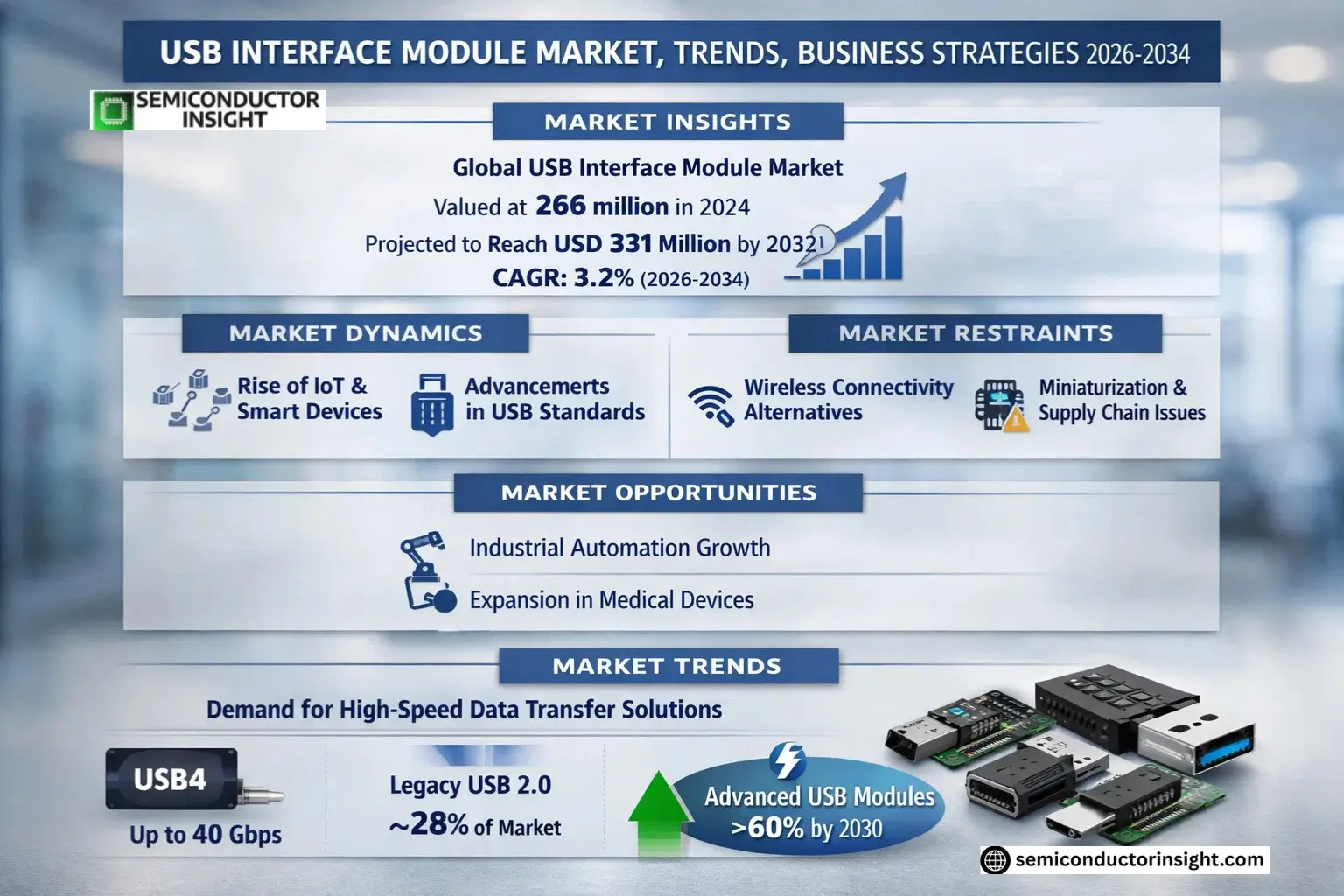
MARKET DYNAMICS
MARKET DRIVERS
Proliferation of IoT and Smart Devices to Accelerate USB Interface Module Demand
The explosive growth of Internet of Things (IoT) technologies and smart devices is creating unprecedented demand for reliable connectivity solutions. USB interface modules serve as critical components in establishing seamless communication between IoT devices and host systems. With over 30 billion IoT devices expected to be in operation by 2025, manufacturers are integrating USB interfaces as standard connectivity options due to their plug-and-play convenience and universal compatibility. Industrial IoT applications particularly benefit from ruggedized USB modules that can withstand harsh environmental conditions while maintaining data integrity.
Advancements in USB Standards Driving Technology Refresh Cycles
The evolution from USB 3.2 to USB4 standards is compelling businesses and consumers to upgrade their interface modules to leverage higher data transfer speeds and improved power delivery capabilities. The latest USB4 specification offers throughput up to 40 Gbps – doubling previous generation speeds – making it indispensable for data-intensive applications like 4K/8K video transmission and high-performance computing. This technology refresh cycle is generating significant replacement demand, with USB 2.0 modules gradually being phased out in favor of more advanced alternatives across all major industries.
Furthermore, the growing adoption of USB-C connectors across consumer electronics is creating cross-industry standardization that simplifies peripheral integration while supporting faster charging and data transfer capabilities.
MARKET RESTRAINTS
Wireless Connectivity Alternatives Limiting Market Expansion
While USB remains the dominant wired interface standard, the rapid advancement of wireless technologies presents a growing challenge to market growth. Bluetooth 5.0 and Wi-Fi 6 implementations now offer sufficient bandwidth for many applications that previously required physical connections, particularly in consumer electronics. The convenience of wireless peripherals is driving manufacturers to develop cable-free alternatives for keyboards, mice, and audio devices – segments that traditionally drove significant USB module demand.
Other Restraints
Miniaturization Challenges
As electronic devices continue shrinking in size, developing USB interface modules that maintain robust performance while fitting increasingly compact form factors presents engineering hurdles. This is particularly acute in wearable technology and medical implant applications where space constraints are critical.
Supply Chain Vulnerabilities
The semiconductor shortages experienced in recent years have exposed vulnerabilities in the USB module supply chain, with production lead times increasing by over 60% for some components between 2020-2022. These disruptions continue to affect manufacturers’ ability to meet growing demand.
MARKET OPPORTUNITIES
Expansion of Industrial Automation Creating New Application Verticals
Industry 4.0 initiatives are driving massive investments in smart manufacturing infrastructure, where USB interface modules play a pivotal role in machine-to-machine communication and equipment monitoring systems. The industrial automation sector is projected to represent nearly 25% of total USB module demand by 2027, with applications ranging from CNC machine control to automated quality inspection systems. Manufacturers are developing specialized industrial-grade modules featuring enhanced EMI shielding and extended temperature ranges to meet these demanding environments.
Additionally, the medical device industry presents significant growth potential as healthcare facilities modernize diagnostic imaging systems and patient monitoring equipment that increasingly rely on high-speed USB interfaces for data acquisition and transfer.
MARKET CHALLENGES
Fragmented Standardization Creating Compatibility Issues
USB Interface Module Market faces ongoing challenges with connector and protocol standardization, particularly during technology transition periods. While USB-C is becoming the connector of choice, legacy USB-A and micro-USB interfaces remain prevalent across existing devices and infrastructure. This fragmentation requires manufacturers to support multiple interface types simultaneously, increasing product development costs and inventory complexity. The automotive sector exemplifies this challenge, where a single vehicle infotainment system might need to support three different USB connector types to accommodate various consumer devices.
Other Challenges
Security Vulnerabilities
USB interfaces present potential attack vectors for malware distribution and data breaches, with studies showing that nearly 25% of corporate cyber incidents originate from infected USB devices. Developing secure authentication protocols without compromising plug-and-play functionality remains an ongoing challenge.
Power Delivery Limitations
While USB Power Delivery specifications continue to improve, meeting the increasing power requirements of professional-grade peripherals and mobile workstations remains technically challenging, particularly for compact interface modules.
USB INTERFACE MODULE MARKET TRENDS
Increasing Demand for High-Speed Data Transfer Solutions Drives Market Expansion
USB Interface Module Market is experiencing significant growth, driven by the escalating demand for high-speed data transfer across diverse industries. Recent developments in USB technology, particularly the widespread adoption of USB 3.2 and USB4 standards, have revolutionized connectivity solutions by offering data transfer speeds up to 40 Gbps nearly four times faster than earlier generations. This trend is particularly evident in sectors such as consumer electronics and industrial automation, where the need for real-time data processing has become critical. Furthermore, the integration of Thunderbolt compatibility in newer USB modules has expanded their application in high-performance computing environments. While traditional USB 2.0 modules still account for approximately 28% of the market due to legacy system requirements, industry projections suggest that advanced interface modules will capture over 60% of market share by 2030.
Other Trends
Industrial IoT Integration
The rapid adoption of Industrial Internet of Things (IIoT) solutions is reshaping the USB Interface Module landscape. Manufacturing facilities are increasingly deploying these modules to enable machine-to-machine communication, with the industrial segment projected to grow at a CAGR of 4.5% through 2032. These modules serve as critical components in predictive maintenance systems, process automation controls, and equipment monitoring solutions. The automotive industry’s transition toward smart manufacturing has further accelerated demand, particularly for ruggedized USB modules capable of withstanding harsh industrial environments.
Healthcare Digitization Fuels Specialized Connectivity Needs
Healthcare’s digital transformation is creating new opportunities for USB interface solutions, particularly in diagnostic imaging and portable medical devices. The sector is witnessing a 32% year-over-year increase in demand for medical-grade USB modules that meet stringent safety and reliability standards. These specialized modules facilitate seamless data transfer from diagnostic equipment to electronic health records systems while ensuring compliance with regulations such as IEC 60601-1. Meanwhile, the proliferation of telehealth solutions during the pandemic has driven innovation in compact USB modules for home healthcare devices, with manufacturers developing versions that support both data transmission and power delivery to simplify patient monitoring.
COMPETITIVE LANDSCAPE
Key Industry Players
Market Leaders Push Innovation to Capture Expanding USB Connectivity Demand
Global USB Interface Module Market features a competitive mix of established electronics manufacturers and specialized connectivity solution providers. Texas Instruments currently dominates the segment, leveraging its semiconductor expertise to deliver high-performance USB interface ICs and modules. The company accounted for approximately 18% of the 2024 market revenue through its extensive industrial and consumer electronics customer base.
Close competitors Advantech and Beckhoff Automation have been gaining market share by focusing on industrial automation applications. Advantech’s USB 3.0 industrial I/O modules demonstrated 27% annual growth in 2024, reflecting strong demand for ruggedized connectivity solutions in manufacturing environments.
Meanwhile, Bosch and ABB are making strategic moves in the automotive USB interface space, developing modules that meet stringent vehicle electrification requirements. Their recent product launches focus on high-voltage isolation and EMI protection features essential for next-generation automotive systems.
The market also sees active participation from specialized players like Tripp Lite in power delivery modules and TRENDnet in consumer-grade connectivity solutions. These companies are differentiating through niche applications while maintaining cost competitiveness.
List of Key USB Interface Module Companies Profiled
- Texas Instruments (U.S.)
- Advantech (Taiwan)
- Beckhoff Automation (Germany)
- Bosch (Germany)
- ABB (Switzerland)
- Tripp Lite (U.S.)
- TRENDnet (U.S.)
- AMETEK (U.S.)
- Omega Engineering (U.S.)
- Velleman (Belgium)
- Linx Technologies (U.S.)
- Interface (U.S.)
Segment Analysis:
By Type
USB 2.0 Segment Leads Market Share Due to High-Speed Data Transfer Capabilities
USB Interface Module Market is segmented based on connectivity standards:
- USB 1.0
- Subtypes: Low-speed (1.5 Mbps) and Full-speed (12 Mbps)
- USB 2.0
- Subtypes: High-speed (480 Mbps) variants
- Others
- Includes proprietary and emerging USB standards
By Application
Industrial Applications Drive Demand for Robust USB Interface Solutions
The market is segmented by end-use applications:
- Industrial Automation
- Factory automation equipment connectivity
- Machine-to-computer interfacing
- Healthcare
- Medical device connectivity
- Diagnostic equipment interfaces
- Consumer Electronics
- Peripheral device connections
- Gaming accessories
- Telecommunications
- Others
By End User
Enterprise Segment Shows Strong Adoption for Bulk Connectivity Solutions
The market is segmented by end-user categories:
- OEMs
- System Integrators
- Enterprise IT
- Individual Consumers
- Others
By Form Factor
Compact Modules Gain Traction in Space-Constrained Applications
The market is segmented by physical configuration:
- Standalone Modules
- Embedded Solutions
- PCIe Card Add-ons
- Others
Regional Analysis: USB Interface Module Market
North America
The North American market for USB interface modules is driven by rapid technological advancements and high adoption rates in key industries such as healthcare, automation, and consumer electronics. The U.S. dominates this region, with major corporations investing heavily in high-speed USB solutions to support data-intensive applications. For instance, the growing demand for USB 3.0 and later versions in industrial automation and medical devices fuels market expansion. Strict quality standards and regulatory compliance further reinforce the need for reliable interface modules, while the presence of key players like Texas Instruments and Advantech strengthens local innovation. Despite high production costs, the region benefits from a robust IT infrastructure and strong demand for plug-and-play connectivity.
Europe
Europe’s USB Interface Module market is characterized by stringent regulatory frameworks and a strong emphasis on energy-efficient and high-performance solutions. Countries like Germany and France lead in industrial automation, where USB interfaces facilitate seamless communication between machinery and control systems. The EU’s push for standardized connectivity across industries ensures steady demand for advanced USB modules, particularly USB-C and Thunderbolt-enabled variants. While Western Europe maintains a mature market, Eastern Europe shows growth potential due to increasing industrialization. Key players such as ABB and Beckhoff Automation continue to drive innovation, ensuring the region remains competitive despite economic uncertainties in certain sectors.
Asia-Pacific
Asia-Pacific is the fastest-growing region for USB interface modules, driven by China’s massive electronics manufacturing sector and India’s expanding IT infrastructure. The widespread adoption of USB 2.0 and USB 3.0 modules in consumer electronics, automotive, and telecommunications contributes significantly to market growth. China alone accounts for over 40% of global USB module production, supported by cost-effective manufacturing and rising domestic demand. However, price sensitivity in emerging markets often limits the adoption of premium-grade solutions. Japan and South Korea remain innovation hubs for high-speed USB technologies, catering to advanced robotics and smart manufacturing applications. The region’s competitive landscape includes both local manufacturers and multinational players.
South America
The South American USB Interface Module market is emerging, with Brazil and Argentina leading demand in industrial and automotive applications. Economic fluctuations and import dependencies pose challenges, but the increasing digitization of manufacturing processes creates opportunities for growth. The adoption of USB modules in sectors like renewable energy and healthcare is on the rise, though at a slower pace compared to other regions. Local suppliers face competition from global brands, but partnerships with technology providers enable gradual market expansion. Investments in smart city projects and automation hint at long-term potential, though infrastructure limitations remain a hurdle.
Middle East & Africa
The Middle East & Africa market is nascent but exhibits promising growth, particularly in the UAE and Saudi Arabia, where smart infrastructure and industrial automation projects drive demand. The region’s reliance on imported USB modules keeps prices elevated, limiting widespread adoption in cost-sensitive areas. However, increasing IT spending and government initiatives to diversify economies create new opportunities. In Africa, South Africa leads in adopting USB technologies for mining and telecommunications, though uneven infrastructure development slows overall market penetration. The focus remains on mid-tier USB 2.0 solutions, with gradual shifts toward advanced connectivity standards as industries modernize.
Report Scope
This market research report provides a comprehensive analysis of the Global and regional USB Interface Module markets, covering the forecast period 2025–2032. It offers detailed insights into market dynamics, technological advancements, competitive landscape, and key trends shaping the industry.
Key focus areas of the report include:
- Market Size & Forecast: Historical data and future projections for revenue, unit shipments, and market value across major regions and segments. The Global USB Interface Module market was valued at USD 266 million in 2024 and is projected to reach USD 331 million by 2032, growing at a CAGR of 3.2%.
- Segmentation Analysis: Detailed breakdown by product type (USB 1.0, USB 2.0, Others), application (Communication, Industrial, Healthcare, Consumer Electronics, Automotive), and end-user industry to identify high-growth segments.
- Regional Outlook: Insights into market performance across North America, Europe, Asia-Pacific, Latin America, and Middle East & Africa. Asia-Pacific holds the largest market share (38% in 2024), driven by electronics manufacturing hubs.
- Competitive Landscape: Profiles of 25+ leading market participants including Texas Instruments, ABB, Bosch, Advantech, and Beckhoff Automation, covering their product portfolios and market strategies.
- Technology Trends & Innovation: Assessment of emerging USB standards, integration with IoT devices, and development of industrial-grade interface solutions.
- Market Drivers & Restraints: Evaluation of factors including growing demand for plug-and-play devices, industrial automation trends, and challenges like USB-C standardization.
- Stakeholder Analysis: Strategic insights for OEMs, component manufacturers, system integrators, and investors regarding market opportunities.
Research methodology includes primary interviews with industry experts and analysis of verified market data from regulatory bodies and trade associations.
FREQUENTLY ASKED QUESTIONS:
What is the current market size of Global USB Interface Module Market?
-> USB Interface Module Market was valued at266 million in 2024 and is projected to reachUSD 331 million by 2032, at a CAGR of 3.2%during the forecast period.
Which key companies operate in Global USB Interface Module Market?
-> Key players include Texas Instruments, ABB, Bosch, Advantech, Beckhoff Automation, and Omega Engineering, among others.
What are the key growth drivers?
-> Key growth drivers include increasing industrial automation, demand for plug-and-play devices, and proliferation of USB-C adoption.
Which region dominates the market?
-> Asia-Pacific dominates with 38% market share, while North America shows strongest growth potential.
What are the emerging trends?
-> Emerging trends include USB4 adoption, industrial-grade interface solutions, and integration with IoT ecosystems.

Get Sample Report PDF for Exclusive Insights
Report Sample Includes
- Table of Contents
- List of Tables & Figures
- Charts, Research Methodology, and more...
 Download Sample Report PDF