Key Statistics
Key Takeaways
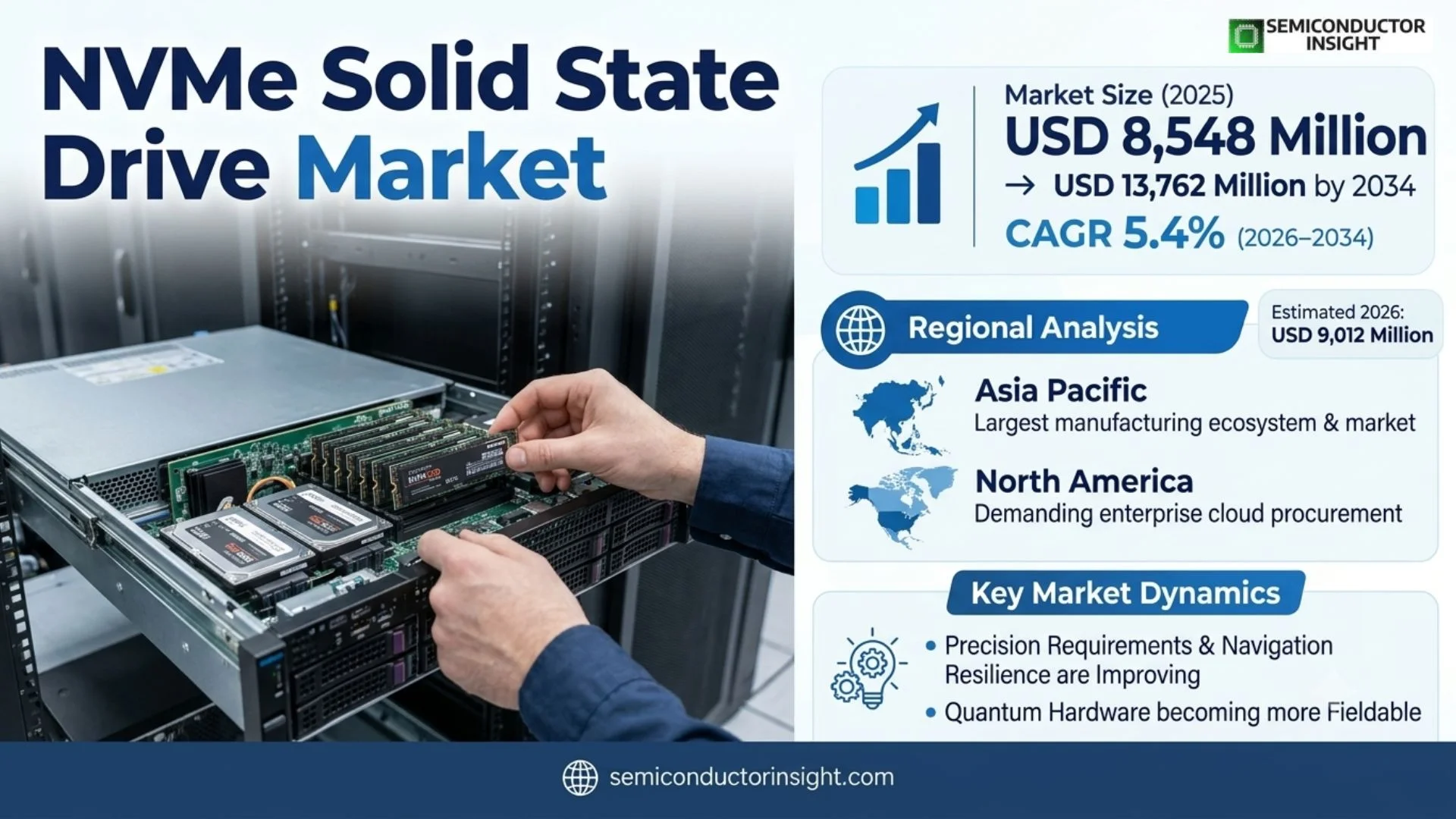
- The global NVMe Solid State Drive market is estimated at USD 8,548 million in 2025 and USD 9,012 million in 2026, and is projected to reach USD 13,762 million by 2034, with a CAGR of 5.4% during 2026–2034.
- NVMe is a storage protocol, while PCIe is the transport interface for the local drives covered here. Interface generation, capacity and physical form factor describe different product attributes.
- Buyers should compare sustained behaviour, latency, endurance and power alongside peak transfer speed. A faster interface does not improve every application equally.
- Client devices and enterprise drives have different qualification and service requirements. They should not be compared solely on price per terabyte.
- The competitive structure has changed: Sandisk carries the separated Western Digital flash business, while Solidigm belongs to the SK hynix ecosystem following the Intel SSD business acquisition.
NVMe Solid State Drive Market Overview
NVMe Solid State Drive market is estimated at USD 8,548 million in 2025 and USD 9,012 million in 2026, and is projected to reach USD 13,762 million by 2034, with a CAGR of 5.4% during 2026–2034. Asia Pacific anchors the manufacturing ecosystem and is the largest market in this outlook, while North American cloud procurement shapes demanding enterprise specifications.
An NVMe solid-state drive combines non-volatile memory, a controller, firmware and a host interface to store and retrieve data electronically. The NVMe protocol is designed for non-volatile storage and differs from the physical form factor of the drive. M.2, U.2 and add-in cards describe packaging, while PCIe generations describe interface capability. A complete product assessment must keep these attributes separate.
The buying decision depends on workload behaviour as well as capacity. A notebook needs appropriate power management and thermal characteristics, while an enterprise server may prioritise predictable latency, endurance and serviceability. NAND type, controller design and firmware influence those outcomes together. Suppliers create value by qualifying a drive for its intended environment rather than relying only on a peak sequential-read benchmark.
Segment Analysis: By Type
Capacity groups below 1TB, from 1TB to 4TB, and above 4TB serve different purchasing needs. Entry configurations compete on affordable system capacity, while larger drives support expanding datasets and consolidation. The correct choice depends on usable capacity, endurance and workload intensity. A high-capacity product is not automatically enterprise-grade, and a smaller drive can still be designed for demanding operational requirements.
| Type | Demand characteristics |
|---|---|
| Below 1TB | Entry and specialised configurations prioritise sufficient capacity at an acceptable system cost. Performance must still fit the intended workload and host. |
| 1TB to 4TB | Mainstream client and workstation configurations balance dataset capacity, cost and available physical space. Product quality varies with controller, NAND and firmware design. |
| Above 4TB | Larger datasets and consolidation favour higher-capacity products. Enterprise suitability depends on endurance, latency consistency and qualification, not capacity alone. |
Segment Analysis: By Interface
| Interface | Commercial relevance |
|---|---|
| PCIe 3.0 | Established platforms can use compatible drives where interface bandwidth meets workload requirements. |
| PCIe 4.0 | Broad platform compatibility supports a balance of performance, power and cost across suitable systems. |
| PCIe 5.0 | Higher interface bandwidth creates opportunities in demanding systems, subject to controller, NAND and thermal limits. |
Segment Analysis: By Form Factor
| Form Factor | Commercial relevance |
|---|---|
| M.2 | Compact packaging serves many client and specialised systems; physical dimensions and cooling must match the host. |
| U.2 | Cabled or backplane-connected designs support suitable enterprise installations and service requirements. |
| Add-in Card | Expansion-card packaging can provide space for controllers and thermal management where the system supports it. |
Segment Analysis: By Application
Desktop Computer, Laptop and Others describe the principal application categories. Desktops can accommodate different thermal and expansion options, while notebooks impose tighter limits on space and power. The Others category includes enterprise and specialised systems where qualification requirements can differ substantially from client products. Suppliers need to match controller, firmware and packaging choices to these distinct purchasing conditions.
| Application | Demand characteristics |
|---|---|
| Desktop Computer | Gaming, content creation and professional workloads create different access patterns. Cooling, expansion options and platform compatibility shape the purchasing decision. |
| Laptop | Thin systems need suitable idle and active power behaviour, thermal control and physical compatibility. Peak throughput may be limited by the host or chassis. |
| Others | Servers, storage infrastructure and specialised systems can require predictable latency, power-loss protection, endurance and serviceable packaging. |
Regional Analysis
Asia Pacific combines memory manufacturing and device assembly with substantial electronics demand, while North America influences enterprise purchasing through cloud and server ecosystems. Europe places emphasis on operational efficiency and deployment requirements. South America and the Middle East and Africa add demand through cloud infrastructure and local enterprise systems. Investment budgets are useful context, but they do not specify SSD quantities, interface mix or procurement location.
Where do storage specifications and regional deployment needs diverge?
| Region | Position | Growth outlook | Demand profile | Access gate |
|---|---|---|---|---|
| Asia Pacific | Largest outlook | Platform-led | Memory and devices | Qualified integration |
| North America | Enterprise influence | Workload-led | Cloud and AI | Fleet qualification |
| Europe | Mature deployment | Efficiency-led | Enterprise and clients | Lifecycle support |
| South America | Expanding deployment | Infrastructure-led | Cloud and enterprise | Procurement channels |
| Middle East & Africa | Project-led growth | Deployment-led | Cloud and AI | Local support |
Competitive Landscape
Competition operates at several layers: NAND production, controller and firmware development, drive integration, and complete-system qualification. Vertically integrated suppliers can coordinate memory and drive design, while independent brands can compete through sourcing, channel reach and targeted products. These business models create different strengths and risks. Buyers should assess the specific drive platform and support commitment rather than assume that brand recognition alone determines suitability.
Samsung, SK hynix, Micron and other storage suppliers operate within an ecosystem that also includes controller specialists, module brands and system vendors. Kingston and ADATA address important channel requirements, while Dell and Hewlett Packard Enterprise integrate storage into wider systems. Those roles should remain distinct in competitive analysis. Complete-server revenue is not interchangeable with the value of the SSDs installed inside it.
Historical corporate names require careful interpretation. The Intel SSD business moved into Solidigm within SK hynix, while Western Digital’s flash separation created an independent Sandisk. These changes affect the current supplier map and can otherwise lead to double-counting. Product qualification, firmware ownership and service continuity should follow the relevant operating business and product family through each corporate transition.
Supplier roles and competitive positioning
| Participant group | Positioning |
|---|---|
| Memory and enterprise-drive ecosystems | Samsung, SK hynix/Solidigm, Micron and Sandisk combine relevant storage technologies and product businesses. |
| Drive brands and channel specialists | Kingston, ADATA, Seagate and other brands address particular product and distribution needs. |
| System integration | Dell Technologies, Hewlett Packard Enterprise, Gigabyte and MSI participate through broader system portfolios; they are not all NAND manufacturers. |
Production Capacity Analysis
NVMe drive output depends on NAND availability, controller supply, firmware readiness and qualification at the finished-product level. More NAND capacity does not automatically produce a greater number of qualified drives in every category. Enterprise platforms can have demanding validation requirements, while client products may use different component combinations. Capacity planning must therefore connect the memory supply chain with the intended product and customer configuration.
Higher-density memory can increase capacity per package, but the commercial outcome also depends on endurance, performance and usable yield. Drive assemblers need to match component sourcing with firmware and test coverage. A substitution that looks equivalent at the memory level can change system behaviour. Suppliers that manage these changes transparently can preserve customer confidence and avoid disrupting long-running qualification programmes.
Market Dynamics
The NVMe market benefits from expanding datasets and more capable host platforms, while its revenue remains sensitive to memory pricing and product mix. Interface advances create new performance options, but customers adopt them only where the workload and system support justify the cost. The resulting market is layered: established generations remain useful as demanding enterprise and specialist applications move toward newer performance and packaging requirements.
Market Drivers
| Factor | Directional influence |
|---|---|
| Data-intensive workloads | High positive |
| Host-platform renewal | Medium positive |
| Capacity consolidation | Medium positive |
| Storage manageability | Medium positive |
Data-intensive workloads
Applications that frequently access large datasets can benefit from storage with suitable throughput and latency. NVMe drives provide a platform for those requirements, but the benefit depends on access patterns and the wider system. Suppliers need workload evidence rather than generic speed claims. Successful products translate device capability into useful application performance and predictable operation under sustained demand.
Host-platform renewal
New computers and servers can support updated interface and storage capabilities. This creates a design-in opportunity as manufacturers qualify components for the next platform cycle. Drive vendors need compatible firmware, suitable thermal behaviour and dependable supply. The commercial benefit follows actual system production and configuration choices, while older hosts may continue using earlier interface generations that meet their requirements.
Capacity consolidation
Larger drives can help customers store more data within a constrained system footprint. The value depends on the relationship between capacity, endurance, failure impact and serviceability. Suppliers can differentiate through products tailored to the intended workload rather than capacity alone. Enterprise buyers in particular need to evaluate how consolidation affects performance consistency and operational resilience across the deployed system.
Storage manageability
Large deployments need predictable firmware behaviour and practical methods for monitoring and maintaining drives. Standardised interfaces help, but implementation quality remains important. Vendors that support qualification, lifecycle management and clear product-change procedures can reduce customer operating effort. These capabilities create commercial value beyond raw speed because the drive must remain dependable throughout its service life in a managed fleet.
Market Restraints
| Factor | Directional influence |
|---|---|
| NAND price and supply cycles | High negative |
| Thermal and platform limits | Medium negative |
| Qualification and firmware risk | High negative |
NAND price and supply cycles
Memory pricing can change the economics of both drive production and customer purchasing. Suppliers must manage inventory and product commitments while demand shifts between capacity tiers. A period of cheaper NAND can support adoption but also pressure revenue per unit. Market analysis therefore needs to distinguish growth in shipped capacity from growth in the monetary value of finished drives.
Thermal and platform limits
A drive’s advertised interface capability may exceed what the host, cooling system or workload can use. Sustained activity can create thermal constraints, particularly in compact systems. Buyers need to evaluate practical behaviour under expected operating conditions. Suppliers that market only peak benchmarks risk disappointing customers whose applications are limited elsewhere in the system rather than by the storage interface.
Qualification and firmware risk
Firmware and component changes can affect reliability and performance in ways that are not visible from a short specification list. Enterprise customers may require substantial testing before deployment. This creates barriers for new suppliers and delays for revised products. Strong change control and technical support can reduce integration risk, but qualification remains a necessary step between product introduction and fleet-scale purchasing.
Market Opportunities
Workload-specific enterprise products
Different workloads need different combinations of endurance, latency and capacity. Suppliers can create value by designing and documenting products around those requirements rather than using one broad performance label. Close collaboration with server and application teams helps establish the correct specification. Commercial success follows qualification and repeated deployment where the drive delivers a measurable operational benefit.
Higher-density storage platforms
Increasing capacity per drive can reduce the number of slots and supporting components needed for a dataset. That can improve system economics when performance and endurance remain suitable. Vendors need to make the trade-offs clear and support validation at the system level. The opportunity is strongest where customers can convert density into lower operating cost or a more practical infrastructure design.
Power-aware client designs
Notebook and compact-system manufacturers need storage that balances responsiveness with battery and thermal requirements. Suppliers can differentiate through controller design, firmware and appropriate power-management behaviour. The objective is a better user experience under real workloads, rather than maximum throughput in isolation. Close integration with the host platform can create durable design wins across a product family.
Lifecycle and replacement support
Enterprise and industrial users need clarity about product availability, firmware maintenance and replacements. A supplier that supports those needs can reduce the cost of keeping systems qualified over time. This creates opportunities for specialised products and long-term customer relationships. The commercial proposition rests on continuity and predictable support, particularly where an unplanned component change requires renewed system testing.
Supply Chain Analysis
NAND memory
NAND provides the non-volatile storage medium and influences capacity, endurance and cost. Suppliers must balance technology transitions with usable yield and customer requirements. Drive makers need a stable understanding of the memory characteristics used by their firmware. Changes in NAND sourcing therefore require engineering assessment, especially when a finished product has already been qualified for a particular system.
Controllers and firmware
The controller and firmware manage how data is stored, retrieved and protected across the memory. Their design influences latency, sustained behaviour and compatibility. This is a major source of product differentiation and qualification effort. Vendors need to support the intended workload over the drive’s operating life, with disciplined testing and change management rather than treating firmware as a minor accessory.
Drive assembly and validation
Assembly combines memory, controller, board and packaging into a product that must meet electrical and thermal requirements. Testing should reflect the intended use and detect problems before shipment. Manufacturers need to control component changes and maintain traceability. Effective validation helps preserve consistent behaviour across production lots, supporting customer confidence and reducing the cost of integration failures.
System and channel delivery
Enterprise drives often reach users through qualified server or storage systems, while client products also move through retail and distribution. These routes require different support and inventory models. Suppliers need to match product documentation, warranty and lifecycle commitments to the channel. Commercial performance depends on serving the actual buyer’s integration and service needs as well as supplying the hardware.
Recent Developments
- 2026 product status
Micron identifies its 9650 PCIe Gen6 data-center SSD as being in mass production, extending the interface roadmap beyond established PCIe 3.0, 4.0 and 5.0 products. Micron - 29 July 2025
Micron introduced a new data-center SSD portfolio, including its 9650 platform. The launch raises performance and integration requirements for suitable enterprise systems. Micron - 11 March 2025
NVM Express ratified base specification revision 2.2, providing an updated protocol framework for product implementation. NVM Express - 24 February 2025
Western Digital announced completion of the flash-business separation into Sandisk, changing the current competitive map. Western Digital
Report Scope & Segmentation
| Attribute | Details |
|---|---|
| Base Year | 2025 |
| Estimated Year | 2026 |
| Forecast Period | 2026–2034 |
| 2025 Market Size | USD 8,548 million |
| 2026 Market Size | USD 9,012 million |
| 2034 Projected Size | USD 13,762 million |
| CAGR (2026–2034) | 5.4% |
| Unit | Revenue in USD million |
| Market boundary | NVMe solid-state drives, including client and enterprise products; excludes complete servers, storage-system revenue, NAND sold outside drives and SATA-only SSDs. |
| By Type | Below 1TB; 1TB to 4TB; Above 4TB |
| By Application | Desktop Computer; Laptop; Others |
| By Interface | PCIe 3.0; PCIe 4.0; PCIe 5.0 |
| By Form Factor | M.2; U.2; Add-in Card |
| By Region | Asia Pacific; North America; Europe; South America; Middle East & Africa |
| Companies and organisations covered | Samsung Electronics; Western Digital (historical flash context; Sandisk successor); Intel Corporation (historical SSD context; Solidigm successor); SK hynix; Micron Technology; Seagate Technology; ADATA Technology; Kingston Technology; Crucial (Micron brand context); Dell Technologies; Hewlett Packard Enterprise; Gigabyte Technology; MSI |
Frequently Asked Questions
What is the market size and growth outlook?
The global NVMe Solid State Drive market is estimated at USD 8,548 million in 2025 and USD 9,012 million in 2026, and is projected to reach USD 13,762 million by 2034, with a CAGR of 5.4% during 2026–2034.
Is NVMe the same as PCIe?
No. NVMe is a storage protocol. PCIe is the interface used by the local drives covered here, and its generation describes a different product attribute.
Is M.2 the same as NVMe?
No. M.2 describes a physical form factor. Buyers must also check the drive protocol, host compatibility, dimensions and thermal requirements.
Which capacity groups are covered?
Below 1TB, 1TB to 4TB and Above 4TB are the principal capacity categories. Capacity alone does not establish enterprise suitability.
What distinguishes enterprise drives?
Enterprise products may prioritise predictable latency, endurance, power-loss protection, manageability and qualification for sustained workloads. Requirements depend on the intended system.
Does a faster interface improve every application?
No. The application may be limited by access patterns, processor, network, cooling or other parts of the system. Practical workload testing is needed.
Which region leads this outlook?
Asia Pacific leads the structural outlook because of its memory and electronics ecosystem. North American enterprise procurement also strongly influences product specifications.
What happened to Intel’s SSD business?
The acquired SSD business moved into Solidigm within the SK hynix ecosystem. Historical Intel activity should not be counted as an additional independent current supplier.
What happened to Western Digital’s flash business?
Western Digital announced its separation into Sandisk in February 2025. Competitive analysis should follow the relevant operating business and product family.
What are the main market risks?
NAND pricing, component supply, firmware qualification and thermal or host limitations can affect adoption, product economics and revenue growth.
Research Sources & Evidence Base
Get Sample Report PDF for Exclusive Insights
Report Sample Includes
- Table of Contents
- List of Tables & Figures
- Charts, Research Methodology, and more...
 Download Sample Report PDF