Market Insights
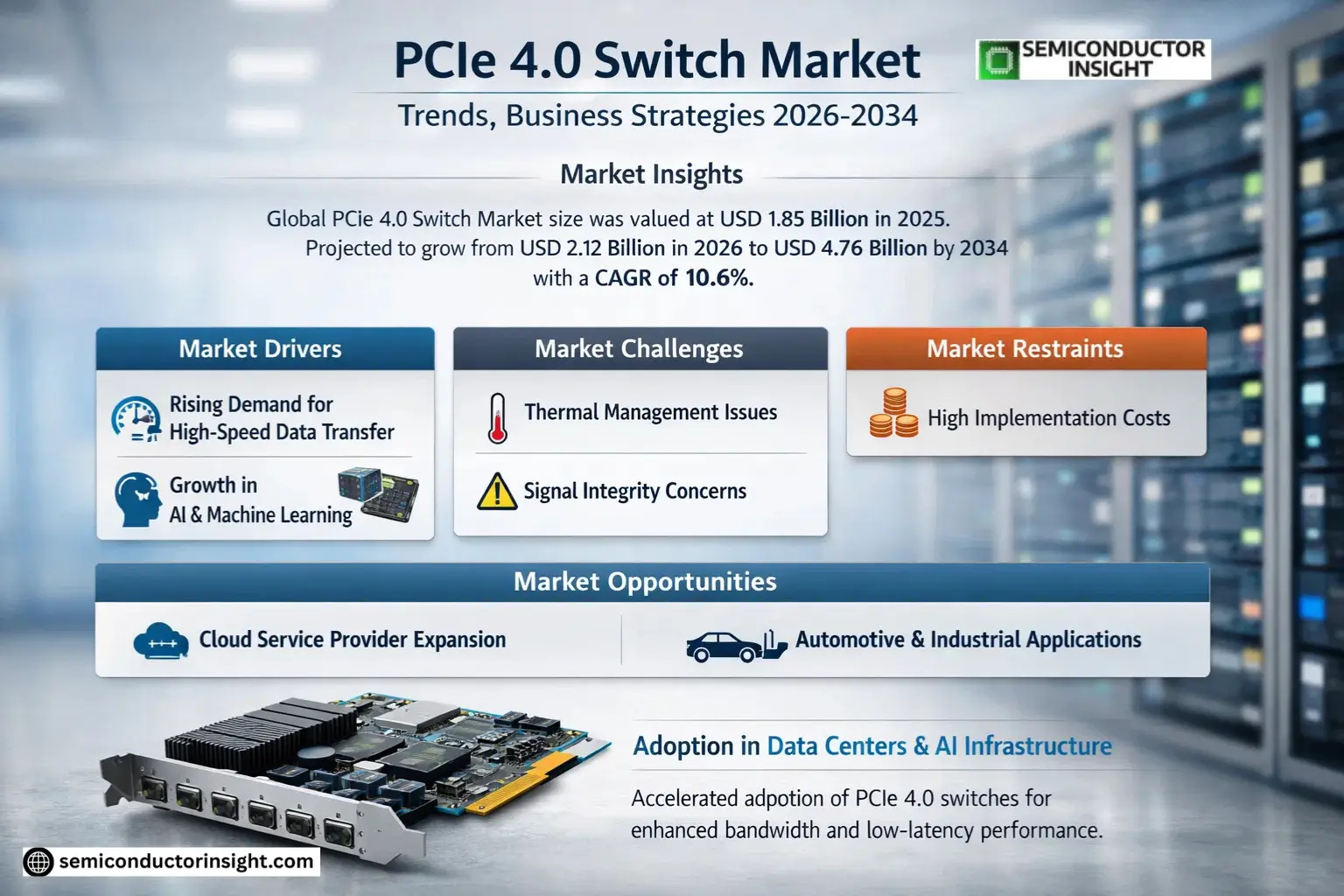
Global PCIe 4.0 Switch Market size was valued at USD 1.85 billion in 2025. The market is projected to grow from USD 2.12 billion in 2026 to USD 4.76 billion by 2034, exhibiting a CAGR of 10.6% during the forecast period.
A PCIe 4.0 switch is a high-performance semiconductor device designed to manage and route data between PCI Express (PCIe) 4.0-enabled components. Delivering double the bandwidth of PCIe 3.0 16 GT/s per lane these switches are critical for applications demanding ultra-low latency and high throughput, such as data centers, AI accelerators, and high-performance computing systems. Their architecture supports scalable connectivity for GPUs, NVMe storage, and networking devices.
Market expansion is driven by escalating demand for hyperscale data centers and edge computing infrastructure, where PCIe 4.0’s bandwidth efficiency reduces bottlenecks in data-intensive workloads. The enterprise segment dominates adoption due to large-scale deployments in cloud service providers, while automotive applications show accelerated growth with the rise of autonomous vehicle architectures requiring real-time sensor processing.
MARKET DRIVERS
Increasing Demand for High-Speed Data Transfer
PCIe 4.0 Switch Market is witnessing significant growth due to the rising need for faster data transfer speeds in data centers and enterprise applications. With a bandwidth of 16 GT/s per lane, PCIe 4.0 switches enable twice the performance of PCIe 3.0, meeting the requirements of modern computing workloads.
Adoption in AI and Machine Learning Infrastructure
As AI and ML workloads become more complex, the demand for high-performance interconnects has surged. PCIe 4.0 switches are critical components in GPU clusters and accelerator-based systems, delivering the low-latency, high-bandwidth connections needed for training large neural networks.
Additionally, the expansion of 5G networks and edge computing is creating new demand for PCIe 4.0 switches in telecommunications infrastructure.
MARKET CHALLENGES
Thermal Management Complexities
The higher data rates of PCIe 4.0 switches generate more heat compared to previous generations, requiring advanced cooling solutions that increase system cost and design complexity. Many enterprises face challenges in optimizing thermal performance without compromising operational efficiency.
Other Challenges
Signal Integrity Issues
Maintaining signal integrity at 16 GT/s poses technical hurdles, especially in dense server configurations where crosstalk and attenuation can degrade performance.
MARKET RESTRAINTS
High Implementation Costs
The transition to PCIe 4.0 switch technology requires substantial investments in compatible hardware, including new CPUs, motherboards, and peripherals. This cost barrier is slowing adoption among small and medium enterprises who still find PCIe 3.0 solutions economically viable.
MARKET OPPORTUNITIES
Cloud Service Provider Expansion
Major cloud providers are actively upgrading their infrastructure to support PCIe 4.0 switches, creating a USD 2.8 billion opportunity for switch manufacturers by 2025. The technology’s improved bandwidth enables more efficient virtualization and containerization at scale.
Automotive and Industrial Applications
Emerging applications in autonomous vehicles and industrial IoT are adopting PCIe 4.0 switches for real-time sensor data processing. The automotive sector alone may account for 18% of PCIe 4.0 switch demand by 2026.
PCIe 4.0 Switch Market Trends
Adoption Accelerates in Data Centers and AI Infrastructure
The demand for PCIe 4.0 switches is growing rapidly in enterprise environments, particularly in data centers and AI-driven applications. These switches enable higher bandwidth and lower latency compared to PCIe 3.0, making them critical for modern computing architectures. The transition to PCIe 4.0 allows for more efficient data routing between GPUs, NVMe SSDs, and networking equipment in hyperscale environments.
Other Trends
Enterprise-Level Segment Growth
The enterprise-level segment continues to dominate adoption, with increasing implementation in server architectures and high-performance computing clusters. Leading cloud service providers and hyperscalers are driving demand as they upgrade infrastructure to handle AI workloads and real-time analytics with higher throughput requirements.
Emerging Applications in Automotive Electronics
Automotive applications are emerging as a significant growth area for PCIe 4.0 switch technology, particularly in advanced driver-assistance systems (ADAS) and autonomous vehicle architectures. The automotive sector requires reliable high-speed data transfer between sensors, processors, and storage systems, making PCIe 4.0 switches increasingly relevant.
Geographic Market Developments
North America remains the largest regional market due to strong data center investments, while Asia-Pacific shows the fastest growth potential with expanding cloud infrastructure in China and increasing electronics manufacturing in Southeast Asia. Europe maintains steady adoption through industrial and automotive applications.
Competitive Landscape Evolution
Key semiconductor manufacturers including Broadcom and Microchip continue to lead the PCIe 4.0 Switch Market, focusing on developing energy-efficient solutions with higher port counts. The competitive landscape is evolving with increased R&D investments to support 5G infrastructure and edge computing applications.
COMPETITIVE LANDSCAPE
Key Industry Players
Market Dominance and Strategic Positioning in PCIe 4.0 Switch Segment
Broadcom Inc. leads the PCIe 4.0 Switch market with a significant revenue share, driven by its comprehensive product portfolio and strong presence in data center applications. The company’s PCIe switches are widely adopted in enterprise servers and storage systems due to their high bandwidth and low latency. Microchip Technology and Texas Instruments follow closely, offering specialized solutions for automotive electronics and industrial applications where reliability and thermal performance are critical.
ASMedia Technology has emerged as a key player in consumer-grade PCIe 4.0 switches, particularly for motherboard and peripheral connectivity solutions. Niche manufacturers like Diodes Incorporated and ON Semiconductor focus on cost-optimized switches for mid-range applications, while Renesas Electronics and NXP Semiconductors cater to automotive and embedded systems with their robust product designs.
List of Key PCIe 4.0 Switch Companies Profiled
- Broadcom Inc.
- Microchip Technology
- Texas Instruments
- ASMedia Technology
- Diodes Incorporated
- ON Semiconductor
- Renesas Electronics
- NXP Semiconductors
- MaxLinear
- Semtech Corporation
- Pericom Semiconductor
- Microsemi Corporation
- Marvell Technology Group
- Silicon Motion Technology
- Phison Electronics
Segment Analysis:
| Segment Category | Sub-Segments | Key Insights |
| By Type |
|
Enterprise-Level dominates the segment due to:
|
| By Application |
|
Server Applications show strongest adoption because:
|
| By End User |
|
Data Centers represent the key end users due to:
|
| By Technology Integration |
|
Artificial Intelligence applications drive significant demand because:
|
| By Component Type |
|
Switches lead this segment due to:
|
Regional Analysis: PCIe 4.0 Switch Market
North America
US-based enterprises lead in PCIe 4.0 switch deployment, prioritizing high-performance computing for financial services and healthcare applications. The technology enables real-time analytics and secure medical imaging transfers.
California and Texas witness concentrated R&D efforts for PCIe 4.0 architecture optimization, with major OEMs developing energy-efficient switches for next-generation data center applications.
Established semiconductor manufacturing ecosystems in Arizona and Oregon facilitate rapid prototyping and production of PCIe 4.0 switch components, reducing time-to-market for new solutions.
Hyperscale data centers in Virginia and Washington drive bulk purchases of PCIe 4.0 switches to support expanding edge computing infrastructure and content delivery network requirements.
Europe
European markets show accelerating PCIe 4.0 switch adoption, particularly in Germany and the UK where automotive and industrial automation sectors implement the technology for machine vision systems. Strict EU data protection regulations encourage investment in secure, high-bandwidth interconnects across banking and government sectors. Collaborative R&D initiatives between academic institutions and semiconductor firms in Belgium and Sweden push innovation in low-power PCIe 4.0 switch designs.
Asia-Pacific
The APAC region exhibits the fastest PCIe 4.0 Switch Market growth, led by hyperscale data center expansions in Singapore and China. Taiwanese semiconductor manufacturers play a crucial role in producing cost-optimized PCIe 4.0 solutions. Japan’s automotive electronics sector and South Korea’s memory manufacturers drive demand for compatible switching architectures in embedded systems and storage applications.
South America
Brazil emerges as the focal point for PCIe 4.0 switch adoption in Latin America, primarily serving financial technology applications and oil/gas data processing needs. Limited local manufacturing results in higher dependence on imports, though government incentives aim to develop domestic semiconductor testing capabilities for PCIe components.
Middle East & Africa
The UAE and Saudi Arabia lead MEA adoption through smart city infrastructure projects requiring high-speed data transfers. Local data center operators gradually transition from PCIe 3.0 to 4.0 switches to support AI-driven surveillance and IoT networks, though market maturity lags behind other regions.
Report Scope
This market research report provides a comprehensive analysis of the PCIe 4.0 Switch Market, covering the forecast period 2025–2034. It offers detailed insights into market dynamics, technological advancements, competitive landscape, and key trends shaping the industry.
Key focus areas of the report include:
- Market Overview: The report begins with an overview outlining its current market scenario, key growth indicators, and industry transformation drivers. It discusses macroeconomic factors, demand–supply balance, regulatory landscape, and the strategic role of semiconductors in powering advancements across industries such as data centers, AI applications, automotive electronics, and high-performance computing.
- Market Size & Forecast: Historical data and future projections for revenue, unit shipments, and market value across major regions and segments.
- Segmentation Analysis: Detailed breakdown by product type, technology, application, and end-user industry to identify high-growth segments and investment opportunities.
- Regional Insights: Insights into market performance across North America, Europe, Asia-Pacific, Latin America, and the Middle East & Africa, including country-level analysis where relevant.
- Competitive Landscape: Profiles of leading market participants, including their product offerings, R&D focus, manufacturing capacity, pricing strategies, and recent developments such as mergers, acquisitions, and partnerships.
- Technology Trends & Innovation: Assessment of emerging technologies, integration of AI/IoT, semiconductor design trends, fabrication techniques, and evolving industry standards.
- Market Drivers & Restraints: Evaluation of factors driving market growth along with challenges, supply chain constraints, regulatory issues, and market-entry barriers.
- Stakeholder Insights: Insights for component suppliers, OEMs, system integrators, investors, and policymakers regarding the evolving ecosystem and strategic opportunities.
Primary and secondary research methods are employed, including interviews with industry experts, data from verified sources, and real-time market intelligence to ensure the accuracy and reliability of the insights presented.
FREQUENTLY ASKED QUESTIONS:
What is the current market size of PCIe 4.0 Switch Market?
-> PCIe 4.0 Switch Market size was valued at USD 1.85 billion in 2025. The market is projected to grow from USD 2.12 billion in 2026 to USD 4.76 billion by 2034, exhibiting a CAGR of 10.6% during the forecast period.
Which key companies operate in PCIe 4.0 Switch Market?
-> Key players include Broadcom, Microchip, Texas Instruments, ASMedia Technology, Diodes, ON Semiconductor, Renesas, and NXP Semicondutors, among others.
What are the key growth drivers?
-> Key growth drivers include increased demand for high-speed data processing, expansion of data centers, adoption of AI applications, and automotive electronics growth.
Which region dominates the market?
-> North America holds significant market share, with the U.S. estimated at USD million in 2025, while Asia (particularly China) is projected to reach USD million.
What is the growth rate of the Enterprise-Level segment?
-> The Enterprise-Level segment is projected to reach USD million by 2034, with a CAGR of % over the forecast period.
Get Sample Report PDF for Exclusive Insights
Report Sample Includes
- Table of Contents
- List of Tables & Figures
- Charts, Research Methodology, and more...
 Download Sample Report PDF