Market Insights
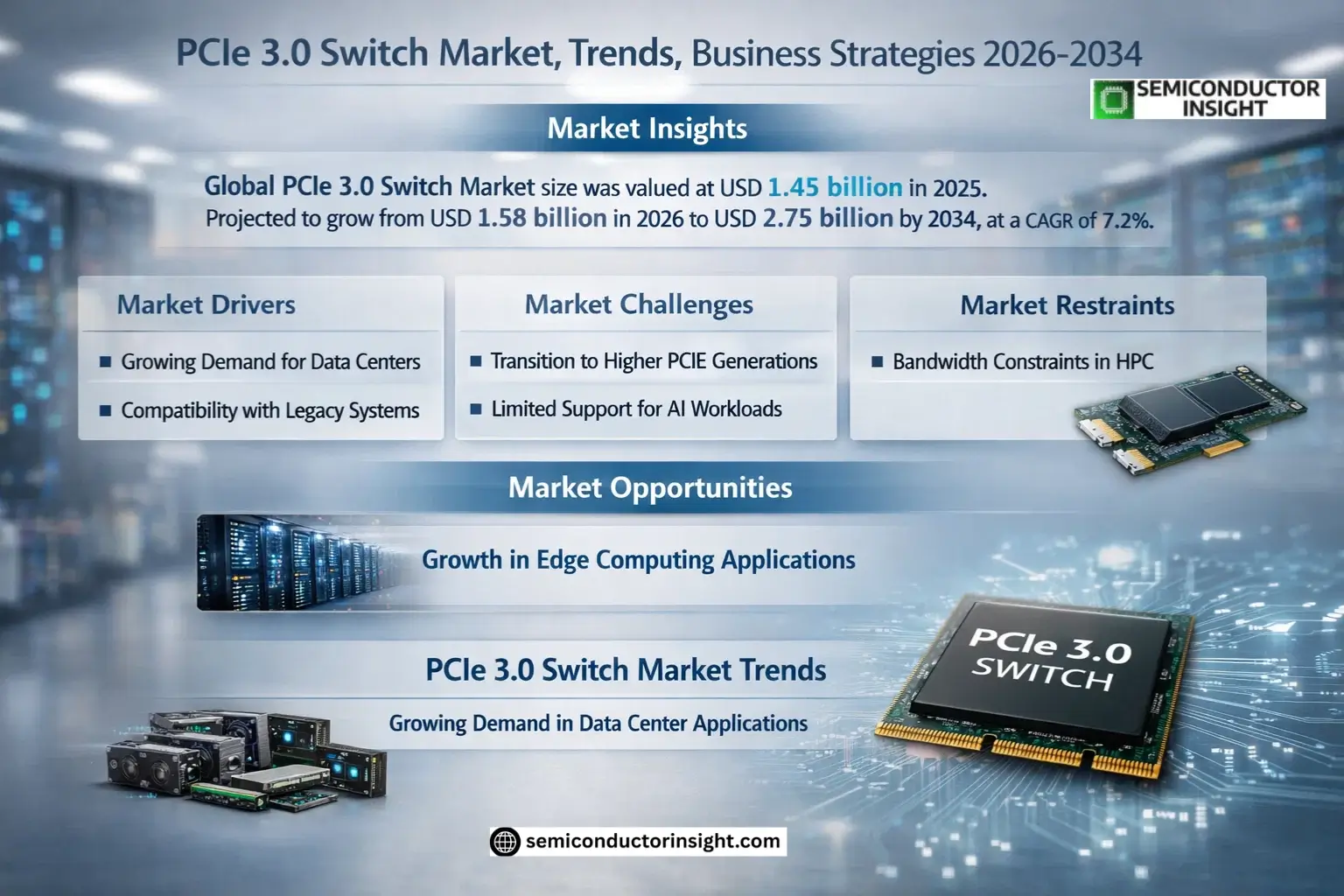
Global PCIe 3.0 Switch Market size was valued at USD 1.45 billion in 2025. The market is projected to grow from USD 1.58 billion in 2026 to USD 2.75 billion by 2034, exhibiting a CAGR of 7.2% during the forecast period.
A PCIe 3.0 switch is a semiconductor device designed to manage and direct data traffic between multiple PCI Express (PCIe) 3.0 devices within a computer system, enabling high-speed data transfer and communication by expanding available PCIe lanes. These switches are critical for connecting GPUs, SSDs, and network cards simultaneously, particularly in data centers, servers, and high-performance computing environments where scalability and efficient data handling are essential.
The market growth is driven by increasing demand for high-bandwidth applications, expansion of cloud computing infrastructure, and rising adoption of NVMe-based storage solutions. Furthermore, advancements in AI workloads and edge computing are accelerating the need for robust interconnect solutions like PCIe 3.0 switches. Key players such as Broadcom, Microchip Technology, and Texas Instruments continue to innovate with low-latency and energy-efficient designs to meet evolving industry requirements.
MARKET DRIVERS
Growing Demand for Data Center Infrastructure
PCIe 3.0 Switch Market is propelled by the increasing need for high-speed data transfer in modern data centers. With data-intensive applications and cloud computing rising, PCIe 3.0 switches provide a cost-effective solution for bandwidth optimization. The technology supports data transfer rates up to 8 GT/s, making it ideal for legacy systems upgrading from older PCIe generations.
Compatibility with Legacy Systems
Many enterprises still rely on PCIe 3.0 due to its backward compatibility with existing infrastructure. Upgrading to newer versions like PCIe 4.0 or 5.0 requires significant hardware changes, making PCIe 3.0 switches a practical choice for businesses focusing on incremental upgrades.
Emerging markets in Asia-Pacific are further contributing to demand as they modernize IT infrastructure while balancing cost considerations.
MARKET CHALLENGES
Transition to Higher PCIe Generations
PCIe 3.0 Switch Market faces pressure from newer standards like PCIe 4.0 and 5.0, which offer doubled bandwidth. While PCIe 3.0 remains relevant, customers planning long-term investments are gradually shifting focus toward next-gen solutions, creating a competitive challenge.
Other Challenges
Limited Support for AI Workloads
PCIe 3.0 switches struggle with AI/ML applications requiring ultra-low latency and higher throughput, pushing enterprises toward PCIe 4.0 alternatives.
MARKET RESTRAINTS
Bandwidth Constraints in High-Performance Computing
PCIe 3.0’s maximum bandwidth of ~1GB/s per lane is becoming a bottleneck for HPC applications. As industries like autonomous vehicles and real-time analytics require faster data processing, the technology faces natural obsolescence in certain high-end segments.
MARKET OPPORTUNITIES
Growth in Edge Computing Applications
PCIe 3.0 switches find renewed relevance in edge computing deployments where cost-efficiency outweighs maximum bandwidth needs. The technology’s proven reliability and lower power consumption make it suitable for distributed computing environments requiring stable performance at moderate speeds.
PCIe 3.0 Switch Market Trends
Growing Demand in Data Center Applications
PCIe 3.0 Switch Market is experiencing significant growth due to increasing demand in data center applications. These switches enable efficient data handling between multiple devices like GPUs and SSDs, making them essential for modern server architectures. Major cloud service providers are adopting PCIe 3.0 technology to improve data transfer rates and system scalability.
Other Trends
Enterprise vs. Consumer Segment Growth
The enterprise segment continues to dominate PCIe 3.0 Switch Market as businesses upgrade their server infrastructures. However, consumer-level adoption is also rising with increased demand for high-performance gaming PCs and workstations that require multiple peripheral connections.
Regional Market Developments
North America currently leads in PCIe 3.0 Switch adoption, particularly in the U.S. where data center investments are surging. The Asia-Pacific region shows the fastest growth potential, driven by China’s expanding server market and increasing tech manufacturing capabilities. Europe maintains steady demand as enterprises modernize their IT infrastructure.
Competitive Landscape Shifts
Key players like Broadcom and Microchip continue to lead PCIe 3.0 Switch Market through continuous product innovation. Recent developments include power-optimized switches for energy-sensitive applications and compact designs for space-constrained installations in automotive electronics.
Technology Transition Considerations
While newer PCIe versions emerge, PCIe 3.0 Switch Market maintains relevance due to its cost-effectiveness and compatibility with existing infrastructure. Manufacturers are focusing on hybrid solutions that support both legacy and newer PCIe standards to ease technology transitions for enterprise customers.
COMPETITIVE LANDSCAPE
Key Industry Players
Global PCIe 3.0 Switch Market Dominated by Semiconductor Giants
PCIe 3.0 Switch Market is consolidated with Broadcom Inc. leading as the dominant player, commanding significant market share through its comprehensive portfolio of high-performance switching solutions. The top five manufacturers collectively accounted for approximately XX% of global revenue in 2025, with Broadcom, Microchip, and Texas Instruments forming the core competitive triad. These established semiconductor companies leverage their extensive R&D capabilities and manufacturing scale to maintain leadership in data center and enterprise applications.
Niche specialists like ASMedia Technology have carved out strong positions in consumer-grade PCIe switching solutions, particularly for SSD and peripheral connectivity applications. The market also features significant participation from Japanese and European semiconductor firms such as Renesas and NXP, which focus on automotive and industrial applications. Emerging regional players are increasingly challenging incumbents with cost-competitive offerings in price-sensitive Asian markets.
List of Key PCIe 3.0 Switch Companies Profiled
- Broadcom Inc.
- Microchip Technology
- Texas Instruments
- ASMedia Technology Inc.
- Diodes Incorporated
- ON Semiconductor
- Renesas Electronics
- NXP Semiconductors
- Intel Corporation
- Marvell Technology
- Silicon Motion Technology
- MaxLinear
- Semtech Corporation
- Pericom Semiconductor
- JMicron Technology
Segment Analysis:
| Segment Category | Sub-Segments | Key Insights |
| By Type |
|
Enterprise-Level switches dominate due to:
|
| By Application |
|
Server Applications show strongest adoption:
|
| By End User |
|
Data Centers represent the prime market:
|
| By Architecture |
|
Standard Switches maintain market leadership:
|
| By Lane Configuration |
|
16-lane configurations are most prevalent:
|
Regional Analysis: PCIe 3.0 Switch Market
North America
Enterprise data centers across North America maintain extensive PCIe 3.0 switch deployments for legacy equipment compatibility. Migration strategies often include hybrid architectures blending PCIe 3.0 with newer generations, prolonging market viability through phased upgrades.
Telecommunications providers leverage PCIe 3.0 switches in edge computing nodes and base stations, particularly for 5G network rollouts requiring cost-effective interconnect solutions where bandwidth requirements remain within PCIe 3.0 specifications.
Manufacturing automation systems across automotive and aerospace sectors continue adopting PCIe 3.0 switch solutions for machine vision systems and industrial PCs, valuing reliability over maximum bandwidth in harsh operating environments.
Academic institutions and corporate R&D centers maintain PCIe 3.0 testbeds for compatibility testing and legacy system integration, acting as innovation hubs for novel switch applications in scientific computing.
Europe
The European PCIe 3.0 Switch Market demonstrates steady demand from industrial automation and automotive sectors, particularly in Germany and France. Strict data sovereignty regulations drive localized data center deployments utilizing PCIe 3.0 infrastructure for legacy application support. The region’s focus on energy-efficient computing aligns well with PCIe 3.0’s power profile, sustaining adoption in green data center initiatives. Automotive manufacturers integrate PCIe 3.0 switches for ADAS and infotainment system development, though gradually transitioning to newer standards.
Asia-Pacific
Asia-Pacific shows accelerated PCIe 3.0 switch adoption in China’s expanding data center market and Japan’s industrial automation sector. Cost-sensitive manufacturing ecosystems value PCIe 3.0’s balance of performance and affordability for factory automation. Southeast Asian markets demonstrate growing demand as cloud service providers establish regional points of presence with mixed-generation infrastructure. India’s emerging IT sector maintains significant legacy equipment relying on PCIe 3.0 connectivity solutions.
South America
South American adoption focuses on telecommunications infrastructure and financial services data centers, with Brazil leading regional demand. Economic constraints prolong equipment refresh cycles, sustaining PCIe 3.0 switch relevance. Mining and oil/gas industries utilize ruggedized PCIe 3.0 solutions for industrial computing applications in remote operations. Limited local semiconductor manufacturing creates import dependence for switching solutions.
Middle East & Africa
The MEA region demonstrates niche demand concentrated in Gulf Cooperation Council countries’ smart city initiatives and data center expansions. African markets show early-stage adoption in financial technology hubs and telecommunications infrastructure. Regional preference for cost-optimized solutions maintains PCIe 3.0 switch relevance despite growing awareness of newer standards. Government-led digital transformation programs incorporate legacy-compatible PCIe solutions in initial deployment phases.
Report Scope
This market research report provides a comprehensive analysis of the PCIe 3.0 Switch Market , covering the forecast period 2025–2034. It offers detailed insights into market dynamics, technological advancements, competitive landscape, and key trends shaping the industry.
Key focus areas of the report include:
- Market Overview: The report begins with an overview outlining its current market scenario, key growth indicators, and industry transformation drivers. It discusses macroeconomic factors, demand–supply balance, regulatory landscape, and the strategic role of semiconductors in powering advancements across industries such as data centers, servers, and high-performance computing environments.
- Market Size & Forecast: Historical data and future projections for revenue, unit shipments, and market value across major regions and segments.
- Segmentation Analysis: Detailed breakdown by product type, technology, application, and end-user industry to identify high-growth segments and investment opportunities.
- Regional Insights: Insights into market performance across North America, Europe, Asia, South America, and the Middle East & Africa, including country-level analysis where relevant.
- Competitive Landscape: Profiles of leading market participants, including their product offerings, R&D focus, manufacturing capacity, pricing strategies, and recent developments such as mergers, acquisitions, and partnerships.
- Technology Trends & Innovation: Assessment of emerging technologies, integration of high-speed data transfer solutions, semiconductor design trends, and evolving industry standards.
- Market Drivers & Restraints: Evaluation of factors driving market growth along with challenges, supply chain constraints, regulatory issues, and market-entry barriers.
- Stakeholder Insights: Insights for component suppliers, OEMs, system integrators, investors, and policymakers regarding the evolving ecosystem and strategic opportunities.
Primary and secondary research methods are employed, including interviews with industry experts, data from verified sources, and real-time market intelligence to ensure the accuracy and reliability of the insights presented.
FREQUENTLY ASKED QUESTIONS:
What is the current market size of PCIe 3.0 Switch Market?
-> PCIe 3.0 Switch Market size was valued at USD 1.45 billion in 2025. The market is projected to grow from USD 1.58 billion in 2026 to USD 2.75 billion by 2034, exhibiting a CAGR of 7.2% during the forecast period.
What is the projected CAGR for the PCIe 3.0 Switch Market?
-> The market is projected to grow at a CAGR of % during the forecast period (2025-2034).
Which key companies operate in PCIe 3.0 Switch Market?
-> Key players include Broadcom, Microchip, Texas Instruments, ASMedia Technology, Diodes, ON Semiconductor, Renesas, and NXP Semicondutors.
What are the main applications of PCIe 3.0 Switches?
-> Main applications include servers, SSDs, automotive electronics, and other high-performance computing environments.
Which region leads in PCIe 3.0 Switch market share?
-> The U.S. market size is estimated at USD million in 2025, while China is projected to reach USD million by 2034.
Get Sample Report PDF for Exclusive Insights
Report Sample Includes
- Table of Contents
- List of Tables & Figures
- Charts, Research Methodology, and more...