xPU (Unified Processor) Market Insights
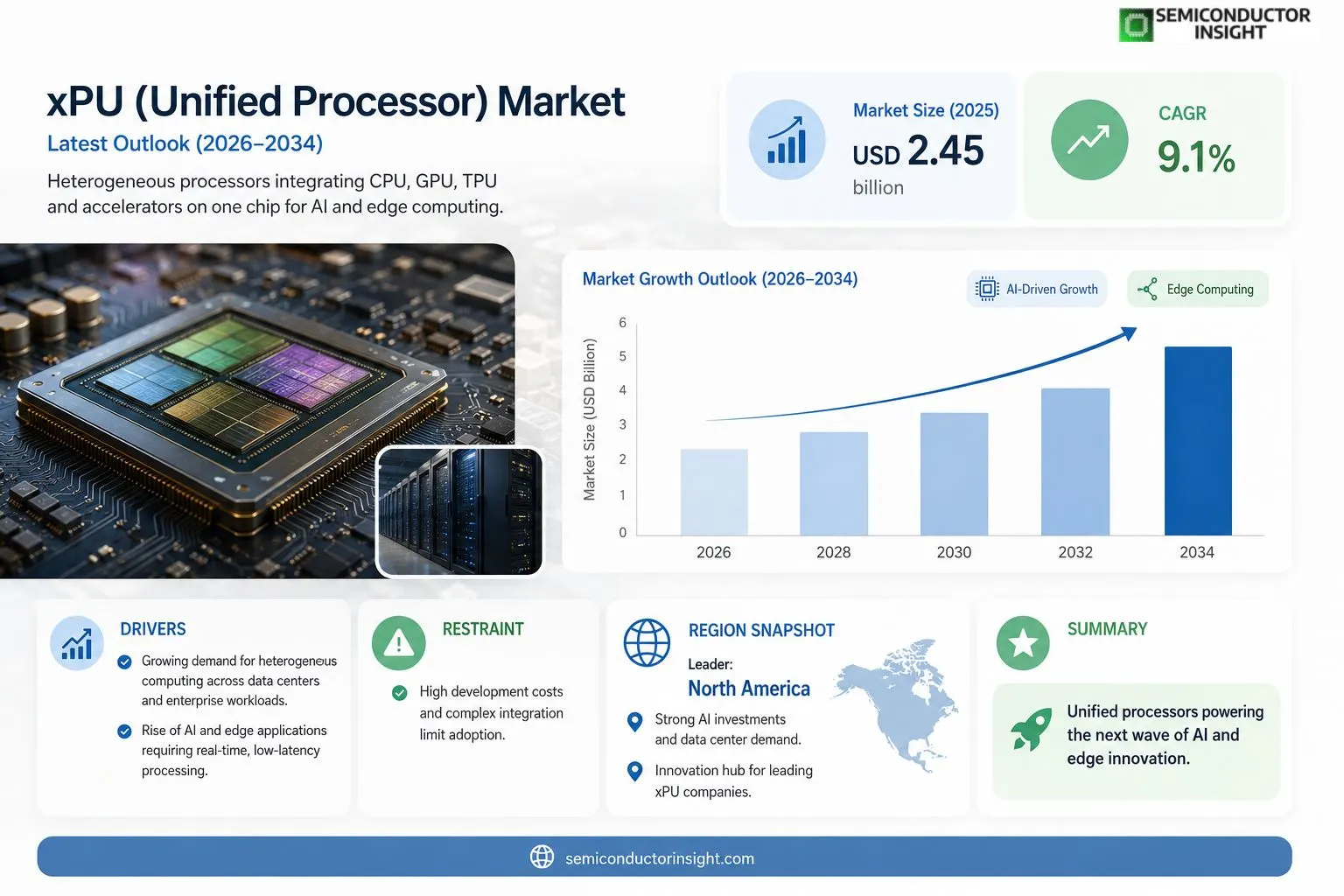
Global xPU (Unified Processor) market size was valued at USD 2.45 billion in 2025. The market is projected to grow from USD 2.60 billion in 2026 to USD 5.12 billion by 2034, exhibiting a CAGR of 9.1% during the forecast period.
xPU (Unified Processor) refers to a heterogeneous computing architecture that integrates CPU, GPU, TPU and other specialized accelerators onto a single silicon substrate, enabling seamless workload distribution across diverse processing units for AI inference, high‑performance computing and edge analytics.The market is experiencing rapid expansion due to heightened investment in AI‑driven workloads, rising demand for real‑time analytics at the edge, and increasing adoption of cloud‑native heterogeneous platforms. Furthermore, advancements in interconnect technologies such as PCIe 5.0 and CXL are reducing latency between cores, while major players,including NVIDIA, AMD, Intel and Google,are launching next‑generation unified chips that promise higher throughput and energy efficiency.
MARKET DRIVERS
Growing Demand for Heterogeneous Computing
The rapid adoption of heterogeneous architectures is reshaping xPU (Unified Processor) Market. Enterprises are consolidating CPU, GPU, and accelerator functions into a single silicon solution to reduce latency and power consumption, driving a surge in design wins across data‑center and automotive sectors.
Rise of AI and Edge Applications
AI inference at the edge now requires real‑time processing with minimal footprint, a niche where unified processors excel. Analysts project a compound annual growth rate of over 12 % for xPU (Unified Processor) Market as smart‑camera, IoT gateway, and autonomous‑vehicle deployments expand.
➤ “Unified processors enable a 30 % reduction in system‑level power compared with discrete CPU‑GPU combinations, unlocking new product categories.”
Additionally, the convergence of cloud‑native workloads with on‑premise acceleration creates a compelling value proposition for vendors, reinforcing the upward trajectory of xPU (Unified Processor) Market through 2028.
MARKET CHALLENGES
Integration Complexity Across Platforms
Designers must reconcile divergent instruction sets, memory hierarchies, and programming models, which can extend development cycles. The steep learning curve associated with unified processor toolchains remains a significant hurdle for many OEMs.
Other Challenges
Supply Chain Constraints
Global semiconductor shortages have limited the availability of high‑performance silicon, compressing lead times for critical components and impacting rollout schedules for xPU (Unified Processor) Market.
MARKET RESTRAINTS
High Development Costs
Creating a monolithic xPU architecture demands substantial R&D investment, often exceeding $200 million for leading vendors. This financial barrier limits entry to a handful of well‑capitalized players.Furthermore, the need for extensive verification across heterogeneous workloads adds to the overall project budget, discouraging smaller firms from pursuing unified‑processor strategies.The sensitivity of cost structures to wafer yields also introduces pricing volatility, which can suppress market enthusiasm during periods of low yield performance.
MARKET OPPORTUNITIES
Expanding Software Ecosystem
Open‑source compilers and runtime libraries are maturing, offering developers streamlined pathways to leverage unified hardware. This evolving ecosystem reduces time‑to‑market for new applications, creating a growth catalyst for xPU (Unified Processor) Market.Additionally, strategic partnerships between silicon vendors and cloud service providers are unlocking scalable deployment models, enabling customers to access unified processing power on a subscription basis.Finally, emerging standards for secure enclaves and trusted execution environments present a niche where unified processors can differentiate themselves, opening high‑margin opportunities in defense and finance sectors.
xPU (Unified Processor) Market Trends
Integration of Heterogeneous Computing
The xPU (Unified Processor) architecture unifies CPU, GPU, TPU and other accelerators on a single silicon die. This integration eliminates the need for discrete components, allowing workloads to migrate dynamically between processing units. As AI inference and high‑performance computing applications demand lower latency, the single‑chip approach reduces data movement and power consumption. Vendors are leveraging this capability to deliver solutions that support both cloud‑scale training and edge analytics within the same hardware envelope. The resulting flexibility is reshaping system design, encouraging OEMs to adopt xPU‑based platforms for next‑generation servers and embedded devices. Customers report up to 30 % improvement in throughput when workloads are scheduled across heterogeneous cores, reinforcing the strategic importance of unified processing for xPU (Unified Processor) Market.
Other Trends
Advancements in Interconnect Technologies
Modern interconnect standards such as PCIe 5.0 and Compute Express Link (CXL) are becoming foundational to the xPU ecosystem. By providing higher bandwidth and lower latency between heterogeneous cores, these interfaces enable more efficient sharing of memory and data streams. The reduced overhead directly benefits AI inference at the edge, where real‑time decision making depends on rapid data exchange. Chip designers are embedding native CXL lanes alongside traditional PCIe pathways, creating a fabric that supports both internal accelerator communication and external device attachment. This convergence accelerates the adoption of unified processors in data‑center accelerators and edge gateways, driving a measurable shift toward tightly coupled heterogeneous systems.
Emergence of Cloud‑Native Unified Platforms
Enterprises are progressively moving AI‑driven workloads to cloud‑native environments that demand seamless scalability and resource abstraction. Unified processors simplify this transition by presenting a single programming model that spans CPUs, GPUs, and specialized tensors, reducing software fragmentation. Major players,including NVIDIA, AMD, Intel and Google,have introduced next‑generation unified chips that promise higher throughput per watt, aligning with sustainability goals. The combination of robust interconnects and unified instruction sets is enabling service providers to offer on‑demand heterogeneous compute pools, where customers can provision the exact mix of processing elements for a given task. This trend is strengthening the overall xPU (Unified Processor) Market by linking hardware innovation with flexible, cloud‑first deployment strategies.
COMPETITIVE LANDSCAPEKey Industry Players
Emerging Unified Processor Landscape Driven by AI Workloads
The xPU market is presently anchored by NVIDIA, whose Grace Hopper Superchip integrates high‑performance CPU cores with next‑generation GPU tensor engines, establishing a de‑facto standard for heterogeneous AI compute. NVIDIA leverages its dominant ecosystem of CUDA, cuDNN and substantial cloud partnerships, creating a market structure where the majority of large‑scale AI training and inference workloads gravitate toward its unified silicon. This concentration is reinforced by strategic investments in interconnect standards such as PCIe 5.0 and CXL, which minimize latency across the integrated components and provide a compelling value proposition for hyperscale data centers seeking ultra‑efficient throughput.Beyond the flagship players, a broader cohort of companies is shaping niche segments of the xPU arena. AMD’s Ryzen‑AI line pairs Zen CPU cores with Radeon Instinct accelerators, targeting edge AI and embedded systems. Intel advances its Ponte Vecchio and Xe‑HPG initiatives, combining Xe‑cores with Xeon scalability. Google extends its TPU family through a unified chip concept, emphasizing cloud‑native AI pipelines. Qualcomm’s Snapdragon XPU focuses on mobile and automotive AI, while Samsung’s Exynos integrates NPU blocks for edge devices. IBM’s Power10 architecture incorporates specialized AI accelerators for enterprise workloads. Innovators such as Graphcore (IPU), Cerebras Systems (Wafer‑Scale Engine), Tenstorrent, and Mythic contribute differentiated analog or dataflow designs that address specific inference latency or energy‑efficiency niches, enriching the competitive tapestry of the unified processor market.
List of Key Unified Processor Companies Profiled
- NVIDIA
- AMD
- Intel
- Qualcomm
- Samsung
- IBM
- Graphcore
- Cerebras Systems
- Tenstorrent
- Mythic
- Arm
- Broadcom
- Marvell Technology
- Alibaba Cloud (DAMO Academy)
Segment Analysis:
| Segment Category | Sub-Segments | Key Insights |
| By Type |
|
AI‑Accelerator‑centric xPU
|
| By Application |
|
Data Center AI
|
| By End User |
|
Cloud Service Providers
|
| By Integration Level |
|
Tight Integration
|
| By Deployment Model |
|
Edge Devices
|
Regional Analysis: North America
United States
The data center sector in the US is a primary consumer of xPUs, driven by the escalating demands of cloud computing, big data analytics, and AI workloads. The need for greater computational power and energy efficiency is pushing data center operators to adopt advanced processor architectures like xPUs.
The burgeoning edge computing market in the US is creating significant opportunities for xPU adoption. Bringing compute closer to data sources necessitates energy-efficient and high-performance processors, making xPUs a compelling solution for various edge deployments.
The US industrial sector is increasingly leveraging xPUs to enhance automation capabilities, improve real-time decision-making, and drive operational efficiency. The demand for robust and reliable processors in industrial environments is fueling the adoption of xPU technologies.
The automotive industry in the US is actively exploring the integration of xPUs for advanced driver-assistance systems (ADAS), autonomous driving capabilities, and in-vehicle infotainment systems. Energy efficiency and real-time processing are key considerations driving this adoption.
Europe
Europe presents a dynamic landscape for xPU (Unified Processor) Market, characterized by a strong emphasis on energy efficiency, security, and regulatory compliance. The region’s robust industrial base, coupled with a growing focus on digital transformation and the Internet of Things (IoT), is driving demand for xPUs across various sectors, including automotive, manufacturing, and healthcare. European governments are actively promoting investments in semiconductor research and development to strengthen the region’s technological competitiveness. The xPU market in Europe is witnessing increasing adoption in data centers, edge computing deployments, and embedded systems, catering to the evolving needs of European enterprises and industries.
Asia-Pacific
Asia-Pacific is emerging as the fastest-growing market for the xPU (Unified Processor). Driven by rapid economic expansion, increasing digitalization, and substantial investments in technology infrastructure, the region presents immense opportunities for xPU vendors. China, in particular, is a key market, with significant demand from the telecommunications, cloud computing, and consumer electronics sectors. The region’s focus on 5G deployment and the proliferation of IoT devices are further fueling the demand for energy-efficient and high-performance xPUs. Competition is intense, with both local and international players vying for market share.
South America
South America represents a developing market for xPU (Unified Processor) Market, with growth potential driven by increasing internet penetration, expanding cloud adoption, and the growth of e-commerce. The region’s telecommunications infrastructure is undergoing significant upgrades, creating opportunities for xPUs in data centers and network equipment. The automotive and industrial sectors are also showing increasing interest in xPU technologies for enhanced performance and efficiency.
Middle East & Africa
The Middle East & Africa market for the xPU (Unified Processor) is nascent but poised for significant growth. Investments in digital transformation initiatives, smart city projects, and infrastructure development are driving demand for advanced computing solutions. The region’s increasing adoption of cloud computing and the growth of the telecommunications sector are creating early opportunities for xPU vendors.
Report Scope
This market research report provides a comprehensive analysis of the xPU (Unified Processor) Market , covering the forecast period 2026–2034. It offers detailed insights into market dynamics, technological advancements, competitive landscape, and key trends shaping the industry.
Key focus areas of the report include:
- Market Overview: The report begins with an overview outlining its current market scenario, key growth indicators, and industry transformation drivers. It discusses macroeconomic factors, demand–supply balance, regulatory landscape, and the strategic role of semiconductors in powering advancements across industries such as automotive, telecommunications, consumer electronics, and industrial automation.
- Market Size & Forecast: Historical data and future projections for revenue, unit shipments, and market value across major regions and segments.
- Segmentation Analysis: Detailed breakdown by product type, technology, application, and end-user industry to identify high-growth segments and investment opportunities.
- Regional Insights: Insights into market performance across North America, Europe, Asia-Pacific, Latin America, and the Middle East & Africa, including country-level analysis where relevant.
- Competitive Landscape: Profiles of leading market participants, including their product offerings, R&D focus, manufacturing capacity, pricing strategies, and recent developments such as mergers, acquisitions, and partnerships.
- Technology Trends & Innovation: Assessment of emerging technologies, integration of AI/IoT, semiconductor design trends, fabrication techniques, and evolving industry standards.
- Market Drivers & Restraints: Evaluation of factors driving market growth along with challenges, supply chain constraints, regulatory issues, and market-entry barriers.
- Stakeholder Insights: Insights for component suppliers, OEMs, system integrators, investors, and policymakers regarding the evolving ecosystem and strategic opportunities.
Primary and secondary research methods are employed, including interviews with industry experts, data from verified sources, and real-time market intelligence to ensure the accuracy and reliability of the insights presented.
FREQUENTLY ASKED QUESTIONS:
What is the current market size of xPU (Unified Processor) Market?
-> xPU (Unified Processor) Market was valued at USD 2.45 billion in 2025 and is expected to reach USD 5.12 billion by 2034.
Which key companies operate in xPU (Unified Processor) Market?
-> Key players include Axalta Coating Systems, AkzoNobel, BASF SE, PPG, Sherwin-Williams, and 3M, among others.
What are the key growth drivers?
-> Key growth drivers include railway infrastructure investments, urbanization, and demand for durable coatings.
Which region dominates the market?
-> Asia-Pacific is the fastest-growing region, while Europe remains a dominant market.
What are the emerging trends?
-> Emerging trends include bio-based coatings, smart coatings, and sustainable rail solutions.
Get Sample Report PDF for Exclusive Insights
Report Sample Includes
- Table of Contents
- List of Tables & Figures
- Charts, Research Methodology, and more...
 Download Sample Report PDF