Edge Processor Market Insights
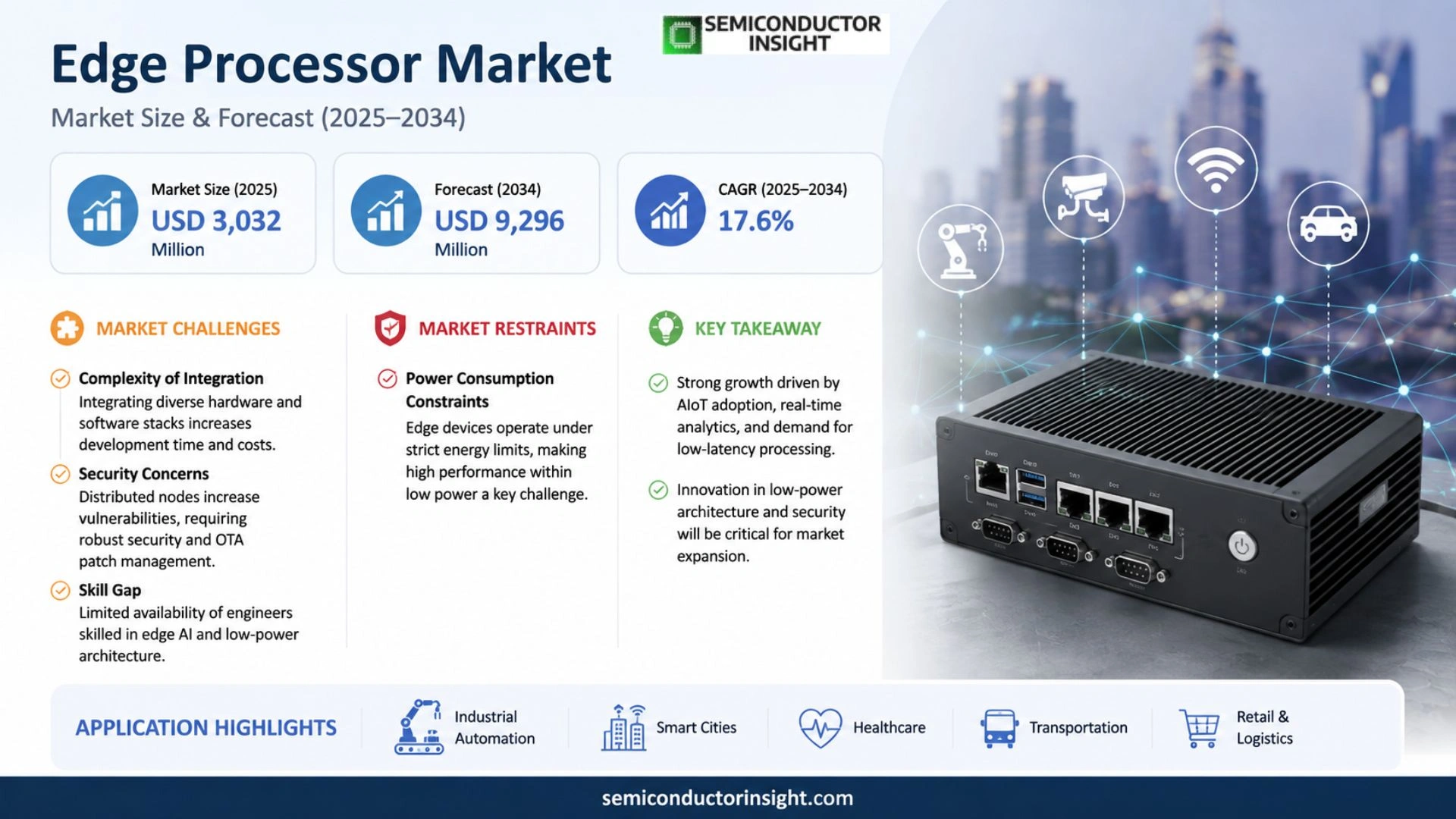
Edge Processor market size was valued at USD 3 032 million in 2025 and is forecasted to reach USD 9 296 million by 2034, reflecting a compound annual growth rate of 17.6 % over the period.
Edge processors are local computing chips or modules installed in end devices or near‑edge nodes. Their core function is to handle sensor data processing, vision analytics, speech and multimodal understanding, control decisions,and generative AI inference without relying on remote cloud resources,thereby lowering latency, bandwidth consumption,and privacy exposure. Contemporary designs fuse CPU, GPU,NPU,image‑signal processing,Video codecs,security blocks,and high‑speed interfaces into a single silicon solution or compute module together with development kits and software stacks.
The expansion is being fueled by rising adoption in robotics, industrial automation,intelligent cameras,and autonomous transportation where real‑time inference at low power is critical. Leading vendors such as Intel,NXP, MediaTek,and NVIDIA have broadened their portfolios toward heterogeneous integrationand performance‑per‑watt optimisation. Recent strategic moves include partnerships between semiconductor firmsand automotive OEMsto embed safety‑grade edge AI for assisted driving.The shift from pure compute metrics toward ecosystem richnessand production efficiency is reshaping competitive dynamics.
MARKET DRIVERS
Rising Demand for Real‑Time Analytics
The surge in applications that require sub‑second decision making,such as autonomous robotics, predictive maintenance, and augmented reality,is compelling manufacturers to embed compute capabilities at the network edge. By processing data locally, organizations avoid latency penalties associated with cloud round‑trips, which directly fuels adoption of Edge Processor Market.
Proliferation of Connected Devices
IoT deployments have crossed the 30 billion‑device threshold globally, and each sensor increasingly generates richer data streams. Edge processors serve as the logical aggregation point, turning raw telemetry into actionable insight before it reaches centralized servers. This scaling pressure creates a tangible market catalyst.
➤ Enterprises that relocate AI inference to the edge report up to 45 % reduction in bandwidth costs while preserving data sovereignty.
Beyond cost considerations, regulators in Europe and North America are tightening data‑privacy rules, prompting firms to keep personally identifiable information on‑premise. The resulting compliance mandate reinforces the strategic relevance of edge‑focused silicon solutions.
MARKET CHALLENGES
Complexity of Integration
Deploying edge processors often requires harmonizing disparate hardware, firmware, and software stacks. Legacy equipment lacks standardized interfaces, forcing system integrators to invest heavily in custom development, which can delay time‑to‑market.
Other Challenges
Security Concerns
Distributed compute nodes expand the attack surface, and many organizations still rely on outdated firmware patch cycles. Mitigating these vulnerabilities demands robust, OTA‑enabled security frameworks, adding both cost and operational overhead.
The skill gap in edge‑native development further compounds these issues; a limited pool of engineers proficient in low‑power AI accelerators constrains scaling efforts for many vendors.
MARKET RESTRAINTS
Power Consumption Constraints
Edge environments,such as remote factories or outdoor stations,often operate under strict energy budgets. While newer silicon nodes improve efficiency, achieving high performance within a few watts remains a technical hurdle that can limit deployment in power‑sensitive scenarios.
Cost Sensitivity also emerges as a restraint. Tier‑1 enterprises can absorb premium pricing for cutting‑edge accelerators, but small‑and‑medium businesses evaluate ROI on a tighter margin, making them hesitant to replace established microcontrollers with more expensive edge processors.
MARKET OPPORTUNITIES
Edge AI Expansion
Advancements in quantized neural networks and model compression are unlocking new use‑cases for on‑device inference, from real‑time video analytics to voice recognition. Companies that can deliver turnkey AI‑optimized edge processors stand to capture a growing slice of the market.
Sector‑Specific Customization presents a parallel avenue. Automotive manufacturers, for instance, demand processors with stringent safety certifications, while industrial firms look for ruggedized packages resistant to temperature extremes. Tailoring silicon to these niche requirements creates differentiated revenue streams and mitigates broader market saturation risks.
Edge Processor Market Trends
Heterogeneous Integration Redefines Edge Compute
The current wave of edge silicon combines central processing, graphics, neural engines, digital signal processing, and dedicated security blocks on a single die. This architectural shift replaces the legacy single‑CPU approach and delivers the compute density required for on‑device vision, speech, and generative AI workloads. By collapsing multiple functions into one package, manufacturers reduce board‑level complexity, lower bill‑of‑materials, and shorten time‑to‑market for OEMs. The consequence for Edge Processor Market is a migration toward solutions that promise higher inference throughput per watt while maintaining a broad peripheral set, such as high‑speed serializers, camera interfaces, and automotive‑grade safety subsystems. Customers that can source a unified chip therefore gain a decisive edge in designing products that must operate under tight thermal envelopes and strict latency budgets.
Other Trends
Power‑Efficiency as a Competitive Lever
Energy consumption has become the primary differentiator among competing silicon. Vendors are engineering custom low‑power cores, dynamic voltage scaling, and fine‑grained power gating to keep average draw in the single‑digit watt range even when executing multiple AI models concurrently. This focus aligns with the needs of industrial robots, smart cameras, and autonomous vehicles, where battery life or thermal management directly influences system reliability. Companies that can demonstrate a measurable improvement in inference per watt are increasingly winning design‑in commitments, pushing the broader market toward a performance‑per‑energy paradigm rather than raw teraflop figures.
Software Ecosystem Alignment Accelerates Adoption
Beyond silicon, the surrounding software stack is now a decisive factor in buyer decisions. Development kits, model‑conversion utilities, and runtime environments that integrate seamlessly with popular AI frameworks reduce engineering overhead and enable faster prototype cycles. Vendors that bundle open‑source libraries, safety‑certified operating system layers, and vertical‑specific APIs create a richer value proposition, encouraging OEMs to embed edge processors early in product roadmaps. This ecosystem‑first approach is reshaping Edge Processor Market by turning hardware into a platform, fostering a virtuous cycle where robust software support drives higher volume shipments, which in turn funds further silicon innovation.
COMPETITIVE LANDSCAPE
Key Industry Players
Edge Processor Market – Competitive Overview
The landscape is dominated by a handful of silicon giants that have turned their broad‑line CPU expertise into heterogeneous SoCs tailored for on‑device AI. Intel leverages its Xeon heritage and OpenVINO ecosystem to offer the Atom and Agilex families, which combine high‑performance CPU cores, integrated GPUs, and dedicated NPUs. NVIDIA’s Jetson line extends the company’s GPU dominance into compact modules, coupling CUDA‑compatible graphics with TensorRT‑optimized inference engines, a combination that appeals to robotics integrators and autonomous‑vehicle developers. Qualcomm’s Snapdragon series continues to push the envelope on power‑efficiency, embedding fifth‑generation AI accelerators alongside robust modem portfolios, thereby winning design‑ins for smart‑camera and AR devices. MediaTek’s Dimensity and Home AI chips integrate vision‑specific ISP pipelines, making them attractive for mass‑market consumer electronics where cost constraints are paramount. Across the board, the competitive advantage now hinges on how tightly silicon, software toolchains, and reference designs are bundled, allowing OEMs to shorten time‑to‑volume.
Beyond the incumbents, a vibrant cohort of specialist firms is reshaping niche segments. Ambarella focuses on vision‑centric processors with industry‑leading video codecs, securing a strong foothold in automotive dash‑cameras and UAVs. Horizon Robotics builds AI‑optimized SoCs that emphasize safety‑critical functions for assisted‑driving platforms, positioning itself as a partner for Tier‑1 automotive suppliers. Hailo’s ultra‑low‑latency AI cores target edge robotics, offering a modular accelerator card that can be slotted into existing compute boards. Europe’s newest entrant, Axera AI, concentrates on edge inference for surveillance and retail analytics, differentiating through an end‑to‑end development suite. Meanwhile, Israel’s Synaptics and Taiwan’s Rockchip provide cost‑effective solutions for smart‑home hubs and low‑end industrial controllers, respectively. These challengers demonstrate that market share is no longer governed solely by raw transistor counts; ecosystem depth, temperature resilience, and safety certification are becoming decisive factors for designers.
List of Key Edge Processor Companies Profiled
- Intel
- NVIDIA
- Qualcomm
- MediaTek
- Ambarella
- Horizon Robotics
- Hailo
- Axera AI
- Synaptics
- Rockchip
- Samsung
- NXP Semiconductors
- Texas Instruments
- Renesas Electronics
Segment Analysis:
| Segment Category | Sub-Segments | Key Insights |
| By Type |
|
Embedding Edge Computing Chips
|
| By Application |
|
Robotics & Autonomous Systems
|
| By End User |
|
Device OEMs
|
| By Integration Form |
|
Vision AI SoC
|
| By Supply Form |
|
Compute Module
|
Regional Analysis: Edge Processor Market
North America
Vendors are embedding dedicated neural‑network accelerators within edge processors, enabling real‑time analytics for video surveillance and predictive maintenance without reliance on central clouds.
Manufacturers are diversifying wafer‑fab locations across Canada and the United States to mitigate geopolitical risks and ensure steady component availability for high‑volume sectors.
Emerging data‑localization statutes in several states compel enterprises to process information at the edge, prompting a surge in demand for on‑device encryption modules integrated into processors.
Open‑source SDKs and pre‑validated reference designs lower entry barriers, allowing startups to prototype edge solutions within weeks rather than months.
Europe
European manufacturers leverage strong automotive engineering heritage to embed edge processors in next‑generation driver‑assistance systems. The region’s emphasis on sustainability drives adoption in smart‑grid infrastructure, where low‑power processing units balance energy efficiency with real‑time load balancing. Collaborative R&D initiatives between universities and chipmakers foster niche solutions tailored for industrial IoT, yet fragmented certification regimes can delay rollout, prompting firms to prioritize cross‑border compliance strategies.
Asia‑Pacific
Asia‑Pacific’s rapid consumer electronics expansion fuels demand for edge processors in smartphones, AR headsets, and home‑automation hubs. Nations such as South Korea and Japan are advancing semiconductor fabs that specialize in heterogeneous integration, merging CPU, GPU, and AI cores on a single die. While cost pressures dominate, the region’s aggressive 5G adoption creates fertile ground for latency‑critical applications in logistics and retail, encouraging vendors to localize support services to capture market share.
South America
In South America, emerging smart‑city projects drive interest in edge processing for traffic management and public‑safety analytics. Limited broadband penetration in peripheral areas makes on‑device computation a pragmatic choice, reducing dependency on distant data centers. Companies are tailoring ruggedized processor packages to withstand tropical climates, a move that opens avenues in agriculture technology where real‑time sensor fusion informs precision farming decisions.
Middle East & Africa
The Middle East & Africa region exhibits a growing appetite for edge solutions in oil‑and‑gas monitoring and renewable‑energy installations. Energy firms require processors that can execute analytics at remote sites, minimizing downtime and transmission costs. Meanwhile, African telecom operators experiment with edge‑enabled edge‑cloud clusters to deliver localized content, stimulating demand for low‑cost, high‑efficiency processing units designed for scalable deployment.
Report Scope
This market research report provides a comprehensive analysis of the Edge Processor Market , covering the forecast period 2026–2034. It offers detailed insights into market dynamics, technological advancements, competitive landscape, and key trends shaping the industry.
Key focus areas of the report include:
- Market Overview: The report begins with an overview outlining its current market scenario, key growth indicators, and industry transformation drivers. It discusses macroeconomic factors, demand–supply balance, regulatory landscape, and the strategic role of semiconductors in powering advancements across industries such as automotive, telecommunications, consumer electronics, and industrial automation.
- Market Size & Forecast: Historical data and future projections for revenue, unit shipments, and market value across major regions and segments.
- Segmentation Analysis: Detailed breakdown by product type, technology, application, and end-user industry to identify high-growth segments and investment opportunities.
- Regional Insights: Insights into market performance across North America, Europe, Asia-Pacific, Latin America, and the Middle East & Africa, including country-level analysis where relevant.
- Competitive Landscape: Profiles of leading market participants, including their product offerings, R&D focus, manufacturing capacity, pricing strategies, and recent developments such as mergers, acquisitions, and partnerships.
- Technology Trends & Innovation: Assessment of emerging technologies, integration of AI/IoT, semiconductor design trends, fabrication techniques, and evolving industry standards.
- Market Drivers & Restraints: Evaluation of factors driving market growth along with challenges, supply chain constraints, regulatory issues, and market-entry barriers.
- Stakeholder Insights: Insights for component suppliers, OEMs, system integrators, investors, and policymakers regarding the evolving ecosystem and strategic opportunities.
Primary and secondary research methods are employed, including interviews with industry experts, data from verified sources, and real-time market intelligence to ensure the accuracy and reliability of the insights presented.
FREQUENTLY ASKED QUESTIONS:
What is the current market size of Edge Processor Market?
-> Edge Processor market is forecasted to reach USD 9 296 million by 2034, reflecting a compound annual growth rate of 17.6 % over the period.
Which key companies operate in Edge Processor Market?
-> Key players include Allwinner, Ambarella, AMD, Apple, Axelera AI, AXERA, Blaize, Canaan, DEEPX, FuriosaAI, Google, Hailo, Horizon Robotics, Huawei, Intel, Kneron, MediaTek, MemryX, Microchip Technology, Mobilint, NVIDIA, NXP Semiconductors, Qualcomm, Renesas Electronics, Rockchip, Samsung, Socionext, SOPHGO, Synaptics, Texas Instruments.
What are the key growth drivers?
-> Key growth drivers include rising demand for real‑time edge AI inference, proliferation of robotics and industrial automation, expansion of smart‑city and intelligent‑transportation initiatives, need for low‑latency processing to reduce bandwidth and privacy concerns, and growing adoption of heterogeneous integration (CPU/GPU/NPU/DSP) in a single chip.
Which region dominates the market?
-> North America currently leads in market revenue, followed closely by Europe and China, which together drive the majority of demand for edge processors across industrial, automotive, and smart‑city applications.
What are the emerging trends?
-> Emerging trends include heterogeneous SoC integration combining CPU, GPU, NPU, DSP and ISP; increased focus on inference performance per watt; expansion of on‑device generative AI; safety‑critical designs for assisted driving; and development of comprehensive software ecosystems (development kits, model conversion tools, runtimes) to accelerate time‑to‑market.
Get Sample Report PDF for Exclusive Insights
Report Sample Includes
- Table of Contents
- List of Tables & Figures
- Charts, Research Methodology, and more...