Wireless Fuel Level Sensor Market Insights
Wireless Fuel Level Sensor market size was valued at USD 986 million in 2025. The market is projected to grow from USD 986 million in 2025 to USD 1 522 million by 2034, exhibiting a CAGR of 6.5% during the forecast period.
A wireless fuel level sensor is an electronic measuring device that uses wireless communication technology to remotely and in real‑time monitor and transmit the liquid fuel (such as diesel, gasoline or engine oil) level or volume percentage in a tank or storage vessel. The upstream chain comprises sensor chip manufacturers, wireless module suppliers, microprocessor makers and component providers (batteries, casings), while downstream users include fleet managers, logistics firms, industrial equipment operators and energy utilities that rely on accurate inventory data for replenishment decisions and theft prevention.The market is gaining momentum because operators seek real‑time visibility into fuel assets to curb losses and optimise maintenance schedules. Recent product launches focus on low‑power ultrasonic and capacitive designs that improve accuracy while extending battery life. Leading players such as Technoton, Omnicomm and VAMOSYS are expanding their portfolios through strategic partnerships that integrate sensor data with telematics platforms, thereby turning dispersed fuel tanks into actionable digital nodes.
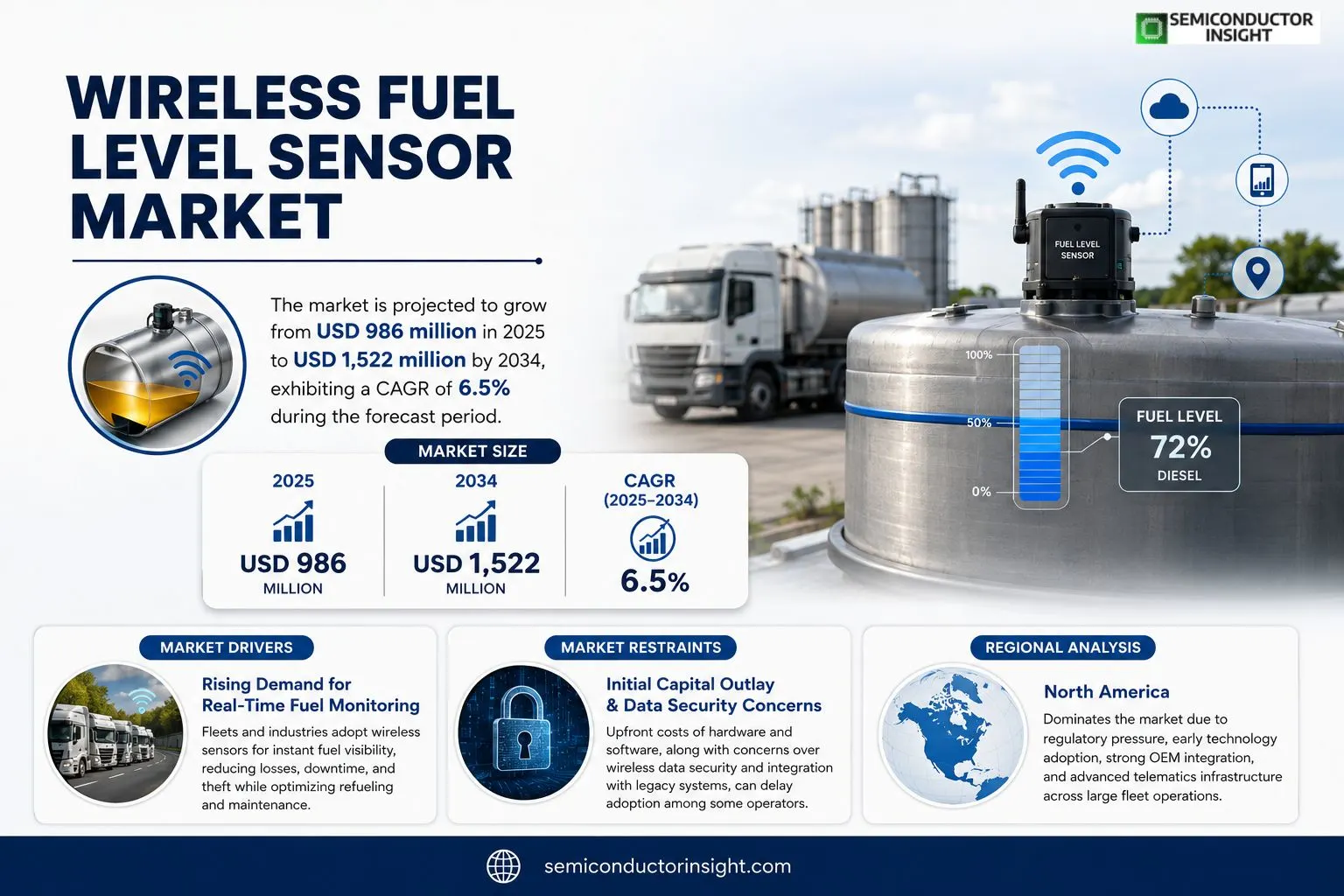
MARKET DRIVERS
Rising Demand for Real‑Time Fuel Monitoring
Operators of logistics and construction fleets are prioritising immediate visibility into fuel consumption. Wireless Fuel Level Sensor Market solutions enable remote readouts, eliminating manual checks and reducing downtime. The ability to pinpoint leaks or abnormal draw rates translates directly into cost avoidance, a compelling reason for accelerated procurement.
Regulatory Pressure on Emissions
Legislation targeting fuel efficiency and greenhouse‑gas reporting has tightened across North America and Europe. Companies facing mandatory audit trails now view wireless sensors as essential compliance tools, because they generate verifiable usage logs without operator intervention.
➤ “The shift toward telematics has turned fuel data from a peripheral metric into a core performance indicator.”
Beyond compliance, the data stream feeds predictive maintenance platforms, allowing service schedules to be optimized based on actual consumption patterns. This synergy between sensor data and analytics is reshaping budgeting cycles for fleet managers.
MARKET CHALLENGES
Interoperability with Legacy Systems
Many enterprises still rely on analog gauges or proprietary telematics that lack open APIs. Integrating wireless fuel sensors into these environments often requires custom middleware, inflating implementation costs and extending rollout timelines.
Other Challenges
Signal Reliability in Harsh Environments
Industrial sites with metal enclosures, high electromagnetic interference, or extreme temperatures can degrade radio performance, prompting users to revert to wired alternatives for critical assets.
MARKET RESTRAINTS
Initial Capital Outlay
Although operating expenses decline after deployment, the upfront purchase price of sensor packages, gateway hardware, and supporting software licenses remains a barrier for small and mid‑sized operators. Budget cycles that prioritize immediate ROI can delay adoption.
Data Security Concerns
Wireless transmission introduces potential vectors for unauthorized access. Firms handling sensitive fuel‑usage data must invest in encryption and secure cloud platforms, adding another layer of complexity that some stakeholders view as a deterrent.
MARKET OPPORTUNITIES
Expansion into Renewable Fuel Monitoring
As biodiesel, ethanol, and hydrogen blends gain market share, the need for sensors capable of accurately measuring mixed‑fuel levels is emerging. Vendors that adapt their wireless platforms to handle varied densities and chemical properties can capture a nascent segment poised for rapid uptake.
Integration with Fleet‑wide IoT Ecosystems
Developers are now bundling fuel sensors with GPS, engine diagnostics, and driver behavior modules into unified dashboards. This holistic approach creates cross‑sell opportunities and positions wireless fuel level technology as a cornerstone of next‑generation fleet management solutions.
Wireless Fuel Level Sensor Market Trends
Increasing Adoption of Remote Fuel Management
Wireless Fuel Level Sensor Market is seeing a clear move toward cloud‑connected fleet operations. Operators of delivery trucks, construction equipment, and power generation assets are demanding instantaneous fuel data to curb loss, optimise refuelling routes, and align inventory with production schedules. Real‑time telemetry reduces the latency between a low‑fuel alarm and a dispatch decision, translating into measurable cost avoidance. In 2025 the sector produced roughly 18 million sensor units at an average price of US$60, delivering a gross margin near 35 %. This cost structure, combined with the ability to embed sensors into existing tank designs, makes the technology financially attractive for mid‑size logistics firms that previously relied on manual gauging. The cumulative effect is a steady uplift in unit shipments, which in turn fuels ancillary services such as analytics platforms and predictive‑maintenance contracts.
Other Trends
Supply‑Chain Consolidation
Upstream manufacturers are merging chip‑fabrication capabilities with wireless‑module expertise to tighten control over component lead times. The resulting vertical integration shortens the cycle from design to production, allowing suppliers to respond faster to spikes in demand from seasonal freight peaks. Down‑stream, a handful of large distributors now bundle sensors with telematics software, creating a one‑stop offering that simplifies procurement for enterprise customers. This consolidation reduces the number of intermediaries, which can improve pricing transparency and accelerate the rollout of new sensor generations across multinational fleets.
Shift Toward Non‑Invasive Sensing Technologies
Customers are gradually preferring non‑invasive ultrasonic and capacitive solutions over invasive designs because they avoid tank modifications and lower installation risk. Non‑invasive units can be retrofitted to existing tanks without draining fuel, a benefit that resonates strongly with regulated industries where downtime is costly. The trend is reinforced by advances in signal‑processing algorithms that now achieve accuracy comparable to invasive counterparts. As more operators adopt these quieter, easier‑to‑install sensors, manufacturers are reallocating R&D budgets toward improving battery life and enhancing wireless security protocols, thereby extending the functional lifespan of each deployment.
COMPETITIVE LANDSCAPE
Key Industry Players
Wireless Fuel Level Sensor Market Competitive Landscape Overview
Technoton dominates the upper tier of the wireless fuel level sensor arena, leveraging a broad ultrasonic portfolio that caters to both heavy‑duty fleet operators and remote energy storage sites. The firm’s ability to integrate sensor chips, low‑power radio modules and ruggedized housings on a single production line has allowed it to sustain a margin around 35% while scaling output beyond 200,000 units per annum per line. Recent movessuch as the acquisition of a micro‑processor specialist in Eastern Europe and the rollout of a cloud‑based analytics platformhave deepened its value proposition beyond raw measurement into predictive refueling and theft‑mitigation services. These strategic layers not only lock in existing customers but also create cross‑sell opportunities into adjacent telematics suites, reinforcing Technoton’s position as the market’s de‑facto benchmark.Beyond the headline leader, a cluster of midsize innovators shapes the market’s breadth. Omnicomm and VAMOSYS focus on compact, cost‑effective designs for the automotive aftermarket, while Dolphin targets high‑temperature industrial tanks with specialty casings. Pictor Telematics and Gill Sensors excel in non‑invasive installation, appealing to operators seeking minimal retro‑fit disruption. European‑based RCS Ltd and Metromatics command strong footholds in the EU logistics sector through localized support networks. Invendis Technologies and Ruptela emphasize seamless integration with fleet‑management software, a differentiator that resonates with logistics firms pursuing end‑to‑end visibility. Asian entrants such as Beijing XT IOT Technology and ITALON LLC are rapidly expanding distribution across China and India, leveraging domestic supply chains to undercut premium pricing. Finally, broader technology groupsTrimble, Laird Technologies and Sensataare entering the space via strategic partnerships, signalling a widening competitive perimeter that could reshape pricing dynamics and accelerate innovation cycles.
List of Key Wireless Fuel Level Sensor Companies Profiled
- Technoton
- Omnicomm
- VAMOSYS
- Dolphin
- Pictor Telematics
- Gill Sensors
- RCS Ltd
- Invendis Technologies
- Metromatics
- Ruptela
- ITALON LLC
- Beijing XT IOT Technology Co., Ltd.
- Trimble Inc.
- Laird Technologies
- Sensata Technologies
Segment Analysis:
| Segment Category | Sub-Segments | Key Insights |
| By Type |
|
Ultrasonic Sensors
|
| By Application |
|
Fleet Management
|
| By End User |
|
Logistics Companies
|
| By Installation Method |
|
Non‑invasive
|
| By Sensor Principle |
|
Radar / Microwave Reflection
|
Regional Analysis: Wireless Fuel Level Sensor Market
North America
Federal and provincial agencies have tightened fuel‑consumption reporting, prompting logistics firms to install wireless sensors that feed data directly into compliance dashboards. The regulatory environment acts as a catalyst, shortening the decision cycle for technology procurement.
Advances in low‑power Bluetooth and LTE‑M have resolved earlier concerns about battery life and connectivity range, enabling sensors to operate reliably across diverse fleet sizes without extensive infrastructure upgrades.
Major OEMs now embed sensor modules during assembly, while aftermarket providers offer plug‑and‑play kits. This dual‑track approach creates a seamless path from new‑vehicle rollout to legacy‑fleet conversion.
A steady stream of venture capital into telematics firms fuels rapid prototype development, encouraging larger players to partner with startups and accelerate market penetration.
Europe
European carriers are responding to a patchwork of emissions directives that vary by nation yet share a common goal of reducing fuel burn. Operators view wireless fuel level sensors as a pragmatic way to quantify inefficiencies and justify route‑optimization initiatives. While the continent lags behind North America in OEM‑driven integration, a growing number of retrofit projects in the United Kingdom and Germany suggest a gradual shift toward broader deployment. Collaborative standards bodies are also harmonizing communication protocols, which should ease cross‑border sensor interoperability and lower adoption barriers for multinational fleets. The combined effect of policy pressure and emerging interoperability standards positions Europe as a burgeoning market with considerable upside potential.
Asia‑Pacific
The Asia‑Pacific region presents a heterogeneous landscape, with rapidly expanding logistics networks in China and India juxtaposed against more mature economies in Japan and Australia. In the high‑growth markets, cost sensitivity drives interest in low‑cost sensor solutions that still deliver actionable data. Meanwhile, Japanese manufacturers are experimenting with integrated wireless modules in commercial vehicles, leveraging their reputation for precision engineering. The region’s emphasis on digital transformation within supply‑chain management is prompting larger shippers to pilot sensor deployments that can feed into broader IoT ecosystems. Although regulatory impetus is less pronounced than in Western markets, the sheer scale of fleet expansion creates a fertile ground for Wireless Fuel Level Sensor Market to gain traction.
South America
South American operators are increasingly aware of the financial impact of fuel leakage and inaccurate gauging, especially in remote transport corridors. In Brazil and Argentina, diesel price volatility has heightened the appeal of technologies that can deliver real‑time consumption visibility. Local distributors are partnering with sensor vendors to offer bundled solutions that include data analytics platforms, addressing the region’s demand for end‑to‑end visibility. Infrastructure constraints, such as limited cellular coverage in rural zones, are encouraging the exploration of alternative communication bands, prompting vendors to adapt their designs. These adaptations, combined with a rising focus on operational efficiency, suggest a modest yet steady expansion of the market in the southern cone.
Middle East & Africa
In the Middle East, oil‑rich economies are diversifying away from hydrocarbon dependence, and logistics firms are seeking efficiency tools to remain competitive. Wireless fuel level sensors are being trialed in road‑hauling fleets that operate across vast desert routes, where traditional fuel gauging can be unreliable. Africa’s fragmented market is characterized by a mix of imported vehicles and locally assembled units, prompting a need for flexible sensor solutions that can retrofit a variety of chassis. Partnerships between regional telecom providers and sensor manufacturers aim to overcome connectivity gaps, enabling data transmission even in low‑coverage areas. Collectively, these developments point to a nascent but strategically important segment for Wireless Fuel Level Sensor Market.
Report Scope
This market research report provides a comprehensive analysis of the Wireless Fuel Level Sensor Market , covering the forecast period 2026–2034. It offers detailed insights into market dynamics, technological advancements, competitive landscape, and key trends shaping the industry.
Key focus areas of the report include:
- Market Overview: The report begins with an overview outlining its current market scenario, key growth indicators, and industry transformation drivers. It discusses macroeconomic factors, demand–supply balance, regulatory landscape, and the strategic role of semiconductors in powering advancements across industries such as automotive, telecommunications, consumer electronics, and industrial automation.
- Market Size & Forecast: Historical data and future projections for revenue, unit shipments, and market value across major regions and segments.
- Segmentation Analysis: Detailed breakdown by product type, technology, application, and end-user industry to identify high-growth segments and investment opportunities.
- Regional Insights: Insights into market performance across North America, Europe, Asia-Pacific, Latin America, and the Middle East & Africa, including country-level analysis where relevant.
- Competitive Landscape: Profiles of leading market participants, including their product offerings, R&D focus, manufacturing capacity, pricing strategies, and recent developments such as mergers, acquisitions, and partnerships.
- Technology Trends & Innovation: Assessment of emerging technologies, integration of AI/IoT, semiconductor design trends, fabrication techniques, and evolving industry standards.
- Market Drivers & Restraints: Evaluation of factors driving market growth along with challenges, supply chain constraints, regulatory issues, and market-entry barriers.
- Stakeholder Insights: Insights for component suppliers, OEMs, system integrators, investors, and policymakers regarding the evolving ecosystem and strategic opportunities.
Primary and secondary research methods are employed, including interviews with industry experts, data from verified sources, and real-time market intelligence to ensure the accuracy and reliability of the insights presented.
FREQUENTLY ASKED QUESTIONS:
What is the current market size of Wireless Fuel Level Sensor Market?
-> Wireless Fuel Level Sensor Market was valued at USD 986 million in 2025 and is expected to reach USD 1522 million by 2034.
Which key companies operate in Wireless Fuel Level Sensor Market?
-> Key players include Technoton, Omnicomm, VAMOSYS, Dolphin, Pictor Telematics, Gill Sensors, RCS Ltd, Invendis Technologies, Metromatics, Ruptela, etc.
What are the key growth drivers?
-> Key growth drivers include the increasing demand for remote, real‑time fuel inventory monitoring in fleet logistics, industrial assets, and energy facilities, as well as the need to mitigate fuel theft, cost overruns, and operational disruptions.
Which region dominates the market?
-> The report highlights strong market activity in both North America and Asia, with the United States and China representing the largest individual country markets, though a single dominant region is not explicitly defined.
What are the emerging trends?
-> Emerging trends include integration of wireless sensors with IoT platforms, AI‑driven predictive maintenance, and advanced data analytics to transform fuel assets into transparent, digitally managed nodes.

Get Sample Report PDF for Exclusive Insights
Report Sample Includes
- Table of Contents
- List of Tables & Figures
- Charts, Research Methodology, and more...
 Download Sample Report PDF