ECoG Electrodes Market Insights
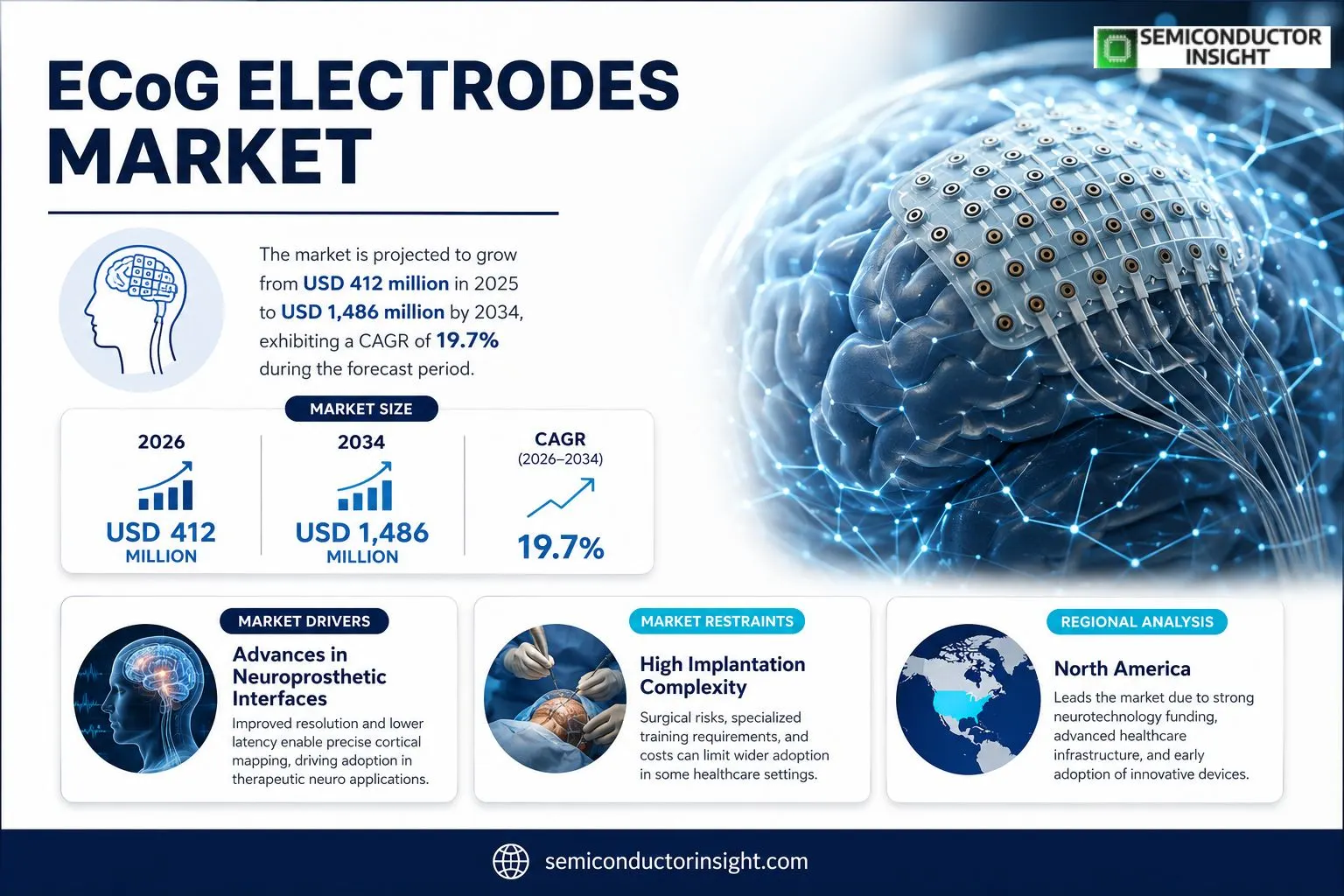
ECoG Electrodes market was valued at USD 412 million in 2025 and is forecasted to reach USD 1,486 million by 2034, reflecting a compound annual growth rate of 19.7 % over the period.
ECoG Electrodes are sensors that record electrical activity directly from the surface of the cerebral cortex. Unlike EEG, which captures signals through the scalp, these electrodes are placed subdurally or epidurally, providing higher spatial and temporal resolution for neural signals. They are widely employed for clinical monitoring such as epilepsy assessment and support research on brain‑computer interfaces.The upward trajectory stems from growing clinical demand for precise seizure mapping and heightened investment in neurotechnology platforms that require high‑fidelity cortical recordings.
MARKET DRIVERS
Advances in Neuroprosthetic Interfaces
The integration of electrocorticography (ECoG) electrodes into next‑generation neuroprosthetic systems has created a compelling value proposition for both clinicians and device manufacturers. Higher spatial resolution and reduced latency compared with surface EEG enable more precise mapping of cortical activity, which translates into improved therapeutic outcomes for patients with movement disorders. This technical edge encourages hospitals to allocate capital toward upgraded implantation suites.
Regulatory Favorability
Recent revisions of medical device guidelines across major jurisdictions have streamlined the approval pathway for implantable ECoG platforms. By clarifying safety benchmarks and post‑market surveillance expectations, regulators have lowered entry barriers for innovators. Accelerated market access boosts investor confidence and prompts early‑stage companies to pursue commercialization strategies.
➤ “Clinicians are opting for ECoG over traditional depth electrodes when the procedural risk profile aligns with patient needs.”
Hospitals that adopt these electrodes benefit from reduced procedure times and lower incidence of infection, factors that improve overall cost efficiency. As reimbursement frameworks evolve to recognize the clinical advantages of ECoG, provider networks are likely to embed the technology into standard neurosurgical protocols.
MARKET CHALLENGES
Technical Integration Complexity
Embedding ECoG arrays within existing neurosurgical workflows demands specialized training and customized instrumentation. The learning curve for electrophysiologists can delay rollout, especially in smaller centers that lack dedicated neuro‑engineering teams. Resource‑intensive training programs elevate upfront expenditures, tempering the speed of adoption.
Other Challenges
Supply Chain Vulnerabilities
The production of high‑precision micro‑fabricated electrodes relies on a limited pool of semiconductor foundries. Disruptionswhether geopolitical or pandemic‑relatedcan create lead‑time extensions that ripple through implant schedules. Manufacturers must therefore invest in dual‑source strategies to mitigate bottlenecks.
MARKET RESTRAINTS
Cost Sensitivity in Emerging Regions
While high‑income markets readily absorb premium pricing for advanced neuro‑monitoring tools, many emerging economies remain price‑averse. The capital outlay for surgical suites equipped for ECoG implantation can limit penetration, especially when public health budgets prioritize more prevalent conditions. Affordability constraints therefore act as a ceiling on market breadth.Reimbursement schemes in several countries still classify ECoG procedures under experimental categories, resulting in limited coverage. Without clear pathways for insurance reimbursement, hospitals may deem the technology financially untenable.Furthermore, the long‑term durability of flexible electrode substrates under chronic implantation is an area of ongoing research. Concerns over device lifespan can deter adopters seeking proven, low‑maintenance solutions.
MARKET OPPORTUNITIES
Personalized Neurotherapy Platforms
The convergence of artificial intelligence with high‑fidelity ECoG data opens avenues for patient‑specific therapeutic algorithms. Companies that harness real‑time cortical signatures to tailor stimulation parameters stand to capture a niche yet expanding segment of the market. Data‑driven personalization promises enhanced efficacy, which can justify premium pricing models.Another promising frontier lies in hybrid devices that combine ECoG recording with drug‑delivery mechanisms. Such integrated solutions could address refractory epilepsy by offering simultaneous monitoring and localized pharmacotherapy, differentiating providers in a competitive landscape.Strategic collaborations between electrode manufacturers and software firms are likely to accelerate innovation cycles. Joint ventures that share R&D costs while combining hardware expertise with analytics platforms can lower barriers to market entry and create differentiated product portfolios.
ECoG Electrodes Market Trends
Shift Toward Flexible, Minimally‑Invasive Designs
The ECoG Electrodes Market is witnessing a migration from rigid platinum‑grid arrays toward polymer‑based, bendable constructs that conform to cortical contours. Engineers have leveraged advances in biocompatible silicones and thin‑film deposition to produce strips that can be introduced through small burr holes, reducing operative time and patient discomfort. Clinicians value the higher spatial fidelity of these flexible grids while retaining the safety margin afforded by sub‑dural placement. This design evolution is accelerating adoption in epilepsy monitoring suites and is opening pathways for routine use in functional mapping during tumor resections. For manufacturers, the transition translates into a need for new tooling and quality‑control protocols, but also creates a pricing premium that supports the current gross‑margin level of roughly 32 %.
Other Trends
Supply‑Chain Consolidation and Raw‑Material Pricing
The upstream segment of the ECoG Electrodes Market remains anchored by precious‑metal suppliers and specialty polymer manufacturers. Recent volatility in platinum spot prices prompted several mid‑size producers to negotiate long‑term contracts, smoothing cost fluctuations and protecting margin. At the same time, a handful of large component distributors have acquired niche polymer firms, streamlining the flow of flexible substrates into assembly lines. This consolidation reduces lead times for new product launches and affords smaller players access to economies of scale that were previously reserved for the top five revenue generators, who together accounted for roughly one‑third of sales in 2025.
Expansion of Brain‑Computer Interface (BCI) Applications
Beyond traditional clinical roles, the ECoG Electrodes Market is being reshaped by the growing interest in high‑bandwidth BCIs for communication and motor‑restoration research. Universities and private labs are scaling pilot studies that require arrays with electrode densities exceeding 1,000 contacts per cm², a specification that only flexible µECoG platforms can meet. Funding streams from both governmental neuroscience programs and venture‑backed neuro‑tech startups are driving demand for prototype batches, nudging manufacturers to adopt modular production cells that can switch between clinical‑grade and research‑grade specifications with minimal re‑tooling. The commercial implication is a bifurcated product portfolio: legacy clinical grids maintain a steady revenue base, while a fast‑moving research line offers higher margin per unit as customers accept premium pricing for cutting‑edge performance.
COMPETITIVE LANDSCAPE
Key Industry Players
ECoG Electrodes Market: Competitive Structure and Player Dynamics
The market is anchored by a handful of firms that command the majority of revenue and dictate technology standards. NeuroNexus Technologies, headquartered in the United States, leads with a portfolio that spans high‑density micro‑ECoG grids and flexible strip assemblies, enabling both clinical monitoring and advanced brain‑computer interface research. Its aggressive investment in polymer‑based substrates has lowered unit costs while preserving biocompatibility, allowing the company to capture a sizable share of the 0.13 M units produced in 2025. The firm’s vertical integrationfrom raw‑material sourcing of platinum and gold to in‑house ASIC developmentcreates a margin advantage that pressures midsize manufacturers to specialize or form strategic alliances. Adjacent to NeuroNexus, G.Tec Medical Engineering GmbH and Blackrock Neurotech together hold a substantial portion of the European and North‑American premium segments, where demand for ultra‑high‑resolution cortical mapping drives pricing power. The overall structure resembles a tiered hierarchy: a dominant tier of three to four leaders, a second tier of well‑capitalized regional players, and a peripheral group of niche innovators focused on emerging form‑factors such as μECoG and minimally invasive depth electrodes.Beyond the top tier, a diverse set of companies sustains market depth by targeting specific application niches or by leveraging unique manufacturing capabilities. NeuroOne Medical Technologies Corporation has carved out a reputation for reliable subdural strip systems, favored by epilepsy monitoring units for their ease of implantation. MicroProbes for Life Science and Ripple Neuro specialize in custom‑shaped grid electrodes that support pre‑clinical neuroscience studies, providing a pipeline of data that fuels downstream BCI ventures. PMT Corporation and Integra LifeSciences Holdings Corporation supply integrated acquisition platforms that bundle connectors, amplifiers, and software, thereby differentiating on system‑level value rather than electrode geometry alone. Smaller innovators such as CorTec GmbH, Natus Medical Incorporated, and Inomed Medizintechnik GmbH focus on flexible polymer‑based arrays that promise reduced scar tissue formation, an attribute increasingly valued by neurosurgeons exploring chronic implant scenarios. This spread of capabilities ensures that even as the market scales toward the projected $1.486 billion in 2034, competitive pressures will remain multifaceted, compelling incumbents to pursue incremental innovations while newcomers exploit emerging clinical and research niches.
List of Key ECoG Electrodes Companies Profiled
- NeuroNexus Technologies
- G.Tec Medical Engineering GmbH
- Blackrock Neurotech
- NeuroOne Medical Technologies Corporation
- MicroProbes For Life Science
- Ripple Neuro
- PMT Corporation
- Integra LifeSciences Holdings Corporation
- CorTec GmbH
- Natus Medical Incorporated
- Inomed Medizintechnik GmbH
- Spike Neuro
- Neurosoft Bioelectronics
- Precision Neuroscience
- Paradromics Inc
Segment Analysis:
| Segment Category | Sub-Segments | Key Insights |
| By Type |
|
Grid Electrodes
|
| By Application |
|
Neurosurgery
|
| By End User |
|
Research Laboratories
|
| By Material |
|
Polymer‑based Flexible Electrodes
|
| By Placement |
|
Subdural Electrodes
|
Regional Analysis: ECoG Electrodes Market
North America
The FDA’s guidance on invasive neural devices promotes a risk‑based approach, encouraging manufacturers to demonstrate safety through targeted pre‑clinical studies. This clarity reduces time‑to‑market for incremental electrode improvements, encouraging a steady pipeline of refined products.
Payers are adjusting coverage policies to reflect the clinical benefits of high‑resolution cortical mapping, linking procedural codes to outcomes such as reduced seizure recurrence. This shift improves hospital willingness to invest in ECoG systems.
Boston and San Francisco host clusters of start‑ups and research institutes that specialize in flexible substrate electrodes, creating a fertile environment for cross‑disciplinary collaboration and rapid prototyping.
Surgeons are increasingly valuing real‑time electrophysiological feedback to delineate functional cortex, especially in epilepsy surgery, which drives demand for electrodes that combine high channel density with biocompatible materials.
Europe
European nations benefit from coordinated health‑technology assessments that streamline market entry for ECoG devices meeting CE marking criteria. Multinational neuro‑research consortia, particularly in Germany and the United Kingdom, foster joint development programs, blending academic expertise with industrial scaling capabilities. Health‑care systems that emphasize cost‑effectiveness are adopting electrode solutions that promise shorter surgical times and fewer postoperative complications, creating a niche for manufacturers that can demonstrate both clinical and economic value. The region’s emphasis on data privacy also shapes device design, encouraging manufacturers to integrate secure data handling within their platforms.
Asia‑Pacific
The Asia‑Pacific landscape is characterized by rapid urbanization of tertiary hospitals and a growing emphasis on precision neuroscience. Countries such as Japan, South Korea, and Singapore have established national guidelines for intra‑operative monitoring, nudging hospitals toward modern ECoG systems. Investment in domestic R&D is rising, with several biotechnology clusters emerging in Shanghai and Bangalore, where cost‑sensitive manufacturing meets innovative electrode geometries. While reimbursement frameworks are still evolving, public‑private partnerships are piloting programs that highlight the long‑term savings associated with improved surgical accuracy.
South America
In South America, leading health‑care providers in Brazil and Chile are beginning to incorporate electrocorticography into specialized epilepsy centers. The regional market is shaped by a combination of emerging private hospital networks and government initiatives aimed at expanding neurosurgical capacity. Procurement decisions often hinge on bundled pricing models, prompting vendors to offer comprehensive service packages that include training and post‑sale support. Local academic institutions are increasingly participating in clinical trials, providing a pathway for the region to adopt international best practices.
Middle East & Africa
Middle East and Africa exhibit a heterogeneous market, with the Gulf Cooperation Council states investing heavily in state‑of‑the‑art medical facilities. These hospitals seek high‑performance ECoG electrodes to differentiate themselves as regional centers of excellence. In contrast, many African nations face constraints in specialist workforce availability, leading to a slower diffusion of advanced neuro‑monitoring technologies. International NGOs and regional training programs are beginning to address this gap, introducing pilot projects that demonstrate the clinical benefits of precise cortical mapping, which could catalyze broader adoption in the coming years.
Report Scope
This market research report provides a comprehensive analysis of the ECoG Electrodes Market , covering the forecast period 2026–2034. It offers detailed insights into market dynamics, technological advancements, competitive landscape, and key trends shaping the industry.
Key focus areas of the report include:
- Market Overview: The report begins with an overview outlining its current market scenario, key growth indicators, and industry transformation drivers. It discusses macroeconomic factors, demand–supply balance, regulatory landscape, and the strategic role of semiconductors in powering advancements across industries such as automotive, telecommunications, consumer electronics, and industrial automation.
- Market Size & Forecast: Historical data and future projections for revenue, unit shipments, and market value across major regions and segments.
- Segmentation Analysis: Detailed breakdown by product type, technology, application, and end-user industry to identify high-growth segments and investment opportunities.
- Regional Insights: Insights into market performance across North America, Europe, Asia-Pacific, Latin America, and the Middle East & Africa, including country-level analysis where relevant.
- Competitive Landscape: Profiles of leading market participants, including their product offerings, R&D focus, manufacturing capacity, pricing strategies, and recent developments such as mergers, acquisitions, and partnerships.
- Technology Trends & Innovation: Assessment of emerging technologies, integration of AI/IoT, semiconductor design trends, fabrication techniques, and evolving industry standards.
- Market Drivers & Restraints: Evaluation of factors driving market growth along with challenges, supply chain constraints, regulatory issues, and market-entry barriers.
- Stakeholder Insights: Insights for component suppliers, OEMs, system integrators, investors, and policymakers regarding the evolving ecosystem and strategic opportunities.
Primary and secondary research methods are employed, including interviews with industry experts, data from verified sources, and real-time market intelligence to ensure the accuracy and reliability of the insights presented.
FREQUENTLY ASKED QUESTIONS:
What is the current market size of ECoG Electrodes Market?
-> ECoG Electrodes Market was valued at USD 412 million in 2025 and is expected to reach USD 1,486 million by 2034, growing at a CAGR of 19.7% during the forecast period.
Which key companies operate in ECoG Electrodes Market?
-> Key players include NeuroNexus Technologies, G.Tec Medical Engineering GmbH, Blackrock Neurotech, NeuroOne Medical Technologies Corporation, MicroProbes For Life Science, Ripple Neuro, AdTech Medical Instrument Corporation, PMT Corporation, Integra LifeSciences Holdings Corporation, CorTec GmbH, among others.
What are the key growth drivers?
-> Key growth drivers include advancements in flexible and minimally invasive electrode designs, increasing demand for high‑resolution brain‑computer interface research, expanding clinical applications such as epilepsy monitoring, and scalable manufacturing capabilities that reduce unit costs.
Which region dominates the market?
-> North America dominates the market, with the United States contributing the largest revenue share, while Asia‑Pacific, particularly China, shows rapid growth potential.
What are the emerging trends?
-> Emerging trends include development of polymer‑based flexible grids, high‑density micro‑ECoG (µECoG) arrays, integration with AI‑driven signal processing platforms, and expanding BCI applications in neurorehabilitation.
Get Sample Report PDF for Exclusive Insights
Report Sample Includes
- Table of Contents
- List of Tables & Figures
- Charts, Research Methodology, and more...
 Download Sample Report PDF