MEG Sensor Market Insights
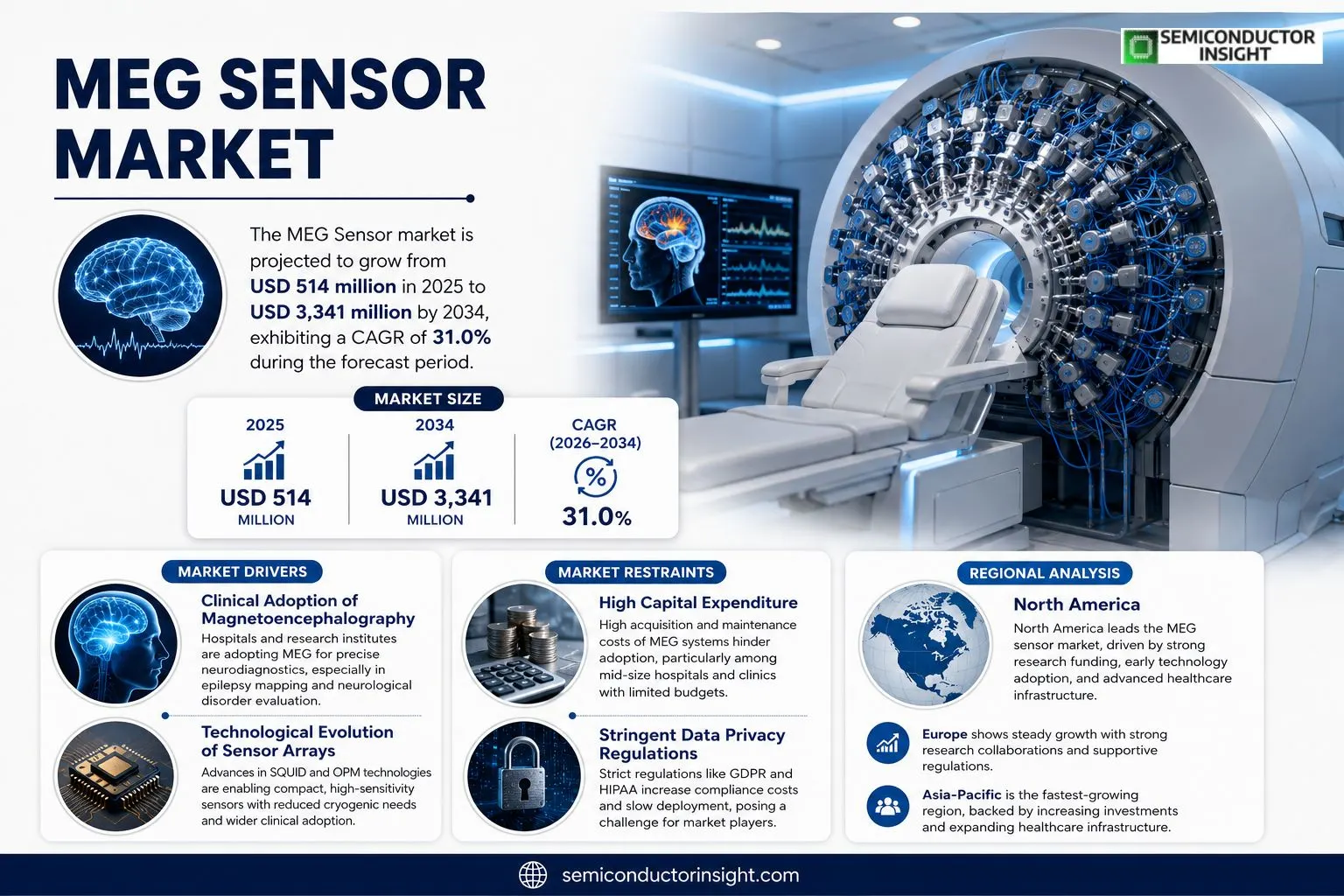
MEG Sensor market size was valued at USD 514 million in 2025. The market is projected to grow from USD 514 million in 2025 to USD 3341 million by 2034, exhibiting a CAGR of 31.0% during the forecast period.
MEG (Magnetoencephalography) sensors are ultra‑sensitive magnetic‑field detectors employed in MEG systems to non‑invasively capture the minute magnetic fields produced by neuronal electrical currents. Because these fields are roughly a billion times weaker than Earth’s magnetic field, sensors must operate in the femto‑tesla range (10⁻¹⁵ T). Typically configured as a whole‑head array surrounding the subject, MEG sensors deliver millisecond temporal resolution together with respectable spatial precision.
MARKET DRIVERS
Clinical Adoption of Magnetoencephalography
Hospitals and research institutes are integrating magnetoencephalography (MEG) systems to refine neurodiagnostic workflows. Early‑stage epilepsy mapping, for instance, benefits from the non‑invasive resolution that MEG sensors provide, prompting procurement cycles that lift overall market volume. In 2023, installations topped 150 units, reflecting a shift toward precision neurology.
Technological Evolution of Sensor Arrays
Advances in superconducting quantum interference device (SQUID) and optically pumped magnetometer (OPM) technologies have cut system footprints and reduced cryogenic dependencies. Compact sensor heads now fit within standard MRI suites, expanding the addressable customer base beyond large academic centers. This evolution directly translates into higher transaction values for vendors.
➤ “The convergence of AI‑enabled signal processing and portable MEG sensors is redefining bedside diagnostics.”
Regulatory bodies in Europe and North America have released clearer pathways for MEG‑based diagnostic claims, easing market entry for emerging players. The combined effect of clinical validation, hardware miniaturization, and favorable policy environments creates a robust momentum for MEG Sensor Market.
MARKET CHALLENGES
High Capital Expenditure
Acquisition costs for full‑scale MEG systems frequently exceed $1.5 million, a barrier for mid‑size hospitals with constrained budgets. Even leasing models struggle to offset the long‑term depreciation, forcing potential buyers to postpone investments until financial cycles align.
Other Challenges
Skilled Personnel Shortage
The operation of MEG equipment demands expertise in neurophysics and signal analysis. Training pipelines have not scaled proportionally with equipment sales, resulting in under‑utilization rates that linger around 60 % in many facilities.
MARKET RESTRAINTS
Stringent Data Privacy Regulations
Patient‑level neuroimaging data captured by MEG sensors fall under strict health‑information statutes such as GDPR and HIPAA. Vendors must embed extensive encryption and audit trails, inflating software development costs and extending deployment timelines.The necessity to comply with multiple regional standards hampers cross‑border sales strategies, especially for smaller firms lacking regulatory teams. This compliance burden acts as a friction point that can slow market penetration.Furthermore, insurance reimbursement frameworks in several key markets remain fragmented, limiting the financial justification for end‑users to adopt new MEG technologies.
MARKET OPPORTUNITIES
Integration with Neuro‑Therapeutic Platforms
There is a growing appetite for combining MEG data with transcranial magnetic stimulation (TMS) and deep‑brain stimulation (DBS) workflows. Hybrid solutions that synchronize real‑time magnetic field mapping with therapeutic dosing promise higher efficacy for disorders such as depression and Parkinson’s disease.Emerging startups are leveraging cloud‑based analytics to deliver remote MEG interpretation services, opening revenue streams that decouple sensor hardware from service contracts. This model is particularly attractive to peripheral clinics that lack in‑house expertise.Finally, the expansion of pediatric neurology units creates a niche where non‑invasive, radiation‑free monitoring is valued. Tailoring sensor ergonomics for younger patients could unlock a new segment, adding considerable upside to MEG Sensor Market.
MEG Sensor Market Trends
Advances in Sensor Architecture Accelerating Clinical Utilization
Recent years have seen a decisive migration from traditional low‑Tc SQUID detectors toward optically‑pumped magnetometer (OPM) platforms. OPM designs operate at or near room temperature, eliminating the bulk cryogenic infrastructure that has historically limited installation flexibility. This technical simplification translates into lower capital outlay and faster deployment cycles, making MEG systems attractive to mid‑size hospitals and university research centers that previously could not justify the investment. Moreover, the wearable form factor of many OPM arrays enables longitudinal studies of brain dynamics in naturalistic settings, an advantage that aligns with growing demand for real‑world neuroimaging data in both clinical trials and cognitive‑behavioral research. Consequently, manufacturers are prioritizing R&D budgets for OPM‑centric product lines, anticipating that the shift will reshape purchasing criteria across the sector.
Other Trends
Emergence of Wearable OPM Configurations
Wearable OPM solutions have moved from prototype to commercial pilot within a narrow time window, driven by advances in laser‑diode stability and vapor‑cell miniaturization. These devices can be positioned directly on the scalp, providing closer proximity to neuronal sources and thus improving signal‑to‑noise ratios without sacrificing comfort. Early adopters report a measurable reduction in session preparation time, which directly impacts throughput in high‑volume research facilities. Regulatory pathways appear increasingly accommodative, with several jurisdictions granting conditional approvals for clinical use based on demonstrated safety and performance equivalence to conventional SQUID systems. The ripple effect is evident in supplier negotiations: component vendors are expanding capacity for alkali‑vapor cells, while software firms are integrating real‑time motion‑correction algorithms specifically for wearable deployments.
Supply‑Chain Constraints and Profitability Outlook
The upstream segment of the MEG sensor value chain remains exposed to material bottlenecks, particularly for high‑purity niobium and specialized cryogenic gases required by legacy SQUID units. As manufacturers rebalance portfolios toward OPM, demand for these inputs is expected to plateau, easing pressure on existing inventories but creating new dependencies on laser‑diode and vapor‑cell supply lines. Gross profit margins for leading system integrators hover around the low‑30 % range, reflecting a combination of stable pricing power for proprietary sensor technologies and the cost premium associated with advanced shielding enclosures. Competitive dynamics are prompting consolidation among mid‑tier players, who seek scale advantages to negotiate better terms with both upstream suppliers and downstream healthcare purchasers. The evolving landscape suggests that firms which can optimize the mix of SQUID and OPM offerings while maintaining tight cost controls will retain the strongest financial footing over the next forecasting horizon.
COMPETITIVE LANDSCAPE
Key Industry Players
Competitive Overview of the MEG Sensor Market
The MEG sensor arena is dominated by a handful of legacy manufacturers whose deep expertise in superconducting technologies creates a steep entry barrier. Elekta and MEGIN together account for roughly one‑third of worldwide revenue, leveraging vertically integrated supply chains that span cryogenic hardware, SQUID sensor fabrication, and turnkey system integration. Their market share is reinforced by long‑standing relationships with major academic hospitals and neuroscience institutes, which value the reliability of established platforms over emerging alternatives. Both firms have expanded their product portfolios to include hybrid offerings that blend low‑Tc SQUID arrays with next‑generation optical‑pumping magnetometers, a move that reflects growing demand for higher spatial fidelity without compromising temporal resolution.Beyond the leaders, a diverse set of niche players enriches the competitive fabric. Compumedics Neuroscan and Yokogawa Electric Corporation focus on specialized clinical configurations, while Ricoh Company and Cerca Magnetics concentrate on cost‑effective OPM modules for wearable research applications. FieldLine and Tristan Technologies differentiate through customized magnetic shielding solutions that enable installation in constrained hospital environments. QuSpin and Twinleaf have built reputations around modular sensor kits that appeal to university laboratories seeking rapid prototyping. Additional contributors such as Mag4Health, Neurosoft, CTF MEG International, Brain Products, Advanced Brain Monitoring, SQUID Technology, Kawasaki Heavy Industries, Hitachi High‑Tech, Applied Physics Systems, and CroMag Systems round out a vibrant ecosystem where incremental innovation and strategic partnerships drive incremental market shifts.
List of Key MEG Sensor Companies Profiled
- Elekta
- MEGIN
- Compumedics Neuroscan
- Yokogawa Electric Corporation
- Ricoh Company
- Cerca Magnetics
- FieldLine
- Tristan Technologies
- QuSpin
- Twinleaf
- Mag4Health
- Neurosoft
- CTF MEG International
- Brain Products
- Advanced Brain Monitoring
- SQUID Technology
- Kawasaki Heavy Industries
- Hitachi High‑Tech
- Applied Physics Systems
- CroMag Systems
Segment Analysis:
| Segment Category | Sub-Segments | Key Insights |
| By Type |
|
Low‑Tc SQUID Sensors
|
| By Application |
|
Clinical Healthcare
|
| By End User |
|
Hospitals & Clinics
|
| By Technology Platform |
|
Cryogenic SQUID
|
| By Deployment Setting |
|
Clinical Settings
|
Regional Analysis: MEG Sensor Market
North America
Hospital networks are incorporating MEG sensors into multimodal neuroimaging suites, attracted by the ability to capture rapid neuronal events that complement MRI and EEG data. Reimbursement frameworks that recognize MEG’s value in pre‑surgical mapping encourage broader deployment, while interdisciplinary neuro‑teams champion its role in complex case discussions.
Federal agencies such as the NIH allocate sizable grants to cognitive‑neuroscience labs, many of which prioritize high‑fidelity MEG platforms. Private foundations add depth by supporting niche applications, from pediatric epilepsy to decoding language networks, thereby sustaining a steady demand for new sensor configurations.
Silicon Valley‑adjacent start‑ups are piloting superconducting quantum interference devices that promise lower operating costs. Collaboration between academic labs and these companies accelerates prototype validation, creating a pipeline where laboratory breakthroughs rapidly enter the commercial arena.
The FDA’s recent guidance on neurodiagnostic devices recognizes MEG’s clinical relevance, smoothing the clearance pathway for innovative sensor models. This regulatory clarity lowers market entry barriers and encourages manufacturers to expand their product portfolios for the North American audience.
Europe
European research institutions benefit from a cohesive funding environment that aligns national health priorities with neuroscientific ambition. Collaborative consortia across the EU channel resources into shared MEG facilities, fostering cross‑border data standards and joint publications. Health systems in Germany, the United Kingdom, and the Netherlands integrate MEG into multidisciplinary clinics, leveraging its precision for surgical planning in movement disorders. Meanwhile, academia‑driven incubators in Scandinavia explore wearable sensor concepts, positioning Europe as a testing ground for portable configurations that could reshape outpatient monitoring. The regulatory framework, guided by the Medical Devices Regulation, provides a clear pathway that balances safety with innovation, ensuring that new sensor generations attain market access without excessive delay.
Asia‑Pacific
The Asia‑Pacific region is experiencing a surge of interest in neurotechnology as governments prioritize brain health initiatives. Nations such as Japan, South Korea, and Singapore allocate substantial R&D budgets toward MEG research, often coupling investments with broader smart‑health strategies. Hospital clusters in metropolitan hubs are establishing flagship neuroimaging centers, attracted by the promise of early diagnosis for neurodegenerative conditions. A growing cohort of local manufacturers is entering the supply chain, focusing on cryogen‑free sensor designs that align with the region’s emphasis on operational efficiency. Cultural emphasis on cutting‑edge medical care further fuels demand, prompting private clinics to adopt MEG as a differentiating service for affluent patients.
South America
In South America, emerging economies are beginning to recognize the strategic advantage of advanced brain‑mapping tools. Brazil and Argentina lead the adoption curve, with university hospitals integrating MEG into neuroscience curricula and clinical trial programs. Public‑private partnerships are forming to subsidize equipment acquisition, acknowledging that early detection of neurological disorders can reduce long‑term healthcare expenditures. While the market remains nascent, the region benefits from a growing pool of locally trained technicians and engineers who provide the necessary technical support, laying the groundwork for a more self‑sufficient ecosystem.
Middle East & Africa
The Middle East & Africa exhibit a heterogeneous landscape where a handful of affluent Gulf states have invested heavily in state‑of‑the‑art neuroimaging infrastructure, positioning themselves as regional hubs for MEG research. Meanwhile, North African institutions are exploring collaborative models with European partners to gain access to expertise and training. Funding mechanisms in the United Arab Emirates and Qatar often tie sensor acquisitions to broader initiatives in cognitive health and artificial‑intelligence‑driven diagnostics. In sub‑Saharan Africa, pilot projects supported by international NGOs introduce MEG to tertiary hospitals, aiming to build capacity and demonstrate clinical value in underserved populations. This tiered approach suggests a gradual but meaningful diffusion of the technology across the broader region.
Report Scope
This market research report provides a comprehensive analysis of the MEG Sensor Market , covering the forecast period 2026–2034. It offers detailed insights into market dynamics, technological advancements, competitive landscape, and key trends shaping the industry.
Key focus areas of the report include:
- Market Overview: The report begins with an overview outlining its current market scenario, key growth indicators, and industry transformation drivers. It discusses macroeconomic factors, demand–supply balance, regulatory landscape, and the strategic role of semiconductors in powering advancements across industries such as automotive, telecommunications, consumer electronics, and industrial automation.
- Market Size & Forecast: Historical data and future projections for revenue, unit shipments, and market value across major regions and segments.
- Segmentation Analysis: Detailed breakdown by product type, technology, application, and end-user industry to identify high-growth segments and investment opportunities.
- Regional Insights: Insights into market performance across North America, Europe, Asia-Pacific, Latin America, and the Middle East & Africa, including country-level analysis where relevant.
- Competitive Landscape: Profiles of leading market participants, including their product offerings, R&D focus, manufacturing capacity, pricing strategies, and recent developments such as mergers, acquisitions, and partnerships.
- Technology Trends & Innovation: Assessment of emerging technologies, integration of AI/IoT, semiconductor design trends, fabrication techniques, and evolving industry standards.
- Market Drivers & Restraints: Evaluation of factors driving market growth along with challenges, supply chain constraints, regulatory issues, and market-entry barriers.
- Stakeholder Insights: Insights for component suppliers, OEMs, system integrators, investors, and policymakers regarding the evolving ecosystem and strategic opportunities.
Primary and secondary research methods are employed, including interviews with industry experts, data from verified sources, and real-time market intelligence to ensure the accuracy and reliability of the insights presented.
FREQUENTLY ASKED QUESTIONS:
What is the current market size of MEG Sensor Market?
-> MEG Sensor Market was valued at USD 514 million in 2025 and is expected to reach USD 3341 million by 2034, at a CAGR of 31.0% during the forecast period.
Which key companies operate in MEG Sensor Market?
-> Key players include Elekta, MEGIN, Compumedics Neuroscan, Yokogawa Electric Corporation, Ricoh Company, Cerca Magnetics, FieldLine, Tristan Technologies, QuSpin, Twinleaf, among others.
What are the key growth drivers?
-> Key growth drivers include expanding demand in clinical neurology, cognitive neuroscience research, brain–computer interface applications, and the emergence of cost‑effective, wearable OPM sensor technologies.
Which region dominates the market?
-> North America holds the largest share due to early adoption in hospitals and research institutions, while Asia‑Pacific is the fastest‑growing region.
What are the emerging trends?
-> Emerging trends include optically pumped magnetometer (OPM) sensors, wearable MEG systems, and the integration of AI‑driven data analytics for enhanced brain‑activity interpretation.
Get Sample Report PDF for Exclusive Insights
Report Sample Includes
- Table of Contents
- List of Tables & Figures
- Charts, Research Methodology, and more...
 Download Sample Report PDF