Breath Alcohol Sensor Market Insights
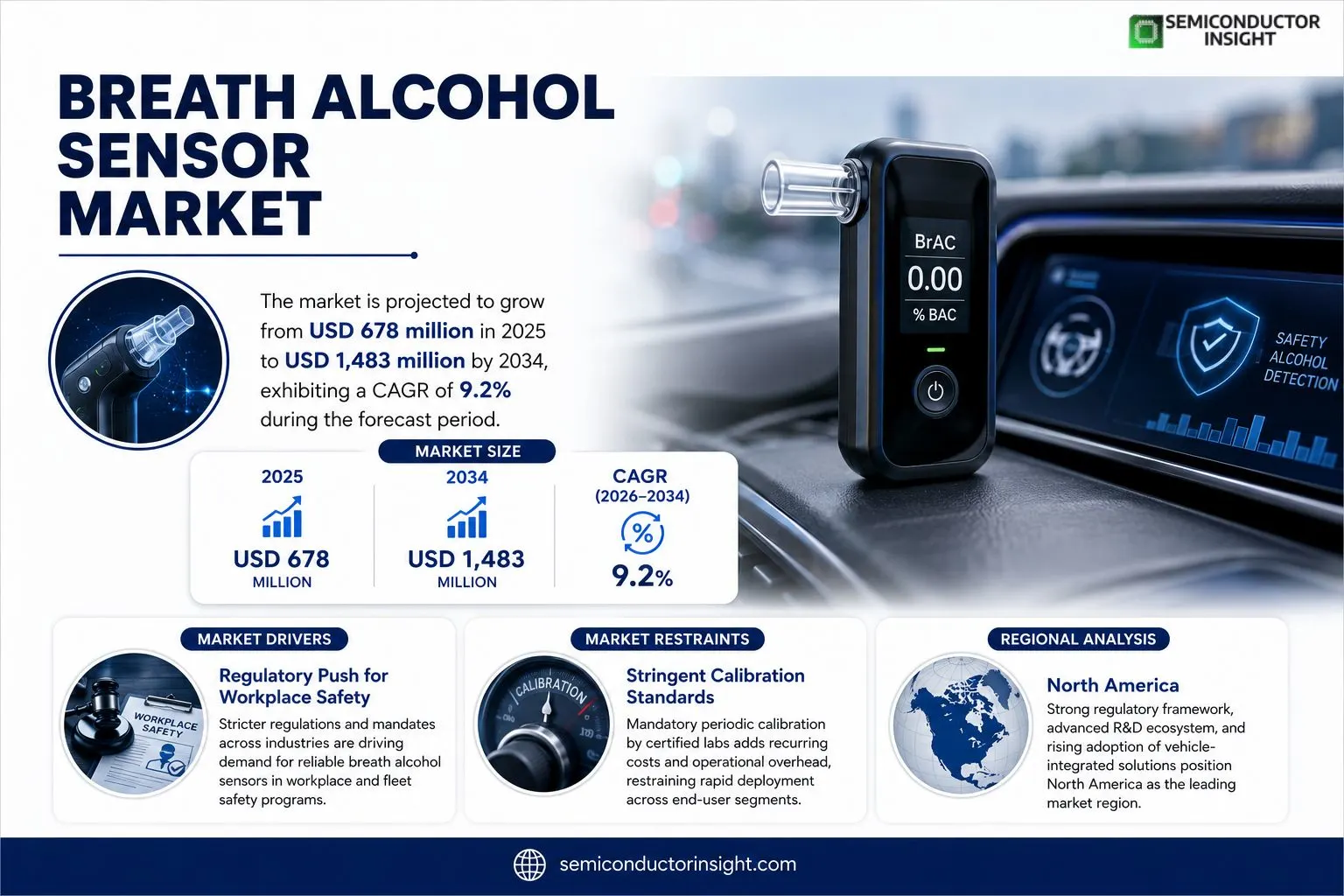
Breath Alcohol Sensor market size was valued at USD 678 million in 2025. The market is projected to grow from USD 678 million in 2025 to USD 1,483 million by 2034, exhibiting a CAGR of approximately 9.2% during the forecast period.
A Breath Alcohol Sensor is a chemical or optical sensing device that detects and quantifies ethanol vapor in human exhaled breath to estimate breath‑alcohol concentration (BrAC), which correlates with blood‑alcohol concentration (BAC). These sensors form the core element of breathalyzers, ignition‑interlock systems, workplace screening tools, and emerging vehicle‑integrated alcohol detection solutions.
MARKET DRIVERS
Regulatory Push for Workplace Safety
Recent amendments to occupational health statutes across North America and Europe have mandated continuous monitoring of alcohol exposure for safety‑critical roles. Companies are therefore allocating budget to replace legacy breath‑testing kits with electronic Breath Alcohol Sensor Market solutions that deliver instant, auditable results.
Increasing Consumer Awareness of Impairment Risks
Surveys indicate that more than 68% of drivers consider real‑time alcohol feedback a decisive factor when choosing a vehicle. This sentiment fuels demand for aftermarket sensors that integrate with infotainment systems, prompting OEMs to embed sensor modules during the design phase.
➤ “Device miniaturization combined with cloud‑based analytics is reshaping how personal intoxication data is collected and acted upon,” notes a senior analyst.
Manufacturers are capitalizing on these pressures by offering modular platforms that can be retrofitted to existing fleets, creating a revenue stream that spans hardware sales, subscription analytics, and service contracts within Breath Alcohol Sensor Market.
MARKET CHALLENGES
Technical Accuracy Limits
Although sensor chemistries have improved, cross‑sensitivity to acetone and humidity remains a source of false positives, especially in outdoor environments. This technical hurdle forces end‑users to maintain redundant verification procedures, slowing adoption in high‑throughput settings.
Other Challenges
Cost Sensitivity
Mid‑range manufacturers struggle to price advanced spectroscopic modules below $120 per unit, a level that many small‑to‑medium enterprises deem prohibitive for routine deployment.
MARKET RESTRAINTS
Stringent Calibration Standards
Regulators in several jurisdictions stipulate quarterly calibration cycles verified by accredited labs. The operational overhead of maintaining calibrated fleets adds a recurring cost that counters the projected savings from accident reduction, tempering enthusiasm for rapid rollout.
MARKET OPPORTUNITIES
Emerging Wearable Platforms
Integration of breath alcohol sensors into smart watches and health bands presents a frontier with untapped commercial potential. Early pilots demonstrate that continuous, passive monitoring can feed directly into employer wellness dashboards, opening subscription‑based revenue models that extend beyond the traditional hardware sale.Furthermore, the convergence of low‑power MEMS technology and 5G connectivity enables real‑time data transmission to centralized risk‑management platforms, positioning Breath Alcohol Sensor Market to capture value from both safety compliance and personal health monitoring segments.
Breath Alcohol Sensor Market Trends
Shift Toward Integrated Vehicle‑Mounted Sensors
Automakers are moving from handheld breathalyzers to embedded detection modules that operate passively while the driver is seated. The push stems from emerging safety regulations that demand continuous monitoring rather than intermittent checks. Engineers are prioritising sensor packages that tolerate temperature swings, humidity, and residual mouth alcohol, because false positives jeopardise user acceptance. Cost pressure is reshaping the bill‑of‑materials: a typical unit sells for around $28, so manufacturers must balance price with the added value of on‑board diagnostics and OTA calibration. The net effect is a race to deliver automotive‑grade reliability at a volume‑friendly price point, a development that will reshape sourcing strategies and partnership models across the supply chain.
Other Trends
Margin Divergence Across Sensor Technologies
Metal‑oxide semiconductor (MOS) devices remain the workhorse for low‑cost applications, achieving gross margins in the 20‑35 % band thanks to inexpensive ceramic substrates and high‑volume packaging. In contrast, fuel‑cell modules command 35‑55 % margins, reflecting the cost of precious‑metal catalysts, membrane assemblies and rigorous calibration protocols required for law‑enforcement use. The emerging non‑dispersive infrared (NDIR) family, which relies on optical links and sophisticated algorithms, can push margins to 40‑60 % once automotive‑grade verification is completed. However, the higher margin is offset by longer engineering cycles and the need for platform‑level integration, meaning that vendors must invest heavily upfront before realizing returns.
Regulatory Pressure Fuels Demand for High‑Reliability Solutions
Enforcement agencies continue to tighten zero‑tolerance policies for commercial fleets and public‑transport operators. This regulatory thrust translates into repeat orders for fuel‑cell sensors, whose certification pathways are well‑established for high‑stakes environments such as ignition‑interlock systems. Simultaneously, the United States National Highway Traffic Safety Administration (NHTSA) is drafting rules for “advanced drunk‑driving prevention technology,” a move that is likely to expand sensor deployment from handheld devices to vehicle‑level safety architectures. As compliance requirements tighten, manufacturers that can demonstrate long‑term drift stability, anti‑interference robustness, and streamlined calibration will secure the most lucrative contracts, prompting a shift in competitive focus from pure price competition to differentiated performance guarantees.
COMPETITIVE LANDSCAPE
Key Industry Players
Breath Alcohol Sensor Competitive Overview
Honeywell, Dräger and Intoximeters together command the bulk of the fuel‑cell and semiconductor sensor business. Their dominance stems from deep‑rooted relationships with law‑enforcement agencies, fleet operators and OEMs that embed sensors into ignition‑interlock and vehicle‑integrated platforms. These firms leverage certified manufacturing processes, extensive calibration service networks and scale‑driven pricing to protect high‑margin segments, while also offering bundled software for drift compensation and remote auditing. The market exhibits a classic “two‑tier” structure: a handful of capital‑intensive players occupy the high‑reliability, premium‑price zone, whereas a broader set of manufacturers compete on cost in the MOS semiconductor space, where gross margins typically linger between 20 % and 35 %.Beyond the three titans, a constellation of niche innovators fuels diversification. Dart Sensors and Winsen supply low‑cost MOS modules to handheld screening devices, while Hanwei and Figaro Engineering specialize in compact optical designs for consumer‑grade breathalyzers. Senseair, Membrapor and Amphenol SGX Sensortech have carved out automotive‑grade NDIR and hybrid solutions that address temperature‑stability and integration latency. Alphasense and Fuel Cell Sensors concentrate on calibration‑intensive fuel‑cell kits for critical safety applications. Lifeloc Technologies, BACtrack, Alcolizer Technology, Andatech and several regional firms provide vertical‑specific variantssuch as workplace safety meters, portable police equipment and emerging passive sniffing unitsthereby expanding the ecosystem without directly challenging the market leaders’ core contracts.
List of Key Breath Alcohol Sensor Companies Profiled
- Honeywell
- Dräger
- Intoximeters
- Dart Sensors
- Winsen
- Hanwei
- Senseair
- Figaro Engineering
- Membrapor
- Amphenol SGX Sensortech
- Alphasense
- Fuel Cell Sensors
- Lifeloc Technologies
- BACtrack
- Alcolizer Technology
- Andatech
Segment Analysis:
| Segment Category | Sub-Segments | Key Insights |
| By Type |
|
Fuel Cell emerges as the premium segment driven by stringent law‑enforcement requirements and the need for high‑reliability interlock systems.
|
| By Application |
|
Road Traffic Safety dominates because of mandatory breath‑test equipment for police checkpoints and growing deployment of vehicle‑integrated passive detection.
|
| By End User |
|
Law Enforcement remains the most demanding end‑user, requiring sensors that deliver uncompromising accuracy and rapid response.
|
| By Signal Output |
|
Digital is gaining traction as system integrators prioritize seamless communication with vehicle networks and cloud‑based monitoring.
|
| By Sampling Method |
|
Passive Sniffing is emerging as a strategic differentiator for vehicle‑integrated solutions and discreet personal devices.
|
Regional Analysis: Breath Alcohol Sensor Market
North America
Federal statutes require interlock devices on high‑risk drivers, prompting OEMs to embed breath sensors early in vehicle design cycles. State‑level incentives for commercial fleets further tighten adoption timelines, nudging suppliers toward pre‑certified modules that meet ASTM standards.
Automotive manufacturers are integrating sensors into infotainment consoles, leveraging low‑power MEMS platforms. Simultaneously, consumer electronics brands experiment with wrist‑worn devices that offer real‑time breath analysis for personal health monitoring.
Established sensor firms capitalize on legacy calibration expertise, while agile start‑ups differentiate through AI‑driven signal processing. Partnerships with chipset producers are becoming a decisive factor for market share acquisition.
End users increasingly value discreet form factors and rapid response times. Brand loyalty is shifting toward providers that can bundle sensor hardware with mobile analytics platforms that offer actionable feedback.
Europe
European markets exhibit a nuanced blend of stringent emission regulations and a cultural emphasis on road safety, influencing Breath Alcohol Sensor Market to align with broader vehicle electrification trends. EU directives encourage the retrofitting of public transport fleets with alcohol detection systems, creating a demand for modular sensors adaptable to diverse power architectures. Moreover, the region’s strong data‑privacy framework mandates secure handling of biometric readings, pushing manufacturers to embed advanced encryption within sensor firmware. Companies that can navigate these legal intricacies while delivering cost‑effective solutions are poised to capture contracts with municipal transport agencies and premium automotive brands seeking compliance‑first designs.
Asia‑Pacific
The Asia‑Pacific corridor presents a heterogeneous landscape where emerging economies prioritize road‑safety initiatives alongside rapid urbanization. Governments in India and Indonesia have launched pilot programs that require breath sensors on commercial taxis, sparking interest among local suppliers in low‑cost, high‑reliability devices. Simultaneously, Japan’s mature automotive sector drives demand for ultra‑compact sensors that can be integrated into autonomous vehicle platforms. The divergent pace of regulatory adoption means that market entrants must tailor product roadmapsoffering scalable architectures for price‑sensitive markets while reserving premium features for high‑end applications.
South America
South American nations are gradually embedding breath alcohol detection within public safety campaigns, especially in Brazil where traffic fatalities remain a policy focus. Partnerships between regional automakers and sensor manufacturers are emerging to localize production, reducing import dependencies and aligning product specifications with local climate conditions. The market’s evolution is closely tied to governmental subsidies for fleet upgrades, which incentivize adoption among logistics firms. Players that can provide robust calibration services and after‑sales support in Spanish and Portuguese gain a decisive edge in securing long‑term service agreements.
Middle East & Africa
In the Middle East and Africa, Breath Alcohol Sensor Market is driven by a mix of luxury‑vehicle penetration and nascent road‑safety regulations. Gulf Cooperation Council states are experimenting with mandatory sensor installation in high‑value car rentals, creating niche opportunities for premium sensor variants with premium aesthetic finishes. African markets, conversely, focus on cost‑effective solutions for informal transport sectors, where durability under harsh temperature swings is paramount. Successful entrants will blend rugged hardware designs with flexible financing models that accommodate public‑private partnership structures aimed at reducing alcohol‑related accidents.
Report Scope
This market research report provides a comprehensive analysis of the Breath Alcohol Sensor Market , covering the forecast period 2026–2034. It offers detailed insights into market dynamics, technological advancements, competitive landscape, and key trends shaping the industry.
Key focus areas of the report include:
- Market Overview: The report begins with an overview outlining its current market scenario, key growth indicators, and industry transformation drivers. It discusses macroeconomic factors, demand–supply balance, regulatory landscape, and the strategic role of semiconductors in powering advancements across industries such as automotive, telecommunications, consumer electronics, and industrial automation.
- Market Size & Forecast: Historical data and future projections for revenue, unit shipments, and market value across major regions and segments.
- Segmentation Analysis: Detailed breakdown by product type, technology, application, and end-user industry to identify high-growth segments and investment opportunities.
- Regional Insights: Insights into market performance across North America, Europe, Asia-Pacific, Latin America, and the Middle East & Africa, including country-level analysis where relevant.
- Competitive Landscape: Profiles of leading market participants, including their product offerings, R&D focus, manufacturing capacity, pricing strategies, and recent developments such as mergers, acquisitions, and partnerships.
- Technology Trends & Innovation: Assessment of emerging technologies, integration of AI/IoT, semiconductor design trends, fabrication techniques, and evolving industry standards.
- Market Drivers & Restraints: Evaluation of factors driving market growth along with challenges, supply chain constraints, regulatory issues, and market-entry barriers.
- Stakeholder Insights: Insights for component suppliers, OEMs, system integrators, investors, and policymakers regarding the evolving ecosystem and strategic opportunities.
Primary and secondary research methods are employed, including interviews with industry experts, data from verified sources, and real-time market intelligence to ensure the accuracy and reliability of the insights presented.
FREQUENTLY ASKED QUESTIONS:
What is the current market size of Breath Alcohol Sensor Market?
-> Breath Alcohol Sensor Market was valued at USD 678 million in 2025 and is expected to reach USD 1248 million by 2032, growing at a CAGR of 9.2% during the forecast period.
Which key companies operate in Breath Alcohol Sensor Market?
-> Key players include Honeywell, Dräger, Intoximeters, Dart Sensors, Winsen, Hanwei, Figaro Engineering, Senseair, Membrapor, Amphenol SGX Sensortech, Alphasense, Fuel Cell Sensors, Lifeloc Technologies, BACtrack, Alcolizer Technology, Andatech.
What are the key growth drivers?
-> Key growth drivers include strengthening drunk‑driving regulations, expanding ignition‑interlock deployments, and advancing vehicle‑mounted passive alcohol detection technologies driven by initiatives such as the US NHTSA rule‑making process.
Which region dominates the market?
-> The report provides detailed analysis for all major regions. Historically, North America and Europe have held significant market shares, while Asia‑Pacific is emerging as a high‑growth region due to increasing automotive integration.
What are the emerging trends?
-> Emerging trends include integration of breath alcohol sensors into vehicle platforms, development of low‑drift fuel‑cell modules, and the rise of non‑contact NDIR optical sensors for automotive and handheld applications.
Get Sample Report PDF for Exclusive Insights
Report Sample Includes
- Table of Contents
- List of Tables & Figures
- Charts, Research Methodology, and more...
 Download Sample Report PDF