Rotary Encoder(Grating) Market Insights
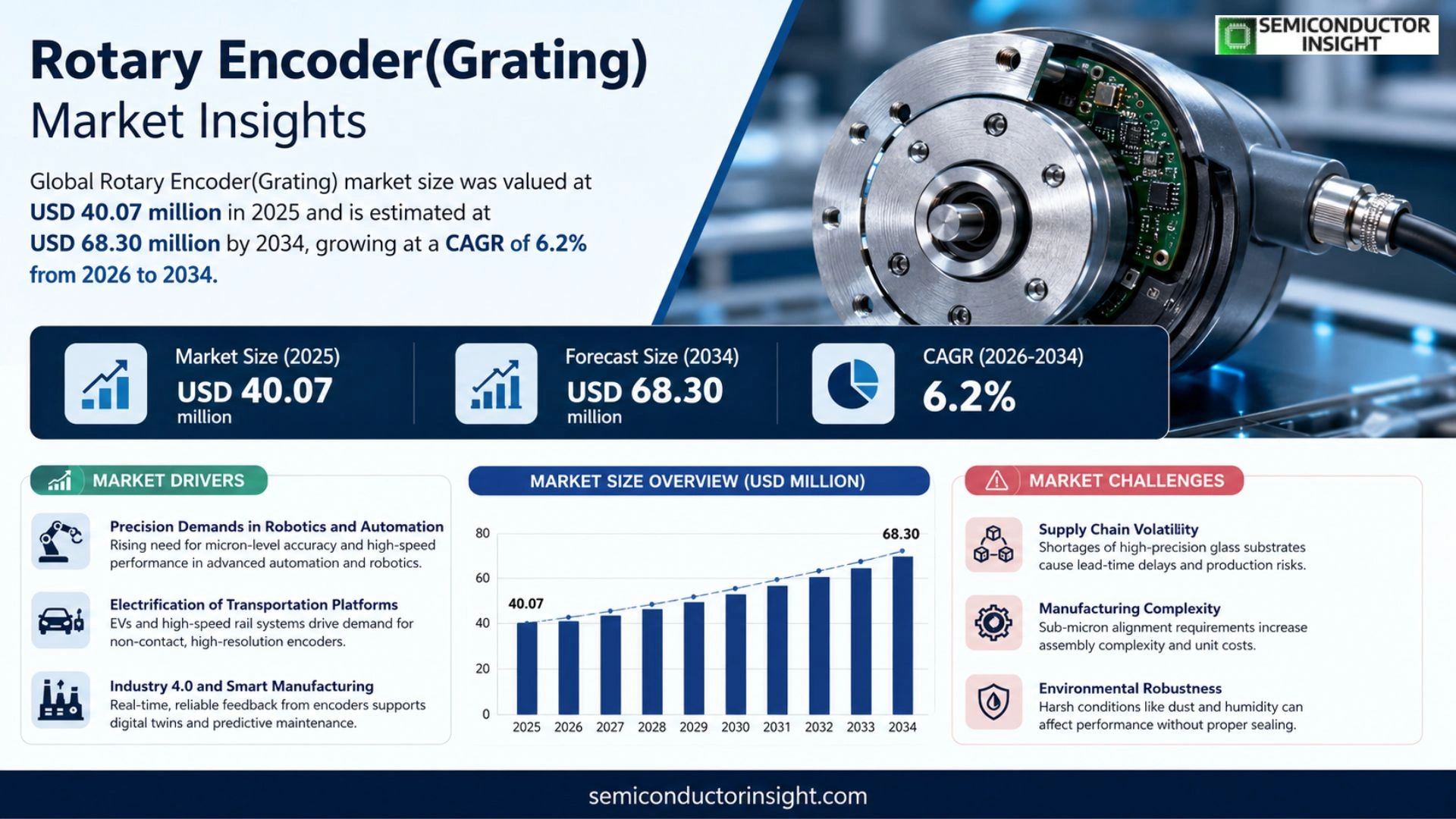
Global Rotary Encoder(Grating) market size was valued at USD 40.07 million in 2025 and is estimated at USD 68.30 million by 2034, showing an implied CAGR of approximately 6.2 % over the period.
A rotary encoder (grating) comprises a circular grating,equally spaced etched lines on glass, low‑expansion ceramic or stainless‑steel substrates,read by an optical head that translates angular displacement into precise electrical signals for motion control.
The market expands because high‑precision CNC machine tools, robotic joints and semiconductor testing equipment increasingly require sub‑micron positioning accuracy; meanwhile advances in photolithography and laser direct‑write processes lower production costs, encouraging broader adoption across automation and ultra‑precision machining sectors.
MARKET DRIVERS
Precision Demands in Robotics and Automation
Manufacturers of collaborative robots are increasingly seeking position‑feedback devices that can deliver micron‑level accuracy at high shaft speeds. Rotary Encoder(Grating) Market suppliers that can guarantee repeatability under vibration have earned preference, because even a marginal error translates into costly re‑work on assembly lines. This shift pushes vendors to refine optical grating patterns, thereby creating a virtuous cycle of product improvement and adoption.
Electrification of Transportation Platforms
Electric vehicles and high‑speed rail systems rely on motor control loops that operate continuously across a wide temperature envelope. The need for non‑contact sensing eliminates wear points, making grating‑based encoders a natural fit. OEMs are embedding these sensors directly into motor housings, which shortens wiring lengths and improves signal integrity, a development that fuels demand for higher‑resolution variants.
➤ “When every percent of efficiency counts, the industry turns to optical encoders that deliver stable, wear‑free performance,” says a senior systems engineer at a leading EV manufacturer.
Another catalyst is the rise of Industry 4.0 initiatives. Data‑rich factories demand real‑time feedback to feed digital twins; grating encoders provide the deterministic output required for predictive analytics, prompting capital budgets toward next‑generation devices.
MARKET CHALLENGES
Supply Chain Volatility
Raw‑material shortages for high‑precision glass substrates have introduced lead‑time extensions that strain project timelines. Companies that cannot secure long‑term contracts face production bottlenecks, forcing end‑users to revert to legacy magnetic encoders despite their lower accuracy.
Other Challenges
Manufacturing Complexity
The alignment of optical gratings to the shaft axis demands sub‑micron tolerances during assembly. Even minor deviations can degrade signal quality, increasing scrap rates and driving up unit costs.
Environmental Robustness
Deployments in abrasive or high‑humidity environments expose the optical surface to contaminants. Without effective sealing solutions, performance degradation accelerates, prompting customers to demand more ruggedized designs.
MARKET RESTRAINTS
Regulatory and Safety Standards
Certification regimes for safety‑critical applications,such as aerospace and medical devices,impose stringent validation procedures. Achieving compliance often requires extensive testing cycles, which inflates development costs and slows product launches.
Moreover, the increasing emphasis on cybersecurity in connected equipment leads to additional firmware encryption requirements for encoder interfaces. Providers that cannot integrate these safeguards risk exclusion from OEM procurement lists.
MARKET OPPORTUNITIES
Emerging Applications in Additive Manufacturing
Additive‑manufacturing machines are moving toward closed‑loop control to achieve tighter dimensional tolerances. Integrating grating‑based rotary encoders into turntables and extruder heads enables real‑time angular monitoring, a capability that is currently underexploited.
Simultaneously, the growth of smart‑grid technologies creates a niche for rugged encoders that can survive outdoor installations while delivering high‑resolution feedback for turbine governors. Companies that tailor their product lines to these sectors stand to capture incremental revenue streams.
Finally, the convergence of AI‑driven fault detection with encoder data offers a pathway to value‑added services. By packaging analytics platforms with the hardware, vendors can transition from one‑off sales to recurring‑revenue models.
Rotary Encoder(Grating) Market Trends
Rising Demand in Precision Automation
In 2025, production of circular gratings reached 23,440 units at an average price of $1,872, yielding a market valuation of $40.07 million. The combination of tighter tolerances in CNC machine tools and the surge of collaborative robots has translated into stronger orders for high‑resolution encoders. Customers are replacing legacy analog feedback loops with optical grating solutions because the latter provide repeatability on the order of a few arc‑seconds, a capability that directly improves surface‑finish quality and cycle‑time efficiency. The margin envelope of 35‑50 % encourages manufacturers to invest in incremental capacity, especially in regions where substrate material costs remain competitive.
Other Trends
Supply Chain Consolidation
Upstream suppliers of low‑expansion glass and stainless‑steel strips have begun to form strategic alliances with photolithography equipment makers. This alignment reduces lead‑time for custom grating patterns and eases the calibration burden for midstream fabricators. As a result, the overall bill‑of‑materials cost per unit has fallen by roughly 4 % since 2022, freeing budget for higher‑grade coating processes that boost thermal stability,a critical parameter for servo‑driven rotary tables operating in harsh industrial environments.
Emerging Opportunities in Semiconductor Equipment
The semiconductor fabrication sector is increasingly reliant on sub‑nanometer positioning, and circular gratings have become the preferred feedback element for wafer‑handle robots and lithography stage movers. The 2025 rollout of next‑generation extreme‑ultraviolet (EUV) tools amplified demand for encoders capable of delivering sub‑microradian angular accuracy. Companies such as Renishaw and Zeiss are extending their product portfolios to include hybrid optical‑magnetic designs, a move that reflects both customer pressure for ultra‑low jitter and the manufacturers’ desire to capture a larger share of the $60.58 million forecast for 2032.
COMPETITIVE LANDSCAPE
Key Industry Players
Rotary Encoder (Grating) Market Competitive Overview
Renishaw continues to dominate the global rotary‑encoder (grating) ecosystem, leveraging its deep expertise in precision optics and a vertically integrated supply chain that spans substrate preparation, photolithography, and final calibration. The company’s ability to deliver tightly‑toleranced glass and low‑expansion metal gratings at scale has translated into a stable revenue base and a pricing premium that sustains gross margins in the upper‑mid‑30 % range. Renishaw’s strong relationships with motion‑control system integrators and OEMs of CNC machines, robotics, and semiconductor test rigs reinforce its position as a preferred supplier, while recent investments in automated inspection stations have reduced lead times and heightened confidence among downstream manufacturers.
Beyond the market leader, a cohort of specialized firms occupies meaningful niches. Zeiss and Heidenhain focus on ultra‑precision gratings for high‑end metrology, whereas RLS and Precilec target cost‑sensitive robot‑joint applications with stainless‑steel and polymer substrates. LAMOTION and Agico Technology (Shenzhen) have built regional strength in Asia by coupling local production of laser‑direct‑written gratings with aggressive service contracts. Emerging challengers such as Mahr, Keyence, and SICK AG are expanding into the encoder space through acquisitions of smaller optics houses, adding breadth to their sensor portfolios. Meanwhile, Panasonic, Schneider Electric, and Pepperl+Fuchs diversify their motion‑control offerings by bundling encoders with proprietary drive electronics, creating bundled value propositions for machine‑tool manufacturers.
List of Key Rotary Encoder (Grating) Companies Profiled
- Renishaw
- Zeiss
- RLS
- Precilec
- LAMOTION
- Agico Technology (Shenzhen)
- Heidenhain
- Mahr
- Keyence
- SICK AG
- Panasonic
- Schneider Electric
- Pepperl+Fuchs
- Jiaxing Jierun
- Yokogawa
Segment Analysis:
| Segment Category | Sub-Segments | Key Insights |
| By Type |
|
Optical Grating Encoders – pivotal for high‑resolution feedback in precision motion control. • Deliver exceptionally fine angular resolution, enabling ultra‑precise positioning in CNC and robotic systems. • Provide inherent resistance to electromagnetic disturbances, enhancing reliability in harsh industrial environments. • Facilitate straightforward integration with existing servo‑control electronics, reducing system complexity. |
| By Application |
|
CNC Machine Tools – the dominant application driving adoption. • Enable sub‑micron positioning accuracy critical for complex part machining. • Support high‑speed spindle rotation while maintaining consistent feedback quality. • Integrated seamlessly with advanced control software, fostering automation and reduced setup time. |
| By End User |
|
Machine Tool Manufacturers – primary consumers of rotary grating encoders. • Seek solutions that enhance repeatability and reduce wear in high‑volume production. • Value long‑term calibration stability, minimizing downtime for re‑qualification. • Prioritize vendors offering comprehensive support and customization for diverse tool architectures. |
| By Geometry |
|
Disc Gratings – most widely adopted geometry. • Provide a balance of fabrication simplicity and high line density, supporting fine resolution. • Compatible with both compact and large‑diameter rotary platforms, offering design flexibility. • Easier to calibrate using standard optical metrology tools, reducing integration effort. |
| By Region |
|
Asia‑Pacific – emerging hub for advanced manufacturing adoption. • Rapid expansion of semiconductor fabs and robotics drives heightened demand for precision encoders. • Local suppliers are investing in ultra‑precision lithography capabilities, strengthening the value chain. • Growing emphasis on Industry 4.0 standards accelerates integration of high‑performance feedback devices. |
Regional Analysis: Rotary Encoder(Grating) Market
Europe
German and Italian manufacturers are retrofitting assembly robots with finer grating resolutions, which translates into tighter tolerances for engine component placement and a noticeable lift in overall plant efficiency.
The United Kingdom’s aerospace firms demand encoders that survive harsh vibration while delivering micron‑level accuracy, prompting a wave of bespoke grating designs that directly support next‑generation airframe production.
Swiss and French medical equipment makers are embedding compact encoders into imaging platforms, where the combination of low latency and high resolution improves diagnostic throughput and patient safety.
Scandinavian robotics firms are partnering with encoder suppliers to co‑develop modular grating kits, enabling rapid re‑configuration of end‑effectors for diverse production scenarios.
North America
The United States leverages its extensive industrial automation investments to drive adoption of rotary encoder (grating) solutions across semiconductor fabrication and logistics hubs. Companies in the Midwest are standardizing on high‑speed feedback loops to synchronize conveyor networks, while West Coast innovators explore integration with AI‑driven predictive maintenance platforms. The market benefits from a strong intellectual‑property ecosystem that encourages rapid prototyping, allowing manufacturers to test novel grating geometries without prolonged qualification cycles. As supply‑chain resilience becomes a strategic imperative, firms favor domestic sourcing options, reinforcing a localized value chain that supports swift component replacement and technical assistance.
Asia‑Pacific
Rapid industrialization across China, South Korea, and India fuels a surge in demand for precision motion control, positioning rotary encoder (grating) technology as a cornerstone of modern factories. Chinese producers are scaling up assembly lines for consumer electronics, where minute positioning accuracy reduces defect rates. Meanwhile, Japanese automation specialists are refining grating substrates to meet the exacting standards of high‑volume automotive paint shops. In India, emerging smart‑factory initiatives are prompting midsized manufacturers to replace legacy potentiometers with digital encoders, unlocking gains in energy consumption and operational visibility. The region’s cost‑competitive manufacturing environment, combined with a growing focus on quality standards, creates a fertile ground for technology diffusion.
South America
Brazil’s expanding food‑processing sector and Mexico’s automotive parts ecosystem are catalyzing interest in compact rotary encoder (grating) units that withstand corrosive environments and high‑temperature cycles. Local integrators emphasize ruggedized housings to match the region’s climatic challenges, while also offering after‑sales training programs that elevate technician proficiency. The gradual shift from manual to automated material‑handling systems is driving a reinterpretation of legacy motion‑control architectures, encouraging OEMs to adopt modular grating solutions that simplify retrofits and reduce capital outlay.
Middle East & Africa
In the United Arab Emirates and Saudi Arabia, oil‑field automation projects incorporate rotary encoder (grating) technology to enhance drill‑string positioning and maintain safety thresholds in harsh offshore conditions. African manufacturing hubs, particularly in South Africa, are experimenting with low‑cost encoder variants to equip assembly lines for renewable‑energy components, such as wind‑turbine gearboxes. The region’s investment in smart‑infrastructure, backed by government incentives, is prompting a cautious yet increasingly sophisticated adoption of precision encoders, with a focus on durability and long‑term support contracts.
Report Scope
This market research report provides a comprehensive analysis of the Rotary Encoder(Grating) Market , covering the forecast period 2026–2034. It offers detailed insights into market dynamics, technological advancements, competitive landscape, and key trends shaping the industry.
Key focus areas of the report include:
- Market Overview: The report begins with an overview outlining its current market scenario, key growth indicators, and industry transformation drivers. It discusses macroeconomic factors, demand–supply balance, regulatory landscape, and the strategic role of semiconductors in powering advancements across industries such as automotive, telecommunications, consumer electronics, and industrial automation.
- Market Size & Forecast: Historical data and future projections for revenue, unit shipments, and market value across major regions and segments.
- Segmentation Analysis: Detailed breakdown by product type, technology, application, and end-user industry to identify high-growth segments and investment opportunities.
- Regional Insights: Insights into market performance across North America, Europe, Asia-Pacific, Latin America, and the Middle East & Africa, including country-level analysis where relevant.
- Competitive Landscape: Profiles of leading market participants, including their product offerings, R&D focus, manufacturing capacity, pricing strategies, and recent developments such as mergers, acquisitions, and partnerships.
- Technology Trends & Innovation: Assessment of emerging technologies, integration of AI/IoT, semiconductor design trends, fabrication techniques, and evolving industry standards.
- Market Drivers & Restraints: Evaluation of factors driving market growth along with challenges, supply chain constraints, regulatory issues, and market-entry barriers.
- Stakeholder Insights: Insights for component suppliers, OEMs, system integrators, investors, and policymakers regarding the evolving ecosystem and strategic opportunities.
Primary and secondary research methods are employed, including interviews with industry experts, data from verified sources, and real-time market intelligence to ensure the accuracy and reliability of the insights presented.
FREQUENTLY ASKED QUESTIONS:
What is the current market size of Rotary Encoder(Grating) Market?
-> Rotary Encoder(Grating) Market was valued at USD 40.07 million in 2025 and is expected to reach USD 60.58 million by 2032, growing at a CAGR of 6.2% during the forecast period.
Which key companies operate in Rotary Encoder(Grating) Market?
-> Key players include Renishaw, Zeiss, RLS, Precilec, LAMOTION, Agico Technology (Shenzhen), among others.
What are the key growth drivers?
-> Key growth drivers include rising demand for high‑precision CNC machine tools, expanding robot joint applications, growth in semiconductor manufacturing and testing equipment, and the need for ultra‑precision machining and metrology solutions.
Which region dominates the market?
-> Asia (particularly China) is the dominant region, driven by strong industrial automation investments and a robust semiconductor equipment sector.
What are the emerging trends?
-> Emerging trends include integration of optical rotary encoders with AI‑enabled motion control, miniaturization for compact robotic joints, and advanced calibration techniques using high‑precision testing equipment.
Get Sample Report PDF for Exclusive Insights
Report Sample Includes
- Table of Contents
- List of Tables & Figures
- Charts, Research Methodology, and more...
 Download Sample Report PDF