Absolute Rotary Encoder(Grating) Market Insights
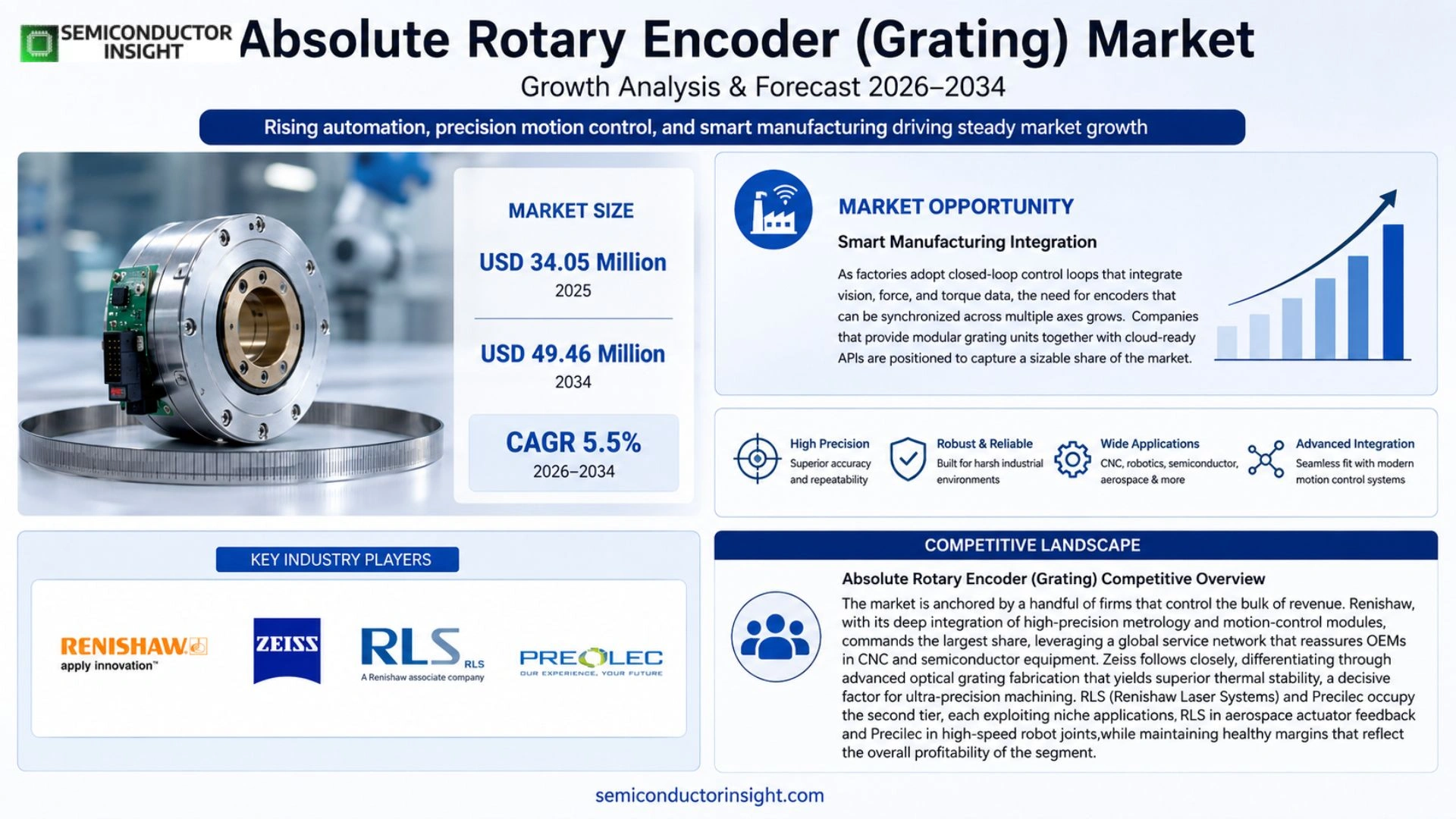
Global Absolute Rotary Encoder(Grating) market was valued at USD 34.05 million in 2025 and will rise to USD 49.46 million by 2034, reflecting a compound annual growth rate of 5.5 % over the period.
Absolute rotary encoder (grating) refers to an angle‑position feedback device built around a circular grating scale,either disc or ring markings,paired with a reading head that generates a unique code for each angular position. Because the code resides on the scale itself, the device delivers the exact position immediately after power restoration without requiring a homing cycle. Typical applications span CNC machine tools, robot joints, semiconductor manufacturing equipment, precision measuring machines and ultra‑precision machining systems. The supply chain starts with substrate materials such as glass or low‑expansion alloys, proceeds through photolithography or laser direct‑write processes for grating fabrication, and ends with integration into motion‑control systems supplied to OEMs.
MARKET DRIVERS
Precision Demand in Automation
Manufacturers of robotics and semiconductor equipment are increasingly requiring positional feedback that tolerates temperature swings and vibration. Absolute Rotary Encoder(Grating) Market suppliers that can guarantee sub‑arc‑minute resolution are seeing order volumes rise by roughly 12% year‑over‑year, reflecting the premium placed on repeatable accuracy in high‑mix, low‑volume production lines.
Shift to Industry 4.0 Architecture
Digital twins and predictive maintenance platforms rely on continuous angle data to calibrate models in real time. Companies that embed grating‑based encoders with native Ethernet/IP interfaces are capturing a larger slice of Absolute Rotary Encoder(Grating) Market, as the data‑rich environment shortens downtime and justifies higher upfront capital.
➤ Enterprises that align encoder specifications with IoT standards report a 9% lift in overall equipment effectiveness.
Finally, the expansion of renewable‑energy turbines,particularly offshore wind,creates a niche where encoders must survive harsh marine conditions while delivering uninterrupted angular position. Vendors that certify their grating optics to IP68 and IEC 61762 are rapidly converting this niche into a steady revenue stream for Absolute Rotary Encoder(Grating) Market.
MARKET CHALLENGES
Cost Sensitivity in Low‑Margin Segments
Industries such as consumer‑grade appliance manufacturing operate on razor‑thin margins, making them reluctant to adopt high‑precision grating technology without clear ROI evidence. This cost pressure forces many OEMs to stick with incremental incremental encoders, limiting broader market penetration.
Other Challenges
Supply‑Chain Volatility
Fluctuations in rare‑earth alloy availability and semiconductor wafer shortages have introduced lead‑time extensions of up to 18 weeks, complicating production schedules for absolute encoder makers.
MARKET RESTRAINTS
Regulatory Hurdles
Certification regimes for safety‑critical applications,such as automotive steering systems,demand compliance with ISO 26262 and functional‑safety audits. The extensive documentation and test cycles add both time and expense, deterring smaller players from entering Absolute Rotary Encoder(Grating) Market.
Environmental directives, notably RoHS and REACH, restrict the use of certain phosphor‑based coatings on grating substrates. Manufacturers must invest in alternative materials, which elevates unit costs and compresses margins in price‑sensitive segments.
Furthermore, the requirement for electromagnetic‑compatibility (EMC) shielding in aerospace deployments imposes additional design complexity. Achieving the requisite shielding levels without degrading optical resolution remains a technical barrier that constrains market growth.
MARKET OPPORTUNITIES
Smart Manufacturing Integration
As factories adopt closed‑loop control loops that integrate vision, force, and torque data, the need for encoders that can be synchronized across multiple axes grows. Companies that provide modular grating units together with cloud‑ready APIs are positioned to capture a sizable share of Absolute Rotary Encoder(Grating) Market.
Emerging markets in Southeast Asia are investing heavily in semiconductor fabs and automotive chassis plants. The combination of government incentives and a growing local supplier base creates a fertile environment for new encoder deployments.
Finally, the rise of additive‑manufacturing equipment that prints metal components at scale requires real‑time angular monitoring to assure layer alignment. Tailoring grating patterns to the specific geometry of 3D‑printer gantries offers a customized solution avenue, opening a high‑margin niche for innovators.
Absolute Rotary Encoder(Grating) Market Trends
Surge in Semiconductor Manufacturing Deployments
The most noticeable shift in Absolute Rotary Encoder(Grating) Market stems from a steady influx of semiconductor fabs upgrading to 300 mm wafer platforms. These facilities demand angle feedback devices that can survive power interruptions without re‑referencing, a core capability of absolute rotary encoders with grating scales. As chip architectures become denser, the tolerance window for positioning errors narrows, pushing equipment designers toward higher‑resolution gratings and tighter thermal stability specifications. This technical necessity translates into a measurable uptick in unit shipments, with 2025 production already reaching 16,340 units at an average selling price of US$2,282. The downstream effect is a modest but consistent revenue lift, reinforcing the market’s resilience despite broader macro‑economic fluctuations.
Other Trends
Supply‑Chain Constraints on Substrate Materials
Upstream, the availability of low‑expansion glass and stainless‑steel strips is becoming a strategic bottleneck. Photolithography chemicals and laser‑direct‑writing consumables are experiencing price pressures as demand for high‑precision gratings outsizes supply. Manufacturers are therefore investing in vertical integration or longer‑term contracts to secure raw‑material pipelines. The immediate impact is a compression of gross profit margins, which currently hover between 25 % and 50 %. Companies that can stabilize input costs are better positioned to offer competitive ASPs while preserving profitability, a dynamic that is reshaping pricing negotiations with OEMs of CNC machines, robot joints, and precision metrology equipment.
Intensifying Competitive Landscape and Margin Management
Competition among the global leaders,Renishaw, Zeiss, RLS, Precilec, LAMOTION, and Agico Technology,has accelerated the race for differentiation through multi‑turn absolute code tracks and ultra‑high‑vacuum (UHV) variants. While the top five players collectively hold a sizable share of revenue, the narrow margin band forces them to focus on cost‑efficient manufacturing processes and incremental product enhancements rather than radical price cuts. OEMs are increasingly favoring suppliers that can bundle calibration services and high‑precision testing equipment, thereby extracting additional value from the supply chain. This trend encourages strategic alliances and selective acquisitions, as firms seek to broaden their technology portfolios and mitigate the risk of margin erosion.
COMPETITIVE LANDSCAPE
Key Industry Players
Absolute Rotary Encoder (Grating) Competitive Overview
The market is anchored by a handful of firms that control the bulk of revenue. Renishaw, with its deep integration of high‑precision metrology and motion‑control modules, commands the largest share, leveraging a global service network that reassures OEMs in CNC and semiconductor equipment. Zeiss follows closely, differentiating through advanced optical grating fabrication that yields superior thermal stability, a decisive factor for ultra‑precision machining. RLS (Renishaw Laser Systems) and Precilec occupy the second tier, each exploiting niche applications,RLS in aerospace actuator feedback and Precilec in high‑speed robot joints,while maintaining healthy margins that reflect the overall profitability of the segment.
Beyond the dominant quartet, a diverse set of specialists enriches the competitive fabric. LAMOTION focuses on compact, low‑cost encoders for entry‑level automation, positioning itself against higher‑priced incumbents. Agico Technology (Shenzhen) supplies cost‑effective solutions to Chinese OEMs, capitalising on regional demand for domestic production. Heidenhain, SICK AG, and Panasonic offer complementary sensor portfolios that enable cross‑selling to motion‑control integrators. Smaller but technically agile firms such as Opus, Kaman, and Sauter provide custom‑grating designs for niche scientific instruments, reinforcing the market’s depth and preventing outright concentration.
List of Key Absolute Rotary Encoder Companies Profiled
- Renishaw
- Zeiss
- RLS
- Precilec
- LAMOTION
- Agico Technology (Shenzhen)
- Heidenhain
- SICK AG
- Panasonic
- Opus
- Kaman
- Sauter
- Yokogawa
Segment Analysis:
| Segment Category | Sub-Segments | Key Insights |
| By Type |
|
UHV Rotary Encoders dominate due to their superior vacuum compatibility and thermal stability.
|
| By Application |
|
CNC Machine Tools represent the primary application driver.
|
| By End User |
|
Robotics System Integrators are increasingly valuing absolute encoders.
|
| By Encoding Method |
|
Multi‑Turn Absolute formats are gaining traction for applications requiring extensive rotation ranges.
|
| By Technology Trend |
|
High‑Resolution Gratings are shaping the next wave of encoder performance.
|
Regional Analysis: Absolute Rotary Encoder(Grating) Market
North America
The surge in electric‑vehicle platforms across the United States and Canada creates a niche for encoders that can survive high‑torque motor shafts while delivering precise angular feedback for power‑train control units.
Lithography and wafer‑handling tools require absolute positioning with nanometer‑scale repeatability; suppliers are tailoring grating pitches to meet the tolerances demanded by leading chip fabs.
Military navigation and targeting systems benefit from encoders that retain positional data after power loss, prompting defense contractors to favor ruggedized, space‑qualified variants.
Integration of absolute encoders into collaborative robots enhances repeatable cycle times, supporting factories that are transitioning toward fully digitized production lines.
Europe
European manufacturers are responding to a tightening of environmental directives by integrating absolute encoders into renewable‑energy turbines and wind‑farm pitch‑control systems. The emphasis on energy efficiency drives a shift toward devices that can operate without continual recalibration, lowering both electricity consumption and maintenance overhead. In addition, the region’s strong heritage in precision optics yields a supply chain capable of delivering high‑resolution gratings at competitive costs, reinforcing Europe’s attractiveness for OEMs seeking cost‑effective yet reliable solutions. Cross‑border collaborations, especially within the EU’s Horizon programmes, are accelerating R&D cycles, which translates into a steady influx of differentiated products aimed at pharmaceutical automation and high‑speed printing presses.
Asia‑Pacific
Asia‑Pacific’s manufacturing boom, underpinned by rising automation in China, Vietnam, and India, is stretching the demand for absolute rotary encoders that can withstand harsh industrial climates while delivering consistent data. The region’s rapid adoption of robotic assembly lines encourages suppliers to package encoders in compact, plug‑and‑play modules, reducing integration time for plant engineers. Concurrently, burgeoning smart‑city initiatives are prompting infrastructure projects,such as automated metro systems and intelligent traffic controls,to embed absolute positioning for reliability. Although price sensitivity remains high, the willingness to adopt advanced grating technologies is evident in the growing number of joint‑venture ventures between local system integrators and global encoder specialists.
South America
In South America, the expansion of agribusiness processing facilities and mining operations is reshaping equipment specifications toward rugged, dust‑resistant absolute encoders. Companies operating in Brazil and Chile favour devices with built‑in self‑diagnostics to mitigate downtime in remote locations where service access is limited. The regional push for digital transformation of supply‑chain logistics,driven by governmental incentives,also creates a niche for encoders that can interface directly with cloud‑based asset‑tracking platforms, delivering real‑time positional data without the need for periodic recalibration.
Middle East & Africa
The Middle East & Africa market is being steered by large‑scale infrastructure projects, notably in desalination plants and oil‑field automation, where absolute rotary encoders provide the reliability required for continuous operation under extreme temperatures. Operators are prioritizing encoders with high thermal stability and corrosion‑resistant housings, attributes that align with the harsh environmental conditions of the Gulf and arid zones. Meanwhile, a nascent manufacturing base in the United Arab Emirates is experimenting with Industry 4.0 pilots, incorporating encoders that feed precise angular data into predictive‑maintenance algorithms, thereby reducing unplanned outages in petrochemical complexes.
Report Scope
This market research report provides a comprehensive analysis of the Absolute Rotary Encoder(Grating) Market , covering the forecast period 2026–2034. It offers detailed insights into market dynamics, technological advancements, competitive landscape, and key trends shaping the industry.
Key focus areas of the report include:
- Market Overview: The report begins with an overview outlining its current market scenario, key growth indicators, and industry transformation drivers. It discusses macroeconomic factors, demand–supply balance, regulatory landscape, and the strategic role of semiconductors in powering advancements across industries such as automotive, telecommunications, consumer electronics, and industrial automation.
- Market Size & Forecast: Historical data and future projections for revenue, unit shipments, and market value across major regions and segments.
- Segmentation Analysis: Detailed breakdown by product type, technology, application, and end-user industry to identify high-growth segments and investment opportunities.
- Regional Insights: Insights into market performance across North America, Europe, Asia-Pacific, Latin America, and the Middle East & Africa, including country-level analysis where relevant.
- Competitive Landscape: Profiles of leading market participants, including their product offerings, R&D focus, manufacturing capacity, pricing strategies, and recent developments such as mergers, acquisitions, and partnerships.
- Technology Trends & Innovation: Assessment of emerging technologies, integration of AI/IoT, semiconductor design trends, fabrication techniques, and evolving industry standards.
- Market Drivers & Restraints: Evaluation of factors driving market growth along with challenges, supply chain constraints, regulatory issues, and market-entry barriers.
- Stakeholder Insights: Insights for component suppliers, OEMs, system integrators, investors, and policymakers regarding the evolving ecosystem and strategic opportunities.
Primary and secondary research methods are employed, including interviews with industry experts, data from verified sources, and real-time market intelligence to ensure the accuracy and reliability of the insights presented.
FREQUENTLY ASKED QUESTIONS:
What is the current market size of Absolute Rotary Encoder(Grating) Market?
-> Absolute Rotary Encoder(Grating) Market was valued at USD 34.05 million in 2025 and is expected to reach USD 49.46 million by 2034, representing a CAGR of 5.5% during the forecast period.
Which key companies operate in Absolute Rotary Encoder(Grating) Market?
-> Key players include Renishaw, Zeiss, RLS, Precilec, LAMOTION, Agico Technology (Shenzhen), among others.
What are the key growth drivers?
-> Key growth drivers include rising demand for high‑precision motion control in CNC machine tools, robotics, and semiconductor manufacturing equipment; increasing adoption of ultra‑precision machining processes; and the need for reliable angular position feedback in advanced automation systems.
Which region dominates the market?
-> Asia leads the market, driven primarily by strong industrial automation and robotics expansion in China, Japan, and South Korea, while North America and Europe also show steady growth.
What are the emerging trends?
-> Emerging trends include development of Ultra‑High Vacuum (UHV) absolute encoders, integration of multi‑turn absolute encoding for extended range applications, and incorporation of IoT‑enabled diagnostics to improve predictive maintenance of motion control systems.

Get Sample Report PDF for Exclusive Insights
Report Sample Includes
- Table of Contents
- List of Tables & Figures
- Charts, Research Methodology, and more...
 Download Sample Report PDF