Flexible Force Sensitive Resistor Sensors Market Insights
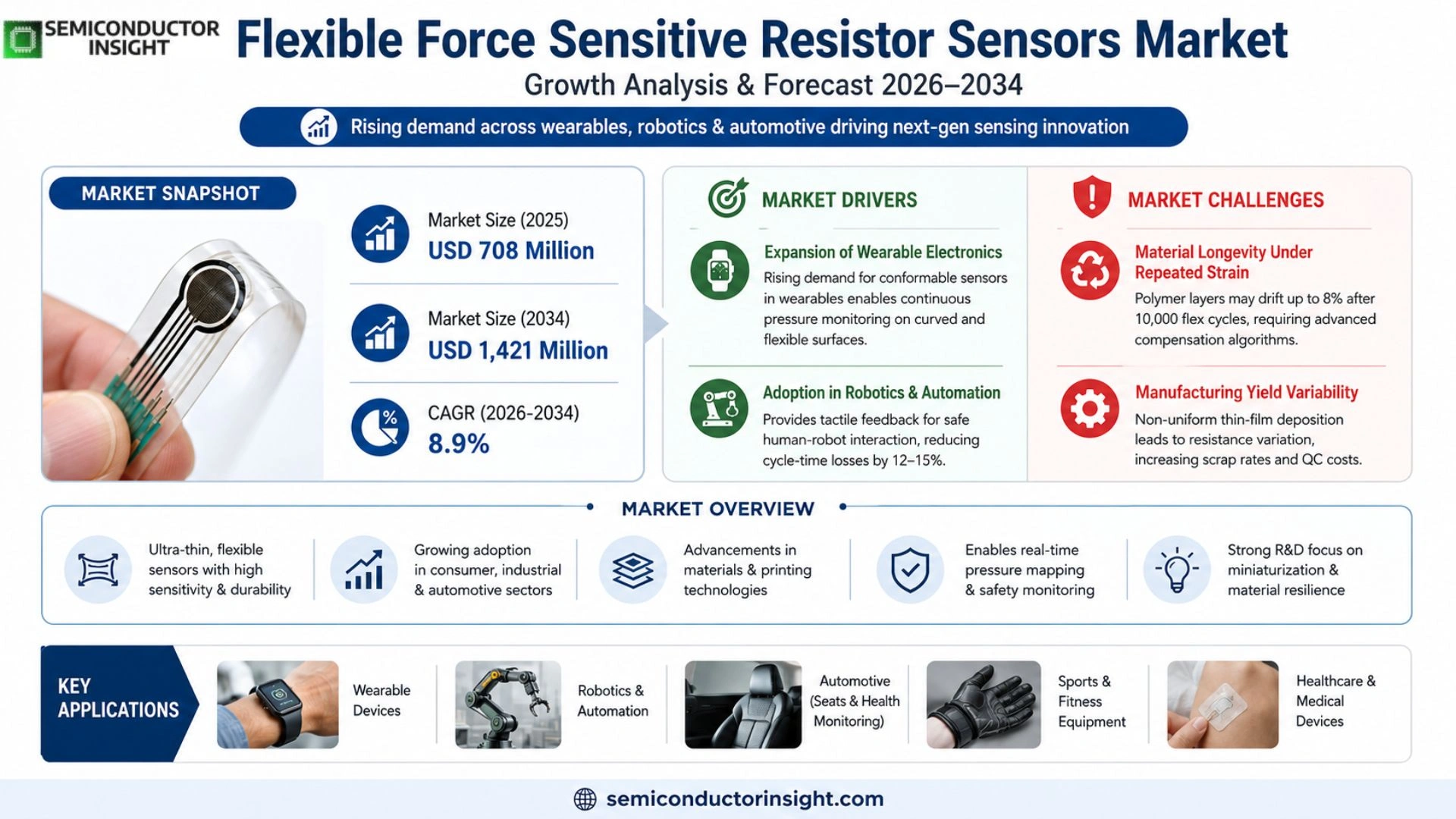
Global Flexible Force Sensitive Resistor Sensors market size was valued at USD 775 million in 2025. The market is forecasted to increase to USD 1,421 million by 2034, reflecting a compound annual growth rate of 8.9% over the period.
Flexible Force Sensitive Resistor Sensors are sensing devices that convert mechanical pressure into an electrical signal through a resistance change. Their core architecture comprises a force‑sensitive resistor element mounted on a flexible substrate such as PET or polyimide, together with signal‑conditioning circuitry that translates resistance variation into voltage or current outputs.
The operating principle relies on the piezoresistive effect: when external force deforms the resistor matrix or alters contact between conductive particles, its electrical resistance varies proportionally. Integrated electronics detect this shift and output a calibrated signal, enabling precise pressure measurement across consumer electronics, automotive systems, medical devices and robotics. Because of their thin form factor, rapid response time and low production cost, these sensors are increasingly adopted as tactile interfaces in smart wearables and as feedback elements in automated manufacturing lines.
MARKET DRIVERS
Expansion of Wearable Electronics
The surge in consumer‑grade wearables has created a pressing demand for sensors that can conform to curved surfaces without compromising signal fidelity. Manufacturers are turning to Flexible Force Sensitive Resistor Sensors because they enable continuous pressure monitoring on fabrics and silicone substrates, a capability traditional rigid sensors cannot provide. As device form‑factors shrink, the ability to embed sensing layers directly into textiles drives platform differentiation and higher price points.
Adoption in Robotics and Automation
Collaborative robots (cobots) now operate alongside humans in assembly lines, requiring tactile feedback that mimics human skin. Flexible Force Sensitive Resistor Sensors Market supplies the proprioceptive data needed for safe force limiting and adaptive grasping. Companies that integrate these sensors report a 12‑15 % reduction in cycle‑time losses due to fewer collision incidents.
➤ “Integrating stretchable pressure arrays cuts tooling change‑over by half, unlocking new revenue streams for OEMs.”
Beyond consumer and industrial use, the automotive sector is experimenting with seat‑integrated pressure maps to enhance occupant comfort and monitor health metrics. The convergence of health‑monitoring trends and vehicle telematics positions flexible force sensors as a cross‑industry catalyst, prompting R&D budgets to allocate a larger slice to sensor miniaturization and material resilience.
MARKET CHALLENGES
Material Longevity Under Repeated Strain
While polymer‑based resistive layers deliver the necessary elasticity, they can suffer drift after thousands of loading cycles. End‑users in sports equipment report calibration drift of up to 8 % after 10,000 flex events, prompting manufacturers to introduce compensation algorithms that add processing overhead.
Other Challenges
Manufacturing Yield Variability
Thin‑film deposition techniques used for sensor patches often produce non‑uniform thickness, leading to batch‑to‑batch resistance differences that complicate quality control and inflate scrap rates.
MARKET RESTRAINTS
High Unit Cost Relative to Conventional Sensors
Current production processes, particularly for multi‑layer stretchable architectures, drive unit costs upward by 30‑40 % compared with silicon‑based force sensors. Small‑volume adopters often find the price gap prohibitive, limiting market penetration to premium segments.
Cost pressures are compounded by limited economies of scale. Unlike mature MEMS suppliers, flexible sensor fabs operate at modest throughput, meaning tooling amortization spreads over fewer units and keeps price points elevated.
Regulatory scrutiny in medical‑device applications introduces another barrier. Validation protocols for long‑term biocompatibility and sterilization add time and expense, discouraging mid‑size firms from entering the field.
MARKET OPPORTUNITIES
Smart Textile Integration
Emerging standards for e‑textiles call for seamless sensor networks woven directly into garment fibers. Flexible Force Sensitive Resistor Sensors Market players that master conductive yarn encapsulation can capture biometric data without detachable modules, unlocking subscription‑based health‑monitoring services.
Geographically, the Asia‑Pacific region presents a fertile landscape. Rapid expansion of low‑cost manufacturing hubs coupled with rising disposable income fuels demand for interactive apparel and localized robotics, offering a projected 18 % compound increase in sensor shipments over the next five years.
Finally, the rise of edge‑AI processors creates an opening for sensors that embed preliminary signal conditioning. Companies that co‑design resistive arrays with on‑chip analog front‑ends can deliver turnkey solutions, reducing integration effort for downstream OEMs and capturing a larger share of system‑level contracts.
Flexible Force Sensitive Resistor Sensors Market Trends
Growing Integration in Smart Devices
Flexible Force Sensitive Resistor Sensors Market is witnessing a decisive shift toward embedding these components in the next generation of consumer electronics and connected automobiles. Manufacturers of smartphones, wearables, and in‑car infotainment systems are capitalizing on the sensors’ thin profile, rapid response, and low cost to replace legacy mechanical switches. This migration delivers richer haptic feedback, more precise pressure‑based controls, and a smoother user interface, which directly translates into higher perceived product quality. At the same time, automotive OEMs are layering tactile sensing into steering wheels and driver‑assist modules, allowing real‑time force monitoring that improves safety algorithms. The convergence of flexible form factors and digital signal‑processing chips creates a feedback loop: better data encourages more sophisticated software, which in turn fuels demand for higher‑resolution sensors.
Other Trends
Rise of Intelligent Manufacturing Applications
In industrial settings, Flexible Force Sensitive Resistor Sensors Market is becoming the backbone of smart factories that rely on real‑time force data to fine‑tune assembly lines. By installing sensor arrays on robotic grippers and press machines, producers can detect minute deviations in applied pressure, preventing product damage and reducing downtime. The technology acts as a “tactile nerve” for automated equipment, enabling predictive maintenance strategies that lower overall operating costs. As manufacturers pursue higher throughput and tighter tolerances, the demand for sensors that combine durability with flexible mounting options is accelerating, prompting vendors to introduce ruggedized variants tailored for harsh environments.
Supply Chain Consolidation and Margin Pressure
Upstream, the market depends on substrate films such as PET and polyimide, alongside conductive powders like high‑purity zinc oxide. A handful of global material suppliers dominate this space, creating a modest but noticeable consolidation trend. Downstream, the single‑line production capacity of sensor manufacturers ranges from tens of thousands to several hundred thousand units, a scale that supports both niche OEM contracts and large‑volume consumer runs. Gross profit margins typically sit between 30 % and 40 %, yet intensifying competition from new entrants is nudging pricing toward the lower end of that band. Companies that can integrate their own substrate processing or secure long‑term raw‑material agreements are better positioned to sustain profitability while expanding into emerging application segments.
COMPETITIVE LANDSCAPE
Key Industry Players
Competitive dynamics in Flexible Force Sensitive Resistor Sensors sector
The market is anchored by a handful of large‑scale manufacturers that dominate revenue streams and drive technology standards. Nissha, with its vertically integrated production line and extensive patent portfolio, controls a substantial share of high‑volume shipments, especially in automotive electronics and industrial automation. Its scale allows tight cost control, which translates into lower unit prices for OEMs seeking to embed tactile feedback in mass‑produced devices. Parallel to Nissha, Tekscan leverages a strong focus on precision engineering to serve medical‑grade applications, where accuracy and reliability command premium pricing. Both firms benefit from entrenched relationships with major system integrators, creating a barrier to entry for new entrants.
Beyond the dominant players, a vibrant cohort of niche specialists contributes depth and diversity to the ecosystem. Companies such as Shenzhen New Degree Technology and Memtronik differentiate themselves through rapid prototyping capabilities and customized sensor geometries for wearable electronics. Butler Technologies and Hanwei Electronics Group have carved out positions in the consumer‑electronics segment by offering ultra‑thin form factors compatible with flexible printed circuits. Smaller outfits like Interlink, Ohmite, and Tangio Printed Electronics focus on specific modes—shunt or thru—or on particular substrate materials, enabling them to capture fragmentary demand pockets that larger manufacturers overlook. This stratified competitive structure fosters continual innovation while keeping pricing pressure moderate across the value chain.
List of Key Flexible Force Sensitive Resistor Sensors Companies Profiled
- Nissha
- Tekscan
- Shenzhen New Degree Technology
- Memtronik
- Butler Technologies
- Hanwei Electronics Group
- Nanjing Momao Electronic Technology
- Interlink
- Ohmite
- Techprint
- Tangio Printed Electronics (Sytek)
- Shenzhen Ruihu Technology (Xiamen Hongxin Electronics Technology)
- Sensitronics
- LEGACT
- Cubbison
Segment Analysis:
| Segment Category | Sub-Segments | Key Insights |
| By Type |
|
Shunt Mode
|
| By Application |
|
Consumer Electronics
|
| By End User |
|
OEM Manufacturers
|
| By Sensitivity Range |
|
50 N – 100 N
|
| By Shape |
|
Rectangle
|
Regional Analysis: Flexible Force Sensitive Resistor Sensors Market
North America
Wearable health monitors dominate the demand curve, leveraging the sensors’ ability to conform to skin without compromising signal fidelity. Simultaneously, automotive interior applications—such as adaptive seat occupancy detection—benefit from the technology’s durability under repeated stress cycles, cementing a diversified revenue base.
Advances in polymer chemistry enable thinner, more stretchable sensor arrays, while edge‑computing chips integrated on the same flexible substrate shorten data latency. These technical strides empower designers to embed sensors directly into garments and smart surfaces, expanding the functional envelope of the market.
Health‑care applications are subject to rigorous FDA scrutiny, prompting manufacturers to adopt stricter validation protocols. In parallel, automotive safety standards require long‑term reliability certifications, influencing product roadmaps toward more resilient material formulations.
Established players leverage scale and supply‑chain control to offer cost‑effective volumes, while agile newcomers focus on niche performance attributes such as ultra‑low hysteresis. Strategic collaborations between sensor firms and integrators are reshaping the value chain, fostering co‑development of application‑specific solutions.
Europe
European manufacturers capitalize on a strong tradition of precision engineering and maintain close ties with medical‑device regulators, allowing rapid approval of flexible sensor‑enabled diagnostics. Sustainability mandates have spurred interest in recyclable substrates, prompting R&D teams to explore bio‑based polymers that meet both performance and environmental criteria. The region’s fragmented market structure encourages cross‑border partnerships, enabling firms to access complementary expertise in electronics packaging and data analytics.
Asia‑Pacific
In Asia‑Pacific, burgeoning consumer electronics corridors generate a steady appetite for thin, low‑cost sensors that can be integrated into smartphones and IoT wearables. Local suppliers benefit from dense component ecosystems, reducing lead times for prototype iterations. However, varying quality standards across countries create a competitive landscape where brand reputation and proven reliability become decisive purchase factors.
South America
South American adoption is propelled by growing interest in agricultural monitoring systems, where flexible force sensors can detect load changes in harvesting equipment. Government initiatives aimed at modernizing rural infrastructure provide modest funding streams, encouraging joint ventures between regional distributors and technology licensors. Market growth is modest but steady, with an emphasis on cost‑effectiveness over cutting‑edge performance.
Middle East & Africa
The Middle East & Africa region exhibits a niche focus on defense and aerospace applications, where sensor durability under extreme temperature fluctuations is paramount. Emerging smart‑city projects also incorporate flexible pressure mapping for traffic management and public‑space safety. Limited local manufacturing capacity drives reliance on imported solutions, creating opportunities for established global firms to establish regional service hubs.
Report Scope
This market research report provides a comprehensive analysis of the Flexible Force Sensitive Resistor Sensors Market , covering the forecast period 2026–2034. It offers detailed insights into market dynamics, technological advancements, competitive landscape, and key trends shaping the industry.
Key focus areas of the report include:
- Market Overview: The report begins with an overview outlining its current market scenario, key growth indicators, and industry transformation drivers. It discusses macroeconomic factors, demand–supply balance, regulatory landscape, and the strategic role of semiconductors in powering advancements across industries such as automotive, telecommunications, consumer electronics, and industrial automation.
- Market Size & Forecast: Historical data and future projections for revenue, unit shipments, and market value across major regions and segments.
- Segmentation Analysis: Detailed breakdown by product type, technology, application, and end-user industry to identify high-growth segments and investment opportunities.
- Regional Insights: Insights into market performance across North America, Europe, Asia-Pacific, Latin America, and the Middle East & Africa, including country-level analysis where relevant.
- Competitive Landscape: Profiles of leading market participants, including their product offerings, R&D focus, manufacturing capacity, pricing strategies, and recent developments such as mergers, acquisitions, and partnerships.
- Technology Trends & Innovation: Assessment of emerging technologies, integration of AI/IoT, semiconductor design trends, fabrication techniques, and evolving industry standards.
- Market Drivers & Restraints: Evaluation of factors driving market growth along with challenges, supply chain constraints, regulatory issues, and market-entry barriers.
- Stakeholder Insights: Insights for component suppliers, OEMs, system integrators, investors, and policymakers regarding the evolving ecosystem and strategic opportunities.
Primary and secondary research methods are employed, including interviews with industry experts, data from verified sources, and real-time market intelligence to ensure the accuracy and reliability of the insights presented.
FREQUENTLY ASKED QUESTIONS:
What is the current market size of Flexible Force Sensitive Resistor Sensors Market?
-> Flexible Force Sensitive Resistor Sensors market is forecasted to increase to USD 1,421 million by 2034, reflecting a compound annual growth rate of 8.9% .
Which key companies operate in Flexible Force Sensitive Resistor Sensors Market?
-> Key players include Nissha, Shenzhen New Degree Technology, Memtronik, Tekscan, Butler Technologies, Hanwei Electronics Group, Nanjing Momao Electronic Technology, NextInput (Qorvo), Interlink, Ohmite, among others.
What are the key growth drivers?
-> Key growth drivers include increasing demand for smart manufacturing pressure monitoring, expansion of touch‑sensitive consumer electronics, and rising adoption in automotive and medical robotics applications.
Which region dominates the market?
-> Asia-Pacific leads the market due to large production capacity and strong adoption in consumer electronics and automotive sectors, while North America remains a significant secondary market.
What are the emerging trends?
-> Emerging trends include integration of flexible FSR sensors with AI‑enabled IoT platforms, development of ultra‑thin printable sensors, and increased use in wearable health‑monitoring devices.

Get Sample Report PDF for Exclusive Insights
Report Sample Includes
- Table of Contents
- List of Tables & Figures
- Charts, Research Methodology, and more...
 Download Sample Report PDF