Intelligent Wireless Temperature and Vibration Sensor Market Insights
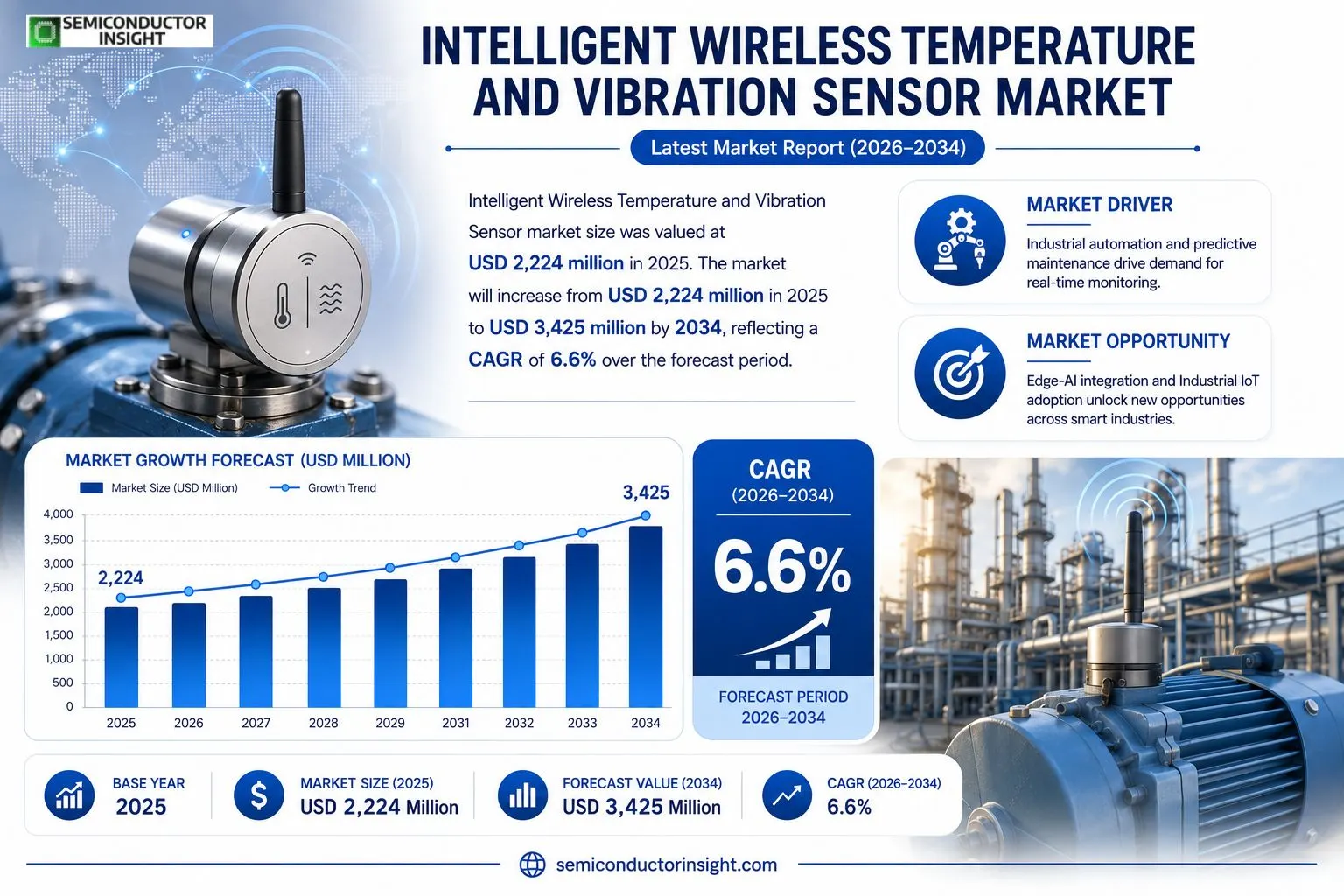
Intelligent Wireless Temperature and Vibration Sensor market size was valued at USD 2,224 million in 2025. The market will increase from USD 2,224 million in 2025 to USD 3,425 million by 2034, reflecting a CAGR of 6.6% over the forecast period.
The intelligent wireless temperature and vibration sensor integrates temperature‑sensing chips with MEMS accelerometers, processes signals locally on an MCU/SoC and forwards real‑time data through Bluetooth, LoRa or NB‑IoT links to a central management system. This architecture supports remote equipment monitoring, fault warning and maintenance optimisation across manufacturing plants, power facilities and transportation networks.Growth is fueled by expanding Industry 4.0 deployments, tighter uptime requirements and declining costs of low‑power wireless modules. However, manufacturers must address explosion‑proof certification for hazardous zones and safeguard IoT communications against cyber threats. Recent collaborationssuch as the March 2024 joint development between Bosch and Schneider Electric on an integrated sensor‑edge analytics moduleshow how leading players are consolidating expertise to satisfy demand in smart factories and smart cities.
MARKET DRIVERS
Industrial Automation and Predictive Maintenance
The rise of Industry 4.0 initiatives compels manufacturers to replace legacy point‑type devices with Intelligent Wireless Temperature and Vibration Sensor Market offerings that deliver real‑time condition data. By eliminating cabling, plants reduce installation overhead and gain flexibility to relocate sensors as production lines evolve, which directly lowers total cost of ownership.
Energy Efficiency Regulations
Stringent government mandates on energy consumption have pushed utilities and heavy‑industry operators to monitor thermal hotspots with greater precision. Wireless sensors, equipped with low‑power microcontrollers, can run for years on a single battery, enabling continuous oversight without the expense of frequent manual checks.
➤ Deployments in petrochemical complexes have shown a 12 % reduction in unplanned shutdowns after integrating intelligent wireless temperature and vibration sensors.
These operational wins translate into higher equipment availability and better compliance with safety standards, prompting procurement teams to prioritize intelligent sensing solutions over conventional wired alternatives.
MARKET CHALLENGES
Interoperability with Legacy Systems
Many plants still run on SCADA platforms that expect analogue inputs. Integrating digital wireless sensors requires gateway devices or protocol converters, creating an additional layer of complexity that can deter early adopters.
Other Challenges
Data Security Concerns
Because wireless nodes transmit over shared spectra, cyber‑risk assessments become a prerequisite. Companies must invest in encryption and authentication mechanisms, which can inflate project budgets.
MARKET RESTRAINTS
Battery Life Limitations in Harsh Environments
Although modern sensors boast multi‑year battery ratings, extreme temperature swings and vibrational stress can accelerate degradation. Operators often schedule preventive battery replacements, adding labor costs that offset some of the financial advantages of wireless deployment.
Regulatory Certification Hurdles
In sectors such as aerospace and defense, equipment must meet rigorous certification pathways. The need to demonstrate electromagnetic compatibility and long‑term reliability for wireless modules can prolong time‑to‑market and discourage smaller vendors.
MARKET OPPORTUNITIES
Edge‑AI Integration
Embedding lightweight analytics directly on the sensor node allows anomaly detection to occur at the edge, reducing latency and bandwidth consumption. Enterprises that adopt edge‑AI can shift from reactive maintenance to truly prescriptive strategies, opening new revenue streams for solution providers.Furthermore, the convergence of 5G private networks with intelligent wireless sensing promises higher data throughput and deterministic latency, which could unlock high‑resolution vibration monitoring in rotating equipment previously deemed too demanding for wireless architectures.
Intelligent Wireless Temperature and Vibration Sensor Market Trends
Integration of Edge Computing in Sensor Networks
The latest wave of edge‑computing capabilities is reshaping how Intelligent Wireless Temperature and Vibration Sensor Market delivers value. By embedding lightweight analytics directly on the sensor module, manufacturers enable real‑time anomaly detection without relying on constant cloud connectivity. This shift reduces latency, conserves bandwidth, and lowers operational costs for users in factories and power plants that cannot afford delayed alerts. Moreover, edge logic supports adaptive sampling rates, allowing the device to concentrate power on critical events while entering low‑power modes during normal operation. The practical outcome is a measurable increase in equipment uptime and a clearer ROI narrative for plant managers who can now act on actionable insights within seconds rather than minutes.
Other Trends
Supply‑Chain Consolidation of Core Components
Component vendors are aligning their product roadmaps to serve the growing demand for integrated sensing platforms. Temperature‑sensing chips, MEMS accelerometers, low‑power MCUs and diverse wireless radios (Bluetooth, LoRa, NB‑IoT) are increasingly offered as pre‑qualified bundles, simplifying design cycles for sensor OEMs. This consolidation trims inventory complexity and accelerates time‑to‑market, particularly for firms targeting regulated environments such as petrochemicals and rail transit. As a side effect, pricing pressure on individual chips eases, encouraging smaller players to focus on niche algorithmic differentiators rather than hardware innovation alone.
Expansion into Energy and Transportation Sectors
Beyond traditional manufacturing, Intelligent Wireless Temperature and Vibration Sensor Market is gaining traction in renewable‑energy farms and high‑speed rail networks. In wind turbines, continuous vibration monitoring coupled with temperature alerts helps pre‑empt bearing failures that would otherwise cause costly downtime. Similarly, railway operators are deploying wireless sensor nodes along tracks to detect early signs of wheel‑set wear and overheating, supporting predictive maintenance schedules that keep trains running on time. The convergence of regulatory safety mandates and the economic incentive to reduce unplanned outages is driving rapid adoption, compelling system integrators to tailor sensor packages for harsh outdoor conditions while maintaining seamless integration with existing SCADA and IoT platforms.
COMPETITIVE LANDSCAPE
Key Industry Players
Intelligent Wireless Temperature and Vibration Sensors: Competitive Overview 2025‑2034
The market is anchored by a handful of multinational equipment manufacturers that combine deep sensor‑fusion expertise with established industrial‑IoT platforms. Honeywell leads the segment by leveraging its extensive portfolio of safety‑critical devices and a service network that accelerates adoption in energy and transportation. Siemens follows closely, integrating its sensor modules into the Digital Industries suite, which gives customers a seamless path from data capture to predictive analytics. Bosch contributes strong MEMS capabilities and a reputation for ruggedized hardware, positioning it well for automotive and manufacturing deployments. Collectively, these three firms command roughly half of the 2025 revenue, creating a tiered structure where the top tier supplies end‑to‑end solutions, while mid‑tier players focus on specialized modules or niche verticals. Their dominance reflects a strategy of bundling sensor hardware with cloud‑enabled platforms, a model that raises switching costs and reinforces market concentration.Beyond the dominant trio, a diverse set of challengers is reshaping the competitive map. Schneider Electric and ABB exploit their energy‑management heritage to offer explosion‑proof sensor nodes for petrochemical and offshore sites. GE Digital differentiates through high‑performance edge‑computing chips that reduce latency in critical rail‑transit applications. Rockwell Automation and Fluke target precision manufacturing with calibrated sensor suites tied to MES systems. Smaller innovators such as Yokogawa, TE Connectivity, Analog Devices, STMicroelectronics, Infineon, National Instruments, and Baker Hughes bring niche innovationsranging from ultra‑low‑power designs to advanced vibration analyticsthat enable them to capture niche market share and challenge incumbents on price and functionality.
List of Key Intelligent Wireless Temperature and Vibration Sensor Companies Profiled
- Honeywell
- Siemens
- Bosch
- Schneider Electric
- GE Digital
- Emerson
- Rockwell Automation
- Fluke
- ABB
- Baker Hughes
- Yokogawa
- TE Connectivity
- Analog Devices
- STMicroelectronics
- Infineon
- National Instruments
Segment Analysis:
| Segment Category | Sub-Segments | Key Insights |
| By Type |
|
Combined temperature and vibration sensors
|
| By Application |
|
Manufacturing equipment monitoring
|
| By End User |
|
Industrial plant operators
|
| By Performance Level |
|
High‑end predictive analytics level
|
| By Deployment Method |
|
Networked mesh deployment
|
Regional Analysis: Intelligent Wireless Temperature and Vibration Sensor Market
North America
Leading manufacturers are embedding AI‑ready micro‑controllers within the sensors, allowing edge analytics that flag anomalies before a failure escalates. This capability shortens the data‑to‑action cycle, making the technology attractive for high‑value assets in aerospace and defense.
The region’s robust logistics network ensures timely delivery of battery‑powered devices, reducing lead times that historically hampered adoption of wireless alternatives in remote facilities.
Industry consortia are converging on common communication protocols, which lowers integration friction for end users and accelerates cross‑vendor deployments in complex plant environments.
Leasing arrangements and outcome‑based contracts are gaining traction, allowing operators to offset upfront costs while benefitting from the performance guarantees of modern wireless sensor suites.
Europe
European manufacturers are leveraging the region’s strong emphasis on sustainability to embed intelligent wireless temperature and vibration sensors into energy‑intensive processes. Compliance with EU directives has pushed facilities toward continuous monitoring, which in turn fuels demand for sensors capable of high‑frequency data capture in harsh environments. While the market is less mature than North America, a growing number of cross‑border collaborations are standardising data‑exchange formats, enabling multinational operators to deploy a single sensing solution across multiple sites. Investment in digital twins is also creating a niche for sensors that can feed high‑fidelity inputs into simulation models, enhancing process optimisation.
Asia‑Pacific
The Asia‑Pacific region exhibits rapid industrialisation, with China, India, and Southeast Asian nations expanding their manufacturing bases. Companies are attracted to wireless temperature and vibration sensors because they simplify retrofits in legacy plants where extensive cabling is impractical. Government programmes that promote smart factories are encouraging early adopters, especially in automotive and electronics assembly. However, fragmented supply chains and varying standards across countries introduce integration challenges that vendors are beginning to address through region‑specific certification pathways.
South America
South American economies are increasingly focusing on upgrading ageing industrial assets, particularly in the oil‑and‑gas and mining sectors. The promise of reduced downtime through predictive maintenance makes intelligent wireless sensors a compelling proposition for operators coping with volatile commodity prices. Localised production of sensor enclosures is emerging, driven by tariff considerations and the desire to shorten delivery cycles. Nonetheless, limited broadband penetration in remote locations means that many deployments rely on low‑power wide‑area network (LPWAN) technologies, shaping the design requirements of new sensor generations.
Middle East & Africa
In the Middle East, the convergence of large‑scale petrochemical complexes and ambitious smart‑city initiatives is creating a fertile environment for wireless sensing technology. Operators value the ability to monitor temperature and vibration in extreme heat, where traditional wired solutions can suffer from conduit degradation. In Africa, pilot projects in renewable‑energy farms are showcasing how wireless sensors can provide continuous performance data for distributed generation assets, prompting interest from utility planners. The region’s infrastructural constraints are prompting vendors to prioritize ruggedised hardware and satellite‑backed connectivity options.
Report Scope
This market research report provides a comprehensive analysis of the Intelligent Wireless Temperature and Vibration Sensor Market , covering the forecast period 2026–2034. It offers detailed insights into market dynamics, technological advancements, competitive landscape, and key trends shaping the industry.
Key focus areas of the report include:
- Market Overview: The report begins with an overview outlining its current market scenario, key growth indicators, and industry transformation drivers. It discusses macroeconomic factors, demand–supply balance, regulatory landscape, and the strategic role of semiconductors in powering advancements across industries such as automotive, telecommunications, consumer electronics, and industrial automation.
- Market Size & Forecast: Historical data and future projections for revenue, unit shipments, and market value across major regions and segments.
- Segmentation Analysis: Detailed breakdown by product type, technology, application, and end-user industry to identify high-growth segments and investment opportunities.
- Regional Insights: Insights into market performance across North America, Europe, Asia-Pacific, Latin America, and the Middle East & Africa, including country-level analysis where relevant.
- Competitive Landscape: Profiles of leading market participants, including their product offerings, R&D focus, manufacturing capacity, pricing strategies, and recent developments such as mergers, acquisitions, and partnerships.
- Technology Trends & Innovation: Assessment of emerging technologies, integration of AI/IoT, semiconductor design trends, fabrication techniques, and evolving industry standards.
- Market Drivers & Restraints: Evaluation of factors driving market growth along with challenges, supply chain constraints, regulatory issues, and market-entry barriers.
- Stakeholder Insights: Insights for component suppliers, OEMs, system integrators, investors, and policymakers regarding the evolving ecosystem and strategic opportunities.
Primary and secondary research methods are employed, including interviews with industry experts, data from verified sources, and real-time market intelligence to ensure the accuracy and reliability of the insights presented.
FREQUENTLY ASKED QUESTIONS:
What is the current market size of Intelligent Wireless Temperature and Vibration Sensor Market?
-> Intelligent Wireless Temperature and Vibration Sensor Market was valued at USD 2,224 million in 2025 and is expected to reach USD 3,425 million by 2034, growing at a CAGR of 6.6%.
Which key companies operate in Intelligent Wireless Temperature and Vibration Sensor Market?
-> Key players include Honeywell, Siemens, Bosch, Schneider Electric, GE Digital, Emerson, Rockwell Automation, Fluke, ABB, and Baker Hughes, among others.
What are the key growth drivers?
-> Key growth drivers include remote real-time monitoring, predictive maintenance enabled by Industry 4.0, energy efficiency improvements, and increasing adoption across manufacturing, energy, utilities and transportation sectors.
Which region dominates the market?
-> The market shows strong adoption across major industrial regions, notably North America, Europe and Asia, with no single region explicitly identified as dominant in the provided data.
What are the emerging trends?
-> Emerging trends include integration with Industrial IoT platforms, AI-driven analytics for predictive maintenance, energy‑harvesting power solutions, and expanded use in smart factories and smart cities.

Get Sample Report PDF for Exclusive Insights
Report Sample Includes
- Table of Contents
- List of Tables & Figures
- Charts, Research Methodology, and more...
 Download Sample Report PDF