Textile Strain Sensors Market Insights
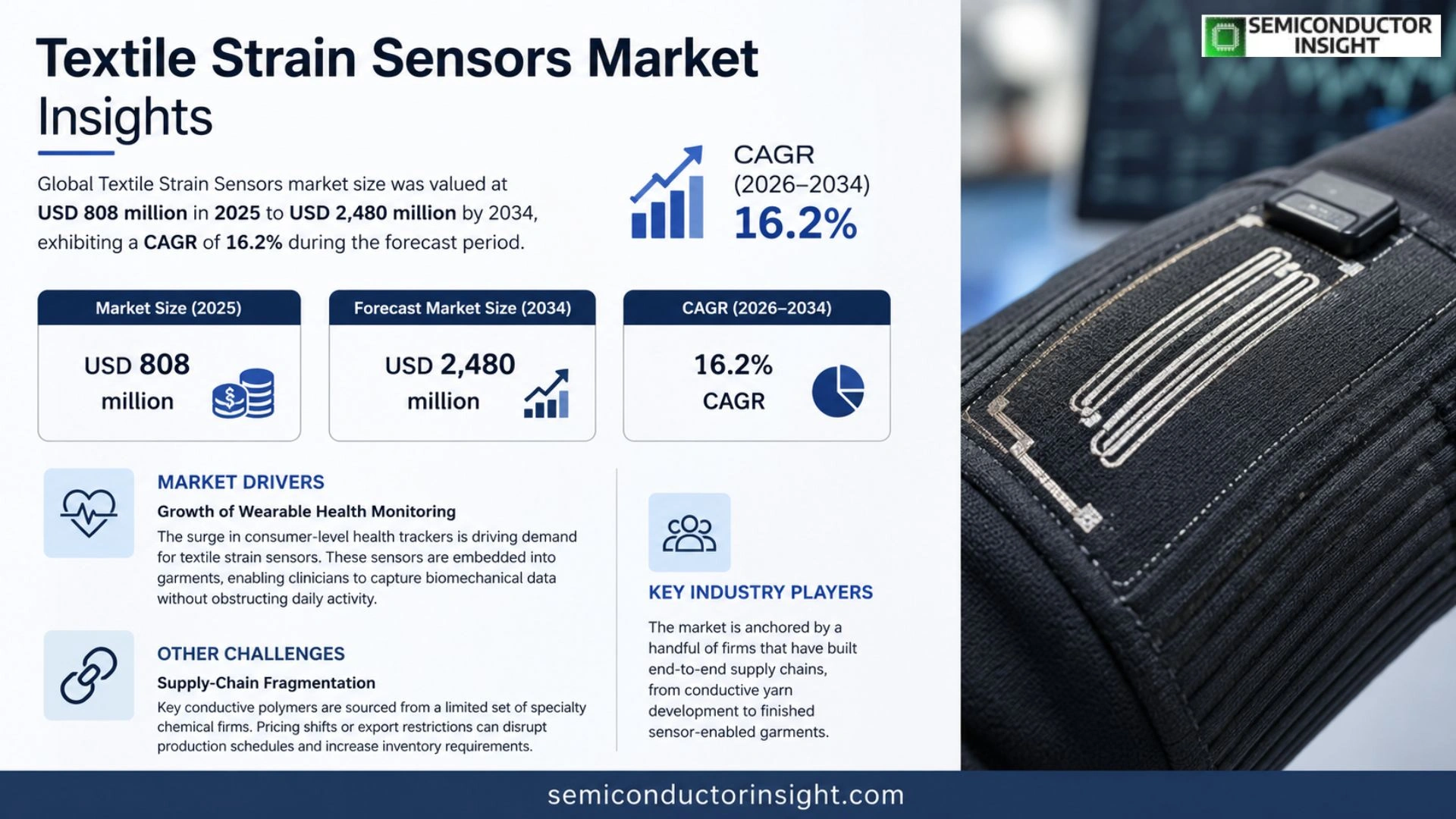
Global Textile Strain Sensors market size was valued at USD 808 million in 2025 to USD 2,480 million by 2034, exhibiting a CAGR of 16.2% during the forecast period.
Textile strain sensors are smart sensing elements embedded directly into fabrics that detect mechanical deformation by monitoring changes in electrical parameters such as resistance, capacitance or inductance. They enable continuous measurement of stretching, bending or compression in wearable garments, health‑monitoring apparel, sports‑tracking equipment and soft‑robotic interfaces.
The expansion of the sector is driven by rising adoption of wearable health devices, increasing investment in flexible electronics, and growing demand for real‑time motion analytics across consumer and clinical applications. Recent collaborations between conductive‑fiber manufacturers and apparel brands are accelerating commercialization, while challenges around washability and signal stability continue to shape R&D priorities.
MARKET DRIVERS
Growth of Wearable Health Monitoring
The surge in consumer‑level health trackers has forced OEMs to look beyond rigid silicon chips. Textile Strain Sensors Market participants are embedding conductive yarns into garments, enabling clinicians to capture biomechanical data without obstructing daily activity. This shift is fueled by a growing willingness among patients to adopt non‑invasive monitoring solutions, which in turn creates a steady pipeline of contracts for sensor manufacturers.
Advances in Smart Textile Manufacturing
Recent breakthroughs in ink‑jet printing and laser sintering have lowered the cost per square meter of functional fabrics. As production lines become more modular, smaller players can introduce niche sensor designs, expanding the overall addressable market. The resulting economies of scale are prompting larger textile firms to allocate capital toward dedicated smart‑fabric divisions.
➤ Companies that integrate strain‑sensing fibers during the weaving stage report up to a 30% reduction in assembly time compared with post‑process attachment methods.
Regulatory bodies in Europe and North America have begun to clarify pathways for medical‑grade smart textiles. By providing clearer compliance criteria, they are removing a long‑standing barrier and encouraging investment in validation labs, which further accelerates market uptake.
MARKET CHALLENGES
Material Compatibility and Durability
Embedding strain‑sensing elements into conventional fabrics often compromises washability and tensile strength. Manufacturers must balance electrical performance with the mechanical demands of everyday wear, a trade‑off that raises engineering costs and can delay time‑to‑market for new product lines.
Other Challenges
Supply‑Chain Fragmentation
Key conductive polymers are sourced from a limited set of specialty chemical firms. Sudden shifts in raw‑material pricing or export restrictions can ripple through the production schedule, forcing sensor makers to hold higher inventory levels or renegotiate contracts.
Design standards for data interoperability remain embryonic, meaning that end‑users frequently encounter proprietary data formats. This lack of uniformity discourages large‑scale adoption by enterprises that require seamless integration with existing analytics platforms.
MARKET RESTRAINTS
High Initial Capital Expenditure
Setting up a dedicated smart‑fabric line involves purchasing specialized looms, coating stations, and testing rigs. For many mid‑size textile firms, the upfront outlay exceeds available cash reserves, prompting a cautious approach to entering the Textile Strain Sensors Market.
Limited Consumer Awareness
Although athletes and rehabilitation clinics have begun to recognize the value of strain‑monitoring apparel, the broader consumer base remains unaware of tangible benefits. Without clear marketing messages that differentiate functional textiles from conventional activewear, demand growth may plateau.
Regulatory approval timelines for medical‑grade smart garments can extend beyond twelve months, adding uncertainty to product roadmaps. Companies that rely on fast‑track approvals risk encountering unexpected compliance hurdles that stall revenue realization.
MARKET OPPORTUNITIES
Integration with IoT Ecosystems
Linking strain‑sensor‑enabled fabrics to cloud‑based analytics platforms unlocks new business models such as usage‑based leasing and predictive maintenance for sports equipment. Firms that develop secure, low‑latency communication stacks are positioned to capture a sizable share of this emerging revenue stream.
Customized Solutions for Industrial Safety
Manufacturers of heavy‑duty workwear are exploring embedded strain sensors to monitor worker posture and fatigue in real time. By offering turnkey safety kits that combine sensors, edge‑processing modules, and alerting apps, vendors can differentiate themselves in a niche yet lucrative segment of the Textile Strain Sensors Market.
Strategic partnerships between textile mills and semiconductor firms are already yielding hybrid fibers that combine sensing with energy harvesting. These collaborations promise to lower operating costs for end‑users while opening a pathway for next‑generation self‑powered garments.
Textile Strain Sensors Market Trends
Conductive Fiber Integration Fuels Product Innovation
The surge in conductive‑fiber engineering has reshaped how manufacturers embed sensing capability into fabrics. By leveraging silver‑coated yarns and carbon‑based filaments, suppliers are achieving lower resistance pathways without compromising textile flexibility. This material advance shortens the signal latency that previously limited real‑time motion capture, making the sensors attractive for high‑frequency sports monitoring and precise rehabilitation feedback. As design cycles compress, firms that align material procurement with modular knitting processes capture early‑stage market share, while rivals still reliant on post‑fabric coating face higher labor costs and longer time‑to‑market. The net effect is a shift toward vertically integrated production lines that prioritize durability and repeatable performance.
Other Trends
Manufacturing Scalability and Cost Management
In 2025 global output reached roughly 5.9 million units, edging toward a capacity ceiling of 6.3 million units. The modest gap between actual production and maximum capacity underscores an industry poised to scale without massive capital infusion. However, the average unit price of US$150 constrains margin expansion, especially when washability upgrades demand premium polymer encapsulation. Companies that adopt hybrid weaving‑embroidery techniques report a 12 % reduction in material waste, translating into a healthier gross profit margin above the sector average of 35 %. Cost‑effective scaling therefore hinges on process automation and standardized testing protocols that reduce rework rates.
Clinical Rehabilitation Emerges as a Growth Engine
Healthcare providers are increasingly deploying textile‑based strain sensors inside patient‑centric garments to monitor joint articulation during physiotherapy. The ability to capture continuous strain data without intrusive electrodes offers clinicians a richer dataset for tailoring exercise regimens. This application segment benefits from the market’s existing supply chain,upstream conductive polymers feed directly into midstream smart‑fabric modules, which are then paired with hospital‑grade data platforms. As reimbursement frameworks evolve to recognize remote monitoring outcomes, manufacturers that certify sensor biocompatibility and wash‑resistance stand to secure long‑term contracts, driving incremental revenue streams beyond the consumer wearables arena.
COMPETITIVE LANDSCAPE
Key Industry Players
Textile Strain Sensors: Competitive Outlook 2025‑2032
The market is anchored by a handful of firms that have built end‑to‑end supply chains, from conductive yarn development to finished sensor‑enabled garments. Texensor, for instance, leverages a proprietary silver‑coated polymer platform that delivers repeatable gauge factors while keeping unit cost below the industry average. Its vertical integration gives it leverage over pricing and accelerates time‑to‑market for large OEM contracts in sports‑wear and clinical rehabilitation. Behind this core, two to three midsize manufacturers collectively control roughly 30 % of global revenue, each focusing on a distinct sensing mechanism,resistive, capacitive or optical,and forging partnerships with apparel brands to embed functionality without compromising washability.
Beyond the dominant tier, a diverse set of niche innovators is reshaping application boundaries. Sensoria Inc. has concentrated on consumer health monitoring, embedding strain patches into footwear to deliver real‑time gait analysis. Tekscan and Interlink Electronics specialize in high‑resolution pressure mapping for medical orthotics, while Wave Company pursues hybrid piezoresistive‑capacitive designs for soft‑robotic actuators. European entrant Ohmatex ApS differentiates through metal‑fiber yarns that survive aggressive laundering cycles. Asian startups such as AiQ Smart Clothing, Fibersensing, and Vancera Technology focus on low‑power, Bluetooth‑enabled modules for wearable entertainment. The breadth of these players creates a competitive matrix where material advantage, integration methodology and after‑sales analytics services become decisive factors for client acquisition.
List of Key Textile Strain Sensors Companies Profiled
- Texensor
- Sensoria Inc.
- Textronics Inc.
- Wave Company
- Ohmatex ApS
- AiQ Smart Clothing Inc.
- Fibersensing
- Sensitronics LLC
- Interlink Electronics
- Tekscan
- Vancera Technology
- Aisiyi (Xiamen) Technology
- Nanjing Shiheng Electronics
- Anhui Zhimin Electrical Technology
- Shenzhen Innovand Systems
Segment Analysis:
| Segment Category | Sub-Segments | Key Insights |
| By Type |
|
Resistive dominates early adoption because:
|
| By Application |
|
Wearable Health Monitoring remains the primary driver because:
|
| By End User |
|
Consumers are embracing smart apparel because:
|
| By Material Type |
|
Carbon‑based fibers are favored for:
|
| By Sensing Mechanism |
|
Capacitive is gaining traction due to:
|
Regional Analysis: Textile Strain Sensors Market
European textile mills are embedding conductive polymers and graphene‑based filaments into traditional yarns, unlocking higher gauge resolution without compromising fabric hand. This material shift supports premium applications in aerospace upholstery and sportswear where precise deformation feedback is a differentiator.
The EU’s Ecodesign Directive and upcoming textile‑labelling rules compel manufacturers to disclose sensor durability and recyclability, prompting early‑stage compliance testing that drives design standardization across the market.
Proximity between fiber producers, sensor developers, and garment assemblers shortens time‑to‑market, enabling rapid prototyping cycles that many Asian competitors struggle to match in Europe’s tightly knit clusters.
End‑users,from luxury fashion houses to defense contractors,are requesting real‑time strain analytics embedded in garments, a trend that is reshaping product roadmaps and encouraging bespoke sensor architectures.
North America
In North America, the Textile Strain Sensors Market benefits from a robust venture‑capital environment and a strong focus on wearable health technology. Major medical‑device firms are partnering with textile innovators to embed strain sensing directly into patient monitoring garments, creating a new revenue stream beyond traditional orthotics. Simultaneously, the automotive sector in the United States is experimenting with smart seat upholstery that can detect occupant posture, a development that could influence safety‑system integration. While the region lags behind Europe in coordinated public‑policy incentives, its agile startup ecosystem compensates by accelerating product iterations and driving early adoption among premium sports‑apparel brands.
Asia‑Pacific
Asia‑Pacific’s contribution to the Textile Strain Sensors Market is anchored in expansive manufacturing capacity and cost‑effective labor. Nations such as China, India and Vietnam are rapidly scaling up production of sensor‑integrated fabrics for both domestic consumption and export. However, the region’s growth is tempered by fragmented quality standards and limited IP protection, which occasionally deter high‑margin contracts from Western OEMs. Growing consumer awareness of smart apparel in markets like Japan and South Korea is beginning to offset these challenges, as local brands seek differentiated products to capture tech‑savvy shoppers.
South America
South America presents a niche but promising landscape for textile strain sensing, largely driven by Brazil’s burgeoning sports‑wear segment and Argentina’s research initiatives in smart farming textiles. Government incentives aimed at modernizing agricultural supply chains have sparked interest in sensor‑infused nets that monitor crop stress, opening a non‑conventional application corridor. Although logistical hurdles and currency volatility constrain large‑scale investment, localized pilot projects are demonstrating tangible cost savings, encouraging regional manufacturers to explore diversification beyond conventional garment production.
Middle East & Africa
In the Middle East and Africa, market activity revolves around safety‑critical applications such as oil‑rig personnel garments and desert‑climate protective wear. The United Arab Emirates and South Africa host a handful of joint‑ventures that blend textile expertise with aerospace‑grade sensor technology, targeting high‑value contracts with defense agencies. Limited domestic demand is offset by export‑oriented strategies, wherein firms leverage tax‑advantaged zones to supply European and North American buyers. As regional economies continue to invest in smart‑city infrastructure, ancillary demand for strain‑sensing textiles in infrastructure monitoring is likely to gain traction.
Report Scope
This market research report provides a comprehensive analysis of the Textile Strain Sensors Market , covering the forecast period 2026–2034. It offers detailed insights into market dynamics, technological advancements, competitive landscape, and key trends shaping the industry.
Key focus areas of the report include:
- Market Overview: The report begins with an overview outlining its current market scenario, key growth indicators, and industry transformation drivers. It discusses macroeconomic factors, demand–supply balance, regulatory landscape, and the strategic role of semiconductors in powering advancements across industries such as automotive, telecommunications, consumer electronics, and industrial automation.
- Market Size & Forecast: Historical data and future projections for revenue, unit shipments, and market value across major regions and segments.
- Segmentation Analysis: Detailed breakdown by product type, technology, application, and end-user industry to identify high-growth segments and investment opportunities.
- Regional Insights: Insights into market performance across North America, Europe, Asia-Pacific, Latin America, and the Middle East & Africa, including country-level analysis where relevant.
- Competitive Landscape: Profiles of leading market participants, including their product offerings, R&D focus, manufacturing capacity, pricing strategies, and recent developments such as mergers, acquisitions, and partnerships.
- Technology Trends & Innovation: Assessment of emerging technologies, integration of AI/IoT, semiconductor design trends, fabrication techniques, and evolving industry standards.
- Market Drivers & Restraints: Evaluation of factors driving market growth along with challenges, supply chain constraints, regulatory issues, and market-entry barriers.
- Stakeholder Insights: Insights for component suppliers, OEMs, system integrators, investors, and policymakers regarding the evolving ecosystem and strategic opportunities.
Primary and secondary research methods are employed, including interviews with industry experts, data from verified sources, and real-time market intelligence to ensure the accuracy and reliability of the insights presented.
FREQUENTLY ASKED QUESTIONS:
What is the current market size of Textile Strain Sensors Market?
-> Global Textile Strain Sensors Market is expected to reach USD 2,480 million by 2032, at a CAGR of 16.2% during the forecast period.
Which key companies operate in Textile Strain Sensors Market?
-> Key players include Texensor, Sensoria Inc., Textronics Inc., Wave Company, Ohmatex ApS, AiQ Smart Clothing Inc., Fibersensing, Sensitronics LLC, Interlink Electronics, Tekscan, among others.
What are the key growth drivers?
-> Key growth drivers include rising demand for wearable electronics, health‑monitoring garments, sports‑tracking devices, soft‑robotics applications, and the need for flexible, lightweight, fabric‑compatible sensors.
Which region dominates the market?
-> Asia leads the market, driven by large‑scale production capacity in China and strong adoption of smart textiles across the region.
What are the emerging trends?
-> Emerging trends include development of wash‑stable sensor designs, modular and hybrid sensing architectures, and integration of AI/IoT for real‑time motion and physiological data analytics.

Get Sample Report PDF for Exclusive Insights
Report Sample Includes
- Table of Contents
- List of Tables & Figures
- Charts, Research Methodology, and more...
 Download Sample Report PDF