Incremental Rotary Encoder(Grating) Market Insights
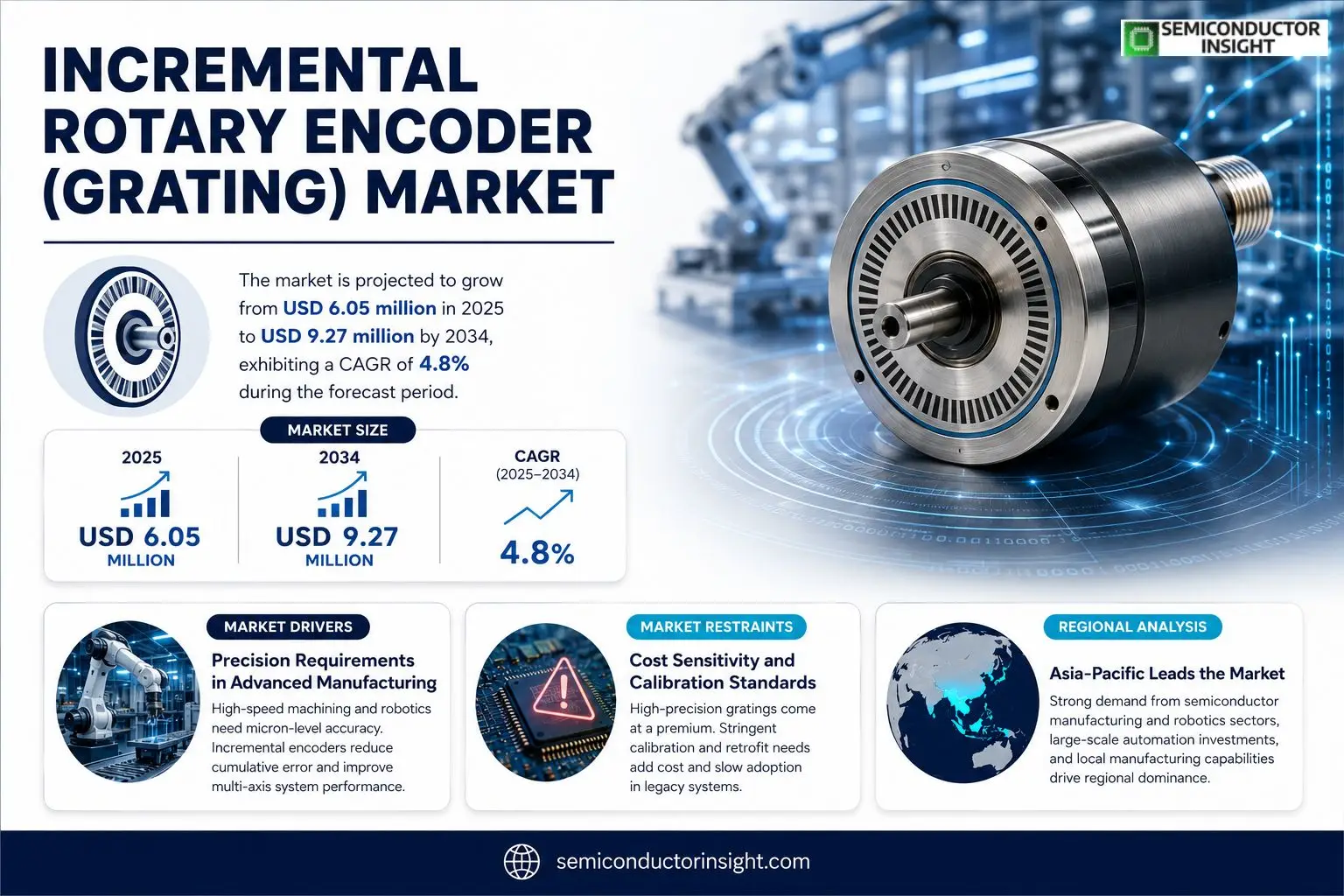
Incremental Rotary Encoder(Grating) market size was valued at USD 6.05 million in 2025. The market will increase from USD 6.05 million in 2025 to USD 9.27 million by 2034, reflecting a CAGR of approximately 4.8% over the forecast period.
An incremental rotary encoder (grating) is a rotary position‑/velocity sensor that employs a circular grating scaleeither disc or ring markingsand an optical readhead as its core element. It generates A/B two‑phase quadrature pulses and provides a zero‑position Z‑phase index, enabling relative angular displacement measurement through pulse counting while requiring re‑zeroing after power loss.The upward trend is supported by expanding automation in CNC machine tools, robot joints and semiconductor testing equipment, where precise angular feedback is essential. Key manufacturers such as Renishaw, Zeiss, RLS, Precilec, LAMOTION and Agico Technology (Shenzhen) continue to invest in higher‑resolution gratings and integrated motion‑control solutions.
MARKET DRIVERS
Precision Requirements in Advanced Manufacturing
The rise of high‑speed machining and robotic assembly lines has forced equipment makers to seek position feedback that can sustain micron‑level accuracy. Incremental Rotary Encoder(Grating) Market suppliers that offer sub‑degree resolution are gaining preference because their output directly reduces cumulative error in multi‑axis systems.
Shift Toward Non‑Contact Sensing
Industries such as semiconductor processing and aerospace are increasingly avoiding magnetic or mechanical contacts that can introduce wear. Optical grating technology delivers signal integrity under harsh vibration, prompting OEMs to redesign gearboxes around these encoders.
➤ Clients report up to a 30 % increase in uptime after retrofitting legacy drives with optical encoders, underscoring the operational advantage of low‑maintenance solutions.
Beyond durability, the ability to integrate encoders with IoT gateways is creating a data‑rich environment where predictive maintenance can be executed with minimal latency, further cementing the appeal of this technology.
MARKET CHALLENGES
Cost Sensitivity in Tier‑One Suppliers
While precision is prized, many Tier‑One automotive and consumer‑electronics manufacturers operate under tight cost caps. Optical gratings, especially those with high‑density patterns, can command premiums that strain budget allocations.
Other Challenges
Supply‑Chain Vulnerabilities
Fluctuations in raw‑material availability for silicon photonics have led to lead‑time extensions, forcing some buyers to revert to legacy magnetic encoders as a stop‑gap.
MARKET RESTRAINTS
Stringent Calibration Standards
The adoption curve is slowed by rigorous calibration procedures mandated by aerospace and defense regulators. Meeting these standards often requires specialized test rigs and skilled technicians, adding another layer of expense.
Compatibility Issues with Legacy Systems
Older equipment designed for incremental magnetic encoders may lack the necessary interface circuitry for optical signals. Retrofitting such machines can involve redesigning PCBs, a task many end‑users defer due to perceived risk.
MARKET OPPORTUNITIES
Growth of Advanced Robotics
Robotics platforms that blend collaborative and high‑payload capabilities are demanding feedback loops with faster update rates. Providers that can deliver encoders with integrated digital outputs are positioned to capture a sizable share of new robot deployments.
Emergence of Compact Medical Devices
Miniaturized surgical robots and diagnostic scanners require encoders that fit within sub‑millimeter housings while preserving accuracy. This niche invites innovative grating designs that could unlock revenue streams previously inaccessible to larger‑scale vendors.
Incremental Rotary Encoder(Grating) Market Trends
Precision Automation Gains Traction
The rise of high‑speed, ultra‑precise machining has pushed manufacturers to favor sensors that deliver repeatable angular data without absolute addressing. Incremental Rotary Encoder(Grating) technology satisfies that need because its quadrature output can be synchronised with external reference points, ensuring tight closed‑loop control in CNC mills and robotic joints. As factories adopt tighter tolerances, the incremental format allows system integrators to overlay zero‑position signals after power interruptions, a flexibility that absolute encoders cannot match without added complexity. This functional advantage translates into broader adoption across both legacy equipment upgrades and green‑field automation projects, reinforcing the sensor’s role as a backbone component in next‑generation motion control architectures.
Other Trends
Supply‑Chain Consolidation
Upstream suppliers of specialised glass substrates and high‑purity photoresists have begun forming strategic alliances with midstream grating manufacturers. The move reduces lead times for the photolithographic steps required to etch the circular scale, while also creating joint‑development programs that target lower thermal drift. For downstream system integrators, a tighter supply network means more predictable pricing and the ability to source calibrated gratings that meet the stringent flatness specifications demanded by precision metrology tools. The consolidation trend is reshaping bargaining power, nudging smaller niche players toward acquisition or partnership models to stay viable.
Emerging Semiconductor Fabrication Uses
Semiconductor fabs are increasingly deploying Incremental Rotary Encoder(Grating) units inside wafer handling robots and alignment stages. The sensor’s ability to provide high‑resolution incremental feedback without the overhead of absolute angle calculation aligns with the fab’s need for rapid re‑zeroing after maintenance cycles. Moreover, the modest gross margin range of 20‑45 % gives equipment manufacturers room to bundle the encoder with value‑added calibration services, generating ancillary revenue streams. As lithography tools push toward sub‑nanometer positioning, the incremental approach offers a cost‑effective pathway to meet tighter positional repeatability, prompting vendors to tailor product variants that emphasize low thermal expansion and enhanced surface coating durability.
COMPETITIVE LANDSCAPE
Key Industry Players
Incremental Rotary Encoder (Grating) – Competitive Overview
Renishaw continues to dominate the incremental rotary encoder (grating) segment through a combination of high‑precision optical read‑head technology and a robust service network. The UK‑based firm leverages its long‑standing expertise in metrology to supply disc‑type units that meet the sub‑micron tolerances demanded by semiconductor inspection tools and ultra‑precision machining centers. Its product roadmap emphasizes modular designs that simplify calibration while preserving a gross margin that comfortably sits within the 20‑45 % range observed across the sector. By anchoring its sales strategy around original equipment manufacturers (OEMs) in robotics and CNC machine tools, Renishaw sustains a stable revenue base despite periodic demand fluctuations in any single downstream market.Beyond the market leader, a cadre of specialized manufacturers carves out niche opportunities. Zeiss and Heidenhain, both European incumbents, focus on ring‑type gratings for high‑speed robot joints where low inertia is critical. Chinese players such as Agico Technology (Shenzhen), Precilec, and LAMOTION compete aggressively on price while incrementally improving coating uniformity to appeal to cost‑sensitive OEMs in the Asian robotics corridor. Smaller firms like RLS, SIKO, OMRON, Panasonic, TR Electronics, Autonics, and CTI Sensors diversify the landscape by targeting discrete applicationsranging from digital square‑wave output for motion‑control integrators to analog sine/cosine solutions for precision measuring machines. This dispersed structure creates a competitive pressure that encourages continual refinement of optical lithography processes and accelerates the adoption of in‑house calibration capabilities.
List of Key Incremental Rotary Encoder (Grating) Companies Profiled
- Renishaw
- Zeiss
- RLS
- Precilec
- LAMOTION
- Agico Technology (Shenzhen)
- Heidenhain
- SIKO
- OMRON
- Panasonic
- TR Electronics
- Autonics
- CTI Sensors
Segment Analysis:
| Segment Category | Sub-Segments | Key Insights |
| By Type |
|
Disc Type is the dominant sub‑segment because it offers robust mechanical stability and high resolution for demanding motion‑control environments.
|
| By Application |
|
CNC Machine Tools drive the greatest demand for incremental rotary encoders because of their need for repeatable positioning and tight feedback loops.
|
| By End User |
|
Machine Tool OEMs prioritize incremental encoders for their proven reliability in high‑speed, high‑precision environments.
|
| By Technology |
|
Optical Read‑Head remains the core technology due to its high signal‑to‑noise ratio and mature calibration ecosystem.
|
| By Supply Chain |
|
Grating Fabrication drives competitive advantage because of the precision required in creating low‑expansion glass or stainless‑steel substrates.
|
Regional Analysis: Incremental Rotary Encoder(Grating) Market
Europe
The transition to electric drivetrains is prompting OEMs to replace traditional speed sensors with higher‑resolution grating encoders, which enable more accurate torque management and regenerative‑braking calibration. Tier‑1 suppliers are therefore prioritizing compact, vibration‑resistant designs to meet the space constraints of modern power‑train layouts.
Collaborative robots in European factories are capitalising on the low‑latency signal of incremental rotary encoders to synchronise multi‑axis motion, delivering higher throughput on assembly lines where cycle‑time reductions are tied directly to profitability.
New EU directives on machine safety stress continuous position verification, a requirement that favours incremental encoders with built‑in diagnostic functions. Compliance becomes a market differentiator for equipment producers.
Regional sourcing initiatives are encouraging joint development programmes between encoder manufacturers and local optics specialists, shortening the procurement cycle and reducing exposure to overseas logistical disruptions.
North America
In the United States, demand for incremental rotary encoder (grating) technology is anchored by aerospace and defense programs that require unwavering reliability under extreme thermal cycling. Parallelly, the semiconductor fabrication sector is incorporating these sensors into wafer‑handling equipment, where positional repeatability directly affects yield. Canadian automation firms are also exploiting the technology to enhance precision in food‑processing lines, reflecting a broader trend of cross‑industry adoption. While the market benefits from a strong R&D pipeline, it faces talent shortages in optical engineering, prompting many players to acquire niche start‑ups to bridge the expertise gap.
Asia‑Pacific
Asia‑Pacific showcases a fast‑moving landscape driven by mass‑production electronics manufacturers in China, South Korea, and Taiwan. Incremental rotary encoder (grating) components are integral to high‑volume smartphone assembly robots, where millimeter‑scale accuracy translates into faster changeovers. Japan’s mature automation sector continues to demand ultra‑high‑resolution encoders for precision machining, reinforcing a dual‑track market: high‑volume, cost‑effective parts alongside premium, high‑performance variants. Trade tensions have nudged regional firms toward building more localized supply chains, yet the sheer scale of output keeps price pressure intense.
South America
Brazil’s growing renewable‑energy infrastructure, especially wind‑farm turbine commissioning, is creating a niche for incremental rotary encoders that can survive harsh outdoor conditions while delivering precise blade‑position feedback. In Argentina, the automotive refurbishment industry is upgrading legacy equipment with newer grating sensors to meet tightening emissions standards. Overall, the market is still emerging, constrained by limited local manufacturing capacity, but foreign investors are establishing assembly lines to serve regional demand.
Middle East & Africa
The Gulf Cooperation Council nations are investing heavily in smart‑factory initiatives tied to oil‑and‑gas processing, where incremental rotary encoders provide the exactitude needed for valve‑actuation and pipeline monitoring. South Africa’s mining sector is beginning to retrofit heavy‑duty conveyors with grating‑based encoders to improve haul‑cycle efficiency. Although the region lags behind in domestic sensor production, aggressive government incentives are attracting multinational vendors to set up regional hubs, laying the groundwork for future growth.
Report Scope
This market research report provides a comprehensive analysis of the Incremental Rotary Encoder(Grating) Market , covering the forecast period 2026–2034. It offers detailed insights into market dynamics, technological advancements, competitive landscape, and key trends shaping the industry.
Key focus areas of the report include:
- Market Overview: The report begins with an overview outlining its current market scenario, key growth indicators, and industry transformation drivers. It discusses macroeconomic factors, demand–supply balance, regulatory landscape, and the strategic role of semiconductors in powering advancements across industries such as automotive, telecommunications, consumer electronics, and industrial automation.
- Market Size & Forecast: Historical data and future projections for revenue, unit shipments, and market value across major regions and segments.
- Segmentation Analysis: Detailed breakdown by product type, technology, application, and end-user industry to identify high-growth segments and investment opportunities.
- Regional Insights: Insights into market performance across North America, Europe, Asia-Pacific, Latin America, and the Middle East & Africa, including country-level analysis where relevant.
- Competitive Landscape: Profiles of leading market participants, including their product offerings, R&D focus, manufacturing capacity, pricing strategies, and recent developments such as mergers, acquisitions, and partnerships.
- Technology Trends & Innovation: Assessment of emerging technologies, integration of AI/IoT, semiconductor design trends, fabrication techniques, and evolving industry standards.
- Market Drivers & Restraints: Evaluation of factors driving market growth along with challenges, supply chain constraints, regulatory issues, and market-entry barriers.
- Stakeholder Insights: Insights for component suppliers, OEMs, system integrators, investors, and policymakers regarding the evolving ecosystem and strategic opportunities.
Primary and secondary research methods are employed, including interviews with industry experts, data from verified sources, and real-time market intelligence to ensure the accuracy and reliability of the insights presented.
FREQUENTLY ASKED QUESTIONS:
What is the current market size of Incremental Rotary Encoder(Grating) Market?
-> Incremental Rotary Encoder(Grating) Market was valued at USD 6.05 million in 2025 and is expected to reach USD 9.27 million by 2032 with a CAGR of 6.3% during the forecast period.
Which key companies operate in Incremental Rotary Encoder(Grating) Market?
-> Key players include Renishaw, Zeiss, RLS, Precilec, LAMOTION, Agico Technology (Shenzhen).
What are the key growth drivers?
-> Growth is driven by increasing demand for high‑precision motion control in CNC machine tools, robotics, semiconductor manufacturing equipment, and ultra‑precision machining, as well as advancements in optical grating technology.
Which region dominates the market?
-> Asia‑Pacific, particularly China, shows strong demand due to expanding semiconductor and robotics sectors, while North America also holds a significant share.
What are the emerging trends?
-> Emerging trends include integration of incremental rotary encoders with IoT‑enabled motion control systems, development of higher‑resolution disc and ring gratings, and the use of advanced calibration techniques to improve accuracy.
Get Sample Report PDF for Exclusive Insights
Report Sample Includes
- Table of Contents
- List of Tables & Figures
- Charts, Research Methodology, and more...
 Download Sample Report PDF