Tactile Sensor for Robot Hand Market Insights
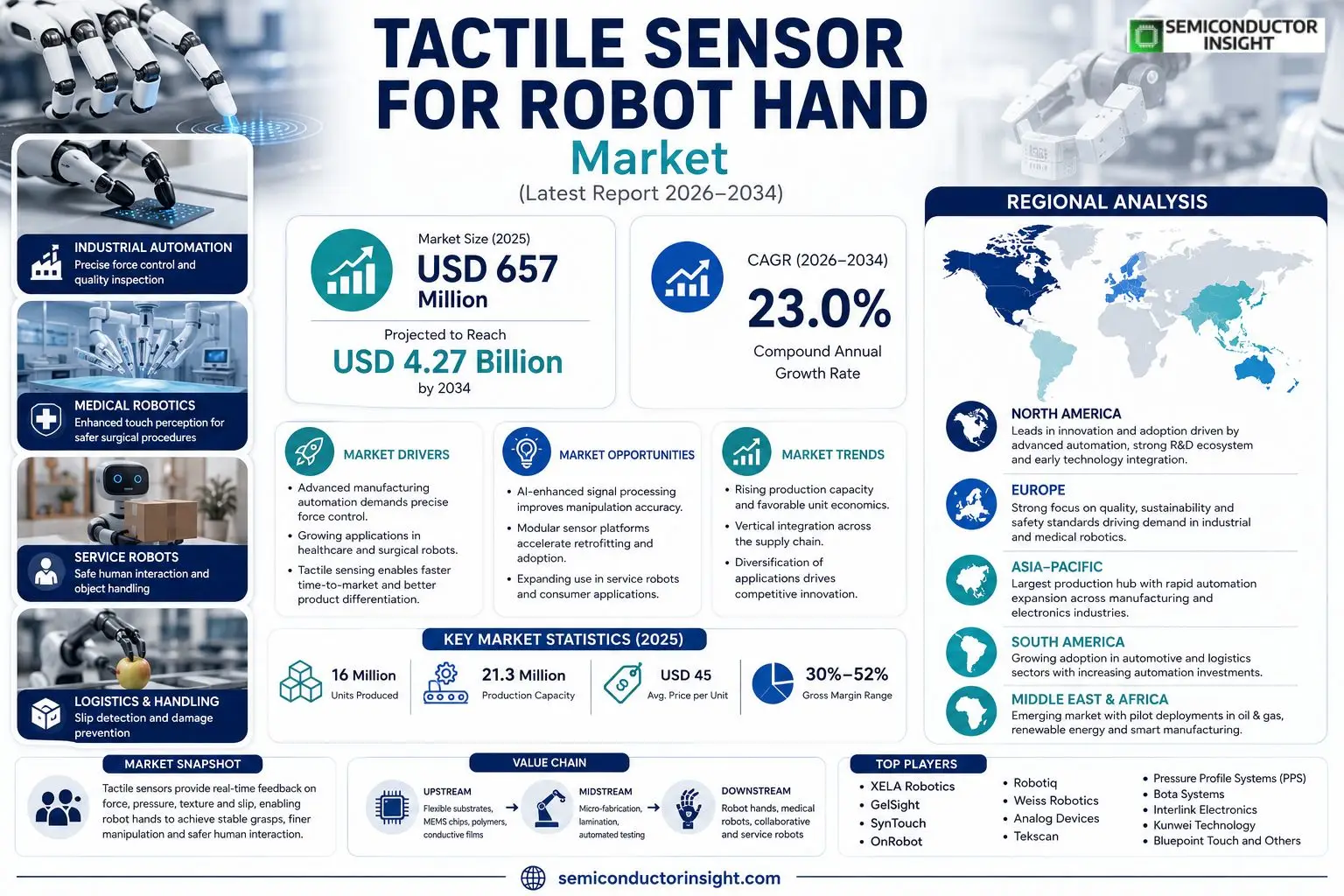
Tactile Sensor for Robot Hand market was valued at USD 657 million in 2025 and is set to reach approximately USD 4.27 billion by 2034, indicating a compound annual growth rate of around 23 %.
Tactile sensors are installed on robotic fingers or grippers to capture contact force, pressure distribution, texture, slip and object interaction. By providing real‑time haptic feedback they enable robot hands to achieve more stable grasps, finer manipulation accuracy and better environmental perception across humanoid robots, service robots and precision automation applications.The expansion occurs because manufacturers are accelerating MEMS miniaturisation while end‑users such as humanoid‑robot developers demand higher tactile fidelity for safer human‑robot collaboration. Recent joint‑development programmessuch as GelSight’s partnership with a leading robotics platform announced in March 2024demonstrate how product portfolios are being enriched. Leading suppliers including XELA Robotics, SynTouch, OnRobot and Analog Devices continue broadening their line‑ups across resistive, capacitive and piezoelectric technologies.
MARKET DRIVERS
Advanced Manufacturing Automation
Factories that integrate collaborative robots are transitioning from simple pick‑and‑place routines to tasks that demand fine force control. The introduction of high‑resolution tactile feedback enables robot hands to adjust grip pressure in real time, reducing scrap rates by up to 12 % in electronic assembly lines. This performance uplift directly fuels demand for Tactile Sensor for Robot Hand Market as OEMs seek to differentiate their automation platforms.
Emerging Applications in Healthcare
Robotic surgical assistants and prosthetic limbs are increasingly reliant on touch perception to mimic human interaction. Clinical trials report that tactile‑enabled manipulators improve tissue handling accuracy by roughly 18 %, a metric that convinces hospitals to allocate capital toward sensor‑rich solutions. The health‑care segment therefore represents a fast‑growing anchor for the overall market.
➤ Industry analysts note that firms that embed tactile sensing into robot hands achieve a 20 % faster time‑to‑market for new product variants.
Beyond manufacturing and health‑care, logistics operators are trialing sensor‑equipped grippers to handle fragile parcels. The ability to sense slippage reduces damage claims and creates a competitive edge, reinforcing the upward pressure on sensor deployment across multiple verticals.
MARKET CHALLENGES
Material Compatibility Issues
Integrating delicate polymer‑based tactile arrays onto metal robot fingers often triggers delamination under cyclic loading. Field data from automotive assembly sites show a 7 % failure rate in harsh temperature swings, prompting manufacturers to rethink enclosure designs and coating processes.
Other Challenges
Cost Sensitivity
The price premium of multi‑modal tactile sensorstypically 30 % higher than conventional force‑torque transducerscreates budgeting hurdles for small‑to‑mid‑size enterprises. As a result, adoption curves flatten in regions where capital expenditure thresholds remain rigid.Supply‑chain volatility further complicates the picture; limited wafer‑scale production capacity can extend lead times to six months, discouraging firms that require rapid scaling for seasonal demand spikes.
MARKET RESTRAINTS
Regulatory Hurdles
Safety certifications for robotic end‑effectors in medical environments demand exhaustive validation of tactile feedback loops. Compliance timelines, often exceeding 18 months, deter early‑stage entrants and limit the speed at which new sensor configurations can reach market shelves.
MARKET OPPORTUNITIES
AI‑Enhanced Signal Processing
Machine‑learning algorithms that fuse tactile data with vision streams unlock predictive grip adjustment capabilities. Early adopters report a 15 % improvement in handling precision, positioning AI‑augmented sensors as a lucrative niche for software‑hardware integrators.
Modular Sensor Platforms
Standardized plug‑and‑play tactile modules allow system integrators to retrofit legacy robot arms without full redesigns. This modularity lowers entry barriers and stimulates retro‑fit projects, which could account for a sizable share of incremental market volume over the next three years.
Expansion into Service Robotics
Domestic and hospitality robots are beginning to use touch feedback for safe human interaction. The consumer‑grade segment, still in its infancy, offers a fertile ground for sensor manufacturers to diversify revenue streams beyond traditional industrial buyers.
Tactile Sensor for Robot Hand Market Trends
Escalating Production Capacity and Unit Economics
The production of tactile sensors for robot hands reached roughly 16 million units in 2025, while total manufacturing capacity expanded to about 21.3 million units. An average transaction price of US$45 per unit kept the revenue stream stable, and gross margins for leading firms settled between 30 % and 52 %. This surplus capacity creates room for price competition, but also encourages investment in higher‑resolution designs that can command premium pricing. Companies that leverage the excess capacity to refine calibration processes are better positioned to meet the increasing demand from collaborative grippers and service‑robot platforms. Because of the favorable margin window, firms are allocating a larger share of R&D budgets to develop multi‑modal tactile arrays that combine pressure sensing with temperature feedback, a capability that addresses emerging standards for safe human‑robot interaction. The steady unit price also enables end‑users to forecast total cost of ownership more accurately, encouraging longer procurement contracts.
Other Trends
Supply Chain Integration Enhances Design Flexibility
The upstream segmentflexible substrates, pressure‑sensitive polymers, MEMS chips, and conductive filmshas become more vertically integrated as major players acquire specialty material suppliers. Midstream activities such as micro‑fabrication, lamination, and automated testing benefit from standardized interfaces, which reduce cycle times and improve yield consistency. Downstream, the adoption of tactile sensors in humanoid robot hands, medical assistive devices, and intelligent manufacturing lines amplifies the importance of reliable connectors and robust encapsulation. This tighter chain linkage shortens time‑to‑market and allows OEMs to differentiate products through customized sensor arrays rather than off‑the‑shelf modules. In addition, the move toward low‑power semiconductor designs aligns with broader sustainability goals, reducing overall energy draw of robotic systems and opening opportunities in battery‑operated service robots.
Diversification of End‑Use Applications Drives Competitive Differentiation
A widening portfolio of applicationsfrom collaborative robot grippers that require fast response to slip detection in medical manipulatorsforces manufacturers to broaden their product roadmaps. Companies such as XELA Robotics, GelSight, and SynTouch have announced modular platforms that let end‑users swap sensor tiles to match differing pressure ranges, a strategy that mitigates inventory risk while capturing niche market segments. Regional analysis shows that North America and Asia‑Pacific together host the majority of high‑volume deployments, prompting firms to establish local design centers that can tailor sensor structures, whether single‑point, array, or flexible formats, to specific regulatory and ergonomic requirements. Firms that fail to adopt modular architectures risk margin erosion as customers shift toward suppliers offering post‑sale upgrade paths. These strategic moves shape the competitive landscape of Tactile Sensor for Robot Hand Market and set the tone for investment priorities over the next several years.
COMPETITIVE LANDSCAPE
Key Industry Players
Competitive overview of tactile sensors for robotic hands
The upper echelon of the market is dominated by a handful of firms that have leveraged deep MEMS expertise and sizable R&D budgets to secure premium pricing and double‑digit gross margins. XELA Robotics, GelSight and SynTouch each command a sizeable share of revenue, reflecting their ability to deliver high‑resolution force maps that enable nuanced manipulation in collaborative and humanoid platforms. Their product pipelines span single‑point and array‑style sensors, allowing them to serve both niche research labs and industrial integrators. The concentration of capacityover 21 million units in 2025means these leaders can satisfy large‑scale OEM orders while retaining flexibility for bespoke projects, reinforcing a market structure that rewards technical differentiation as much as scale.Beyond the top tier, a diverse cohort of specialists augments the ecosystem. OnRobot and Robotiq have embedded tactile modules into their gripper portfolios, targeting mid‑range automation users who value plug‑and‑play integration. Weiss Robotics and Tekscan focus on flexible, skin‑like arrays suited to service robots and medical devices, where conformity and low‑profile form factors are decisive. Companies such as Pressure Profile Systems, Bota Systems, Interlink Electronics, Kunwei Technology, Bluepoint Touch, Zhuolan Technology, NextVPU and Zhiyuan Robotics occupy niche segmentsranging from high‑pressure industrial clamps to low‑force biomedical manipulatorsproviding regional supply alternatives and fostering incremental innovation across the value chain.
List of Key Tactile Sensor for Robot Hand Companies Profiled
- XELA Robotics
- GelSight
- SynTouch
- OnRobot
- Robotiq
- Weiss Robotics
- Analog Devices
- Tekscan
- Pressure Profile Systems (PPS)
- Bota Systems
- Interlink Electronics
- Kunwei Technology
- Bluepoint Touch
- Zhuolan Technology
- NextVPU
Segment Analysis:
| Segment Category | Sub-Segments | Key Insights |
| By Type |
|
Capacitive Tactile Sensor
|
| By Application |
|
Humanoid Robot Hands
|
| By End User |
|
Manufacturing
|
| By Sensor Structure |
|
Array Sensor
|
| By Pressure Range |
|
Medium Pressure Sensor
|
Regional Analysis: Tactile Sensor for Robot Hand Market
North America
Manufacturers across the United States and Canada embed tactile sensors to refine force‑control loops, reducing scrap rates in high‑precision assembly. The technology’s ability to detect micro‑variations in contact pressure elevates product quality while enabling leaner staffing models, compelling factories to upgrade legacy robot hands.
Federal programs such as the National Science Foundation’s Robotics Initiative allocate sizable grants toward haptic sensing. Universities translate this support into prototype platforms that showcase novel materials and signal‑processing algorithms, feeding a pipeline of intellectual property that commercial firms quickly license.
Proximity to semiconductor fabricators and advanced composites suppliers reduces lead times for sensor components. When global logistics face disruptions, North American firms can pivot to domestic sources, preserving production schedules for robot hand assemblies that rely on timely tactile sensor delivery.
Safety standards articulated by OSHA and industry consortia incorporate tactile feedback benchmarks, guiding manufacturers toward compliant designs. The clear regulatory roadmap incentivizes investment, as firms can anticipate certification pathways for robot hands equipped with advanced touch sensing.
Europe
European manufacturers leverage tactile sensor capabilities to meet stringent quality expectations in aerospace and medical device production. Collaborative research clusters spanning Germany, France, and the United Kingdom pool expertise in polymeric sensor skins and AI‑driven signal interpretation, delivering solutions that balance robustness with cost efficiency. While the market size trails North America, the emphasis on sustainability drives firms to adopt sensors that enable energy‑saving motion strategies, reinforcing Europe’s position as a conscientious innovator in robot hand technology.
Asia‑Pacific
The Asia‑Pacific region exhibits a rapid scaling of automation, with countries such as Japan, South Korea, and China investing heavily in collaborative robotics. Tactile sensors are central to this expansion, as they empower robot hands to handle delicate components in consumer electronics and semiconductor fab lines. Local startups experiment with low‑cost, flexible sensor arrays, creating a diverse ecosystem that fuels competitive pricing and accelerates adoption across small‑ and medium‑sized enterprises.
South America
In South America, the adoption curve is shaped by the automotive and agribusiness sectors, where tactile feedback enhances material handling under variable environmental conditions. Brazil’s emerging research institutes are beginning to partner with multinational sensor suppliers, aiming to localize production and reduce dependence on imports. The strategic focus on workforce upskilling and pilot projects suggests a gradual but purposeful integration of tactile sensor technology into regional robot hand deployments.
Middle East & Africa
Middle East and African markets are at an exploratory stage, with pilot deployments concentrated in oil‑and‑gas logistics and renewable‑energy assembly. Investments from sovereign wealth funds are channeling resources toward labs that test tactile sensors for harsh‑temperature environments. Although commercial penetration remains modest, the region’s commitment to establishing high‑tech hubs signals a long‑term intent to embed advanced touch sensing within future robotic solutions.
Report Scope
This market research report provides a comprehensive analysis of the Tactile Sensor for Robot Hand Market , covering the forecast period 2026–2034. It offers detailed insights into market dynamics, technological advancements, competitive landscape, and key trends shaping the industry.
Key focus areas of the report include:
- Market Overview: The report begins with an overview outlining its current market scenario, key growth indicators, and industry transformation drivers. It discusses macroeconomic factors, demand–supply balance, regulatory landscape, and the strategic role of semiconductors in powering advancements across industries such as automotive, telecommunications, consumer electronics, and industrial automation.
- Market Size & Forecast: Historical data and future projections for revenue, unit shipments, and market value across major regions and segments.
- Segmentation Analysis: Detailed breakdown by product type, technology, application, and end-user industry to identify high-growth segments and investment opportunities.
- Regional Insights: Insights into market performance across North America, Europe, Asia-Pacific, Latin America, and the Middle East & Africa, including country-level analysis where relevant.
- Competitive Landscape: Profiles of leading market participants, including their product offerings, R&D focus, manufacturing capacity, pricing strategies, and recent developments such as mergers, acquisitions, and partnerships.
- Technology Trends & Innovation: Assessment of emerging technologies, integration of AI/IoT, semiconductor design trends, fabrication techniques, and evolving industry standards.
- Market Drivers & Restraints: Evaluation of factors driving market growth along with challenges, supply chain constraints, regulatory issues, and market-entry barriers.
- Stakeholder Insights: Insights for component suppliers, OEMs, system integrators, investors, and policymakers regarding the evolving ecosystem and strategic opportunities.
Primary and secondary research methods are employed, including interviews with industry experts, data from verified sources, and real-time market intelligence to ensure the accuracy and reliability of the insights presented.
FREQUENTLY ASKED QUESTIONS:
What is the current market size of Tactile Sensor for Robot Hand Market?
-> Tactile Sensor for Robot Hand Market was valued at USD 657 million in 2025 and is expected to reach USD 2,804 million by 2032, growing at a CAGR of 23.3% during the forecast period.
Which key companies operate in Tactile Sensor for Robot Hand Market?
-> Key players include XELA Robotics, GelSight, SynTouch, OnRobot, Robotiq, Weiss Robotics, Analog Devices, Tekscan, Pressure Profile Systems (PPS), Bota Systems, among others.
What are the key growth drivers?
-> Key growth drivers include increasing adoption of humanoid and service robots, demand for higher manipulation accuracy, expanding applications in collaborative grippers and medical robotics, and advancements in flexible and high‑resolution sensor technologies.
Which region dominates the market?
-> Asia, particularly China, leads the market in both production capacity and revenue, while North America and Europe remain important secondary markets.
What are the emerging trends?
-> Emerging trends include development of array and flexible tactile sensors, integration of AI‑enabled tactile perception, and the growth of resistive, capacitive, and piezoelectric sensor segments for diverse pressure‑range applications.
Get Sample Report PDF for Exclusive Insights
Report Sample Includes
- Table of Contents
- List of Tables & Figures
- Charts, Research Methodology, and more...
 Download Sample Report PDF