Wire-Wound Surface Mount Chip Inductors Market Insights
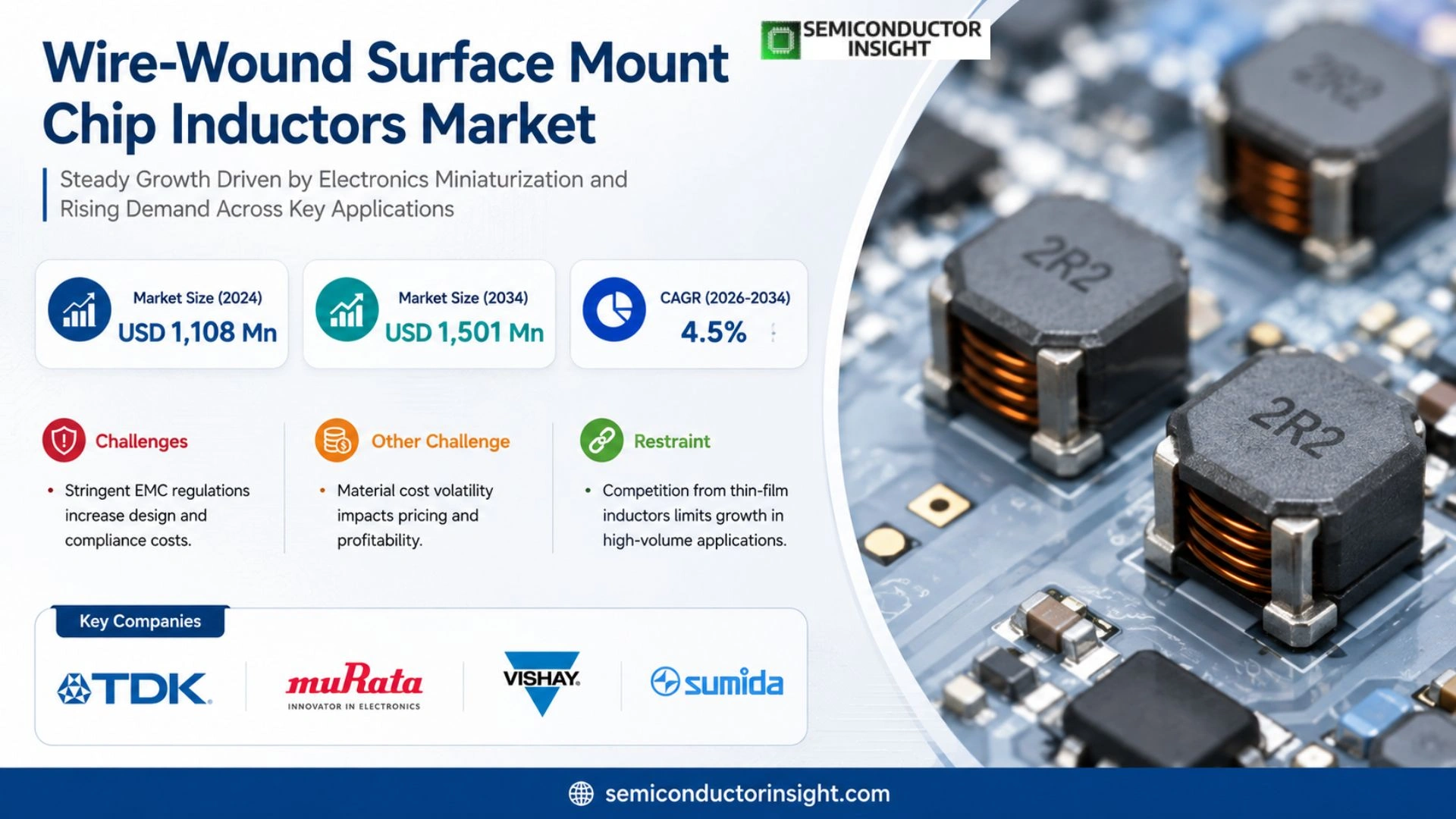
Wire-Wound Surface Mount Chip Inductors market size was valued at USD 1,108 million in 2024. The market is projected to grow from USD 1,108 million in 2026 to USD 1,501 million by 2034, exhibiting a CAGR of 4.5% during the forecast period.
Wire‑wound surface‑mount chip inductors are passive components that provide a wide inductance range with high precision while tolerating large permissible currents. They are produced by winding conductive wire around magnetic or ceramic cores, resulting in compact devices suited for high‑frequency applications such as communications modules, automotive electronics, consumer gadgets and computer hardware.
The sector is expanding because system designers require higher performance in ever‑smaller form factors without sacrificing efficiency. Growing deployment of advanced communication networks, electric‑vehicle power electronics and IoT devices drives demand for these inductors. Key suppliers,including TDK, Murata, Taiyo Yuden, Vishay and Sumida,command roughly 65 % of global shipments; China alone represents about 50 % of total volume.
MARKET DRIVERS
Shift Toward Mini‑aturized Electronics
Manufacturers of handheld devices and wearables are compressing bill of material footprints to meet escalating consumer expectations. Wire‑Wound Surface Mount Chip Inductors deliver high inductance in a compact footprint, enabling designers to shrink RF front‑ends without compromising performance. This design imperative fuels adoption across smartphones, IoT sensors, and medical wearables, where every millimeter of board space translates into measurable competitive advantage.
Rising Demand for High‑Frequency Power Management
Power‑delivery architectures in 5G radio modules and electric‑vehicle chargers now operate above 1 GHz, a regime where traditional multilayer inductors suffer loss. Wire‑Wound Surface Mount Chip Inductors exhibit superior Q‑factor at these frequencies, reducing thermal dissipation and extending product life‑cycles. OEMs therefore prioritize these components to meet efficiency targets and regulatory limits on heat generation.
➤ “Design teams cite inductance density as the decisive factor when selecting components for next‑gen RF modules.”
Beyond performance, the supply chain for precision‑wound inductors has benefited from automation investments in Asia‑Pacific foundries. Faster lead times and tighter tolerances lower inventory costs, prompting original equipment manufacturers to lock in longer‑term contracts, which in turn reinforces market momentum.
MARKET CHALLENGES
Stringent Electromagnetic Compatibility (EMC) Regulations
Regulatory bodies across Europe and North America are tightening emissions limits for consumer electronics. While Wire‑Wound Surface Mount Chip Inductors help attenuate noise, their design flexibility is constrained by the need to meet exact shielding specifications, driving up development cycles and validation expenses for smaller suppliers.
Other Challenges
Material Cost Volatility
The price of high‑purity copper and specialty ferrite powders fluctuates with global commodity cycles. When raw‑material costs surge, manufacturers either absorb the hit, eroding margins, or pass it to downstream buyers, which can dampen demand in price‑sensitive segments such as low‑cost IoT devices.
MARKET RESTRAINTS
Competition from Thin‑Film Technologies
Thin‑film inductors have closed the performance gap at lower frequencies while offering superior batch‑to‑batch consistency. Their cost advantage in high‑volume automotive applications creates a head‑to‑head rivalry that limits the expansion potential of the wire‑wound segment, especially where ultra‑high inductance is not a prerequisite.
Furthermore, the integration trend toward system‑in‑package (SiP) solutions embeds passive components directly on silicon, reducing the need for discrete inductors in certain high‑density modules. This architectural shift compresses the addressable market for traditional surface‑mount parts.
MARKET OPPORTUNITIES
Emergence of Wide‑Bandgap Power Devices
Silicon‑carbide (SiC) and gallium‑nitride (GaN) converters demand inductors that can endure higher ripple currents without saturation. Wire‑Wound Surface Mount Chip Inductors are uniquely positioned to meet these thermal and electrical stresses, opening a niche in power‑train modules for electric vehicles and renewable‑energy inverters.
In parallel, the proliferation of edge‑computing nodes in industrial automation creates a requirement for rugged, high‑Q inductors capable of sustained operation in harsh environments. Tailoring magnetic‑core formulations for temperature‑stable performance could unlock a lucrative segment that values reliability over unit cost.
Wire-Wound Surface Mount Chip Inductors Market Trends
Shift Toward High‑Precision Magnetic Cores
The adoption of magnetic‑core wire‑wound designs has accelerated as manufacturers chase tighter inductance tolerances required by 5G front‑end modules and advanced power‑management ICs. Unlike thin‑film alternatives, wire‑wound structures preserve a broader inductance range while delivering current handling that aligns with the higher power densities of modern communication boards. This technical advantage is prompting original equipment manufacturers to favor the wire‑wound form factor for sub‑100 µH applications, especially where temperature stability and low‑DCR are mission‑critical. Consequently, suppliers are investing in alloy‑optimised winding techniques and tighter coil‑geometry controls to safeguard performance against the tighter electromagnetic‑interference (EMI) budgets of next‑generation devices.
Other Trends
Regional Concentration and Competitive Landscape
China commands roughly half of the global demand, reflecting its role as both a primary design hub and a major assembly base for consumer and automotive electronics. Southeast Asia and Japan together account for another fifth, underscoring a tiered supply chain where high‑volume production resides in China while niche, high‑reliability batches are sourced from Japan’s precision‑focused firms. The five leading players,TDK, Murata, Taiyo Yuden, Vishay and Sumida,collectively hold about 65 % of market share, enabling them to steer pricing trends and dictate product roadmaps. Their dominance is reinforced by extensive IP portfolios covering winding automation and proprietary core formulations, which raise entry barriers for smaller outfits attempting to compete on cost alone.
Application‑Driven Diversification
Communications continues to be the premier application segment, driven by the rollout of broadband infrastructure and the proliferation of IoT gateways. Automotive electronics follows closely, as electric‑vehicle power‑train control units and advanced driver‑assistance systems demand inductors that can survive vibration and thermal cycling while maintaining inductance accuracy. Meanwhile, consumer‑electronics designers are exploring wire‑wound chip inductors for wearables, where space constraints intersect with the need for stable energy storage during rapid charge‑discharge cycles. This diversification forces manufacturers to broaden their product portfolios, offering variants tuned for RF, power‑stage, and mixed‑signal environments, thereby creating cross‑selling opportunities that can cushion cyclical demand fluctuations.
COMPETITIVE LANDSCAPE
Key Industry Players
Wire‑Wound Surface Mount Chip Inductors – Competitive Overview
The market is dominated by a handful of global electronics firms that command the bulk of revenue. TDK, Murata Manufacturing, Taiyo Yuden, Vishay Intertechnology and Sumida hold roughly 65 % of worldwide sales, reflecting a highly concentrated structure. Their advantage stems from mature foundry capacity, extensive product portfolios covering ceramic and ferrite cores, and deep relationships with OEMs in communications and automotive electronics. By leveraging scale, they can absorb price pressure while maintaining tight tolerance specifications that end‑users demand for high‑frequency modules. This concentration creates a barrier for newcomers, as entry requires substantial capital investment in winding technology and certification.
Beyond the top tier, a second tier of specialist manufacturers supplies niche or region‑specific designs. Companies such as KYOCERA AVX, Coilmaster Electronics, Bourns, Johanson Technology, Zxcompo, Erocore, Core Master Enterprise, ZONKAS ELECTRONIC, JANTEK Electronics and Fenghua (HK) Electronics have carved out positions by focusing on customized inductance values, localized supply chains, or cost‑effective ferrite variants for consumer electronics. Their agility enables rapid response to emerging standards in RF technique or antenna amplifiers, where bespoke inductance and current handling are critical. Although their collective market share remains modest, they influence pricing dynamics and drive incremental innovation that larger players eventually adopt.
List of Key Wire‑Wound Surface Mount Chip Inductors Companies Profiled
- TDK
- Murata Manufacturing
- Vishay Intertechnology
- Sumida Corporation
- Taiyo Yuden
- KYOCERA AVX
- Coilmaster Electronics
- Bourns
- Johanson Technology
- Zxcompo
- Erocore
- Core Master Enterprise
Segment Analysis:
| Segment Category | Sub-Segments | Key Insights |
| By Type |
|
Leading Segment
|
| By Application |
|
Leading Segment
|
| By End User |
|
Leading Segment
|
| By Performance Characteristics |
|
Leading Segment
|
| By Integration Level |
|
Leading Segment
|
Regional Analysis: Wire-Wound Surface Mount Chip Inductors Market
Silicon Valley, Austin and the Boston corridor host a dense network of design houses that routinely embed wire‑wound surface mount chip inductors in prototype boards, pushing performance envelopes and establishing best‑practice design guidelines for the broader industry.
Localized winding plants and nearby metallurgical suppliers enable rapid adjustments to coil specifications, granting OEMs the flexibility to respond to short‑run automotive electrification programmes without incurring long lead times.
Energy‑efficiency directives such as ENERGY STAR and emerging IEC standards incentivise the use of high‑inductance, low‑loss components, directly benefitting manufacturers of wire‑wound surface mount chip inductors.
The region’s automotive, aerospace and consumer electronics sectors demand compact magnetic solutions with tight tolerances, creating a steady pipeline of design contracts that sustain long‑term market growth.
Europe
European manufacturers leverage a strong heritage in precision winding techniques, especially in Germany and the United Kingdom, where high‑mix, low‑volume production aligns with niche applications such as medical imaging and defense avionics. Energy‑saving mandates across the EU stimulate demand for inductors that can operate at higher frequencies while maintaining low core losses, prompting local suppliers to differentiate through material science innovations rather than sheer volume. Collaborative R&D programmes funded by Horizon Europe further tighten the feedback loop between academia and component producers, ensuring that design guidelines evolve in step with emerging standards for electromagnetic compatibility.
Asia‑Pacific
The Asia‑Pacific region has become a crucible for cost‑effective manufacturing, with China, South Korea and Taiwan investing heavily in automated winding lines that balance price pressure against quality expectations. While the market is often viewed through a volume lens, rising smart‑phone and electric‑vehicle production in India and Vietnam is driving a parallel need for high‑performance inductors that satisfy stricter thermal and size constraints. Regional trade agreements are easing cross‑border component flow, yet localized design expertise remains limited, prompting many OEMs to rely on North American or European design houses for the most demanding specifications.
South America
In South America, Brazil’s burgeoning renewable‑energy sector and Argentina’s expanding automotive assembly lines are creating modest but growing pockets of demand for compact magnetic components. Local distributors are beginning to stock wire‑wound surface mount chip inductors that meet IEC 60068 reliability tests, facilitating quicker adoption in infrastructure projects. However, the region’s fragmented supply network and limited high‑frequency design capabilities mean that many manufacturers still import core technologies, positioning South America as an emerging rather than leading consumer.
Middle East & Africa
The Middle East and Africa exhibit a mixed portrait: Gulf Cooperation Council nations are investing heavily in datacenter and 5G roll‑out projects, which require inductors that can sustain high current densities in constrained footprints. Meanwhile, South Africa’s industrial automation push introduces modest demand for ruggedized magnetic solutions. Market growth is tempered by logistical challenges and a relatively small pool of specialized design talent, compelling regional OEMs to partner with established global suppliers to meet performance criteria while maintaining cost competitiveness.
Report Scope
This market research report provides a comprehensive analysis of the Wire-Wound Surface Mount Chip Inductors Market , covering the forecast period 2026–2034. It offers detailed insights into market dynamics, technological advancements, competitive landscape, and key trends shaping the industry.
Key focus areas of the report include:
- Market Overview: The report begins with an overview outlining its current market scenario, key growth indicators, and industry transformation drivers. It discusses macroeconomic factors, demand–supply balance, regulatory landscape, and the strategic role of semiconductors in powering advancements across industries such as automotive, telecommunications, consumer electronics, and industrial automation.
- Market Size & Forecast: Historical data and future projections for revenue, unit shipments, and market value across major regions and segments.
- Segmentation Analysis: Detailed breakdown by product type, technology, application, and end-user industry to identify high-growth segments and investment opportunities.
- Regional Insights: Insights into market performance across North America, Europe, Asia-Pacific, Latin America, and the Middle East & Africa, including country-level analysis where relevant.
- Competitive Landscape: Profiles of leading market participants, including their product offerings, R&D focus, manufacturing capacity, pricing strategies, and recent developments such as mergers, acquisitions, and partnerships.
- Technology Trends & Innovation: Assessment of emerging technologies, integration of AI/IoT, semiconductor design trends, fabrication techniques, and evolving industry standards.
- Market Drivers & Restraints: Evaluation of factors driving market growth along with challenges, supply chain constraints, regulatory issues, and market-entry barriers.
- Stakeholder Insights: Insights for component suppliers, OEMs, system integrators, investors, and policymakers regarding the evolving ecosystem and strategic opportunities.
Primary and secondary research methods are employed, including interviews with industry experts, data from verified sources, and real-time market intelligence to ensure the accuracy and reliability of the insights presented.
FREQUENTLY ASKED QUESTIONS:
What is the current market size of Wire-Wound Surface Mount Chip Inductors Market?
-> Wire-Wound Surface Mount Chip Inductors market is projected to grow from USD 1,108 million in 2026 to USD 1,501 million by 2034, exhibiting a CAGR of 4.5%
Which key companies operate in Wire-Wound Surface Mount Chip Inductors Market?
-> Key players include TDK, Murata, Taiyo Yuden, Vishay, Sumida, among others.
What are the key growth drivers?
-> Key growth drivers include wide inductance range, high inductance precision, large permissible current, and rising demand in communications, automotive electronics, and consumer electronics.
Which region dominates the market?
-> China is the largest market, accounting for about 50% share, followed by Southeast Asia and Japan contributing roughly 20% collectively.
What are the emerging trends?
-> Emerging trends include increasing adoption of magnetic‑core inductors for communications applications and expanding use in automotive electronics.

Get Sample Report PDF for Exclusive Insights
Report Sample Includes
- Table of Contents
- List of Tables & Figures
- Charts, Research Methodology, and more...
 Download Sample Report PDF