Wearable Device Board to Board Connector Market Insights
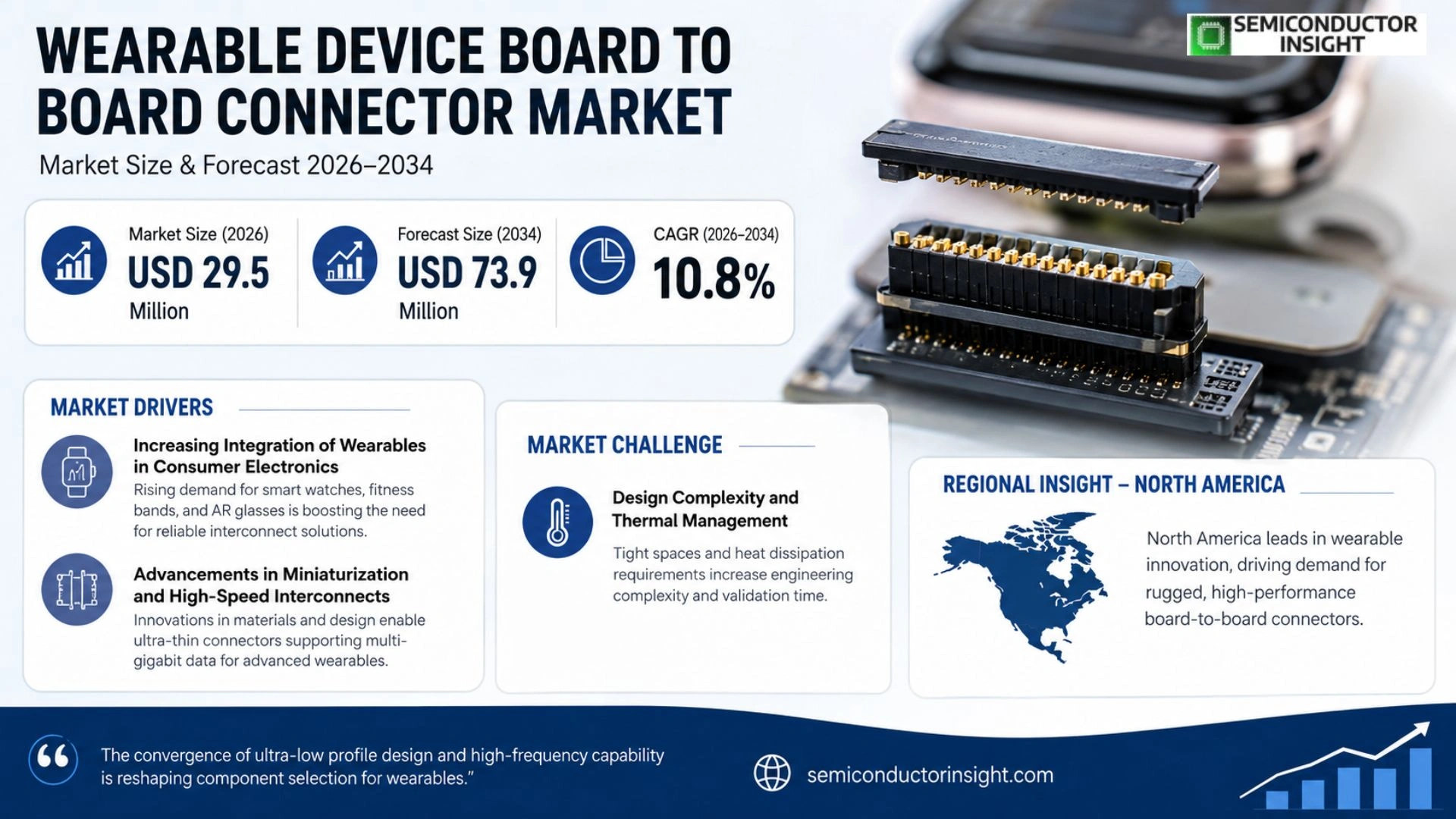
Global Wearable Device Board to Board Connector market size was USD 26.6 million in 2024, grew to approximately USD 29.5 million in 2026 and will reach USD 73.9 million by 2034, reflecting an implied CAGR of about 10.8% over the period.
Small form factor board‑to‑board (BTB) connectors are employed in stackable configurations that enable precise interconnection between printed circuit boards (PCBs). They accommodate diverse PCB orientations, spacing tolerances and design constraints while offering a range of materials, platings, pin spacings and heights that satisfy electrical performance and mechanical robustness requirements.
The expansion of wearable electronics,such as smart watches, wireless earbuds and AR glasses,creates sustained demand for compact, high‑speed interconnect solutions that minimize profile height yet maintain signal integrity. Manufacturers including TE Connectivity, Amphenol and Molex have broadened their portfolios with low‑profile high‑frequency series introduced in early‑2024, responding to OEM pressure for thinner devices with longer battery life.
MARKET DRIVERS
Increasing Integration of Wearables in Consumer Electronics
The proliferation of smart watches, fitness bands, and AR glasses has forced OEMs to adopt smaller, more reliable interconnect solutions. Board‑to‑board connectors that can sustain repeated flex cycles while maintaining signal integrity are becoming indispensable, prompting a noticeable uptick in orders across Wearable Device Board to Board Connector Market. Manufacturers that can guarantee consistent performance under daily motion are seeing a surge in design wins.
Advancements in Miniaturization and High‑Speed Interconnects
Recent breakthroughs in substrate materials and contact geometry enable connections that are both thinner and capable of handling multi‑gigabit data streams. This technical progress aligns with the demand for richer sensor arrays and real‑time analytics on the wrist or ear, compelling system designers to specify next‑generation connectors. Companies that invest in these high‑density solutions are capturing a larger share of Wearable Device Board to Board Connector Market.
➤ “The convergence of ultra‑low profile design and high‑frequency capability is reshaping component selection for wearables, turning connectors into strategic assets rather than mere passive parts.”
Consequently, the pace of product refresh cycles has accelerated; designers now iterate faster to stay competitive. The enhanced reliability of modern connectors reduces warranty costs, allowing brands to allocate resources toward feature differentiation rather than troubleshooting.
MARKET CHALLENGES
Design Complexity and Thermal Management
Embedding multiple sensors, batteries, and antennas in a confined chassis forces engineers to confront tight clearances and heat dissipation issues. Board‑to‑board connectors must therefore balance a minimal footprint with adequate thermal pathways, a compromise that raises engineering effort and validation time. Projects that overlook these nuances often encounter late‑stage redesigns, inflating development budgets.
Other Challenges
Regulatory Compliance
Compliance with regional safety and electromagnetic compatibility (EMC) standards adds another layer of scrutiny. Suppliers that cannot provide documented test results for RoHS, REACH, or specific medical device directives may lose contracts, especially in health‑focused wearables where certification is non‑negotiable.
MARKET RESTRAINTS
Cost Sensitivity in High‑Volume Production
Mass‑market wearables compete on price, exerting pressure on component costs. Even marginal price differences in connectors can erode profit margins when units run into the tens of millions. Vendors that rely on niche materials or low‑volume tooling may find their offerings priced out of the mainstream segment of Wearable Device Board to Board Connector Market.
Furthermore, supply‑chain volatility,driven by fluctuations in raw‑material availability,can magnify cost challenges. Manufacturers must negotiate long‑term contracts or adopt flexible pricing models to remain viable, a task that smaller players often struggle to execute.
These financial constraints discourage risk‑averse OEMs from experimenting with unproven connector architectures, thereby slowing the adoption of potentially superior technologies.
MARKET OPPORTUNITIES
Emerging Applications in Health Monitoring
Continuous glucose monitoring, ECG patches, and wearable spirometers are transitioning from niche to mainstream healthcare solutions. Such devices demand connectors that can survive harsh physiological environments while delivering uninterrupted data streams. Companies that tailor board‑to‑board solutions for biocompatibility and sterilization protocols are poised to capture a growing slice of Wearable Device Board to Board Connector Market.
In parallel, the rise of edge‑AI processors on wearable platforms creates a need for connectors supporting higher pin counts and faster signaling. Vendors that pre‑emptively design for upcoming AI chip specifications can embed themselves early in the value chain, securing design‑win agreements that extend throughout product lifecycles.
Lastly, the expansion of wearables into industrial safety and logistics introduces new certification requirements and ruggedization standards. Suppliers that develop modular connector families capable of quick adaptation to diverse form factors will find ample room for differentiation and revenue expansion.
Wearable Device Board to Board Connector Market Trends
Miniaturization and Stacking Height Reduction
The most visible shift in Wearable Device Board to Board Connector Market is the relentless push toward thinner stack heights. Designers of smart watches, wireless earbuds and emerging VR/AR headsets are now routinely specifying connectors under 0.7 mm to meet overall device thickness limits while preserving mechanical robustness. This move is not merely aesthetic; it enables tighter integration of sensors, battery packs and antennas, thereby expanding functional density without inflating the bill of materials. Because the market size doubled from roughly $26 million in 2024 to an anticipated $54 million by 2031, manufacturers that can guarantee sub‑0.7 mm performance while maintaining low insertion loss are gaining preferential treatment in procurement decisions. The trend also pressures supply chains to adopt precision stamping and advanced plating processes that can sustain reliability across millions of mating cycles.
Other Trends
Material Innovations for Reliability
High‑speed data paths and power‑dense modules in wearables demand connectors that resist corrosion, temperature swings and mechanical fatigue. Recent product launches from TE Connectivity, Molex and Amphenol feature copper‑alloy alloys with nickel‑palladium‑gold platings that balance conductivity with surface endurance. Concurrently, polymer‑based insulators with lower dielectric constants are being introduced to curb signal attenuation in high‑frequency applications such as AR glasses. These material advances are critical because a failure in a connector can lead to whole‑device recalls, eroding brand credibility and inflating warranty costs. Companies that secure a reliable supply of advanced materials are better positioned to negotiate volume contracts and to differentiate their product lines through longer mean‑time‑between‑failures metrics.
Diversification of Application Portfolios
Beyond traditional smart watches, Wearable Device Board to Board Connector Market is seeing a notable expansion into niche categories like medical monitoring patches and low‑profile hearing aids. Each segment imposes distinct electrical and mechanical specifications; for example, medical patches prioritize biocompatibility and hermetic sealing, while hearing aids focus on ultralight weight and acoustic isolation. The proliferation of these applications stimulates demand for a broader range of connector types,including floating and power‑optimized variants,while also encouraging OEMs to adopt modular designs that can be re‑used across product families. This diversification reduces dependence on any single end‑use, smoothing revenue volatility and prompting larger players to invest in R&D portfolios that address multiple verticals simultaneously.
COMPETITIVE LANDSCAPE
Key Industry Players
Wearable Device Board‑to‑Board Connector Market – Competitive Overview
TE Connectivity dominates the high‑frequency segment, leveraging its extensive portfolio of miniature BTB solutions that meet stringent size and reliability requirements of smart‑watch and AR‑glass modules. The company’s global footprint, reinforced by a robust supply chain across North America, Europe and Asia‑Pacific, allows it to capture bulk orders from OEMs seeking consistent performance across multiple product generations. Its recent launch of a sub‑0.5 mm stacking‑height series illustrates a strategic push toward ultra‑thin form factors, a move that pressures rivals to accelerate their own miniaturization roadmaps.
Beyond the market leader, a constellation of specialized manufacturers competes on niche attributes such as ultra‑low insertion loss, high‑current capability, or cost‑effective bulk production. Amphenol and Molex have expanded their catalogues with flexible‑cable‑compatible BTB parts, targeting wearable audio and health‑monitoring devices. Panasonic and Kyocera emphasize high‑reliability ceramic housings for medical‑grade wearables. Smaller but agile firms,HRS, LCN, JAE, ECT, OCN, Sunway Communication, YXT, Acon and CSCONN,focus on regional supply, custom plating, or proprietary spring‑lock mechanisms that differentiate them in price‑sensitive or highly regulated segments. This fragmented landscape creates opportunities for partnerships, as larger players often outsource low‑volume custom designs to these niche specialists.
List of Key Wearable Device Board to Board Connector Companies Profiled
- TE Connectivity
- Amphenol
- Molex
- Panasonic
- Kyocera
- HRS
- LCN
- JAE
- ECT
- OCN
- Sunway Communication
- YXT
- Acon
- CSCONN
Segment Analysis:
| Segment Category | Sub-Segments | Key Insights |
| By Type |
|
High‑Speed Connectors are favored for their ability to sustain rapid data transfer in compact wearable modules.
|
| By Application |
|
Smart Watch applications drive demand for miniature, reliable interconnects.
|
| By End User |
|
Healthcare Wearables demand connectors that combine robustness with biocompatibility.
|
| By Stacking Height |
|
Below 0.7 mm height solutions dominate premium wearables where device thickness is a critical differentiator.
|
| By Material |
|
Polyimide material is increasingly preferred for high‑temperature and flexible applications.
|
Regional Analysis: Wearable Device Board to Board Connector Market
North America
Localized silicon fabs and connector foundries mitigate exposure to cross‑border disruptions. Companies capitalize on regional logistics hubs to maintain short lead times, allowing firmware developers to iterate rapidly without inventory bottlenecks.
Frequent collaboration between hardware architects and material scientists accelerates the adoption of flexible substrates, resulting in connectors that accommodate curved displays without compromising electrical performance.
Stringent safety standards for medical‑grade wearables enforce rigorous testing regimes, prompting vendors to embed traceability features within connector designs, thereby enhancing end‑user confidence.
Brands prioritize tactile reliability; connectors that survive repeated donning and doffing become a differentiator, influencing purchasing decisions across consumer and enterprise segments.
Europe
European manufacturers blend precision engineering with sustainability targets, prompting a shift toward connectors fabricated from recyclable alloys. The region’s emphasis on data privacy, especially under GDPR, forces developers to embed secure interconnects that can support encrypted communication pathways. Moreover, cross‑border collaborations among EU research consortia foster standards that emphasize low‑power consumption, aligning with the continent’s broader energy‑efficiency agenda. These dynamics encourage suppliers to refine latch mechanisms and surface finishes that reduce insertion loss while meeting stringent environmental certifications.
Asia-Pacific
In Asia‑Pacific, the sheer volume of wearable device production drives a competitive emphasis on cost‑effective connector solutions. Manufacturers in China, South Korea, and Taiwan leverage high‑volume stamping processes to deliver sub‑micron pitch offerings at scale. Simultaneously, emerging health‑tech startups in Japan and Singapore demand connectors that can survive extreme temperature swings, nudging suppliers toward hybrid ceramic‑metal hybrids. The region’s rapid adoption of 5G also influences connector architecture, as higher data rates necessitate tighter impedance control within board‑to‑board interfaces.
South America
South American markets experience a growing appetite for wearable fitness and remote‑monitoring devices, particularly in Brazil and Argentina. Infrastructure constraints push OEMs to select connectors with robust shielding that can tolerate variable power quality. Local distributors favor modular connector families that simplify inventory management across fragmented retail channels. As consumer awareness of health monitoring rises, firms are increasingly integrating connectors that support over‑the‑air firmware updates, extending device lifecycles in regions where device replacement costs remain a concern.
Middle East & Africa
The Middle East & Africa region showcases a divergent trajectory, where high‑income Gulf states invest heavily in premium wearables for elite sports and security applications, while sub‑Saharan markets prioritize rugged, low‑cost solutions for agricultural monitoring. Suppliers adapt by offering connectors that balance high‑temperature tolerance with economical material choices. Furthermore, the rise of smart‑city initiatives in the UAE introduces standards for secure, high‑density interconnects, compelling vendors to engineer connectors that can operate reliably amidst heightened electromagnetic interference in densely wired environments.
Report Scope
This market research report provides a comprehensive analysis of the Wearable Device Board to Board Connector Market , covering the forecast period 2026–2034. It offers detailed insights into market dynamics, technological advancements, competitive landscape, and key trends shaping the industry.
Key focus areas of the report include:
- Market Overview: The report begins with an overview outlining its current market scenario, key growth indicators, and industry transformation drivers. It discusses macroeconomic factors, demand–supply balance, regulatory landscape, and the strategic role of semiconductors in powering advancements across industries such as automotive, telecommunications, consumer electronics, and industrial automation.
- Market Size & Forecast: Historical data and future projections for revenue, unit shipments, and market value across major regions and segments.
- Segmentation Analysis: Detailed breakdown by product type, technology, application, and end-user industry to identify high-growth segments and investment opportunities.
- Regional Insights: Insights into market performance across North America, Europe, Asia-Pacific, Latin America, and the Middle East & Africa, including country-level analysis where relevant.
- Competitive Landscape: Profiles of leading market participants, including their product offerings, R&D focus, manufacturing capacity, pricing strategies, and recent developments such as mergers, acquisitions, and partnerships.
- Technology Trends & Innovation: Assessment of emerging technologies, integration of AI/IoT, semiconductor design trends, fabrication techniques, and evolving industry standards.
- Market Drivers & Restraints: Evaluation of factors driving market growth along with challenges, supply chain constraints, regulatory issues, and market-entry barriers.
- Stakeholder Insights: Insights for component suppliers, OEMs, system integrators, investors, and policymakers regarding the evolving ecosystem and strategic opportunities.
Primary and secondary research methods are employed, including interviews with industry experts, data from verified sources, and real-time market intelligence to ensure the accuracy and reliability of the insights presented.
FREQUENTLY ASKED QUESTIONS:
What is the current market size of Wearable Device Board to Board Connector Market?
-> Wearable Device Board to Board Connector market grew to approximately USD 29.5 million in 2026 and will reach USD 73.9 million by 2034
Which key companies operate in Wearable Device Board to Board Connector Market?
-> Key players include TE Connectivity, Amphenol, Molex, Panasonic, Kyosera, HRS, LCN, JAE, ECT, OCN, among others.
What are the key growth drivers?
-> Key growth drivers include the rapid expansion of wearable devices, demand for miniaturized high‑speed interconnects, and the need for stackable low‑profile connectors to address space constraints.
Which region dominates the market?
-> Asia‑Pacific leads the market, driven by strong adoption in China and Japan, while North America remains a significant contributor.
What are the emerging trends?
-> Emerging trends include sub‑0.7 mm stacking height connectors, integration of high‑speed signaling, and development of flexible PCB‑compatible board‑to‑board solutions.
Get Sample Report PDF for Exclusive Insights
Report Sample Includes
- Table of Contents
- List of Tables & Figures
- Charts, Research Methodology, and more...
 Download Sample Report PDF