Wall Mount Power Adapter Market Insights
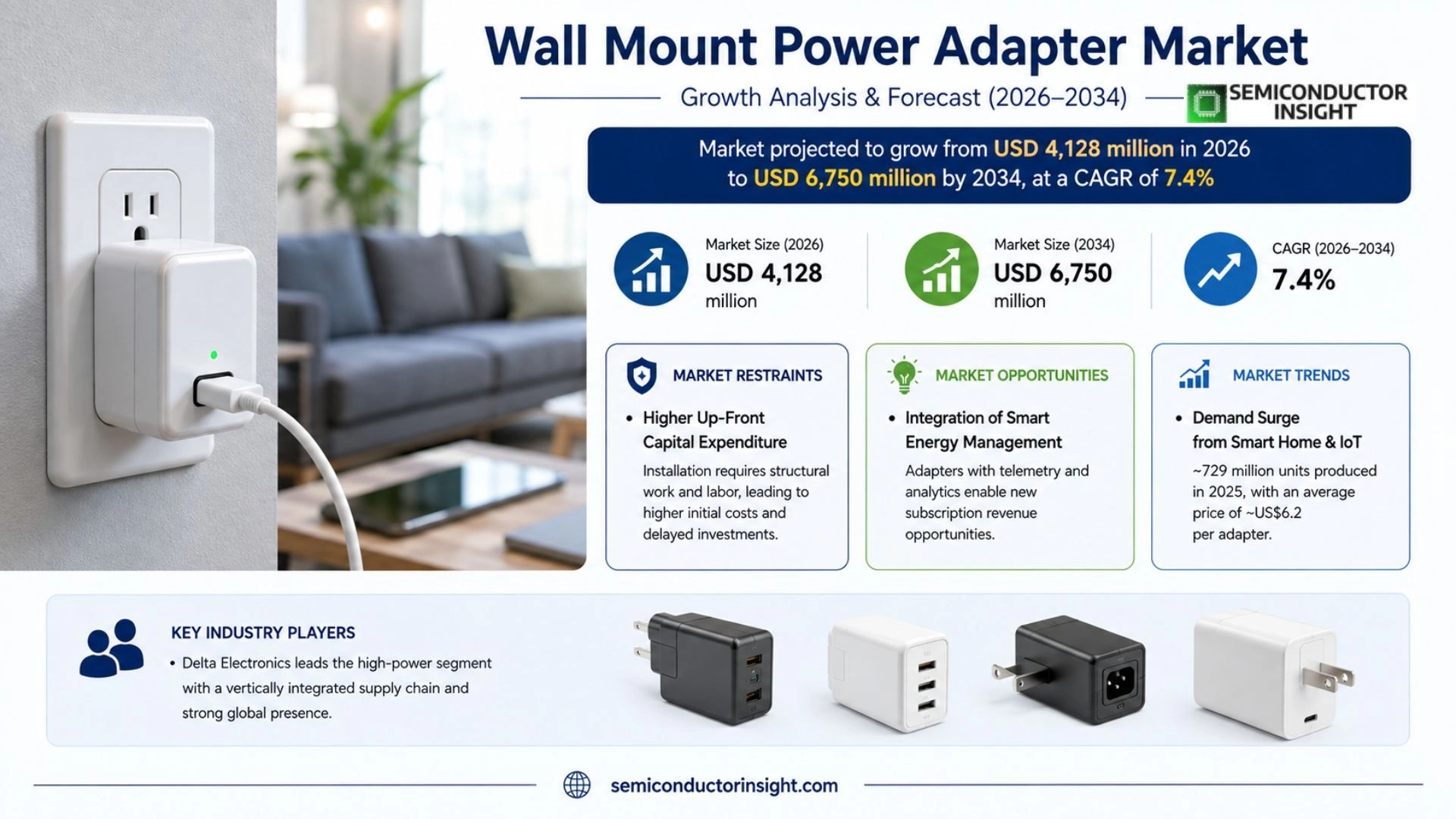
Wall Mount Power Adapter market is projected to grow from USD 4,128 million in 2026 to USD 6,750 million by 2034, exhibiting a CAGR of 7.4% during the forecast period.
Wall Mount Power Adapters are compact AC‑DC conversion devices that plug directly into wall outlets and deliver regulated DC power for electronic equipment. Their small footprint, ease of installation and compatibility with consumer electronics, networking devices and industrial terminals make them a preferred choice across multiple sectors.
The market expands because consumer‑electronics demand remains strong, IoT‑enabled smart‑home products continue to proliferate and efficiency standards push manufacturers toward higher‑efficiency designs. Major suppliers such as Advantech Co., Ltd., Artesyn Technologies, CUI Inc., Delta Electronics, TDK Corporation, MEAN WELL Enterprises Co., Ltd., Schneider Electric and XP Power are actively enhancing product portfolios and pursuing certification programs to meet evolving safety requirements.
MARKET DRIVERS
Rising Demand for Space‑Efficient Power Solutions
Enterprises are redesigning workspaces to maximize usable floor area, and wall‑mounted adapters eliminate the clutter associated with floor‑standing units. This shift reduces cable congestion and simplifies maintenance, prompting facilities managers to specify wall‑mount options in new procurement cycles.
Growth of Commercial Real Estate Renovations
Across North America and Europe, older office blocks are undergoing retrofits that prioritize modular power distribution. Wall Mount Power Adapter Market benefits because retrofit projects often replace outdated plug‑in systems with integrated wall solutions that meet contemporary safety standards.
➤ “Adopting wall‑mounted adapters cuts installation time by up to 30 % and lowers lifecycle costs for tenants.”
Manufacturers are responding by expanding product lines with higher‑current ratings and smart‑monitoring capabilities, a move that aligns with the broader trend toward IoT‑enabled infrastructure. The resulting product diversity fuels additional demand as end‑users seek adapters that can communicate usage data to building management systems.
MARKET CHALLENGES
Compatibility with Legacy Equipment
Many firms operate legacy hardware that requires specific connector types or voltage ranges not always offered by modern wall‑mount adapters. Reconciling new standards with older devices often necessitates adapters or converters, adding cost and complexity to deployment projects.
Other Challenges
Regulatory Fragmentation
Across regions, safety certifications such as UL, CE, and IEC differ in testing criteria. Companies must navigate multiple approval processes, which can delay time‑to‑market and inflate engineering expenses.
MARKET RESTRAINTS
Higher Up‑Front Capital Expenditure
Installing wall‑mounted power infrastructure typically requires structural modifications, conduit routing, and electrician labor, all of which raise initial outlays. Budget‑constrained projects may defer such investments, favoring portable solutions despite their operational drawbacks.
MARKET OPPORTUNITIES
Integration of Smart Energy Management
Emerging demand for real‑time energy monitoring creates a niche for adapters equipped with telemetry and load‑balancing features. Vendors that embed analytics platforms can capture recurring revenue through subscription services, positioning Wall Mount Power Adapter Market at the intersection of power delivery and data analytics.
Wall Mount Power Adapter Market Trends
Demand Surge from Smart Home and IoT
Wall Mount Power Adapter Market is feeling pressure from the relentless expansion of consumer‑electronic devices, networking gear and smart‑home installations. In 2025 the sector produced roughly 729 million units, translating to an average price near US$6.2 per adapter. That volume reflects a market worth about US$4.1 billion, and the upward trajectory toward a forecast of US$6.8 billion by 2034 illustrates that manufacturers are successfully matching the proliferation of portable and connected equipment. The compact form factor and plug‑in simplicity make these adapters the default power solution for everything from Wi‑Fi routers to medical bedside monitors, which explains why demand outpaces modest capacity growth of 972 million units. As device penetration deepens in emerging economies, the market’s ability to supply high‑volume, low‑cost units becomes a decisive factor for OEMs looking to keep bill‑of‑materials in check.
Other Trends
Regulatory Efficiency and Safety Momentum
Regulatory efficiency and safety momentum are reshaping product development cycles. Governments across Europe and Asia have tightened permissible conversion loss thresholds, forcing manufacturers to adopt high‑frequency topologies and silicon‑based controllers. Certification bodies now require UL and IEC 60950 compliance for most industrial and consumer variants, extending testing time but delivering a clear market signal: only adapters that meet the stricter loss and leakage criteria will be accepted in large‑scale deployments. The shift pushes supply chains toward components such as low‑ESR capacitors and advanced magnetic cores, raising unit cost but also enabling longer warranty periods. Companies that integrate these requirements early can differentiate their offerings, command higher gross margins within the 20‑35 % band, and reduce the risk of costly product recalls.
Competitive Landscape and Margin Management
Competitive landscape and margin management have become focal points for senior management. A handful of global players,among them Delta Electronics, MEAN WELL and Schneider Electric,control a sizable share of the 2025 revenue pool, yet each reports gross margins that fluctuate between 20 % and 35 %. The narrow spread reflects intense price competition in the commoditized 5‑24 W segment, where unit pricing hovers near the historical US$6.2 average. At the same time, capacity utilization sits just above 75 % of the 972 million‑unit ceiling, indicating that excess production capability can be leveraged to meet sudden spikes from new smart‑home rollouts. Firms that invest in automated assembly lines and modular design are better positioned to compress lead times, protect margin, and respond to OEM requests for customized voltage profiles without sacrificing scale.
COMPETITIVE LANDSCAPE
Key Industry Players
Wall Mount Power Adapter Market – Competitive Overview
Delta Electronics dominates the high‑power segment, leveraging a vertically integrated supply chain that spans transformer fabrication to final safety certification. Its ability to secure premium component contracts and to operate large‑scale assembly lines yields a gross margin near the upper end of the industry spectrum (30‑35%). This cost advantage translates into a market‑share edge in industrial‑grade adapters above 100 W, where reliability and efficiency thresholds are stringent. The company’s production capacity,approaching 970 million units annually,allows it to satisfy bulk orders from data‑center and telecom OEMs while maintaining inventory buffers that blunt price volatility. By aligning its R&D pipeline with evolving IEC standards, Delta reinforces its position as a preferred partner for customers that require long‑term product certification and supply security.
Beyond the tier‑1 cluster, a cohort of specialized manufacturers such as MEAN WELL, TDK, and XP Power capture niche opportunities in consumer‑electronics and smart‑home applications. These firms excel at delivering compact 5 W–25 W units that meet emerging efficiency mandates while preserving aggressive price points, a critical factor as device makers chase slimmer form factors. Smaller players,including Cincon Electronics, Jeckson Electric, and Artesyn Technologies,differentiate through rapid product‑cycle turnover and bespoke voltage‑adjustable solutions for medical and industrial control systems. Their agility fuels competition on feature sets such as multi‑voltage adaptability and built‑in surge protection, prompting larger rivals to accelerate innovation. The combined effect of IoT proliferation, stricter safety regulations, and pressure on unit cost creates a dynamic environment where market share can shift quickly based on design speed and compliance expertise.
List of Key Wall Mount Power Adapter Companies Profiled
- Delta Electronics
- MEAN WELL Enterprises Co., Ltd.
- TDK Corporation
- XP Power
- Schneider Electric
- Advantech Co., Ltd.
- Artesyn Technologies
- CUI Inc
- Cincon Electronics Co., Ltd.
- Jeckson Electric Co., Ltd.
- Motorola Solutions Inc.
- Volex (a division of Molex)
- Lite‑On Technology Corp.
Segment Analysis:
| Segment Category | Sub-Segments | Key Insights |
| By Type |
|
Above 100W is emerging as the preferred type for high‑performance industrial and data‑center installations.
|
| By Application |
|
Consumer Electronics continues to dominate application demand, driven by proliferation of smart‑home gadgets and portable devices.
|
| By End User |
|
Commercial end users are adopting wall‑mount adapters for office networking equipment and unified communications infrastructure.
|
| By Voltage |
|
Multi‑Voltage Adapter is gaining traction as global device portfolios become increasingly diverse.
|
| By Industry |
|
Smart Home stands out as the leading industry segment, propelled by rapid adoption of connected appliances and security systems.
|
Regional Analysis: Wall Mount Power Adapter Market
Europe
The EU’s Ecodesign Regulation now mandates a minimum efficiency class for fixed adapters, steering manufacturers toward silicon‑carbide technologies that cut conduction losses while retaining compact footprints.
Companies are reshoring component sourcing to mitigate geopolitical volatility, establishing regional depots in Poland and the Czech Republic to shorten delivery cycles for large‑scale construction contracts.
Integration of IoT sensors within adapters is gaining traction, allowing building managers to track power quality and anticipate maintenance needs without deploying separate monitoring hardware.
Facility owners in data‑center districts are opting for wall‑mount units that combine high‑density output with modular cabling, reducing rack footprint and simplifying upgrade paths.
North America
North America reflects a fragmented demand base, where commercial real‑estate developers prioritize adapters that meet both safety codes and the aesthetic expectations of modern office interiors. The market is being nudged by a growing preference for plug‑and‑play solutions that can be installed behind drywall without extensive conduit work. Several large‑scale office‑campus projects are specifying adapters with built‑in surge protection, a move that urges suppliers to bundle protective features rather than sell them as separate accessories. The result is a gradual shift toward “all‑in‑one” wall‑mount units that streamline procurement and reduce installation labor.
Asia‑Pacific
In the Asia‑Pacific region, rapid urbanization fuels a surge in high‑rise residential towers where wall‑mount power adapters become a default choice to conserve floor‑space. Local manufacturers are capitalizing on low‑cost production capabilities while experimenting with modular designs that can be customized for varying voltage standards across the region. Rising consumer awareness of energy bills is prompting a modest tilt toward higher‑efficiency models, though price sensitivity remains a dominant factor in purchasing decisions.
South America
South America exhibits a cautious expansion of Wall Mount Power Adapter Market, tempered by economic volatility in several countries. Nevertheless, infrastructure upgrades in Brazil and Chile are introducing newer building codes that require concealed power distribution, prompting architects to specify wall‑mounted adapters. Vendors are responding by offering locally‑assembled units that comply with regional certification schemes, thereby avoiding import delays and appealing to cost‑conscious developers.
Middle East & Africa
The Middle East & Africa landscape is shaped by large‑scale hospitality and commercial projects that demand reliable power delivery in extreme temperature conditions. Suppliers are adapting by introducing heat‑resistant components and reinforced housings that can endure harsh climates. In North Africa, emerging smart‑city initiatives are creating niche opportunities for adapters that support remote firmware updates, allowing operators to maintain compliance without on‑site interventions.
Report Scope
This market research report provides a comprehensive analysis of the Wall Mount Power Adapter Market , covering the forecast period 2026–2034. It offers detailed insights into market dynamics, technological advancements, competitive landscape, and key trends shaping the industry.
Key focus areas of the report include:
- Market Overview: The report begins with an overview outlining its current market scenario, key growth indicators, and industry transformation drivers. It discusses macroeconomic factors, demand–supply balance, regulatory landscape, and the strategic role of semiconductors in powering advancements across industries such as automotive, telecommunications, consumer electronics, and industrial automation.
- Market Size & Forecast: Historical data and future projections for revenue, unit shipments, and market value across major regions and segments.
- Segmentation Analysis: Detailed breakdown by product type, technology, application, and end-user industry to identify high-growth segments and investment opportunities.
- Regional Insights: Insights into market performance across North America, Europe, Asia-Pacific, Latin America, and the Middle East & Africa, including country-level analysis where relevant.
- Competitive Landscape: Profiles of leading market participants, including their product offerings, R&D focus, manufacturing capacity, pricing strategies, and recent developments such as mergers, acquisitions, and partnerships.
- Technology Trends & Innovation: Assessment of emerging technologies, integration of AI/IoT, semiconductor design trends, fabrication techniques, and evolving industry standards.
- Market Drivers & Restraints: Evaluation of factors driving market growth along with challenges, supply chain constraints, regulatory issues, and market-entry barriers.
- Stakeholder Insights: Insights for component suppliers, OEMs, system integrators, investors, and policymakers regarding the evolving ecosystem and strategic opportunities.
Primary and secondary research methods are employed, including interviews with industry experts, data from verified sources, and real-time market intelligence to ensure the accuracy and reliability of the insights presented.
FREQUENTLY ASKED QUESTIONS:
What is the current market size of Wall Mount Power Adapter Market?
-> Wall Mount Power Adapter market is projected to grow from USD 4,128 million in 2026 to USD 6,750 million by 2034, exhibiting a CAGR of 7.4%
Which key companies operate in Wall Mount Power Adapter Market?
-> Key players include Advantech Co., Ltd., Artesyn Technologies, Cincon Electronics Co., Ltd., CUI Inc., Delta Electronics, TDK Corporation, Jeckson Electric Co., Ltd., MEAN WELL Enterprises Co., Ltd., Motorola Solutions Inc., Schneider Electric, and XP Power.
What are the key growth drivers?
-> Growth is driven by sustained demand from consumer electronics, networking equipment and smart devices, expansion of IoT and smart‑home products, increasing efficiency standards and safety regulations, as well as the need for compact, reliable and cost‑controlled power solutions.
Which region dominates the market?
-> The reference material does not specify a single dominant region; regional analyses are provided in the full report.
What are the emerging trends?
-> Emerging trends include higher‑efficiency adapter designs to meet stricter energy standards, integration of smart‑control features for IoT devices, and continued miniaturization to support space‑constrained applications.

Get Sample Report PDF for Exclusive Insights
Report Sample Includes
- Table of Contents
- List of Tables & Figures
- Charts, Research Methodology, and more...
 Download Sample Report PDF