Fast Phone Charger Market Insights
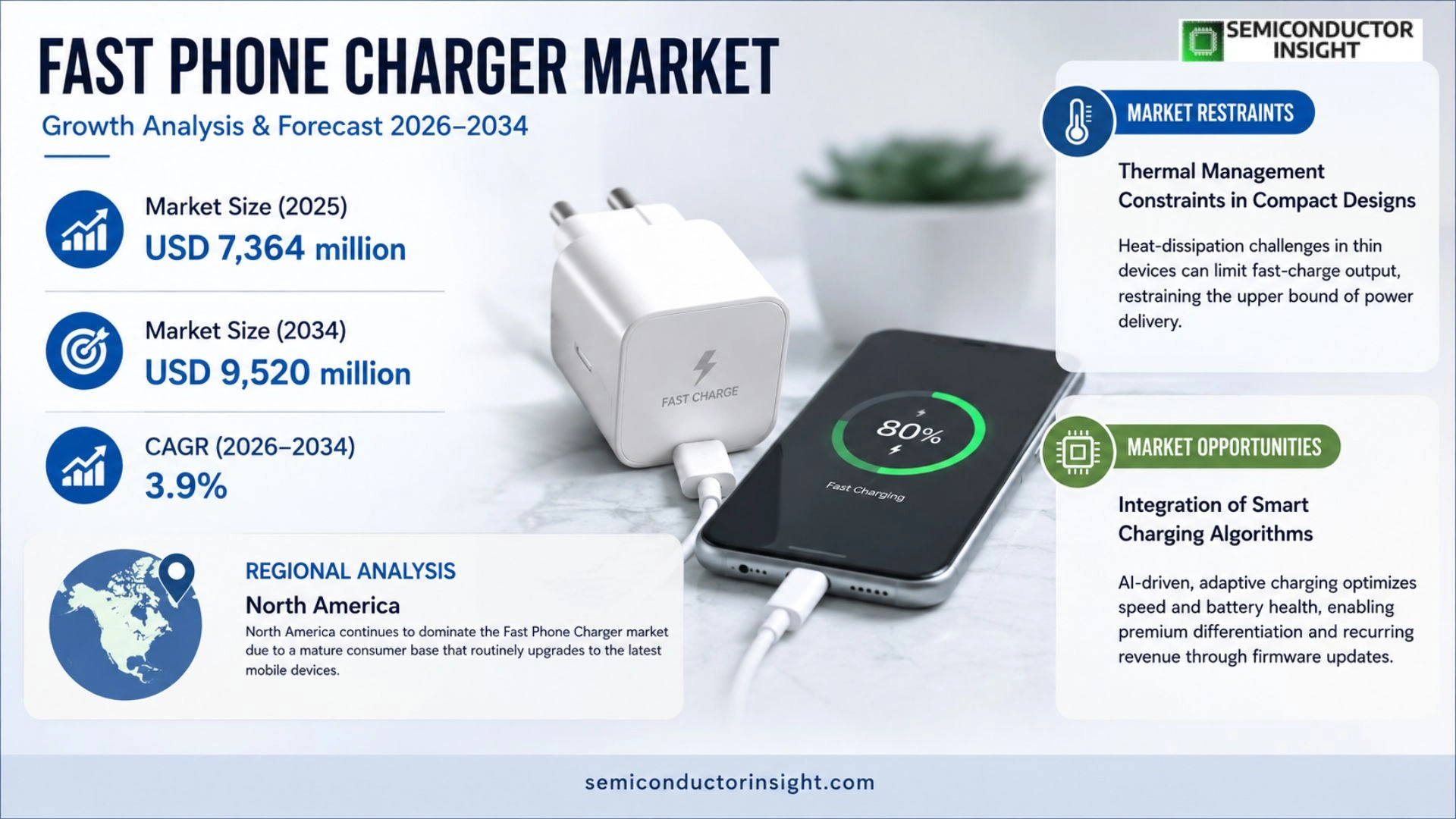
Fast Phone Charger market size was valued at USD 7,364 million in 2025. The market is projected to reach USD 9,520 million by 2034, exhibiting a CAGR of 3.9% during the forecast period.
A fast phone charger is a compact higher‑power AC/DC conversion device built for smartphones and related accessories. It typically employs USB‑C or USB‑A connectors and negotiates voltage, current and power profiles through standards such as USB Power Delivery (including PPS), Qualcomm Quick Charge or proprietary fast‑charging ecosystems. The design must reconcile larger battery capacities with users’ brief “top‑up” windows,commuting, travel or meetings,while managing higher thermal stress and strict interoperability requirements.
The market is experiencing growth due to several factors: expanding consumer demand for rapid charging experiences; broader adoption of USB‑C across device manufacturers; regulatory focus on energy efficiency and safety certifications; and technological advances such as GaN‑based multi‑port chargers that deliver higher power density with reduced heat generation. Recent collaborations between semiconductor firms and OEMs have accelerated integration of programmable power supply (PPS) capabilities. Leading brands,including Anker, Samsung, Baseus, Belkin and Ugreen,continue to diversify portfolios with smart charging features and sustainability‑oriented designs.
MARKET DRIVERS
Consumer Preference for Rapid Power Delivery
Smartphone users now expect a full charge within minutes rather than hours. Battery capacity has climbed to 5,000 mAh on average, pushing manufacturers to adopt chargers capable of delivering 30 W or more. This shift in usage pattern fuels Fast Phone Charger market as OEMs and aftermarket brands race to meet the demand for shorter downtime.
Expansion of USB‑PD and Proprietary Fast‑Charging Standards
Standards such as USB Power Delivery (USB‑PD) 3.0 and Qualcomm’s QuickCharge 4+ have become de‑facto specifications for contemporary devices. Their broader adoption simplifies supply chains and reduces certification costs, encouraging more players to launch compatible chargers. The resulting ecosystem effect pushes volume sales and accelerates product iteration cycles.
➤ “Devices that can draw 25 W or higher are now commonplace, turning fast charging from a premium feature into a baseline expectation.”
Retail data indicate that units priced under $30 now capture roughly 45 % of the total fast‑charger shipments, highlighting price elasticity as a catalyst for market penetration across emerging economies.
MARKET CHALLENGES
Compatibility Fragmentation Across Device Portfolios
Although universal standards are gaining traction, many flagship smartphones still rely on proprietary connectors or voltage profiles. This divergence forces consumers to purchase multiple chargers or adapters, diluting the overall market efficiency and complicating inventory management for distributors.
Other Challenges
Regulatory Compliance Burden
Across the EU, the recent harmonization of charger specifications mandates a single 65 W USB‑C charger for all devices by 2025. While intended to reduce e‑waste, the transition requires manufacturers to redesign power‑management circuitry, incurring short‑term R&D expenses that can compress margins.
MARKET RESTRAINTS
Thermal Management Constraints in Compact Designs
Embedding high‑power charging modules in thin chassis raises heat‑dissipation challenges. Without effective thermal solutions, device reliability may suffer, prompting manufacturers to limit fast‑charge output on thin‑form‑factor models. This technical ceiling restrains the upper bound of power delivery that can be marketed broadly.
MARKET OPPORTUNITIES
Integration of Smart Charging Algorithms
Emerging micro‑controller platforms enable adaptive charging that balances speed with battery health. Companies that embed AI‑driven algorithms can differentiate their offerings, opening premium pricing tiers and creating recurring revenue streams through firmware updates. This technological edge aligns with consumer concerns about long‑term battery degradation.
Fast Phone Charger Market Trends
Accelerated Adoption of USB‑C Power Delivery
Fast Phone Charger market is being reshaped by the rapid diffusion of USB‑C PD and programmable power‑supply (PPS) profiles. As smartphone batteries grow in capacity, users increasingly demand “top‑up” solutions that restore meaningful charge within minutes. Manufacturers respond by integrating multi‑voltage, protocol‑handshake engines that can negotiate up to 100 W while preserving efficiency. This shift matters because it forces a rethink of the charger’s internal topology: power semiconductors, magnetic components, and control ICs must operate at higher frequencies yet stay within tight EMI envelopes. Companies that invest in systematic validation across cables, ports, and device firmware gain a clear competitive edge, turning interoperability from a liability into a market differentiator. The trend also nudges pricing dynamics, as high‑power GaN modules command premium margins while enabling smaller enclosures that appeal to travel‑oriented consumers.
Other Trends
Thermal‑Optimized Architectures
Thermal management has become the primary engineering battleground in Fast Phone Charger market. Higher power density, especially in dual‑ and multi‑port designs, concentrates heat in compact housings. Firms are turning to wide‑bandgap silicon‑carbide (SiC) and gallium‑nitride (GaN) devices not only for efficiency gains but also for their superior thermal conductivity. However, the benefits arrive with new challenges: increased switching speeds amplify EMI, and the reduced thermal mass demands precise heat‑sink geometry and advanced thermal interface materials. Leaders differentiate by embedding closed‑loop temperature sensors that throttle power in real time, preserving battery health and extending product lifespan. This approach aligns with OEM expectations for reliability across varying ambient conditions and reduces warranty claims, creating measurable upside for manufacturers that embed robust thermal strategies.
Supply‑Chain Discipline and Regulatory Scrutiny
Recent tightening of certification regimes and marketplace requirements is compressing Fast Phone Charger market around firms that can guarantee traceable components and consistent quality. Retail platforms now mandate documented EMI compliance, flame‑retardant housing, and end‑to‑end testing against the latest USB‑IF specifications. The implication for vendors is twofold: first, supply‑chain visibility becomes a cost driver, as sourcing of certified MOSFETs, magnetic cores, and high‑grade capacitors must be auditable. Second, brands that maintain in‑house firmware control can quickly adapt to evolving safety thresholds, protecting market share against white‑label entrants that lag in firmware updates. Consequently, the sector is consolidating around players with integrated design‑for‑compliance pipelines, while niche competitors may survive by focusing on specialized form‑factors or ultra‑low‑cost segments where regulatory pressure is lighter.
COMPETITIVE LANDSCAPE
Key Industry Players
Fast Phone Charger Market – Competitive Overview
The market is dominated by a handful of vertically integrated brands that command premium pricing and benefit from deep control over component sourcing, firmware development, and certification pipelines. Samsung leverages its handset ecosystem to bundle proprietary fast‑charging solutions, driving brand loyalty and enabling price premiums that lift average selling price above the industry mean. Anker, with its aggressive R&D spend on GaN and multi‑port architectures, has carved out a high‑margin niche in the consumer‑direct channel, where design aesthetics and rapid firmware updates differentiate its portfolio. Delta Electronics, as a mature power‑electronics supplier, supplies both branded chargers and OEM‑grade modules, using scale to negotiate better terms for silicon and magnetic components, thereby preserving a healthy gross margin. These leaders anchor the market structure by setting performance baselines,USB‑PD 3.1, PPS, and Quick Charge 5,while also dictating compliance expectations that smaller players must meet to achieve shelf‑space in regulated retail environments. Their strategic focus on thermal engineering, EMI shielding, and durability translates into longer product lifecycles, which in turn pressures margin compression for low‑cost competitors.
Beyond the headline names, a diverse set of niche manufacturers sustains the broader ecosystem through cost‑effective designs, OEM partnerships, and regional market penetration. Aohai Technology and Salcomp specialize in high‑volume production for telecom operators and data‑center accessory brands, emphasizing supply‑chain reliability over flashy firmware features. Flextronics and Lite‑On operate primarily as contract manufacturers, translating client specifications into mass‑produced units while offering limited after‑sales support. Companies such as Bichamp, BYD Electronics, and Huntkey focus on price‑sensitive segments in emerging markets, often adopting a white‑label approach that keeps branding costs low but requires rigorous interoperability testing to avoid warranty claims. Chicony Power and AcBel Polytech differentiate themselves by integrating proprietary protection ICs that improve safety ratings, a selling point increasingly demanded by online marketplaces. The strategic choices of these players,lean production, selective component sourcing, and targeted regulatory certifications,allow them to capture modest yet profitable slices of the fast‑charging market, especially in multi‑port and travel‑oriented product categories where brand loyalty is weaker.
List of Key Fast Phone Charger Companies Profiled
- Samsung
- Anker
- Delta Electronics
- Baseus
- Belkin
- Aohai Technology
- Salcomp
- Flextronics
- Lite-On Technology
- Bichamp
- BYD Electronics
- Huntkey
- Chicony Power
Segment Analysis:
| Segment Category | Sub-Segments | Key Insights |
| By Type |
|
Multi‑Port Fast Chargers
|
| By Application |
|
Mobile Travel & On‑the‑Go Solutions
|
| By End User |
|
Individual Consumers seeking convenience
|
| By Power Rating |
|
45‑60W and Above
|
| By Charging Protocol |
|
USB‑PD with Programmable Power Supply (PPS)
|
Regional Analysis: Fast Phone Charger Market
North America
Early adopters prize charging speed as a differentiator, prompting premium‑segment buyers to replace legacy adapters with fast chargers. Influencer reviews and tech media amplify the perceived value, driving a steady stream of repeat purchases and fostering brand loyalty across the ecosystem.
Federal safety standards mandate rigorous testing of high‑wattage adapters, which curtails the entry of sub‑standard products. Certification programs also create a clear benchmark that manufacturers leverage in marketing, reinforcing consumer confidence in the fast‑charging segment.
Proximity to major component suppliers shortens lead times for semiconductor and cable assemblies, enabling rapid scaling of production runs. This logistical advantage translates into lower inventory risk and more agile responses to shifting consumer preferences.
A blend of established electronics brands and nimble startups vie for market share, each emphasizing proprietary fast‑charging protocols. Partnerships with smartphone OEMs amplify reach, while differentiated design cues such as compact form factors become crucial differentiators.
Europe
European consumers exhibit a strong preference for sustainability, prompting manufacturers to highlight energy‑efficiency certifications alongside fast‑charging performance. The EU’s stringent electromagnetic‑compatibility directives shape product development cycles, encouraging firms to integrate advanced thermal management early on. Retail channels remain fragmented, with a mix of specialist electronics stores and online platforms offering niche fast chargers that cater to both premium and value‑oriented segments. This regulatory rigor, paired with a willingness to pay for reliability, sustains Europe’s relevance within Fast Phone Charger market.
Asia‑Pacific
The Asia‑Pacific region fuels the majority of smartphone sales, creating an expansive user base eager for rapid recharging solutions. Cost‑conscious buyers gravitate toward fast chargers that balance price with performance, prompting manufacturers to adopt scalable production techniques such as automated assembly lines. Government incentives in several economies promote the adoption of energy‑saving technologies, indirectly boosting demand for chargers that minimize power loss. The convergence of high device penetration and evolving consumer expectations positions the region as a pivotal growth engine for Fast Phone Charger market.
South America
South America’s burgeoning middle class is beginning to replace older charging accessories with faster alternatives, especially in urban centers where connectivity is essential for work and entertainment. Limited electricity reliability in certain locales drives a desire for chargers that can deliver a full charge in a shorter window, reducing dependence on intermittent power. Local distributors often customize packaging to reflect regional pricing sensitivities, ensuring that fast‑charging options remain accessible without sacrificing core functionality.
Middle East & Africa
In the Gulf Cooperation Council, high disposable incomes and a strong appetite for luxury tech elevate Fast Phone Charger market’s premium segment. Conversely, many African markets prioritize affordability, leading to a dual‑track approach where brands offer both high‑end GaN chargers and more economical silicon‑based models. Infrastructure constraints, such as uneven grid stability, make rapid charging an attractive proposition, while varying regulatory frameworks require adaptable compliance strategies across the region.
Report Scope
This market research report provides a comprehensive analysis of the Fast Phone Charger Market , covering the forecast period 2026–2034. It offers detailed insights into market dynamics, technological advancements, competitive landscape, and key trends shaping the industry.
Key focus areas of the report include:
- Market Overview: The report begins with an overview outlining its current market scenario, key growth indicators, and industry transformation drivers. It discusses macroeconomic factors, demand–supply balance, regulatory landscape, and the strategic role of semiconductors in powering advancements across industries such as automotive, telecommunications, consumer electronics, and industrial automation.
- Market Size & Forecast: Historical data and future projections for revenue, unit shipments, and market value across major regions and segments.
- Segmentation Analysis: Detailed breakdown by product type, technology, application, and end-user industry to identify high-growth segments and investment opportunities.
- Regional Insights: Insights into market performance across North America, Europe, Asia-Pacific, Latin America, and the Middle East & Africa, including country-level analysis where relevant.
- Competitive Landscape: Profiles of leading market participants, including their product offerings, R&D focus, manufacturing capacity, pricing strategies, and recent developments such as mergers, acquisitions, and partnerships.
- Technology Trends & Innovation: Assessment of emerging technologies, integration of AI/IoT, semiconductor design trends, fabrication techniques, and evolving industry standards.
- Market Drivers & Restraints: Evaluation of factors driving market growth along with challenges, supply chain constraints, regulatory issues, and market-entry barriers.
- Stakeholder Insights: Insights for component suppliers, OEMs, system integrators, investors, and policymakers regarding the evolving ecosystem and strategic opportunities.
Primary and secondary research methods are employed, including interviews with industry experts, data from verified sources, and real-time market intelligence to ensure the accuracy and reliability of the insights presented.
FREQUENTLY ASKED QUESTIONS:
What is the current market size of Fast Phone Charger Market?
-> Fast Phone Charger market is projected to reach USD 9,520 million by 2034, exhibiting a CAGR of 3.9% during the forecast period.
Which key companies operate in Fast Phone Charger Market?
-> Key players include Samsung, Anker, Baseus, Ugreen, Delta Electronics, Flextronics, Lite-On Technology, Aohai Technology, Salcomp, BYD Electronics, Huntkey, Chicony Power, AcBel Polytech, Shenzhen Honor Electronic, Phihongtech, Mophie/Zagg, Belkin, Goneo Group, among others.
What are the key growth drivers?
-> Key growth drivers include increasing smartphone penetration, larger battery capacities, consumer demand for rapid top‑up, regulatory emphasis on safety and efficiency, and the adoption of wide‑bandgap (GaN) technologies.
Which region dominates the market?
-> Asia-Pacific is the fastest-growing region, while Europe remains a dominant market.
What are the emerging trends?
-> Emerging trends include GaN‑based high‑power density chargers, multi‑port all‑in‑one designs, smarter negotiation algorithms, and heightened focus on sustainability through recyclable housings and reduced idle power consumption.
Get Sample Report PDF for Exclusive Insights
Report Sample Includes
- Table of Contents
- List of Tables & Figures
- Charts, Research Methodology, and more...
 Download Sample Report PDF