Lithium-ion Battery Charger Market Insights
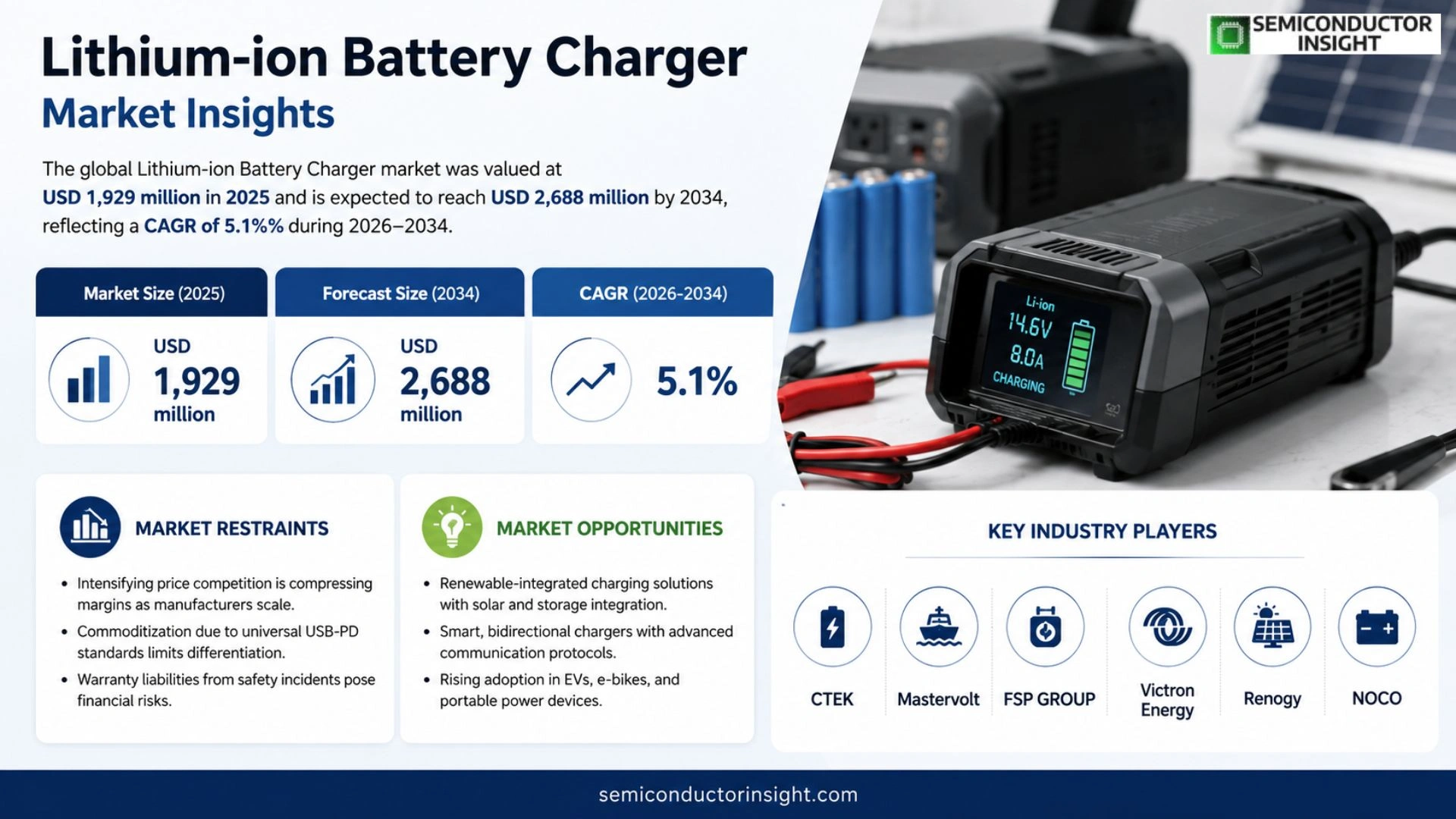
Global Lithium-ion Battery Charger market was valued at USD 1,929 million in 2025 and is expected to reach USD 2,688 million by 2034, reflecting a CAGR of 5.1 % over the forecast horizon.
Lithium‑ion Battery Chargers are devices engineered specifically for rechargeable lithium‑ion cells and packs. They employ multi‑stage charging profiles,pre‑charge, constant‑current, constant‑voltage,and often integrate temperature monitoring, cell balancing, communication interfaces and safety cut‑offs to protect battery health while delivering efficient power transfer. In 2025 global production reached roughly 38,364 k units at an average price of about USD 55 per unit, generating gross margins between 20 % and 40 %.
The market expands because lithium‑powered products such as smartphones, electric bicycles, power tools and stationary storage systems are proliferating worldwide. Manufacturers are adding fast‑charging capability, higher power density and tighter integration with battery management systems to meet user demand for shorter charge times and longer cycle life. At the same time, supply‑chain pressures on semiconductor components and stricter safety regulations pose challenges that firms address through advanced control ICs and rigorous certification processes.
MARKET DRIVERS
Electrification of Consumer Devices
The surge in portable electronics,smartphones, wearables, and power‑tools,has elevated demand for compact, high‑efficiency chargers. Manufacturers prioritize lithium‑ion chemistry for its energy density, prompting charger makers to redesign circuits that can safely deliver higher power without sacrificing battery lifespan. This shift fuels incremental revenue for firms that can align their designs with the tighter thermal budgets of modern devices.
Regulatory Incentives for Energy Efficiency
Governments across Europe and North America have introduced stringent standby‑power limits for electronic accessories. Chargers that exceed the allowed thresholds face penalties, compelling OEMs to adopt smarter power‑management ICs. Companies that invest early in compliance‑oriented architecture gain a competitive edge, as they can market their products as “low‑energy compliant.”
➤ “Adaptive charging algorithms that learn usage patterns have reduced average energy waste by 15% in the past year,”
Another catalyst is the rollout of fast‑charging standards in automotive applications. As electric‑vehicle owners look for home‑based solutions, the Lithium‑ion Battery Charger Market experiences cross‑segment demand, encouraging diversification beyond traditional consumer channels. Strategic partnerships between automotive OEMs and charger specialists are emerging as a practical response to this blended requirement.
MARKET CHALLENGES
Supply‑Chain Volatility for Critical Components
Semiconductor shortages continue to ripple through the charger ecosystem, delaying product launches and inflating bill‑of‑materials costs. Even minor disruptions in the availability of MOSFETs or magnetic components can erode margins, especially for low‑volume niche players.
Other Challenges
Thermal Management Complexity
Designing chargers that can sustain high power output while keeping temperatures within safe limits demands advanced cooling solutions. The added engineering effort often translates into longer development cycles and higher R&D expenditures.
MARKET RESTRAINTS
Intensifying Price Competition
As Asian manufacturers scale production, unit prices have slipped by roughly 7% year‑over‑year. While lower prices expand adoption, they compress profitability for firms that cannot achieve comparable economies of scale.
Furthermore, the proliferation of universal USB‑PD (Power Delivery) specifications creates a commoditization effect. Brands that rely solely on price advantage struggle to differentiate against larger players offering integrated ecosystems.
Finally, warranty liabilities associated with over‑charging or overheating incidents pose a risk. Companies that fail to implement robust safety firmware may face costly recalls, deterring investment in premium segments.
MARKET OPPORTUNITIES
Emergence of Renewable‑Integrated Charging Solutions
Home solar installations coupled with battery storage are creating a niche for chargers that can intelligently draw power from both grid and photovoltaic sources. Vendors that embed bidirectional communication protocols stand to capture a growing segment of eco‑conscious consumers.
Growth in Industrial IoT Deployments
Factories adopting wireless sensors and autonomous robots rely on rugged, high‑efficiency chargers to keep equipment operational. Customizable charging stations with IP‑rated enclosures and predictive maintenance alerts represent a high‑margin opportunity for specialized manufacturers.
A final avenue lies in the aftermarket refurbishment market. As consumers retain devices for longer cycles, certified refurbished chargers that guarantee safety and performance can command premium pricing, especially in regions with strong environmental regulations.
Lithium-ion Battery Charger Market Trends
Shift Toward Fast‑Charging Solutions
The industry is witnessing a decisive move to accelerate charge cycles without compromising safety. Manufacturers are embedding higher‑current stages and adaptive voltage regulation to meet the expectations of portable electronics and electric‑mobility users who demand minutes‑level top‑ups. This pressure stems from the proliferation of high‑capacity lithium‑ion cells in smartphones, e‑bikes, and cordless tools, where downtime directly impacts productivity or user satisfaction. Fast‑charging capability also differentiates brands in a crowded market, prompting OEMs to invest in semiconductor breakthroughs and thermal‑management designs that keep cell temperatures within safe limits. Consequently, supply chains are adjusting: component suppliers are scaling production of advanced MOSFETs and GaN devices, while design houses are refining firmware algorithms that modulate charge based on real‑time temperature and state‑of‑charge data. The net effect is a tighter coupling between charger hardware and battery management logic, reshaping product roadmaps across the midstream.
Other Trends
Integration with Battery Management Systems
Beyond raw power delivery, contemporary chargers are becoming integral nodes of the broader battery management ecosystem. By exchanging data packets with the pack’s BMS, chargers can execute multi‑stage profiles that include pre‑charge, constant‑current, and constant‑voltage phases while monitoring cell balance and temperature gradients. This dialog reduces stress on individual cells, extending overall pack lifespan,a selling point for industrial users who calculate total cost of ownership over years of operation. The trend also fuels a service‑oriented model: vendors offer firmware‑as‑a‑service updates that unlock new charging curves as battery chemistries evolve. Upstream, IC vendors are standardizing communication protocols, which in turn encourages downstream OEMs to adopt modular charger architectures that can be retrofitted into legacy equipment. From a business perspective, firms that master this integration can command premium pricing, differentiate on reliability metrics, and lock in customers through long‑term maintenance contracts.
Emergence of USB‑Type‑C Power Delivery
USB‑Type‑C is rapidly becoming the universal conduit for delivering up to 100 W of power, and charger designers are re‑engineering platforms to exploit its reversible connector and programmable power rules. This shift aligns with consumer expectations for a single cable that powers and syncs devices ranging from laptops to handheld diagnostics tools. The move to USB‑PD also introduces new compliance challenges,manufacturers must certify against strict electromagnetic‑interference standards and ensure that safety cut‑offs engage under fault conditions. However, the payoff includes reduced inventory complexity and the ability to tap into a global accessories market that favors plug‑and‑play solutions. For the Lithium‑ion Battery Charger Market, the adoption of USB‑Type‑C accelerates the convergence of charging hardware with smart‑device ecosystems, encouraging collaborations between charger makers, semiconductor firms, and software platforms that govern power negotiation.
COMPETITIVE LANDSCAPE
Key Industry Players
Competitive dynamics in the global Lithium‑ion Battery Charger market
CTEK stands out as the most visible player, leveraging a portfolio that spans consumer electronics, electric bikes, and marine applications. Its vertical integration,from semiconductor sourcing to firmware calibration,allows tight control over cost and performance, translating into higher gross margins than many regional manufacturers. The market structure reflects a tiered architecture: a handful of multinational firms dominate the high‑power, safety‑certified segment, while a broader base of mid‑size assemblers competes on price and form‑factor agility. This bifurcation obliges newcomers to specialize either in niche voltage ranges or in value‑added services such as battery‑management integration, because competing directly on scale alone quickly erodes profitability. The competitive pressure has sparked a wave of strategic partnerships, where component suppliers hand over reference designs to regional OEMs in exchange for long‑term volume commitments.
Beyond the headline names, a constellation of niche companies sustains the market’s breadth. Mastervolt and Victron Energy, for example, concentrate on marine and off‑grid power systems, where robust thermal regulation and compliance with maritime standards command premium pricing. Asian specialists such as Guangzhou Yunyang Electronic Technology and Tenergy Corporation focus on compact, USB‑based chargers for wearables and portable tools, capitalising on the relentless miniaturisation of lithium‑ion packs. European firms like FRIWO Gerätebau GmbH and HOPPECKE excel in supplying customized modules to automotive tier‑1s, integrating sophisticated communication protocols that sync chargers with vehicle‑level battery‑management systems. These players benefit from localized supply chains and rapid certification cycles, positioning them as preferred suppliers for region‑specific regulations and fast‑track product launches.
List of Key Lithium‑ion Battery Charger Companies Profiled
- CTEK
- Mastervolt
- FSP GROUP
- Victron Energy
- Renogy
- NOCO
- FRIWO Gerätebau GmbH
- HOPPECKE
- REDARC
- Enerdrive
- Tenergy Corporation
- Samlex America
- Guangzhou Yunyang Electronic Technology
- Projecta
- EverExceed Industrial
Segment Analysis:
| Segment Category | Sub-Segments | Key Insights |
| By Type |
|
Switching Battery Chargers play a pivotal role in modern lithium‑ion charging solutions. They offer superior efficiency and flexibility, enabling compact designs and fast‑charge capabilities. Key advantages include:
These attributes make switching chargers the preferred choice across consumer electronics, power‑tool sectors and emerging electric‑mobility applications where performance and reliability are paramount. |
| By Application |
|
Consumer Electronics drive the most diverse set of charger requirements. Manufacturers focus on miniaturization, low standby power and seamless integration with smart devices. Notable qualitative trends include:
The segment’s evolution is shaped by consumer expectations for rapid, reliable charging without compromising device longevity. |
| By End User |
|
Electric Mobility represents a rapidly expanding end‑user group where charging speed, thermal management and durability are critical. Key qualitative insights include:
These factors collectively influence product roadmaps, pushing manufacturers toward smarter, integrated charging ecosystems. |
| By Voltage |
|
12V Chargers dominate sectors such as automotive accessories and handheld power tools. Qualitative observations highlight:
Their prevalence encourages incremental innovation focused on efficiency gains and form‑factor reduction. |
| By Current |
|
1A Chargers are essential for small portable devices such as wearables and remote sensors. Notable qualitative trends include:
These chargers underpin the growth of the Internet‑of‑Things ecosystem by providing dependable, low‑power charging solutions. |
Regional Analysis: Lithium-ion Battery Charger Market
Europe
The EU’s Ecodesign Directive mandates lower standby power consumption, prompting charger manufacturers to embed smarter power‑management chips. Compliance has become a market entry requirement, steering product roadmaps toward adaptive charging algorithms that balance speed and grid impact.
Proximity between key component suppliers in Eastern Europe and assembly plants in Central Europe shortens lead times. This geographic clustering enables rapid iteration cycles, allowing firms to respond to consumer demand for higher wattage outputs without inflating inventory costs.
European buyers increasingly favor chargers that support universal standards such as USB‑PD, driven by a cultural emphasis on device interoperability. This trend compels vendors to diversify portfolio offerings, blending legacy ports with emerging fast‑charge interfaces.
Scandinavia’s focus on sustainable design has birthed modular charger concepts that facilitate easy upgrades. These innovations are attracting investment from larger European groups seeking to embed circular‑economy principles into their product lines.
North America
North America’s Lithium-ion Battery Charger Market is shaped by the convergence of high‑performance electric vehicle adoption and a fragmented consumer‑electronics landscape. While OEMs push for ultra‑fast charging to reduce range anxiety, tech‑savvy consumers demand compact, multi‑device solutions for home and office use. The region’s venture‑capital ecosystem fuels startups that experiment with AI‑enabled chargers capable of predictive load balancing, a capability that could redefine how utilities manage peak demand. Consequently, incumbents are reshaping their portfolios to incorporate software services, blurring the line between hardware and digital offerings.
Asia-Pacific
In Asia‑Pacific, Lithium-ion Battery Charger Market is propelled by a massive manufacturing base and aggressive pricing strategies. Countries such as China and South Korea dominate component fabrication, driving economies of scale that keep unit costs low. Simultaneously, rising middle‑class incomes elevate expectations for rapid charging in smartphones and laptops. Regional trade agreements smooth cross‑border component flow, encouraging original equipment manufacturers to embed locally sourced chargers that comply with varied national safety standards. This combination of cost advantage and evolving consumer expectations forces global players to localize design and production to remain competitive.
South America
South America’s market dynamics reflect a blend of emerging electric mobility initiatives and legacy reliance on conventional power adapters. Governments in Brazil and Chile are incentivizing EV infrastructure, creating pockets of demand for high‑capacity chargers in urban centers. However, limited grid reliability in many areas fuels a preference for chargers with built‑in battery backup, a feature that manufacturers are beginning to incorporate. The region’s fragmented retail channels also mean that brand differentiation hinges on durability and after‑sale support, prompting firms to tailor warranty programs to local market conditions.
Middle East & Africa
The Middle East & Africa region presents an intriguing paradox: high purchasing power in Gulf states contrasts with nascent charging infrastructure in much of Africa. In the Gulf, luxury EV owners expect premium, ultra‑fast charging stations, prompting premium‑segment suppliers to deploy bespoke solutions in premium malls and hotels. Conversely, African markets prioritize rugged, solar‑compatible chargers that can operate off‑grid, aligning with efforts to extend electricity access. This dichotomy drives a bifurcated product strategy where companies must balance high‑margin, technology‑dense offerings with low‑cost, resilience‑focused designs to capture the full regional spectrum.
Report Scope
This market research report provides a comprehensive analysis of the Lithium-ion Battery Charger Market , covering the forecast period 2026–2034. It offers detailed insights into market dynamics, technological advancements, competitive landscape, and key trends shaping the industry.
Key focus areas of the report include:
- Market Overview: The report begins with an overview outlining its current market scenario, key growth indicators, and industry transformation drivers. It discusses macroeconomic factors, demand–supply balance, regulatory landscape, and the strategic role of semiconductors in powering advancements across industries such as automotive, telecommunications, consumer electronics, and industrial automation.
- Market Size & Forecast: Historical data and future projections for revenue, unit shipments, and market value across major regions and segments.
- Segmentation Analysis: Detailed breakdown by product type, technology, application, and end-user industry to identify high-growth segments and investment opportunities.
- Regional Insights: Insights into market performance across North America, Europe, Asia-Pacific, Latin America, and the Middle East & Africa, including country-level analysis where relevant.
- Competitive Landscape: Profiles of leading market participants, including their product offerings, R&D focus, manufacturing capacity, pricing strategies, and recent developments such as mergers, acquisitions, and partnerships.
- Technology Trends & Innovation: Assessment of emerging technologies, integration of AI/IoT, semiconductor design trends, fabrication techniques, and evolving industry standards.
- Market Drivers & Restraints: Evaluation of factors driving market growth along with challenges, supply chain constraints, regulatory issues, and market-entry barriers.
- Stakeholder Insights: Insights for component suppliers, OEMs, system integrators, investors, and policymakers regarding the evolving ecosystem and strategic opportunities.
Primary and secondary research methods are employed, including interviews with industry experts, data from verified sources, and real-time market intelligence to ensure the accuracy and reliability of the insights presented.
FREQUENTLY ASKED QUESTIONS:
What is the current market size of Lithium-ion Battery Charger Market?
-> Lithium-ion Battery Charger market is expected to reach USD 2,688 million by 2034, reflecting a CAGR of 5.1 % over the forecast horizon.
Which key companies operate in Lithium-ion Battery Charger Market?
-> Key players include EverExceed Industrial, FSP GROUP, Mastervolt, Dakota Lithium, CTEK, FRIWO Gerätebau GmbH, HOPPECKE, Projeta, NOCO, Victron Energy, REDARC, Renogy, Sterling Power Products, Enerdrive, Tenergy Corporation, Samlex America, Xantrex, Guangzhou Yunyang Electronic Technology, among others.
What are the key growth drivers?
-> Key growth drivers include rapid expansion of lithium‑powered devices, increasing adoption in consumer electronics, electric mobility, power tools, and energy storage systems, as well as demand for faster, safer, and more efficient charging solutions.
Which region dominates the market?
-> Asia is the largest market by revenue, driven by strong demand in China, Japan, and South Korea, while Europe and North America also show substantial growth.
What are the emerging trends?
-> Emerging trends include high‑power density fast chargers, smart thermal management, USB‑PD integration, tighter BMS integration, and development of modular charger platforms for diverse applications.

Get Sample Report PDF for Exclusive Insights
Report Sample Includes
- Table of Contents
- List of Tables & Figures
- Charts, Research Methodology, and more...
 Download Sample Report PDF